Usens Pi: Headset offers virtual reality you can control with your hands
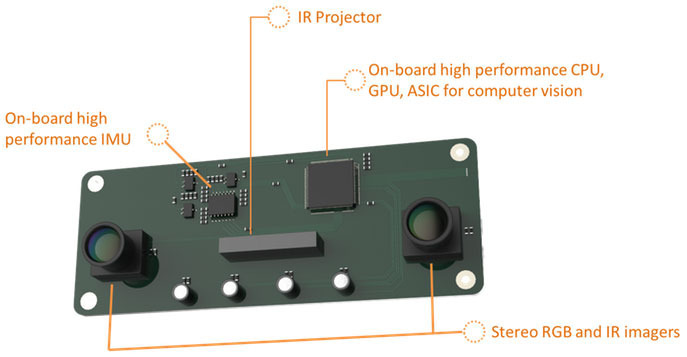 For $279 you can buy a version of the headset (which has about two hours of battery life) that allows you to place your iPhone 6 or Android phone into the headset for VR functionality (much like the Samsung Gear VR). And for $359 you get the all-in-one version of the device (with about one and a half hours of battery life), which has its own built-in display (no mobile phone necessary).
"AR is not the main focus with Oculus," says Fei. "Compared to the HoloLens, we are more similar, but we have a solution that is much cheaper and more realistic from a technology point of view. And we are more open to supporting Android and iOS."
Fei believes that delivering AR through the Impression Pi's video display is better than having someone place a lens over their eyes, as with the HoloLens or Google Glass.
"[AR lens overlays] always have a dark grey cover, making the real world harder to see," says Fei. "The other drawback is that the viewing angle is extremely small and needs to be adjusted to the viewer's eyes carefully." (Fei claims the viewing angle on the Impression Pi is 90 degrees.)
See the full story here: http://mashable.com/2015/03/16/impression-pi/