Facebook Signs Exclusivity Deal with AR Display Maker Plessey
Plessey’s microLED displays are said to combine very high-density RGB pixel arrays with high-performance CMOS backplanes to produce what it calls “very high-brightness, low-power and high-frame-rate image sources” for AR and VR headsets.
Vuzix, a maker of smartglasses and AR headsets, entered into a similar agreement with Plessey last year, which at the time was said to simplify existing AR optical systems of red, green and blue light sources by replacing it with a single self-emitting display which has integrated micro-optical elements. At the time, Vuzix’s agreement was seeking to use Plessey’s displays to reduce size and weight of their headsets.
See the full story here: https://www.roadtovr.com/facebook-exclusivity-deal-ar-display-plessey/?fbclid=IwAR0WiUzG50dh6lK58xxE_5HW67KYVloQ9TUc-ell46R9VILD275IjUbBmeY
For Shut-In Pilgrims, the World’s Holiest Sites Are a Click Away
[PhilNote: the site gives links to Jewish, Christian, and Islamic site 360 documentaries.]
For nearly two years, Eilat Lieber, director and chief curator of the Tower of David Museum in Jerusalem’s Old City, has been excited for this April, when Passover, Easter and Ramadan — touchstone holidays of three major religions — would collide for the first time in nearly two decades.
To prepare for the 400,000 or so tourists who had been projected to visit Jerusalem this April, the Tower of David Museum began collaborating with two virtual reality production houses — Blimey, based in Israel, and OccupiedVR, based in Canada — to create an immersive augmented reality experience for the crowds expected at its medieval stone citadel.
And then coronavirus shut everything down. Israel closed its borders to foreign visitors; all nonresidents are now banned from the Old City. So Ms. Lieber made the decision to put “The Holy City,” a virtual reality experience that lets viewers drop in on Jerusalem’s holiest sites and festivals, online for free starting April 9. Her move came as virtual reality experiences of holy sites across the globe are more readily available, allowing shut-in pilgrims of multiple religions a window into virtual worship in an unprecedented time.
Here’s how virtual reality can bring ancient cities back to life (Ugarit, 3,000 BC)
[PhilNote: it is amazing ANY of it survives. It is in coastal Syria.]

Although only 30 per cent of Ugarit has been excavated, the discovered areas give clues about the organisation of the city. The buildings include royal palaces, large houses, tombs, sanctuaries, public buildings and temples. Ugarit’s golden age was between the 14th and 12th century BC, and the excavated ruins show that interesting political, social and economic evolution took place in the city.
Virtual conservation
A shift toward using virtual technologies as preservation methods to document historic sites and provide educational opportunities has taken place in recent years. This prevents misguided architectural conservation, which can damage a site.
Preserving a sacred route
Excavations have revealed a key sacred route that linked the Royal Palace with the main Temple of Baal and passed through public areas of Ugarit. Researchers believe that the king followed this sacred path to practice cult sacrifices at the temple.
Virtual reconstruction is an effective tool to assess these proposals and judge their ability to protect the ruins, as well as revealing intangible aspects, such as the atmosphere of a street, which are lost to time. We have developed virtual tours which create an opportunity for screen displays to be installed on the site before the actual proposal is implemented.
This political situation also means that it is not possible to visit Ugarit at the moment – a position shared by hundreds of archaeological sites around the world. So the virtual reconstructions serve another purpose: they allow those interested a glimpse of this fascinating city and provide an opportunity to raise awareness of the site’s cultural importance with an international audience.
See the full story here: https://www.citymetric.com/horizons/heres-how-virtual-reality-can-bring-ancient-cities-back-life-4958
Google 3D animals: Which ones are available and how to use them
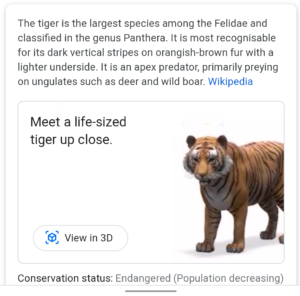
List: 3D animals available on Google Search
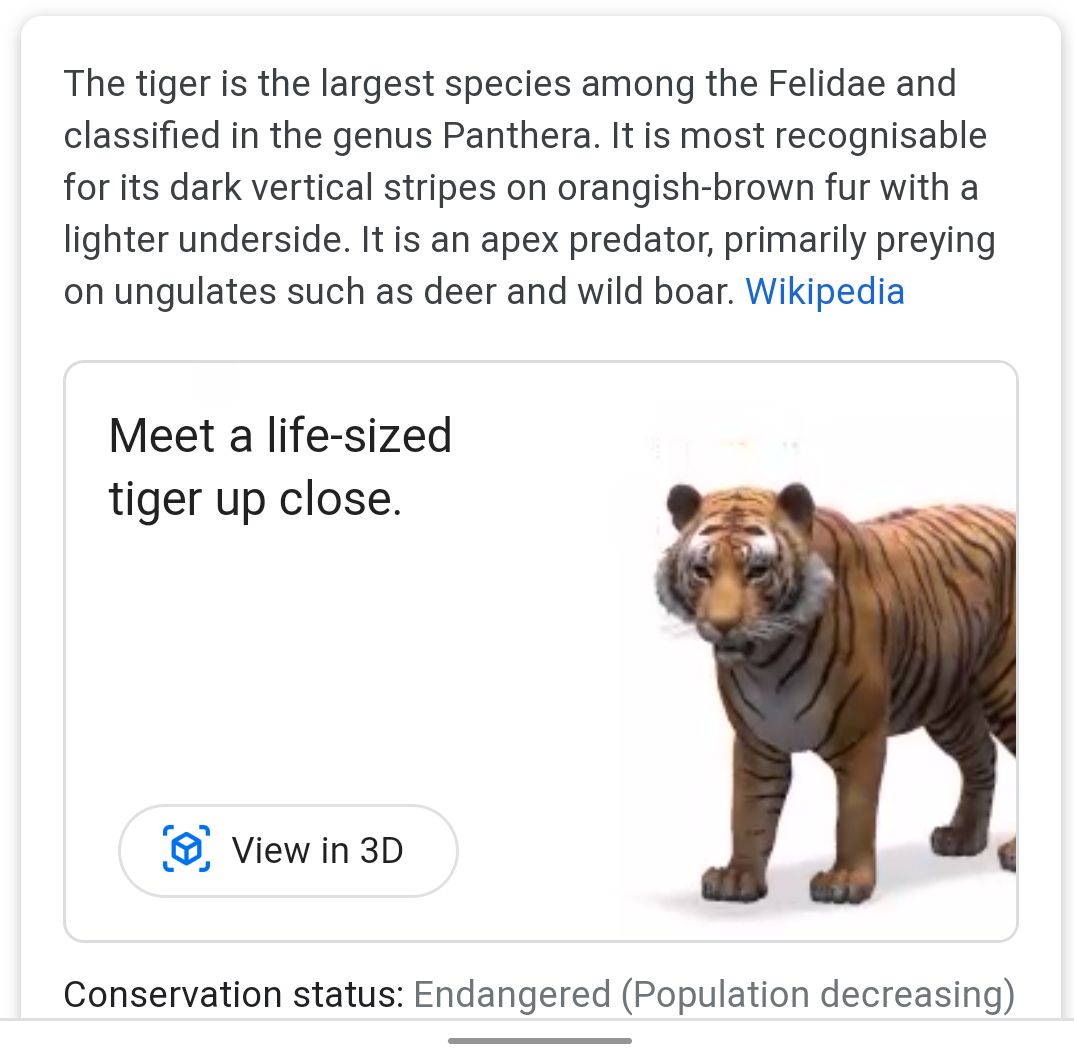
What other AR objects are available in Google Search?
What you need to view AR objects on Google
Google’s 3D animals are different on every device. Typically speaking, you might not see AR or 3D objects on a desktop computer or laptop. Rather, you’ll need a supported smartphone to view these objects.
The good news? Most modern smartphones are supported!
See the full story here: https://9to5google.com/2020/03/28/google-3d-animals-list/
Half-Life: Alyx Didn’t Need Virtual Reality, Virtual Reality Needed Half-Life: Alyx
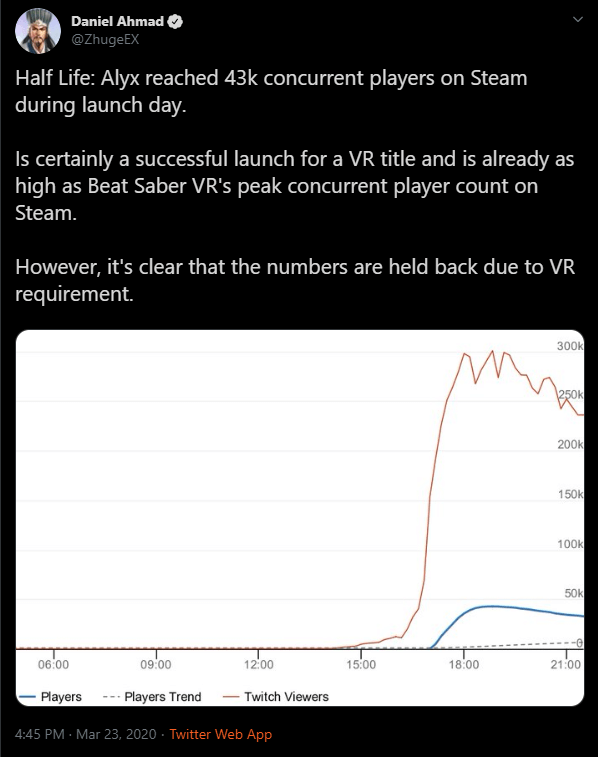
Virtual Reality gaming couldn't have had a better developer and a gaming franchise batting for it. - Half-Life: Alyx is exclusive to VR headsets.
- This limitation angers longtime fans.
- However, a VR Half-Life is the only way to push headset adoption.
Despite near-perfect reviews, debate still surrounds Valve’s Half-Life: Alyx and virtual reality exclusivity. Many don’t have access to VR. How could Valve put such a beloved franchise on a limited platform?
Well, to get more people buying virtual reality headsets.
See the full story here: https://www.ccn.com/half-life-alyx-didnt-need-virtual-reality-virtual-reality-needed-half-life-alyx/
Deeper Dive—What is Facebank and why did it merge with fuboTV?

When virtual MVPD fuboTV this week announced plans to merge with Facebank Group and form a new company called fuboTV Inc., it may have left some wondering what exactly is Facebank.
FuboTV has emerged as a frequently mentioned independent competitor in the vMVPD space that is dominated by services like Hulu + Live TV, YouTube TV and Sling TV, all tied to much bigger companies and household names Disney, Google and Dish Network, respectively.
Facebank, which sounds a little like Facebook opened a financial institution, is not as commonly known. The company describes itself as a “developer of hyper-realistic digital humans” that can be distributed across traditional media as well as live entertainment, virtual reality, augmented reality, mobile, interactive and artificial intelligence applications. Remember the Tupac hologram from Coachella a few years ago? That was Facebank, back when it was called Pulse Evolution.
FuboTV has proven remarkably resilient in competing against its bigger vMVPD peers and if it can grow internationally, it will have accomplished something that its rivals have not.
See the full story here: https://www.fiercevideo.com/video/deeper-dive-what-facebank-and-why-did-it-merge-fubotv
NEWS 5G augmented reality bus tour trialled in Barcelona
The tour displays real-time visual content on the front window of the bus, creating what is said to be a unique tour experience for the passengers.
For example, the tour included a display of the inactive Montjuic fountains, and although they’re not currently functioning, the screen displayed them as if they were. It also displayed historical information on buildings and monuments as the bus moved through the city.
Mediapro Group designed the experience, selected and generated the tourist information, and developed the software and augmented reality content. It was also responsible for the installation of the transparent screens.
Telefónica arranged the high-speed network that provides 5G large bandwidth downstream and upstream, allowing optimised quality of content and real-time broadcasting.
See the full story here: https://www.intelligenttransport.com/transport-news/97639/5g-augmented-reality-bus-tour-trialled-in-barcelona/
Live Shows Are Canceled—More Virtual Reality Concerts Are Coming
A story about The Wave, Jadu, and digitally connecting with artists.
See the full story here: https://www.complex.com/music/2020/03/virtual-rap-shows-coronavirus
Book Review – In Matt Ruff’s ‘88 Names,’ virtual reality dangers bleed into the real world
At some indeterminate date just over the horizon — far enough away from 2020 for the film “Fast & Furious 17” to have come and gone — virtual reality gaming has been perfected to such an extent that it offers an addictive experience wholly immersive for sight, sound and even touch (with all the cybersex possibilities that might entail). Our hero, 21-year-old John Chu, is a savvy digital native who spends almost every minute of his day online. He earns his living as a “sherpa,” a guide for newbies who wish to enter and enjoy such complex, competitive environments as Call to Wizardry. Helping John are three teammates: Anja, Ray and Jolene (each of them emerging as charmingly quirky individuals). A subsidiary member of John’s support group is his mother, who just happens to be a superspy working for the ultra-secret U.S. agency dubbed Zero Day. There used to be a fifth member of the Sherpa team, Darla. But she left in a huff, feeling betrayed, and now John lives in fear that she will use her gamer’s expertise to sabotage his life.
...From here, it’s off onto various vividly described quests, each of which adds to the puzzle or provides a missing piece. John conducts his clients across a half-dozen virtual landscapes, with complications piling on, until finally he is forced to abandon his preferred digital life and engage with the real world — where getting killed does not lead to a resurrection.
...Ruff’s second major victory is in making the reader care about virtual reality. Whenever a novel plunges too deeply into this kind of artificial turf, it risks losing the reader’s interest because of a lack of sensory grounding and the notion that when anything can happen, nothing matters. Ruff overcomes this by making his adventures fashioned from electrons and bytes read as authentically as any naturalism. It took me a while to realize that aside from John’s backstory, every scene of action occurred in cyberspace.
Last year the global box office for films totaled roughly $41.7 billion dollars, while the gaming industry took in $152 billion. As for book publishing — don’t make me laugh! Any novel that can bridge these disparate worlds and appeal to gamers and literary fans alike is a treasure greater than the loot in a cyber-dragon’s cave.
Eric Schmidt – American innovation can bring us tools and solutions that will outlast today’s crisis
Consider big data and novel manufacturing. The government lacks a strong grasp of complex supply and distribution chains for life-critical medical equipment and other goods. Specialists in big data analytics should now turn to modeling these networks to develop real-time tracking and data visualization platforms to better inform policy decisions. The predictive maintenance and additive manufacturing that are gaining traction in the military should become more prominent in health care. Some hospitals are already using 3-D printers to fabricate respirator valves, and it’s saving lives. Companies like Amazon know how to supply and distribute efficiently. They will need to provide services and advice to government officials who lack the computing systems and expertise.
Finally, the country is long overdue for a real digital infrastructure. Government at every level should move to cloud, mobile and web-based software and start treating data as a strategic asset. It’s now painfully obvious that these tools are essential for effective action. Moreover, the American people will need that infrastructure for their daily lives. If we are to build a future economy and education system based on tele-everything, we need a fully connected population and ultrafast infrastructure. The government must make a massive investment—perhaps as part of a stimulus package—to convert the nation’s digital infrastructure to cloud-based platforms and link them with a 5G network.
See the full story here: https://www.wsj.com/articles/a-real-digital-infrastructure-at-last-11585313825
Pages
- About Philip Lelyveld
- Mark and Addie Lelyveld Biographies
- Presentations and articles
- Trustworthy AI – A Market-Driven approach
- Tufts Alumni Bio