Snapchat Evolves AR Scope With Ground Segmentation Lenses
 Snapchat is expanding its arsenal of Lenses that alter the look of users and the environment, and in doing so is quickly becoming the leader in augmented reality. While Snapchat’s communication tools place the app in the realm of social media, it’s not hard to see why it calls itself a “camera company.”
See the full story here: https://www.forbes.com/sites/rebeccabellan/2020/02/29/snapchat-evolves-ar-scope-with-ground-segmentation-lenses/#1e960fe51a8c
The Political Pundits of TikTok
 In a sense, these TikTok users are building short-form TV networks, each with a cast of talking heads. On TikTok they’re called hype houses, named after the high-powered influencer collab house in Los Angeles. These political houses are not physical homes, but virtual, ideological ones represented by group accounts.
There are conservative-leaning houses (@conservativehypehouse, @theconservativehypehouse, @TikTokrepublicans and @therepublicanhypehouse, which amassed more than 217,000 followers in under a month) and liberal ones (@liberalhypehouse, @leftist.hype.house). There are also bipartisan houses, for users who love discourse, and undecided houses, for those who aren’t sure what or whom they love.
“I do feel like TikTok is cable news for young people,” said Sterling Cade Lewis, 19, who has nearly 100,000 followers. “CNN and Fox and big-name news media, those are all geared toward people who have honestly grown up with a longer attention span.”
TikToks, on the other hand, run a maximum of 60 seconds; most videos are as short as 15. “Being able to make shorter videos and educational clips, it’s easier to connect with a younger generation who’s just swiping through their phones 24/7,” Mr. Lewis said.
Though they disagree on major issues, members of different political groups frequently engage with each other. Their videos often go viral when they “duet” on major issues. (Duetting is a feature on TikTok that allows users to respond to videos with videos of their own and post them side by side.)
See the full story here: https://www.nytimes.com/2020/02/27/style/tiktok-politics-bernie-trump.html
Let’s Be Honest: The Augmented Reality Market Is Literally All About The Smartphone Right Now
... not very upfront about the fact that almost all the value in the augmented reality ecosystem is currently being generated by AR on phones. And that this will continue for likely another four to six years.
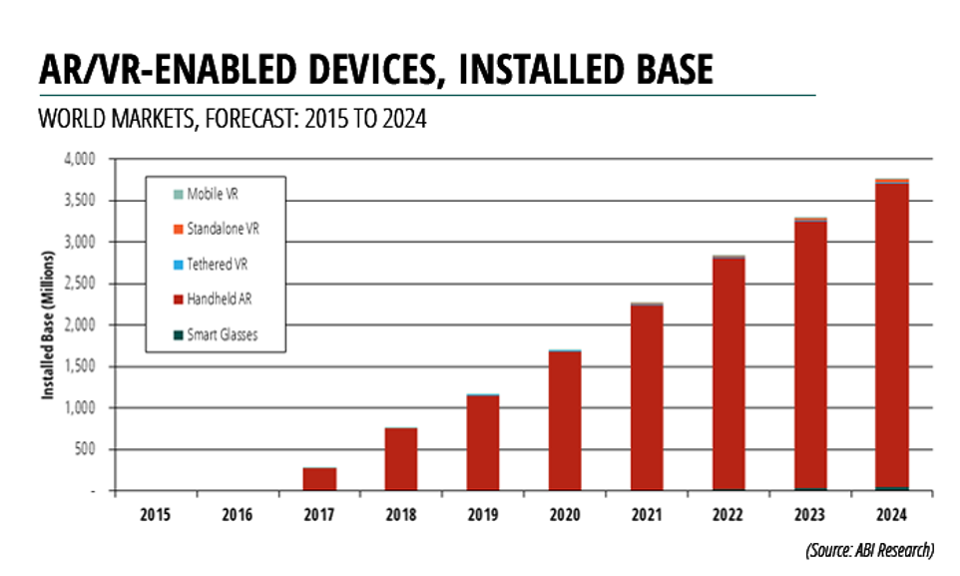 At first glance, the legend is spectacularly unhelpful, providing labels for chunks of data that don’t seem to exist in the chart. At closer glance, there are slices of units in the mobile VR, standalone VR, tethered AR, and smartglasses categories. They’re just so small that they almost entirely vanish compared to the Handheld AR category.
See the full story here: https://www.forbes.com/sites/johnkoetsier/2020/02/27/lets-be-honest-the-augmented-reality-market-is-literally-all-about-the-smartphone-right-now/#3052bd3f118d
Mojo AR contact lenses hands-on: A new way to look at the world
How Mojo’s lenses work
Unlike soft contact lenses that are made of flexible plastic, the Mojo lenses are rigid gas permeable lenses that rests on the sclera — the white of your eye — forming a vault over your cornea.


The lenses are specifically designed for the specific topology of the wearer's eyes. That way, Sinclair said, they don't rotate or slip during the day, keeping the display embedded on the Mojo lens pointed at your fovea, where the center of your field of vision is found.

This required customization explains why the demos I used at Mojo's Saratoga, Calif., headquarters featured VR headsets and exterior lenses, rather than the extensive fitting needed for a pair of contact lenses.
The current version of Mojo's lenses feature oxygenation, which allows the company's employees and testers to wear the lens for extended periods. (Sinclair says it's quite comfortable.) The future version, in addition to adding a battery, will have a higher-resolution display, motion sensors for tracking eye movements, and an image sensor that can see what you're seeing, for computer vision purposes. In other words, the lenses will be able to recognize the objects you're looking at and bring up contextual information.
For now, the work at Mojo is going to focus on efforts to shepherd the contact lenses through the FDA-approval process now that the basic idea behind these AR-powered devices looks solid.
"We're wearing them. We see content. We know that it's not a matter of if now, it's just a matter of when and proving the safety and efficacy so the FDA certifies it," Sinclair said.
See the full story here: https://www.tomsguide.com/hands-on/mojo-ar-contact-lenses-features-specs
Spatial, Nreal, and 5G carriers team up for holographic collaborative AR
 Spatial’s eponymous holographic collaboration software is one of the most impressive augmented reality apps to date, enabling lifelike 3D avatars to communicate within virtual workspaces, assuming you’re using one of nine supported devices to participate. Today, the company is announcing a partnership with AR headset maker Nreal and three cellular carriers to bring a collaborative AR solution to the mass market using 5G.
The carriers — Germany’s Deutsche Telekom, Japan’s KDDI, and South Korea’s LG Uplus — provide the high-bandwidth, low-latency 5G network environment necessary to enable Spatial’s software to run smoothly, as well as stores to sell Nreal’s Light and the required Android smartphones.
See the full story here: https://venturebeat.com/2020/02/20/spatial-nreal-and-5g-carriers-team-up-for-holographic-collaborative-ar/
With An Election On The Horizon, Older Adults Get Help Spotting Fake News
 A recent study suggests these classes could be increasingly important. Researchers at Princeton and New York universities found that Facebook users 65 and over posted seven times as many articles from fake news websites, compared with adults under 29.
"People who are not digital natives didn't grow up online, having a sort of a natural relationship to using computers and the Internet," he says. "They are simply more susceptible to the kinds of online content that happened to be weaponized in that particular election.
"If we were standing in line in the supermarket, and we saw a tabloid," she says, "people in my generation know what that means, but if we see something online, the traditional cues we're used to are not present."
Nash says confirmation bias, the tendency to interpret new information in a way that confirms prior beliefs, can also get stronger with age.
Isolation can be a factor, too...
At the Schweinhaut Senior Center, trainer Bre Clark coaches participants about the difference between propaganda, deep fakes and sponsored content. And she runs through a checklist for evaluating information online: Who wrote the information? What's the source of a claim? Does the author have an agenda?
See the full story here: https://www.npr.org/2020/02/26/809224742/with-an-election-on-the-horizon-older-adults-get-help-spotting-fake-news
Facebook Is Buying Another Virtual Reality Game Studio
 Facebook Inc. said it has acquired development studio Sanzaru Games to join the Oculus gaming group inside its virtual-reality division.
Sanzaru has produced a number of games, including from the Sonic the Hedgehog and Marvel Studios franchises, according to its website. The studio’s most popular VR game, Asgard’s Wrath, was highly reviewed at the time of its release in October, and was included in several games-of-the-year lists.
See the full story here: https://www.bloomberg.com/news/articles/2020-02-25/facebook-is-buying-another-virtual-reality-game-studio