Twitter co-founder Biz Stone has spoken about his decision to invest in artificial intelligence as part of a project which aims to create “a new type of media”.
Mr Stone was joined by AI Foundation co-founder and chief executive Lars Buttler at the One Young World conference to introduce the concept of “personal media”
The digital pioneers presented the concept, which is communication through an artificial version of yourself, as the next type of media following on from mass media and social media.
The AI Foundation, a start-up business based in San Francisco, is working on artificial intelligence “that think and act like you” using 10 billion dollars of funding from investors.
Users of this technology would own an AI version of themselves, which would “share their values and interests” by being programmed and controlled by them.
Ping, which uses artificial intelligence to automatically track lawyers' work and fill out timesheets for them. There's a massive opportunity to eliminate a core cause of burnout, lift law firm revenue by around 10% and give them fresh insights into labor allocation.
Traditionally, lawyers have to keep track of their time by themselves down to the tenth of an hour — reviewing documents for the Johnson case, preparing a motion to dismiss for the Lee case, a client phone call for the Sriram case. There are timesheets built into legal software suites like MyCase, legal billing software like TimeSolv and one-off tools like Time Miner and iTimeKeep. They typically offer timers that lawyers can manually start and stop on different devices, with some providing tracking of scheduled appointments, call and text logging, and integration with billing systems.
Ping goes a big step further. It uses AI and machine learning to figure out whether an activity is billable, for which client, a description of the activity and its codification beyond just how long it lasted. Instead of merely filling in the minutes, it completes all the logs automatically, with entries like "Writing up a deposition - Jenkins Case - 18 minutes." Then it presents the timesheet to the user for review before they send it to billing.
The big challenge now for Alshak and the team he's assembled is to grow up. They need to go from cat-in-sunglasses logo Ping to mature wordmark Ping.
NEWPORT BEACH, Calif. - November 12, 2019 - ( Newswire.com )
NuEyes, a pioneer in the field of low-vision technology, today announced that the United States Patent and Trademark Office has issued US Patent 10,429,675 "System for Using Augmented Reality for Vision" covering key advantages such as:
Auto-Focus set to continuous but locked at set distances determined by magnification settings.Variable magnification inclusive but not limited to 0× (or no mag) up to 12×.Contrast or augmented reality threshold filters specifically designed to enhance the visually impaired experience.Voice In/Voice Out. A large variance of voice frequencies and algorithms set to commands and key phrases that control the smartglasses enabling hands-free control.TTS/OCR. The augmented reality software ecosystem has the ability to read back text, signs or any printed material up to but not limited to 10 ft from said device.Voice Controlled Recording or picture taking. For purposes of visually impaired and/or surgical and dental loupes the software can record or take pictures via voice commands, then stored to an on-board gallery or be emailed to a secure server or electronic medical record.On-Board Gallery. The software ecosystem contains within it a secure gallery that can store images and recordings.2× Lens (hardware). The lens has the ability, but not limited to take a 50 degree electronically magnified image at distances of great than 50+ feet and cut the field of view down to 30 degrees in turn creating a clear image. The lens can also be affixed or taken off the smart glasses.
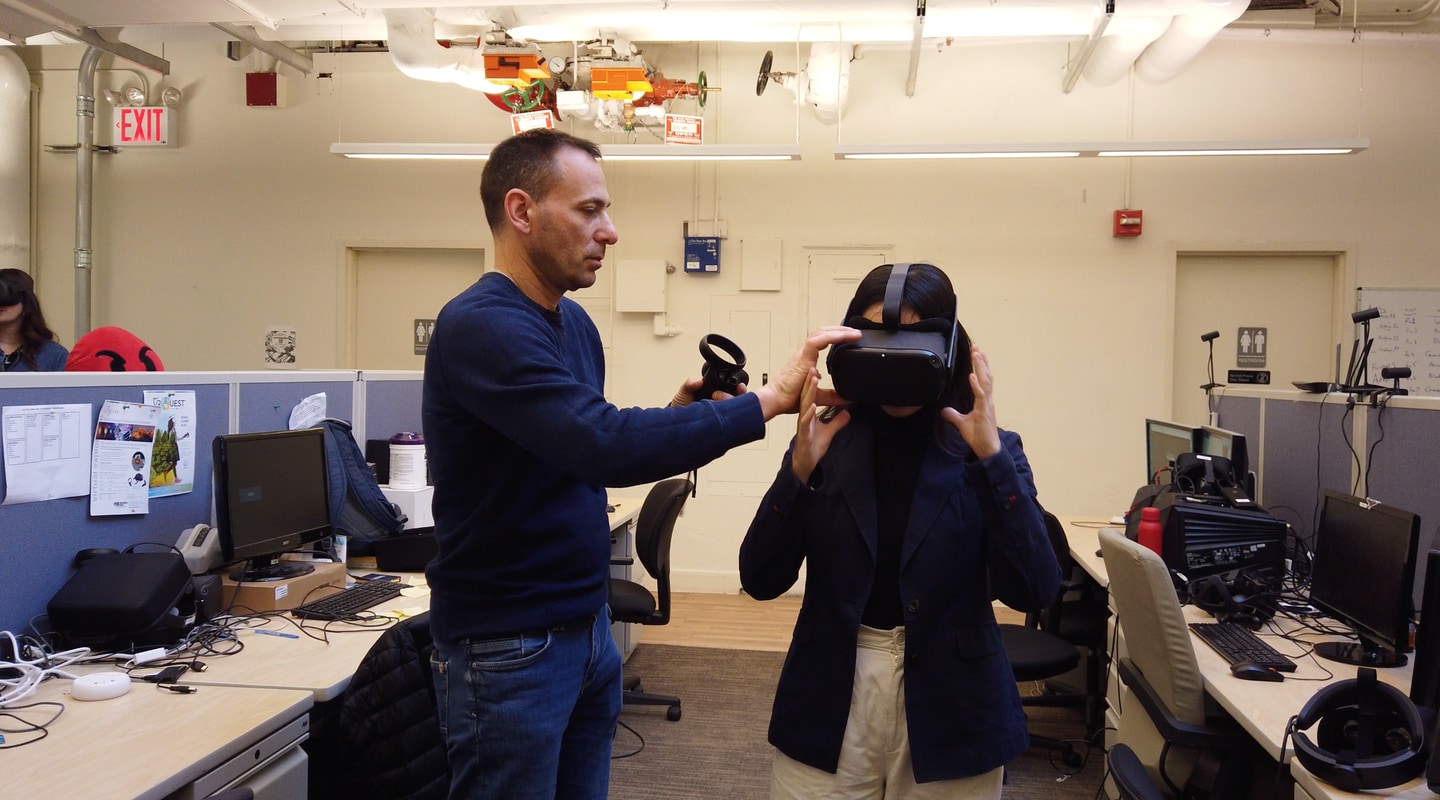
In one simulation, students learn how to network among groups of strangers gathered in a room. In others, they lead negotiations at a high-stakes business meeting in a conference room or give presentations in front of colleagues. While a handful of students are immersed in a simulation, their virtual selves are broadcast on a projector for the rest of the class to watch, and critique, in real time.
The students in the VR experience are given new names, genders and voices so that their true identity remains anonymous, which enhances the realism, according to Lyron Bentovim, the professor leading the class alongside professor Christine Janssen.
Beyond their in-class VR, the Glimpse Group this week unveiled a new way for Fordham students to experience class from outside the classroom. They call it Project Chimera, an immersive educational broadcast that mixes virtual reality with 180-degree video and real life. With a VR headset strapped on, remote students can sit in on the class in real time as if they are physically present, and even interact with one another, the teacher and local students via a custom avatar.
Connect the wireless vibrating mask to your Rift or Vive or other headset, load it up with hundreds of different scent cartridges, and at last enter a level of entertainment not seen since gimmicky theme park theaters. Water and wind shoot in your face. Try out pre-made scent profiles for various movies and aroma therapy programs, or create your own interpretation of Thanos’ genocidal musk. Finally, the perfect device for playing Earthbound’s failed smell-based promotional campaign. Only thing missing is a some kind of tasting tube.
Watch the full FeelReal explanation below, and if your interested snag one for yourself on the IndieGogo page starting at $300 for delivery this month.
Riot Games kicked off this year’s League of Legends World Championships with a spectacular holographic concert in Paris.
The opening ceremony, which took place this weekend ahead of a showdown between Europe’s G2 and China’s FPX, features a performance from the in-game musical collective True Damage which mixes real-world dancers and singers with augmented reality holographs.
I asked if sentient AI was on the horizon. He corrected me, noting “sapient AI” is the right description, as it refers to AI that are conscious, self-aware, and able to think. Before we create sapient non-player characters in games, Bartle believes we need an ethical system in place. And he’s not so sure that we should create them in the first place. Bartle believes that game developers are like gods of the worlds they create. “Those who control the physics of a reality are the gods of that reality,” he said.
Let’s suppose that we have these AIs, but they’re in a pocket environment and they can’t get out. They can’t do anything to us except through us. How should we treat them? What’s right and what’s wrong? It turns out that when you look into the philosophy of this, well, the philosophers haven’t. They haven’t really looked at what it means to be someone in control of an entire reality in which intelligent beings live.
Theologists have, sort of, but they’ve only looked at our reality. They haven’t looked at a sub-reality in which we are the gods.
If I assert that the game characters are my property — I bought them with my $60 for the game — can I just do anything I want with my property?
If I create a game as a designer and the game’s got intelligent NPCs, then I sell that game to somebody else.
I’m not selling the NPCs. I’m just selling the world in which the NPCs live. But what happens when you lose interest and stop playing? All those characters are going to disappear and die? Did you just kill all those characters? That’s something we don’t really have an answer for at the moment.
Emergent behavior and consequences
GamesBeat: I had some similar experiences in Red Dead 2. I shot a dog by accident, and the sheriff came after me and wanted me out of town. I didn’t go out fast enough, and so he started shooting at me, so I fired back and killed the sheriff. Then a whole posse came after me and killed me. I learned the lesson. You shouldn’t shoot dogs in this game.
...
Bartle: What I would say is, there’s a larger question. That is, is it actually moral or ethical to create an intelligent being in the first place? Never mind what the dangers are, because if they’re intelligent, then they’ll probably develop their own sense of morality and it will probably be in line with ours, because every time any culture in the world has had to develop a morality, they basically come down to the same set of core rules, humanist types of rules. The larger question is, should we create intelligent life anyway? Ignoring anything that it could possibly do to hurt us, assuming that isn’t going to hurt us, is ethical to create life?
For one, the field of view is much larger, now covering a 52-degree window rather than 34. It still only takes up a portion of your field of view, but it’s significantly more useful.
For another, the HoloLens 2 can respond to a wide variety of gestures, not just the finnicky index finger taps of old. This allows you to resize and moves around objects and interact with app interfaces in a way that feels far more intuitive. Further improving the experience is advanced eye-tracking that is eerily good at figuring out exactly where you are looking at
It effectively went from a high learning curve product to a highly intuitive one.
Microsoft is still primarily aiming HoloLens 2 for enterprise and research use, but it’s a significant step forward for the futuristic technology.
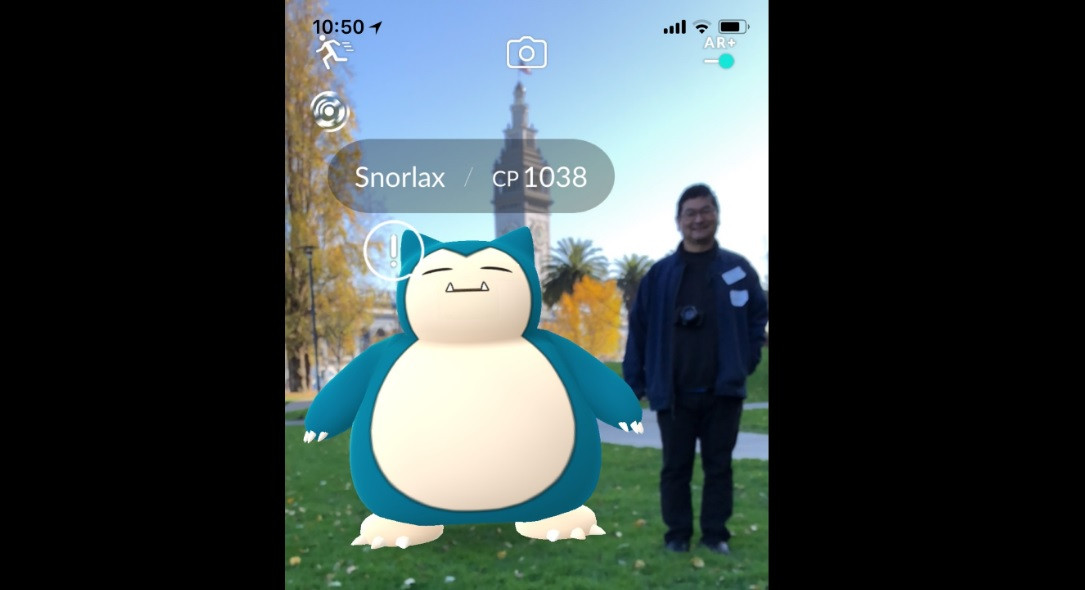
And today, the company is making a bunch of announcements, some that will immediately or eventually benefits its games. One feature will be called Buddy Adventure in Pokémon Go. This means that multiple people will be able to share an augmented reality experience together and take selfie pictures of their Pokémon creatures and themselves in the same scene.
Niantic showed a demo with three people holding phones in an outdoor setting. They each had their Pokémon buddy creatures placed at the same real-world location. And when you looked through the screens of the phones, you could see three Pokémon creatures in the same scene, alongside their real-world trainers.
Perhaps more impressive and widely interesting is the Niantic Wayfarer program, which will enable players in all Niantic games to submit interesting locations to be included as sites in the virtual maps of the location-based games. This is part of what Hanke called “planet-scale AR.”
"Our whole goal is to help somebody to have a peaceful passing,” said Casey Cuthbert-Allman, executive director of Continuum Care Hospice, which operates the facility where Holmes is receiving care. “Part of that process is to do a life review. This technology really helps us transport them to accomplish that. This VR project also helps them reconnect with family members."
"We would never say that technology could replace the human touch," Grace Andruszkiewicz, marketing director for Rendever, the Somerville-based company that makes the VR technology Holmes uses. "What we’re trying to do is augment the human touch."
At the end of her VR session, Holmes decided she'd also like to travel in VR to places she never got to in real life. As she looked around at a 360-degree virtual view of the marbled halls of the Vatican, she joked about not having to stand in line, as she did on so many real trips.
Would she consider a safari?
"At this distance, yes," Phyllis said with a laugh.