‘Knitting Is Coding’ and Yarn Is Programmable in This Physics Lab
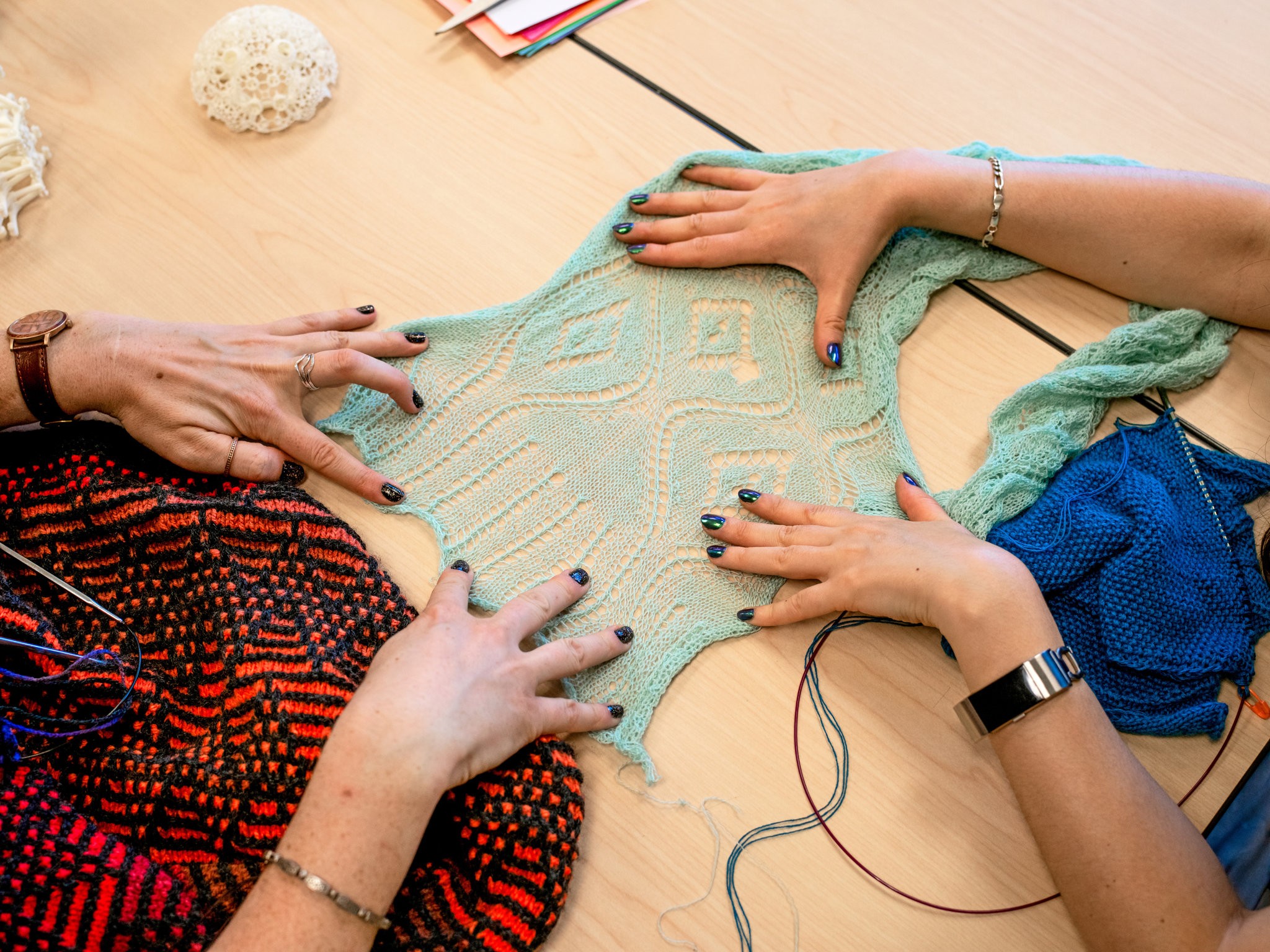 For Dr. Matsumoto, knitting is more than a handicraft hobby with health benefits. She is embarking on a five-year project, “What a Tangled Web We Weave,” funded by the National Science Foundation, to investigate the mathematics and mechanics of “the ancient technology known as knitting.”
Some of the oldest examples date to the 11th century B.C.E. in Egypt. But despite generations of practical and experiential knowledge, the physical and mathematical properties of knitted fabric rarely are studied in a way that produces predictive models about how such fabrics behave.
Dr. Matsumoto argues that “knitting is coding” and that yarn is a programmable material. The potential dividends of her research range from wearable electronics to tissue scaffolding.
During the happy-hour meetup, she knitted a swatch illustrating a plastic surgery technique called Z-plasty. The swatch was for a talk she would deliver at 8 a.m. on Wednesday morning called “Twisted Topological Tangles.” Scores of physicists turned up, despite a competing parallel session on “The Extreme Mechanics of Balloons.”
Knitted fabric is also a metamaterial. A length of yarn is all but inelastic, but when configured in slipknots — in patterns of knits and purls — varying degrees of elasticity emerge.
“Just based on these two stitches, these two fundamental units, we can make a whole series of fabrics, and each of these fabrics has remarkably different elastic properties,” Dr. Matsumoto told the audience.
See the full story here: https://www.nytimes.com/2019/05/17/science/math-physics-knitting-matsumoto.html
HOW ONE LAB BUILDS VERY FILM-LIKE SMARTPHONE PHOTO FILTERS


 It all starts with a freezer in the company's Oakland lab. That fridge-sized box—which sits amongst the office's industrial wood desks, couches, and whiteboards—contains hundreds of rolls of film, much of it hard to find and all of it capable of capturing images in a way no other film, or smartphone, can. The Fujifilm Superia 1600 is great for shooting vibrant colors in a mix of lighting conditions, but it's been discontinued. The Agfa Ultra 50 is also rare—so rare that Hodges had to fork over $500 to get his stash on eBay. "They claimed it was the most colorful, saturated negative film ever made, and I think that might be true," he says.
See the full story here: https://www.wired.com/story/vsco-film-photo-filters/
Leonardo da Vinci’s Visionary Notebooks Now Online: Browse 570 Digitized Pages
 The digitized notebooks debuted in 2007 as a joint project of the British Library and Microsoft called “Turning the Pages 2.0,” an interactive feature that allows viewers to “turn” the pages of the notebooks with animations. Onscreen glosses explain the content of the cryptic notes surrounding the many technical drawings, diagrams, and schematics (see a selection of the notebooks in this animated format here). For an overwhelming amount of Leonardo, you can look through 570 digitized pages of Codex Arundel here. For a slightly more digestible, and readable, amount of Leonardo, see the British Library’s brief series on his life and work, including explanations of his diving apparatus, parachute, and glider.
See the full story here: http://www.openculture.com/2017/07/leonardo-da-vincis-visionary-notebooks-now-online-browse-570-digitized-pages.html?fbclid=IwAR2bfOSkbzGnThx8o5ezd0qfsb9XAo9L0o0tHyIoA8p9l8wt6g2V3Wy-qoI
Facebook is on a hiring tear for its Augmented Reality (AR) team
An ongoing search for 140 professionals with expertise in AR isn't a blip; it's a concerted effort by Facebook to figure out and execute the technology as part of a larger effort, most likely related to the company's Spark AR augmented reality platform that is a potential revenue source when it comes to advertising and product placement.
The vast majority of Facebook's AR hires are being done at its Menlo Park, CA headquarters followed by Redmond, Washington.
See the full story here: https://media.thinknum.com/articles/facebook-is-on-a-hiring-tear-for-augmented-reality/
Nomadic rolls out new mixed reality arcade in Las Vegas with Area15
 The attraction will operate two play-spaces that occupy a total of 6,000 square feet of the 200,000 square foot complex, located close to Area15’s anchor tenant, the art collaborative Meow Wolf.
The place will host immersive “mixed reality” experiences that combine virtual reality with movie-like set designs. The place will host VR games such as Arizona Sunshine: Contagion Z and Arizona Sunshine: Rampage (both in coordination with partner Vertigo Games).
See the full story here: https://venturebeat.com/2019/05/15/nomadic-rolls-out-new-mixed-reality-arcade-in-las-vegas-with-area15/
DigiLens secures $50M in funding on the path to cheap augmented reality
 DigiLens Inc., maker of holographic waveguide technology for augmented reality devices, today announced it has raised $50 million in a new funding round.
New partners in this investment include UDC Ventures, the venture arm of Universal Display Corporation, and Samsung Venture Investment Corp. Others joining include Niantic Inc. — best known for Pokemon Go — Continental AG, Sony Innovation Fund and Diamond Edge Ventures.
See the full story here: https://siliconangle.com/2019/05/14/digilens-secures-50m-funding-path-cheap-augmented-reality/
Apple CEO Tim Cook Promotes New Statue of Liberty Augmented Reality App
 According to the Vogue article on the app, it was created by the Statue of Liberty Foundation and Yap Studio. Its creation took more than a year of scanning and photography, and it offers up a time-lapse view from the statue's eyes, a look inside of it, and a time-lapse of how the color changed over time.
"I met Tim Cook from Apple, and discovered first of all that he had never been to Liberty Island, so I arranged for him to go," DvF revealed. "Not even knowing what I was talking about, I said, 'Wouldn't it be wonderful to give people an Apple experience when they go on the Island?' I met the people who do apps and we started, not knowing where it would all end up. The foundation created this app that will reach hundreds of millions of people. It will be the biggest opening of a museum ever!"
See the full story here: https://www.macrumors.com/2019/05/14/statue-of-liberty-ar-ios-app/
Stanford scholar Jeremy Bailenson and other researchers found that people’s interactions with a virtual person in augmented reality, or AR, influenced how they behaved and acted in the physical world.

Mark Miller works with lab manager Talia Weiss to run through the experiment during a testing phase.
For example, people avoided sitting on a chair they had just seen a virtual person sit on. Researchers also found that participants appeared to be influenced by the presence of a virtual person in a similar way they would be if a real person were next to them. These findings are set to publish May 14 in PLOS ONE.
“We’ve discovered that using augmented reality technology can change where you walk, how you turn your head, how well you do on tasks, and how you connect socially with other physical people in the room,” said Bailenson, who co-authored the paper with graduate students Mark Roman Miller, Hanseul Jun and Fernanda Herrera, who are the lead authors.
In recent years, many technology companies have focused on developing augmented reality goggles and other products, shifting away from their previous emphasis on virtual reality, Bailenson said.
To examine how AR affected the way people behaved in social situations, researchers recruited 218 participants and conducted three studies. In the first two experiments, each participant interacted with a virtual avatar named Chris who would sit on a real chair in front of them.
“The fact that not a single one of the subjects with headsets took the seat where the avatar sat was a bit of a surprise,” Bailenson said. “These results highlight how AR content integrates with your physical space, affecting the way you interact with it. The presence of AR content also appears to linger after the goggles are taken off.”
In the third study, researchers examined how AR affects the social connection between two people who are having a conversation while one of them wears an AR headset. Researchers found that those wearing AR goggles reported feeling less socially connected to their conversation partner.
See the full story here: https://news.stanford.edu/2019/05/14/augmented-reality-affects-peoples-behavior-real-world/