IDC story https://lbe.news/2019/02/11/idc-announces-top-ten-forecasts-for-the-vr-ar-market-in-2019/?fbclid=IwAR0pKis2tHz1uwofO5BTU9roMOS-gS1B0czM-E_Ez2kzfG3Oi_e9EMjq6CQ
Original Mandarin version http://finance.eastmoney.com/a/201902111041103663.html
Google Translate version below and here: https://translate.google.com/translate?hl=en&sl=auto&tl=en&u=http%3A%2F%2Ffinance.eastmoney.com%2Fa%2F201902111041103663.html
Beijing, February 11, 2019
Under the active guidance of the domestic policy environment, the VR/AR market has risen steadily in 2018.IDC believes that the current industry application is further expanding and deepening, and the consumption scenes in the segmented areas are continuously enriched. The VR terminal market is gradually transitioning to the mid-to-high-end product form with better experience, and the industrial ecological development is more mature.
Technological innovation and application will become an important development trend of the VR/AR market in 2019. The maturity and popularity of new technologies will empower the market for continued growth. The content ecology is still the key to the overall progress of the industry. In the future, there will be more industrial fields to extend the olive branch to VR/AR technology equipment providers and content producers.
Prediction 1: The VR market of the cinema will continue to grow. 35% of VR machines will be used for family viewing. Family IMAX viewing will be expected to be defined, manufacturers will bring clearer, more interactive and more VR viewing equipment, and is expected to lead the global viewing VR market. In 2018, the domestic VR all-in-one market ushered in rapid development, becoming the product with the highest shipment volume in the overall VR market last year. Video entertainment has become an important way for VR to enter the family scene. With the maturity and popularity of 4K resolution display technology, more manufacturers will join this segment in the future, and the price, content and wearing experience will become products. The key factor of competition.
Prediction 2: 5G network will drive the development of VR/AR security inspection market. Especially in the AR field, power, manufacturing and other inspections will be deployed in AR applications, and better support for remote information interaction and support with 5G networks. The application of AR technology plays an important role in the intelligent development of the industrial Internet. Through the combination of the Internet of Things and AR technology to achieve visual control, staff can intuitively obtain key real-time information of the target facility through AR equipment, and can quickly locate problems and formulate solutions based on abnormal prompts, thereby effectively reducing equipment accident rate and improving municipality. Facility operation and maintenance inspection efficiency. The popularity of 5G networks will provide a high-quality information communication environment, support real-time audio and video interaction during the inspection process, and multi-tasking such as data transmission.
Prediction 3: AI will be equipped with virtual/augmented reality devices, 65% of VR/AR devices will provide voice technology interaction, and 20% of VR/AR devices are expected to make users accustomed to voice interaction, thus better making up for the shortcoming of virtual keyboards. board. The development of artificial intelligence will promote the change of traditional interaction modes in VR/AR devices. With the technology of speech recognition, users will get rid of the limitations of the handle and sensor. At the same time, because the speech recognition system involves data transmission and background computing and other units, vendors need to integrate chip technology and application development resources to solve the problem of system delay, equipment cost and user experience.
Prediction 4: Mobile AR content is more ecological. Professional content developers will bring more AR applications, while user-generated content (UGC) for mobile 3D modeling
The AR application scenario and user experience will also be enhanced.
Thanks to development platforms such as ARKit and ARCore, mobile AR content and applications continue to be enriched, growing rapidly in games, social, marketing and e-commerce. At present, the domestic Internet and mobile phone manufacturers are also actively participating in the layout of the mobile AR market. By combining AI image recognition technology, location-based LBS application and 3D scanning modeling technology, the mobile AR market will continue to grow rapidly in the future. The traditional form of content interaction will usher in an upgrade.
Prediction 5: The VR game market will grow by 75% in 2019. The offline experience store game revenue accounted for more than 80% of the overall VR game revenue. Excellent VR games will be extended to the experience store, and the sinking experience will bring more potential users. As domestic game makers increase their investment in the VR industry, more high-quality content and products will enter the domestic market, which will help improve the content richness in the VR game market. At present, the popularity of domestic VR game users is low, and the two-way drainage from offline experience stores and online social platforms will help expand user coverage, and supporting players to record and share game videos will enhance game performance and increase appeal to potential users.
Prediction 6: By 2023, there will be more than one billion people visiting at least one consumer place where VR devices are installed each year, and 10% of consumers will try to use VR devices, which will foster users' interest in buying home VR devices. IDC
FutureScape: Consumer Digital Transformation and the Home Internet of Things Market Global 2019 Forecast shows that there will be more offline entertainment venues, such as cinemas, theme parks, amusement halls and Internet cafes, to provide customers with paid VR experience projects. The offline entertainment scene will further become an important promotion channel for the VR industry in the consumer market, helping to promote the conversion of ordinary users to VR paying users, and driving the market growth of home VR hardware devices, software development and content subscription.
Prediction seven:
More than 30% of the display scenarios will be integrated through the rental method to provide equipment, software, and services, so that users do not have to bear high hardware costs, but also achieve excellent interactive display. Although VR/AR technology can help solve the problem of insufficient interactive experience and space limitation in the field of industry application and business activities, but due to the high cost of equipment and content acquisition, related applications have certain limitations in actual operation. Sex. In the future, as more service providers provide VR/AR overall solutions through leasing, they can help customers meet the needs of equipment, applications and supporting services in the display scenario, while reducing one-time procurement costs and increasing equipment utilization. Gradually cultivate market maturity.
Prediction 8: The weight of the commercial market is growing further, especially in the education market, which is affected by policy tilt and increased investment in education. More than 1,000 schools are expected to adopt VR/AR technology.
In the future, VR/AR will find more commercial scenarios in the industry application, and targeted solutions to the application pain points in the market. According to the IDC market tracking report, it is expected that the share of VR/AR shipments in the domestic education market will account for nearly 7.0% of the overall market in 2018. With the promotion of relevant policies, the education and training market in the vertical and vertical fields such as medical and manufacturing has developed rapidly. The simulation application supporting multi-person collaboration will help enhance content interactivity and improve training efficiency.In the future, more universities will adopt VR/AR content for course training, which will drive the demand for education market to continue to grow.
Prediction 9: By 2024, 7% of domestic companies will use VR applications as a solution to support cross-regional collaboration, and the future workplace and teamwork model will usher in transformation and upgrade.
"IDC FutureScape: Connectable Devices Global 2019 Forecast -
China Revelation shows that VR will help solve the problem of low efficiency in cooperation across offices and regions. The current utility of using collaborative software and hardware for the workforce is low, and in addition to enabling the team to enter the same virtual space, the VR technology can also display and manipulate data and even objects. In China, VR technology has begun to showcase in cross-space applications in medical and other industries, such as live broadcasts and other specific scenarios. In the future, this application will require more network infrastructure and other layouts to support a wider range of practical operations.
Prediction 10: By 2024, 55% of Chinese large and medium-sized enterprises will deploy AR hardware for some employees. The key driver is to improve work efficiency. Early adopters in the industry have achieved significant results by deploying AR hardware, including fewer downtimes, faster execution times, and shorter induction training hours. As the AR market matures, industry-specific application scenarios will gradually break down and begin to attract a wider range of commercial applications. The integration of enterprise systems will become easier, the developer talent pool will become larger and larger, and the aggregation of content will make the AR platform more efficient in deploying between different departments. In the future, companies and enterprises will extend AR applications to various business units, including internal and external IT support, product development and customer support.
(Article source: IDC Consulting)
 Immotion Group’s fully immersive VR simulators are to be installed at most Legoland Discovery Centres (LDC) across the globe.
With striking wrap-around sound and multi-directional movement, Immotion’s fully immersive VR simulators deliver an exhilarating virtual reality experience.
VR simulators with eight headsets are currently being used at the Boston site in the United States and at Manchester, United Kingdom.
Following the successful trials of the immersive platforms at these two LDC sites, Merlin Entertainments has agreed to introduce 21 new VR simulators with two headsets at different Legoland Discovery Centres around the world.
A VR platform will also be installed at a hotel at Germany’s Legoland Deutschland Resort. Six VR simulators have also been bought for Legoland Discovery Centres in Asia.
The company supplies most of its VR simulators on a concession basis, which shares revenue with theme park and entertainment site owners. In exchange, Immotion Group provides sites with the equipment, technical support, content and training.
See the full story here: http://interpark.co.uk/immersive-vr-simulators-are-coming-to-legoland-discovery-centres-worldwide/?fbclid=IwAR3hubSCffaFuCIMev30pNxaDBIG-gF5OM7JnZv0Jl1O6fL2gy7-iHH1yVA
Washington State has introduced a bill to regulate facial recognition software, and tech giant Microsoft is advocating for its passage, while e-commerce leader Amazon remains undecided. Amazon asked state senator Reuven Carlyle, who sponsored the bill, for clarification as well as a change to the requirement that AI software developers claiming the ability to identify faces must allow third parties to test it. Carlyle explained he would examine all submitted requests and introduce a revised version of the bill.
Bloomberg reports Carlyle stated that, “it’s fair to say Amazon has a deep skepticism and concern about meaningful restrictions on facial recognition.” But he added that Amazon has also “made it clear their goal is to attempt to get to a place where they can be supportive of the legislation.”
Microsoft president/chief legal officer Brad Smith stated that, with regard to the Washington legislation, “opening up the software for third-party testing is one of the key parts of the bill.” He noted that being opposed to testing is “like an automobile company objecting to testing of airbags.” “The public has the right to evaluate these services, and responsible companies should recognize the importance of this kind of third-party testing,” said Smith.
Third parties — MIT Media Lab researcher Joy Buolamwini and the American Civil Liberties Union — have already tested Amazon and Microsoft’s facial-recognition programs.
See the full story here: http://www.etcentric.org/microsoft-advocates-for-washington-state-ai-regulation-bill/
 While government leaders and members of civil society will be discussing solutions to problems posed by climate change and war, two artists will be making their case for environmental protection and peace through virtual reality at the seventh World Government Summit (WGS) that starts today.
Serbian Milica Zec and American Winslow Porter, co-founders and directors at newreality.co, are showcasing 'Tree' and 'Giant', which are virtual-reality projects that will transform viewers into a tree in the Amazon rainforest, and how it feels to be trapped in a war zone, respectively.
The Tree project premiered at the recent World Economic Forum in Davos, Switzerland, which was attended by Sheikh Hamdan bin Mohammed bin Rashid Al Maktoum, Crown Prince of Dubai. Zec and Porter said Sheikh Hamdan watched it and invited them to attend the World Government Summit in Dubai.
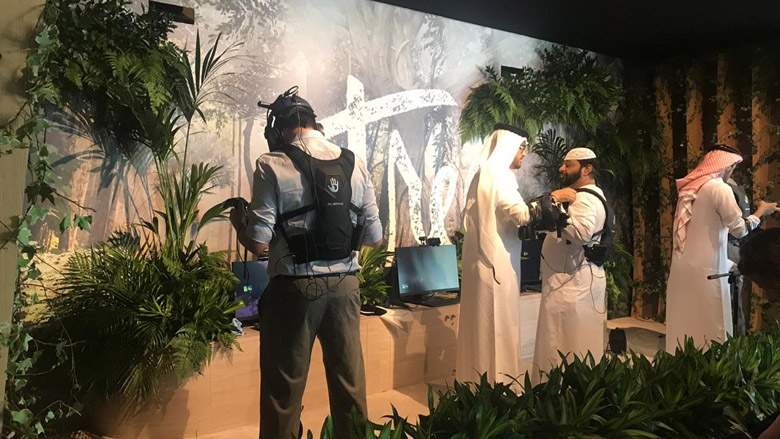 While government leaders and members of civil society will be discussing solutions to problems posed by climate change and war, two artists will be making their case for environmental protection and peace through virtual reality at the seventh World Government Summit (WGS) that starts today.
 Carrenger, an active-duty soldier, has worked with Microsoft in creating a software that allows someone to walk around a prospective home without having to be there. This app has been designed to help active-duty military in the moving process from one location to the next.
 HypnoVR – Founded in 2016, HypnoVR just began marketing its medical hypnosis virtual reality solution to improve the management of patient pain, stress and anxiety. Using virtual reality headsets like Oculus Rift or Samsung Gear, HypnoVR’s solution places the patient into an intense multisensory tridimensional immersion experience. The technology is currently being used in applications for pediatric surgery, gastroenterology, gynecology and dental surgery. The startup, based in Strasbourg, has raised €700k to date.