Scepticism over Google plan to replace labs with virtual reality
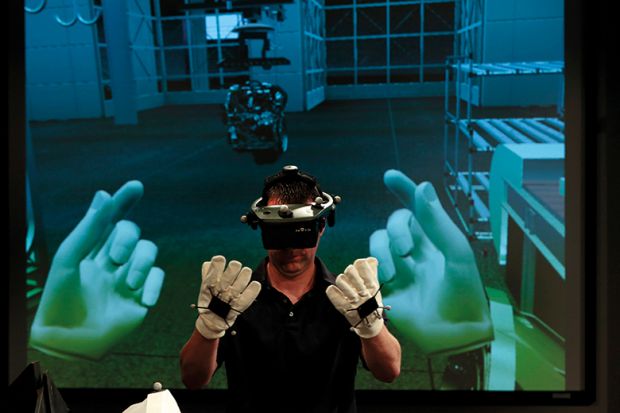 But students performing an experiment in a virtual lab would not necessarily confront all the possible variables and confounding factors that they might encounter in a physical lab, he added.
If a student had only ever used a virtual lab, “are you going to employ that student?” Dr Campen asked.
A spokesman for Labster argued that the technology would offer significant benefits to online-only and campus degrees.
“Many of the labs are built with the use of mathematical modelling that simulates what would happen in the real world. There’s also the ability to dive in and see the reactions and processes at the molecular level, using complex animations that are based on modelling databases,” he said.
“Combining that with the actual immersive environment and interactivity, while allowing students to drive the whole experience…makes students more confident stepping into a lab and using the equipment, but also gives them a better understanding of the concepts and how to apply them.”
See the full story here: https://www.timeshighereducation.com/news/scepticism-over-google-plan-replace-labs-virtual-reality
Monetizing Remixes Is Now Possible With the BlockTune App
BlockTune, a remix monetization app from Common Edits, was the big winner at Sunday’s Entertainment App Challenge held during the AT&T SHAPE conference at Warner Bros. Studios in Los Angeles. BlockTune has both a simple and an advanced UI for sampling music and creating remixes that can be shared with others. The key feature that won over both the judges and the audience is BlockTune’s ability to track the use of samples on a moment-by-moment basis and determine what portion of ad revenue should go to the source artists and the person who created the remix while the music is streaming.
In response to a question from the judges, reps from Common Edits said that their primary competitors are the hundreds of thousands of remixes created using unlicensed content that are available online and that return zero revenue to the rightsholders and artists. The audience responded with applause to the idea that the remixer would get a slice of the ad revenue.
Founders Matthew Lewis and Adam Seigler built the app using Creative Commons licensed music. But after conversions and demos with Universal Music Group executives they now have legal access to the entire UMG content library. Any percentage of the revenue attributed to the Creative Commons samples is redistributed among the for-profit creators and rightsholders.

Common Edits hopes to sign the other major music labels soon. In their on-stage pitch on the Warner Bros. lot, Lewis made the tongue-in-cheek comment that a win might help them get the attention of management at Warner Bros. Records.
The BlockTune team is working on building blockchain and a cryptocurrency economy into the app. This app could be a proof-of-concept for monetizing video clip usage at a later date.
For more from AT&T SHAPE, videos of the main stage sessions are available online.
See the original post here: http://www.etcentric.org/monetizing-remixes-is-now-possible-with-the-blocktune-app/
The Best New Products Displayed at Augmented World Expo
Several demos stood out at the 9th annual Augmented World Expo in Santa Clara, California last week. The most compelling involved a holographic display from Brooklyn-based Looking Glass Factory. Co-founder and CEO Shawn Frayne and his team have been working for a few years on a technique that “blends the best of volumetric rendering and light field projection.” Also compelling was a markerless multi-person tracking system that runs off a single video feed, developed by a Canadian computer vision/deep learning company named wrnch. And marking its first exhibit in the United States since launching its latest satellite office in San Francisco this April, Japanese company Miraisens demonstrated how a suite of effects could be used to enhance extended reality experiences.
The latest deliverable from Looking Glass is an approximately 3-inch thick clear Lucite block that appears to have a 3D interactive object floating inside of it in front of a black rear panel. They are readying an 8.6-inch diagonal and a 15.9-inch diagonal screen for sale at proposed $600 and $3,000 price points, respectively.
The demo I saw used a Leap Motion hand tracker that enables you to virtually play with a very realistic looking frog. The control was intuitive and the frog’s response was realistic and entertaining. The displays can be tiled with spacers, like a window with multiple panes.
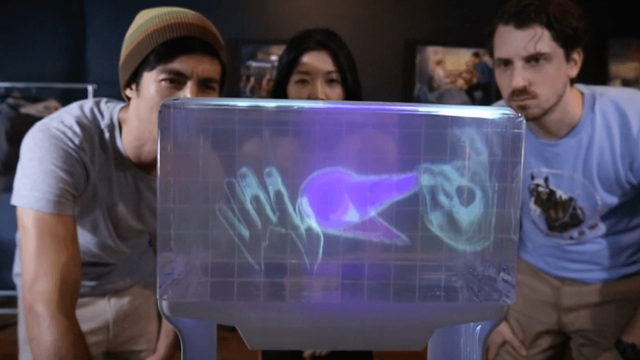
Frayne has also developed a black-box interactive holographic display. You can reach into it and interact with floating objects that are visible, with parallax, across a wide arc around the unit. If there is interest, we will ask for demos of both technologies at an ETC event.
Wrnch founder and CEO Paul Kruszewski conducted a live demo during his stage presentation in which a single webcam recorded a wide swath of the audience and the video feed displayed on the main screen showed both the audience members and a stick figure overlay on many of them that tracked their movements in real time. Attendees who were near to the camera also had some of their facial features tracked.

Kruszewski detailed three unique features of wrnchAI:
- Accurate — Proprietary deep learning networks and synthetic 3D data pipeline.
- Robust — Biomechanical 3D human model and body, hands and face tracking.
- Fast — Optimized for real-time across Nvidia and mobile AI processors and Unity integration for rapid development.
This wrnchAI technology is available now.
The haptic feedback demo by Miraisens beautifully demonstrated how a handheld pod the size of a lipstick case could steer your hand left, right, forward, backward, give you the sense that you were pulling or pushing on a spring, and convey textures as the cursor slides over images of different surface types.
Miraisens is looking to license the software drivers for the haptics or contract out its software development services. I have experienced demos like this before from other companies, but Miraisens did an exceptionally good job of demonstrating how the suite of effects could be used to enhance the illusion of XR.
For more from AWE 2018, check out this year’s Auggie Awards winners.
See the original post here: http://www.etcentric.org/the-best-new-products-displayed-at-augmented-world-expo/
‘Jurassic World’ Virtual Reality Experience to Debut at Dave & Buster’s
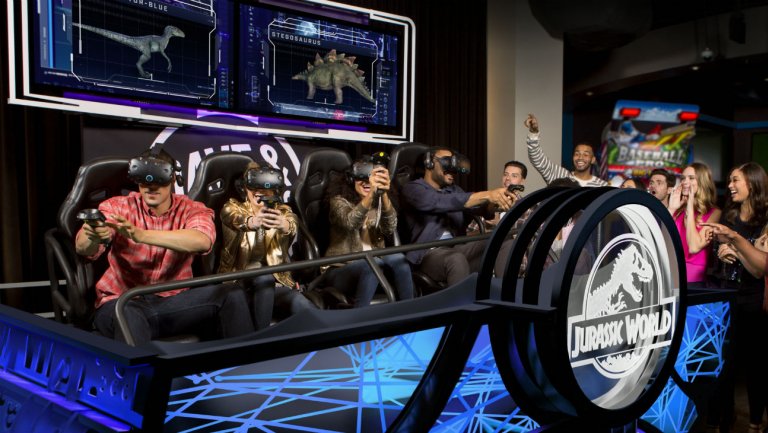 Tied to the June 22 release of Universal's Jurassic World: Fallen Kingdom, the VR experience will be available starting June 14 at all 114 Dave & Buster's locations in the U.S. and Canada. Each site will have at least one motion simulator that seats up to four players in the Jurassic World experience, which uses the HTC Vive VR headsets and hand controllers.
Dave & Buster's also funded the development of the VR project, created by VRC, which was co-foundered by chief creative officer and two-time Academy Award winner Robert Stromberg and CEO Guy Primus.
VRC licensed the brand from Universal; the production budget was in the "low seven figures," according to VRC.
VRC creative director James Lima wrote and directed the experience. “We wanted to take people to Isla Nublar and visit Jurassic World, and here is where the power of VR presents its potential as a medium that is an extension of the film," Lima said.
See the full story here: https://www.hollywoodreporter.com/behind-screen/jurassic-world-virtual-reality-experience-debuts-1117631
The Startup That Wants to Use Virtual Reality To Make The World A Better Place (From Space)
 “SpaceVR aims to give everyone the opportunity to experience the truly infinite, boundless Universe through virtual reality,” he explained in quietly earnest tones, which were somewhat disconcerting to a cynical old tech journalist.
His inspiration, he told me, was a well-documented phenomenon called the Overview Effect, which is that first moment an astronaut realizes their place in an infinite universe, something they only achieve through direct observation. This in turn leads to reprioritization of protecting the earth and working together on a global scale.
It’s what prompted Neil Armstrong to say that space travel made him feel “very, very small,” and is perhaps best summed up by a colorful quote from Apollo 14 astronaut Edgar Mitchel, who in a 1984 interview for People Magazine said: “From out there on the Moon, international politics look so petty. You want to grab a politician by the scruff of the neck and drag him a quarter of a million miles out and say, ‘Look at that, you son of a bitch.’”
See the full story here: https://www.forbes.com/sites/alicebonasio/2018/06/06/the-startup-that-wants-to-use-virtual-reality-to-make-the-world-a-better-place-from-space/#5ad1f6222e56
Futuristic Collective teamLab Will Launch Its Own Museum in Tokyo, Promising a Wonderland of Digital Art
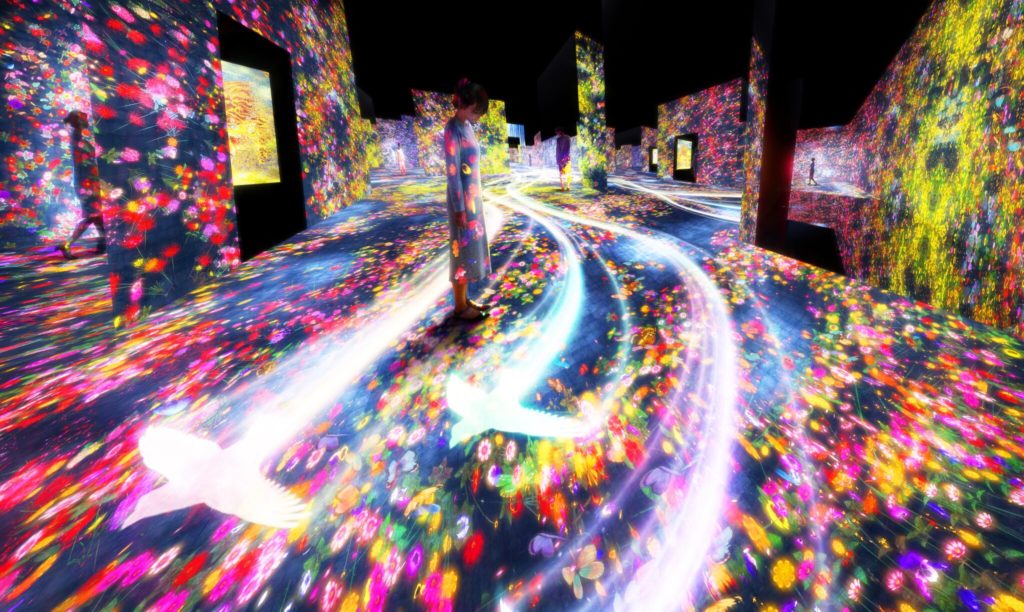 The high-tech collective teamLab wants to make white walls and plinths a thing of the past. The 400-person group of artists and scientists plan to launch their own museum dedicated to digital art in Tokyo this summer.
The vast team of designers, animators, engineers, programmers, mathematicians, and architects is collaborating with real estate developer MORI Building to open a 107,000-square-foot venue to showcase its interactive, digital works of art. The space will be located in Palette town—a complex that is part amusement park, part shopping mall—in Odaiba, a man-made island in Tokyo Bay.
With its Instagram-friendly, interactive projections of flowers, waterfalls, and trees, teamLab has already proven itself to be an audience magnet. The group’s exhibition at Pace Menlo Park in 2016—which cost up to $20 to enter—drew close to 200,000 visitors in 10 months. (The gallery had projected 30,000.) In one work, visitors were invited to download an app, walk through a forest of 50,000 LED lights, and create different patterns by pressing buttons on their phones.
See the full story here: https://news.artnet.com/art-world/teamlab-museum-tokyo-1210904
SEEK LAUNCHES WORLD’S FIRST MOBILE AUGMENTED REALITY (AR) CREATION STUDIO
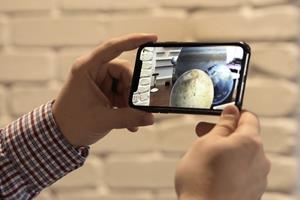 Today, fast-growing augmented reality startup, Seek, is launching Seek Studio, the world’s first mobile augmented reality studio, allowing anybody with a phone and no coding expertise required, to create their own AR experiences and publish them for the world to see.
To make the process incredibly easy, Seek provides templates for users to create their first AR experiences. As an example, a user can select a photo on their phone, outline the portion of the image they want turned into a 3D object and then publish it to Seek. They will then be able to share it with their friends through popular social networks or text. A brand could additionally upload a 3D model of their product and publish it to Seek, providing an experience for their customers to easily view that content in their own home. Seek Studio will launch with 6 templates and will release new ones every few days over the coming months to constantly improve the complexity and types of experiences possible to create within the platform.
One key feature of Seek Studio is publishing tools for users of Amazon Sumerian.
Many brands and influencers have already begun to publish content to Seek, including Lionsgate, Samsung, Six Flags, Dani Cohn, and others.
See the full story here: https://globenewswire.com/news-release/2018/05/29/1513190/0/en/SEEK-LAUNCHES-WORLD-S-FIRST-MOBILE-AUGMENTED-REALITY-AR-CREATION-STUDIO.html
Highly-Anticipated VR Stealth Game ‘Budget Cuts’ Arrives This Week
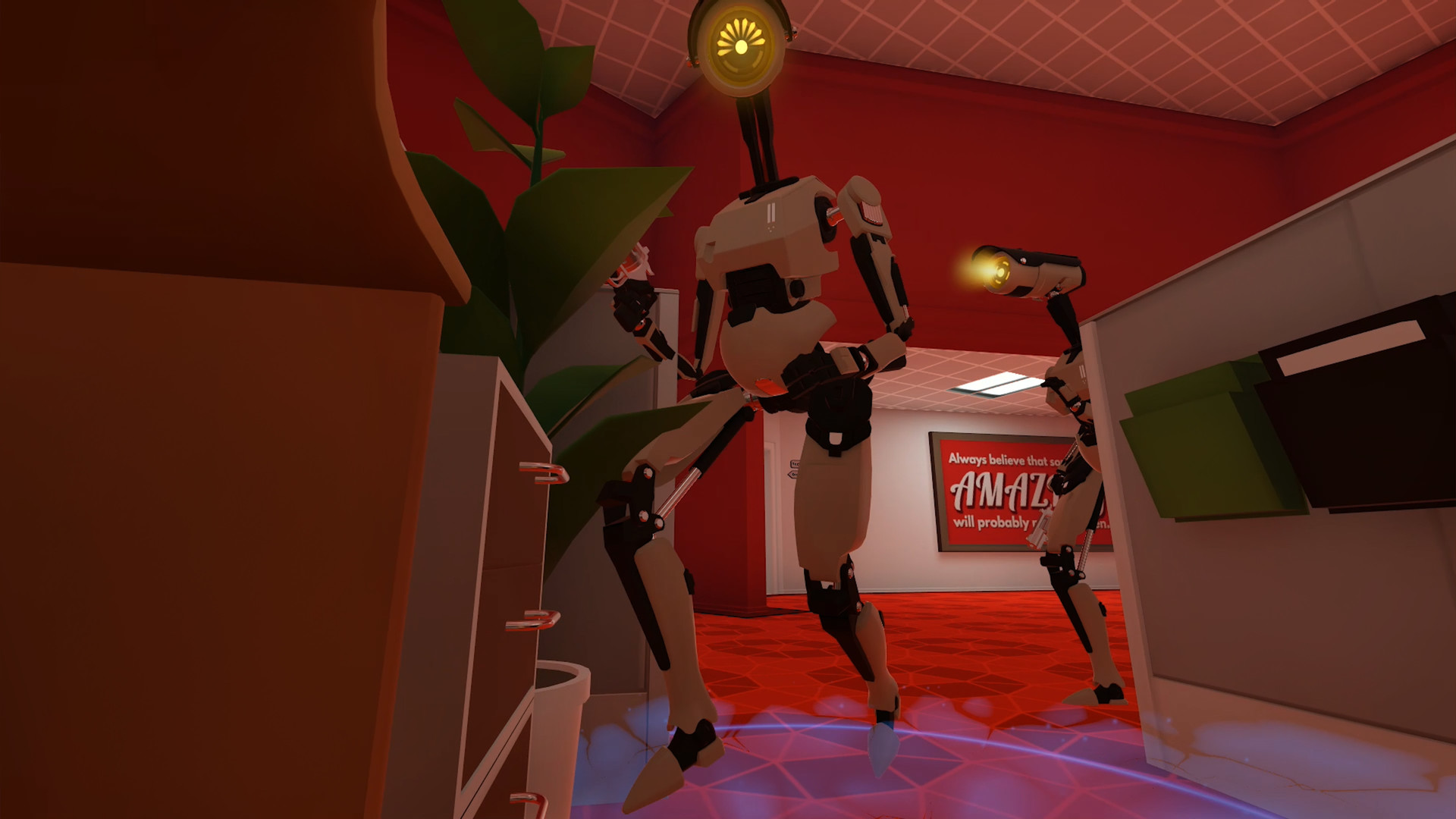 Budget Cuts steps you into the shoes of an average employee-bot of mega conglomerate TransCorp, where you’re tasked with the crucial work of stamping papers and filing files. Unlucky for you however, Transcorp is infamous for its ability to pump out cost-effective robots, and as you watch as one of your fellow mechanical coworkers is banished to the horrifying HR department, you begin to realize you’ll soon be sharing the same fate. That’s when a mysterious package arrives, and you’re action-packed ninja mission through a corporate hell hole begins.
Budget Cuts is centered around stealth-based combat, having you sneak your way around enemies using an assortment of deadly weapons, and office supplies, to take down your battery-powered pursuers. The ambitious title features a full-fledged single player campaign including some top-tier voice acting.
However its the use of room-scale technology that is sure to impress you the most. You’ll find yourself constantly moving around your play space as you peak around walls, duck behind cover, dodge incoming fire, even climbing on your hands and knees to look through holes in the floor (It’s more exciting than it sounds).
Budget Cuts will be available for $30 on Steam as well as the Oculus Store when its page goes live May 31st.
NextVR Finally Launches On Vive, Rift Coming Soon
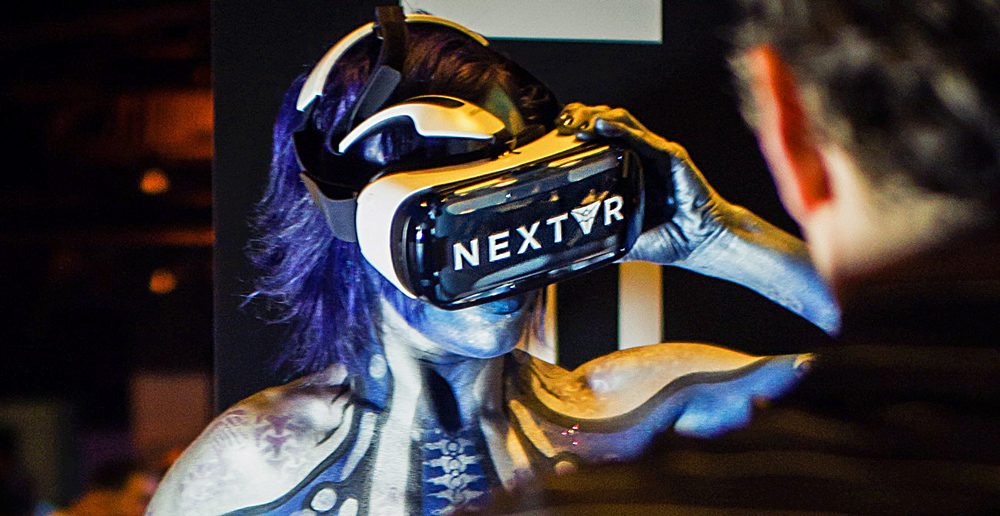 NextVR, a service that offers live sports and entertainment broadcasting in 360 degrees, this month launched on Viveport with support for both the HTC Vive and the Vive Pro. Despite launching on Gear VR years ago and even coming to Microsft’s Windows-based mixed reality devices last year, this is the first time the platform has been available on HTC’s headset. The company also told Road to VRthat a version for the Oculus Rift will be coming soon and a Steam release is on the cards too. It’s free to download on Viveport.
NextVR offers a range of 360 degree experiences as well as live programming. The app’s current lineup includes ringside viewing of WWE and boxing matches, front row access to Live Nation concerts and sideline locations for NFL games among others. In these videos, users can twist and turn their heads to look in any direction, though can actually move their heads through virtual space.
See the full story here: https://uploadvr.com/nextvr-finally-launches-vive-rift-coming-soon/