 Google and LG Display have joined forces to design the clearest OLED display to date. The 4.3-inch screen, which Google recently revealed at Display Week, is designed to push the boundaries of VR image quality with an incredible 1,443 ppi resolution. For comparison, Japan Display Inc unveiled its slightly smaller 1,001 ppi LCD screen earlier this month, which outclassed both the Oculus Go (538 ppi) and HTC's Vive Pro (615 ppi).
24May/18Off
Stepping into a Virtual Reality Classroom for Teacher Training
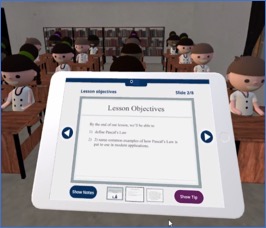 Using Virtual Reality (VR), teacher training can be facilitated in a comfortable and individual virtual space where teachers can practice pedagogical approaches and new ways of integrating Information and Communications Technology (ICT) at their convenience and as frequently as possible. It reduces the hassle of high costs associated with training venues, per diems during training periods, travel to training sites or missing school days. While introduction of technology does not completely eliminate the need for in-person and personalized trainings, the VR for teacher training pilot was first envisioned as the project began sketching out a sustainability plan of the existing Connect To Learn Myanmar project, launched in 2015.
Connect To Learn Myanmar is a project headed by Ericsson in partnership with the Earth Institute and with funding support from Qualcomm® Wireless Reach™. It provides ICT solutions to 31 schools with in-person teacher training under the broader vision of increasing quality of instruction and student participation, especially for girls, in secondary schools in marginalized communities. With the project period ending in 2019 and funding support for in-person teacher trainings ending as a result, the project proposed digital content housed through a VR environment, which can continually be used by teachers even after project wrap-up with Ministry of Education oversight.
See the full story here: http://csd.columbia.edu/2018/05/23/stepping-into-a-virtual-reality-classroom-for-teacher-training/
24May/18Off
Viewers Not Warming to Recommendations by Video Services
 According to research from UserTesting, the personalized viewing recommendations offered by video streaming services are failing to gain traction with most consumers. While results varied across services, only 29 percent of participants indicated that they watch content recommended to them. In addition to relevant recommendations, the study rated services based on metrics such as speed, availability of content, episode scanning, and overall ease-of-use. With a total score of 89.5, Netflix led the field, followed by Hulu (86.8), Amazon Prime (85) and YouTube TV (80.7).
UserTesting found that 45 percent of viewing “takes place on TV or via streaming media devices like Roku, Apple TV or Amazon Fire TV,” reports TechCrunch. “Thirty-seven percent preferred laptops, and 11 percent said their smartphone or tablet was their primary streaming device. For some services, TV viewing is even higher — Hulu recently said that the majority — 78 percent — takes place on TVs.”
See the full story here; http://www.etcentric.org/viewers-not-warming-to-recommendations-by-video-services/
24May/18Off
Nvidia Emphasizes Software at Technicolor Experience Event
 At the Technicolor Experience Center in Culver City, Nvidia held an event highlighting its decisive move into software, with artificial intelligence, virtual reality and other areas. Vice president of developer programs Greg Estes noted that the company has 850,000 developers all over the world in universities and labs as well as companies like Adobe. Its developer program provides hands-on training in AI and parallel computing, impacting the media and entertainment industry, as well as smart cities, autonomous vehicles and more.
Andrew Edelsten, Nvidia director of developer technologies for deep learning, described the company’s efforts in AI, including its Deep Learning Institute, which has trained 100,000 developers in AI. He defined deep learning as the ability to add “hidden layers” to neural networks to solve complex problems. “We’re focusing on what makes deep learning successful,” he said, stressing that deep learning is not magic. “If a human being can’t map it, neither can DL,” he warned. He encouraged developers to pick a task that will bring a return on investment. “Put your ideas through the wringer,” he advised.
He focused on the ways that AI and VR can be used to create an end-to-end platform for self-driving cars, and to create simulations to train robots. The team is also experimenting with cable physics that helps articulate virtual hands. “We can now simulate things that are right and don’t just look right,” he said.
See the full story here; http://www.etcentric.org/nvidia-emphasizes-software-at-technicolor-experience-event/
24May/18Off
MIT’s Super-Efficient Dispatching Algorithm Minimizes a City’s Taxi Fleet
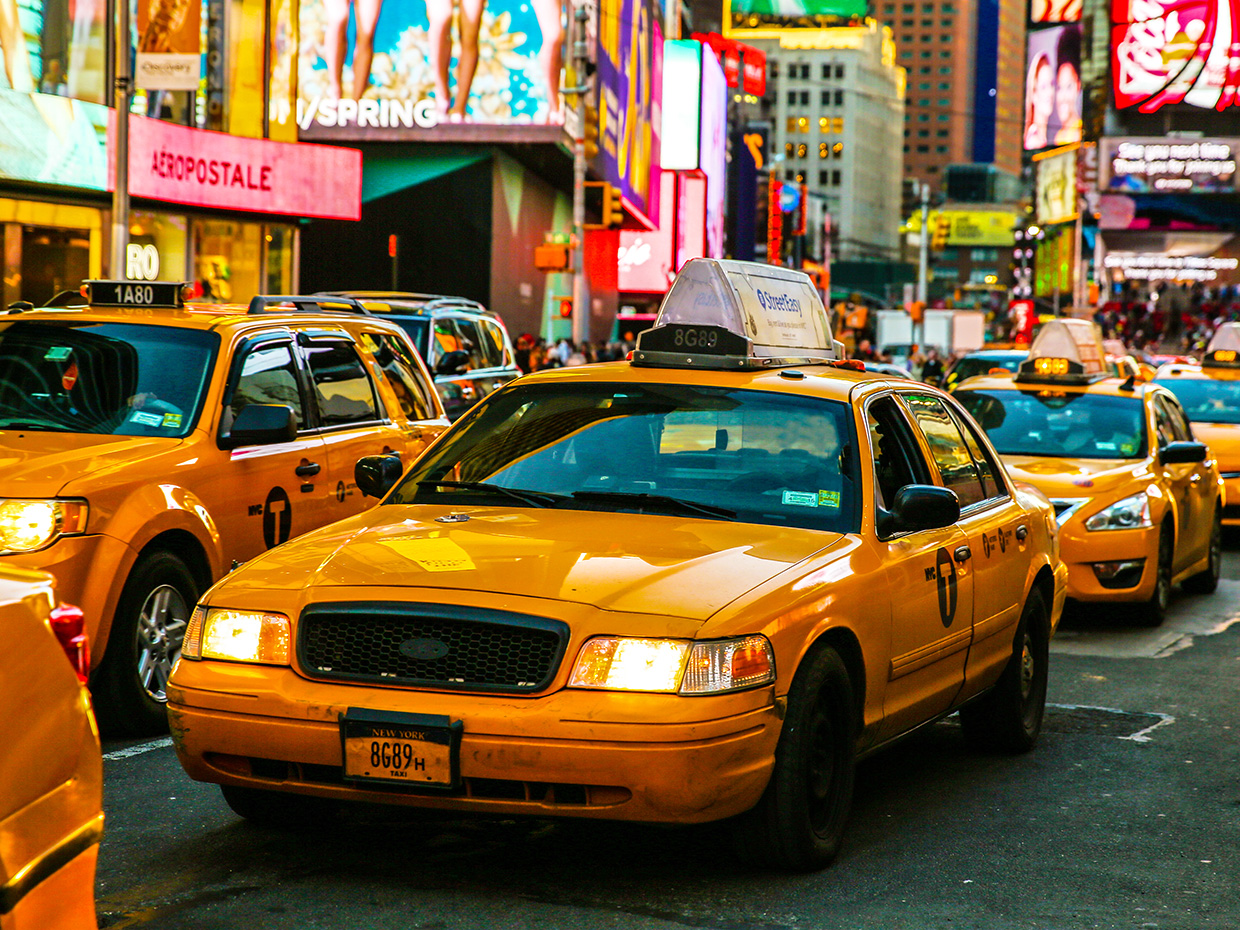
Times Square, New York City, New York State, Night, Taxi
By giving due weight to minimizing the distance between a taxi’s destination and the origin of its next potential trip, the model moves more passengers per vehicle over a given period of time.
A perfect solution would lay to rest the famous Traveling Salesman Problem, which tries to find the shortest path a salesman must take to hit every spot on his route. That problem quickly becomes intractable, however, as the number of spots increases. You could solve it for Mayberry, but not for Manhattan.
Instead, the MIT researchers created what they call a vehicle sharing network, similar to the network they used in 2014 for optimizing ride sharing. It looks like a graph in which each node represents a trip and each line linking two nodes represents a pair of trips that one vehicle can handle. Manipulating the layout of the graph provides ways of improving (if not perfecting) the solution.
See the full story here: https://spectrum.ieee.org/cars-that-think/transportation/mass-transit/mit-finds-mathy-way-to-minimize-taxi-fleet