Stanford senior and university VR club co-founder creates pioneering augmented reality film with fellow undergraduate

Image courtesy of Max Korman
Stanford undergraduates Max Korman, ’18, and Khoi Le, ’20, launched what may be the world’s first augmented reality narrative film. And they did it using their mobile phones.
Snowbird is a 3D-animated short movie about porcelain creatures that come to life in a snow globe. Viewers can place a snow globe into their surroundings at any time – which could be at work, or home, during their commute or on May 12 at Stanford’s first annual VR for Everyone conference.
VR for Everyone is hosted by Rabbit Hole, Stanford’s virtual reality club co-founded in 2015 by Korman with an objective to foster community among immersive reality enthusiasts. The conference is expected to attract hundreds of attendees from campus and community. As reflected in the event’s name, VR for Everyone, adoption and inclusion in the industry are key themes.
The conference will also be the first public screening of Snowbird.
“The premise of immersive technology is the ability for creators to completelycurate a person’s visual and auditory experience. So, I think it has the potential to transform any activity that relies on these senses.”
Korman and Le are already assessing different narrative premises for new AR films even without a clear distribution pipeline.
See the full story here; https://news.stanford.edu/2018/05/10/stanford-undergrads-create-pioneering-augmented-reality-film/
Cannes: Virtual Reality Plays Bigger Role on Croisette as Advocates Tout Platform and Possibilities

A still image from SPHERES: Songs of Spacetime by Eliza McNitt, an official selection of the New Frontier VR Experiences program at the 2018 Sundance Film Festival. Courtesy of Sundance Institute.
When Sundance sales were tallied this year, one title was left out of many stories: “Spheres,” a three-part virtual reality series from executive producer Darren Aronofsky’s Protozoa Pictures. VR financing/distribution outfit CityLights’ seven-figure acquisition of the project was reportedly a record for the fest’s 11-year-old New Frontier section.
“The sale signaled that there is a path for independent VR,” Aronofsky says of director Eliza McNitt’s work, which places viewers in the center of outer space with narration by Jessica Chastain and Patti Smith. “The most important films are often made outside the studio system, where creators have the freedom to advance the medium. We now know this can be true of VR, too.”
The sale was promising news for Next, the innovation hub at Cannes Market. The section will showcase more than 25 projects (including VR companion pieces for Christopher Nolan’s “Dunkirk” and Wes Anderson’s “Isle of Dogs”), a theater for VR market screenings equipped with Positron’s pod-like Voyager chairs (programmed to move viewers and literally shake up their senses) and a panel on Cinema VRE [Virtual Reality Experiences] and the Future of Immersive Technologies, moderated by Intel global content technology strategist Ravi Velhal.
Yet exhibitors are also beginning to fuel a market for new projects. Imax has launched seven VR centers, some in partnership with AMC Theatres and Regal Cinemas, in New York City; L.A.; Toronto; Manchester, England; Bangkok, and Shanghai. It has developed a $50 million fund for VR content and partnered with Warner Bros. Home Entertainment to co-finance and produce VR projects (including an exclusive “Justice League” presentation out now). AMC (joining 21st Century Fox, MGM, Warner Bros. and others) has reportedly invested more than $40 million in the tech startup Dreamscape Immersive to open up to six “virtual reality multiplexes” by next year. Cinemark will open its first “virtual reality experience” in its flagship West Plano, Texas, theater this summer. And in April, Regal Entertainment Group introduced Moviebill, a magazine featuring an interactive augmented reality (AR) platform with exclusive content, interviews and games that “come to life” when consumers scan it with an app.
Teenagers, he’s found, “are more interested in social networks, and the price point of VR is a bit too expensive for them right now.”
More stars are also expected to jump on the bandwagon. At Next this year, Alicia Vikander will voice a lead role in Penrose Studios’ animated VR sequel “Arden’s Wake: Tide’s Fall,” and a graphic novel adaptation from Will.i.am and the Black Eyed Peas will include the voice talents of Queen Latifah, Ice-T and Jamie Foxx.
See the full story here: http://variety.com/2018/film/spotlight/virtual-reality-cannes-2018-1202801543/
Virtual Reality Comes to Mainstream Cinema in South Korea
 More recently, VR romance drama “Stay With Me” opened in the immersive 4DX format at the CJ-CGV cinema chain. Directed by Bryan Ku, “Stay” revolves around the relationship between a boy who dreams of becoming a musician but is too afraid to go on stage, and a girl who aspires to become an actress.
“4DX effects for VR should be different from those for other movies,” says Yoo Young-gun of CGV. “Visual elements are not enough to accomplish what VR is up to, which is to expand to a form of storytelling with its immersive characteristics maximized. With 4DX technology, the audiences can touch, smell and feel the films, meaning that virtual reality in its literal sense can be achieved.”
CJ CGV is aiming to globally introduce 4DX VR by applying VR technology to its 500 4DX theaters across the world.
On the other hand, Lotte Cinema, South Korea’s second-largest exhibition chain, arranged a special program dedicated to VR content earlier this year. The program’s selection included Patrick Kwon’s “Nine Days,” South Korea’s first VR movie designed for theatrical release.
Since VR is still at an early stage and barely has a stable market, most VR productions rely on support funds. The Ministry of Culture, Sport and Tourism and institutes such as Korea Creative Content Agency and National IT Industry Promotion Industry are funding VR projects. Also, the Korean Academy of Film Arts launched a special course for VR production.
At the same time, companies in the private sector are also making investments. Leading visual-effects house Dexter Studios is running a digital human virtual reality research lab and is working on a string of VR films that are set for theatrical releases at CGV within this year. The studio’s lineup includes sci-fi animation “From the Earth” and live-action horror picture “Trapped.”
See the full story here: http://variety.com/2018/biz/news/vr-virtual-reality-gina-kim-1202801584-1202801584/
I tried to get a date using augmented reality
 Sharing that much data could actually make it harder to find love. Too much information at the beginning could make us more judgemental about possible dates before we’ve had the chance to bond with one another, potentially making us more likely to turn people down who we might have fallen in love with.
“AR might be exciting, but most of us aren’t willing to give up the amount of privacy that using AR entails,” says Nick Saretzky.
I think he’s right. At the same time, though, after two weeks of walking London’s streets, looking out for the circled faces of all the hot singles around me, non-augmented reality dating feels like a boring step back.
See the full story here: https://www.bbc.co.uk/bbcthree/article/d342e05c-58a4-493d-92c7-c77bbc872ab5
And for His Next Act, Ev Williams Will Fix the Internet
 But while other tech leaders enter the confessional booth, Mr. Williams, 46, seems to be emerging with a new outlook — a blend of old-fashioned Silicon Valley optimism tempered with the caution of a tech veteran who has seen well-intended products hijacked by horrible people.
Last week, Mr. Williams sent me a kind of mini-manifesto — a two-page document containing his thoughts about technology’s potential, the problems with ad-supported media and the regulation of social media platforms. We followed up with a phone interview, in which he expanded on the ideas, some of which he has been thinking about and refining for years but had yet to make public.
“One of the things we’ve seen in the past few years is that technology doesn’t just accelerate and amplify human behavior,” Mr. Williams wrote. “It creates feedback loops that can fundamentally change the nature of how people interact and societies move (in ways that probably none of us predicted).”
Last year, after that strategy failed to catch on, Medium laid off a chunk of its staff and turned to a subscription model. Users can now pay $5 per month for access to premium stories, and writers can earn small amounts of money when their stories get positive feedback (known as “claps”) from other users. The company has also hired human editors in order to elevate substance over fluff.
Mr. Williams wants people to find Medium valuable enough to pay for, but he doesn’t necessarily want it to be the kind of site that people visit 10 times a day. He has become a fan of the work of Tristan Harris, a former Google design ethicist who has criticized the addictive qualities of popular internet services.
(The company recently solicited proposals for tools to help it measure “conversational health.”)
See the full story here: https://www.nytimes.com/2018/05/09/business/ev-williams-twitter-medium.html
Facebook Restructures With Executive Shuffle, New Divisions
 Facebook is undergoing the biggest reorganization in the company’s history. Messenger, WhatsApp, and Facebook’s core app will get new leaders, while the company’s product and engineering organizations will be reorganized into three main divisions: the “Family of Apps” group, run by chief product officer Chris Cox, will include social apps Facebook, Instagram, Messenger and WhatsApp; the “New Platforms and Infrastructure” group, managed by CTO Mike Schroepfer, will cover AI, AR, VR, and blockchain tech; and the “Central Product Services” group, headed by VP of growth Javier Olivan, will handle shared features across products and apps, including advertising, analytics, and security.
While the roles of top execs Zuckerberg and COO Sheryl Sandberg will not be impacted during the changes, the company is appointing Jeff Zients as a new board member. Zients was director of the National Economic Council under President Obama.
See the full story here: http://www.etcentric.org/facebook-restructures-with-executive-shuffle-new-divisions/
Facebook Establishes Team to Integrate Privacy into Products
 In the wake of criticism over data privacy issues and in anticipation of the European Union’s stricter data regulations, Facebook has formed a new team devoted to privacy. The 300-person team, headed by product director David Baser, is tasked with integrating stronger privacy features into all Facebook products. The first such tool is Clear History, which the company introduced at last week’s F8 conference. This feature allows users to opt out of Facebook collecting and matching their browsing history to their profile.
See the full story here: http://www.etcentric.org/facebook-establishes-team-to-integrate-privacy-into-products/
TaTaTu: Blockchain-Based Entertainment and Social Platform
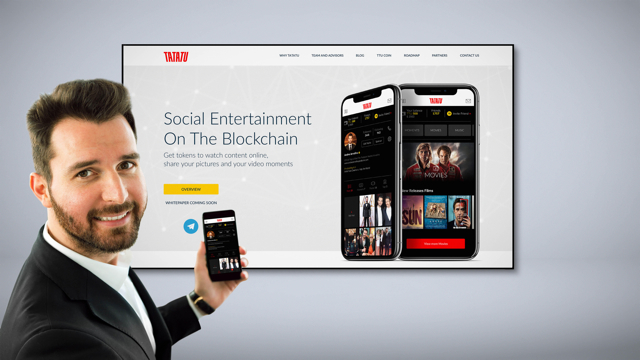 The brainchild of producer Andrea Iervolino, TaTaTu rewards viewers for watching content including movies, TV shows, sports, and gaming — and adds rewards when their friends also watch.
TaTaTu rewards content consumption with digital tokens; “blockchain lets TaTaTu record each transaction in an open distributed ledger, which ensures users and content providers get rewarded.” The platform also includes a blockchain-based digital rights management (DRM) system, which provides “an accurate record” for “all talent, distributors, and studios.”
“We need the blockchain to create a unique token that is universal and can be used as a rewarding system for our community of users,” explained Iervolino. “We want to create an ecosystem based on trust and fairness embodied by the principle of the blockchain community.”
“The DRM is built on the blockchain to ensure film rights do not get lost,” he continued. “There are many examples of studios being bought, going bust, and rights getting lost.”
To build TaTaTu, the company has put together “a team of over 250 developers, as well as adding a dedicated blockchain team.” Content offerings will begin with movies and videos “but it will also expand to providing music, sports, and games on demand.” Iervolino stressed that TaTaTu does not compete with Netflix or Amazon “as they are subscription-based, nor with platforms like Hulu, which focus solely on advertising.”
“Our business model is unique, as we reward users — focusing on the relationship between the advertiser and the content viewer,” he said. “It is something completely new in the market and that we believe is the future.”
See the full story here: http://www.etcentric.org/tatatu-blockchain-based-entertainment-and-social-platform/