Virtual reality training on display at downtown firefighters convention
 Simulated emergencies on display included a kitchen fire, a propane tank leak and an aircraft fire.
The system consists of a set of VR goggles that provide a 360 degree view of simulated emergencies in real time. It also includes a fire jacket that can be heated to simulate heat radiating from a virtual fire. The hose held by a firefighter training on the system is attached to a reel that pulls backward when water is being sprayed.
All the components of the system are hooked to a computer that runs the simulation and tracks various metrics during the exercise. The computer keeps track of a firefighter’s timing and water usage, as a way to gauge how efficiently a firefighter responds to each situation.
See the full story here: http://cbs4indy.com/2018/04/25/virtual-reality-training-on-display-at-downtown-firefighters-convention/
Snapchat Spectacles 2.0 launch
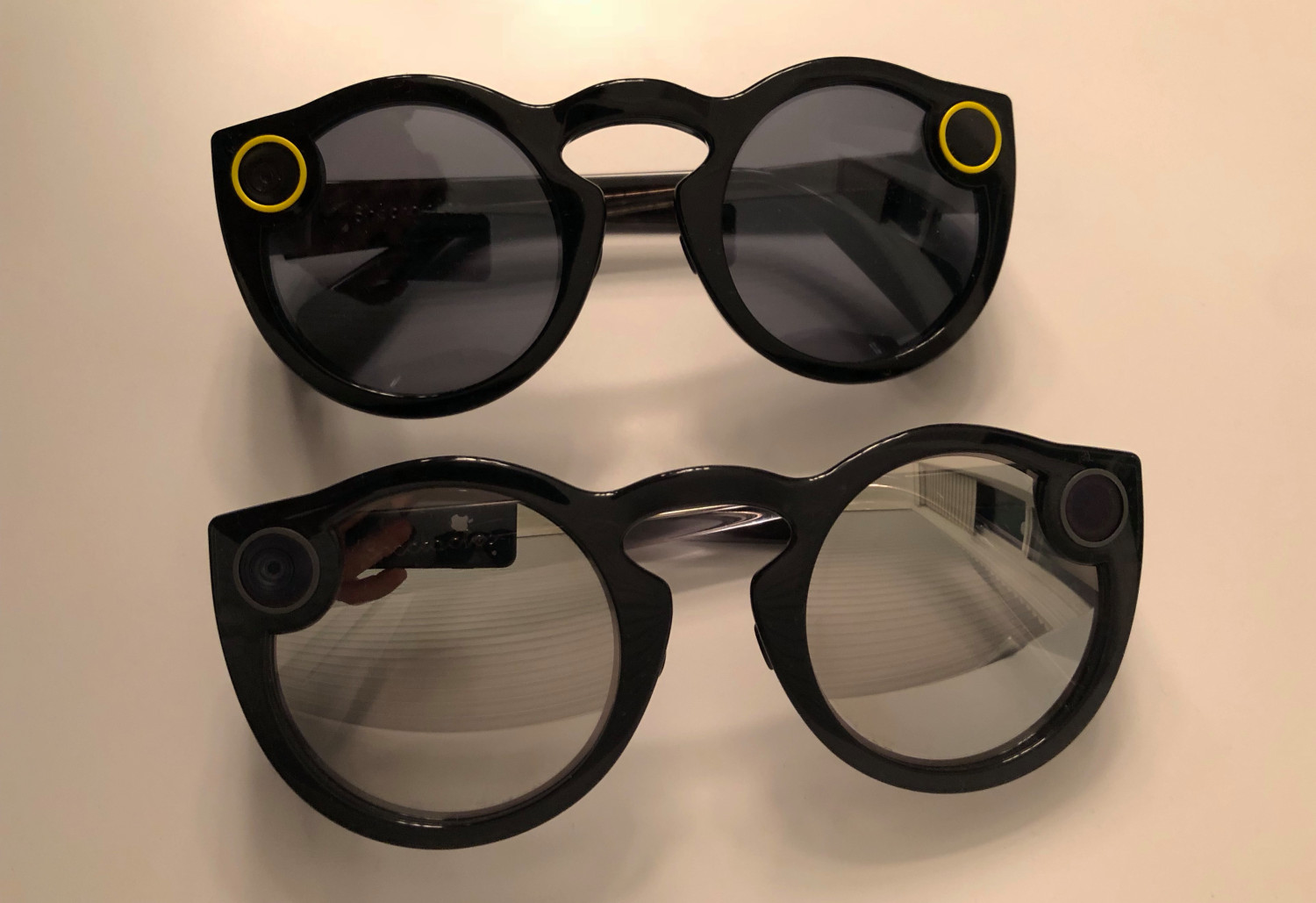 Photos, not just video. No yellow ring alerting people to the camera. Underwater-capable. Classier colors with lighter lenses. Prescription options. Faster syncing. And a much slimmer frame and charging case. Snapchat fixed the biggest pain points of its Spectacles camera sunglasses with V2, which launch todayfor $150. The company only sold 220,000 pairs of V1, with their limited functionality, tricky exports and goofy hues. But V2 is stylish, convenient and useful enough to keep handy. They’re not revolutionary. They’re a wearable camera for everybody.
What Snap doesn’t need is a privacy scandal, and that risk is the trade-off it’s making with its more discreet Spectacles design. They still display a little circle of white lights while recording, but with the permanent yellow ring on the corner removed, you might not notice there’s a camera lens there. That could make people a little nervous and creeped out.
But the company’s VP of hardware Mark Randall tells me he thinks the true purpose of V1 was to get people comfortable wearing and being recorded by a face computer.
Spectacles are supposed to have enough battery and memory to record and transfer 70 videos over a week on a normal charge, plus carry four extra charges in the case.
They come in onyx black, ruby red and sapphire blue and you can choose between a more mirrored or natural lens color too. Users in the U.S. can order them with prescription lenses through Lensabl.
It’s easy to long-press for a photo or tap for 10-second video, with extra taps extending the clip up to 30 seconds. Either fires up the light ring to let people know you’re recording, but this is much more subtle than the permanent yellow ring that was there on V1.
Unfortunately, Snapchat is what’s holding Spectacles back. You can only sync your Spectacles to Snapchat Memories first before exporting videos individually or as one big Story to your camera roll. That makes it a pain to share them elsewhere.
See the full story here: https://techcrunch.com/2018/04/26/snapchat-spectacles-2/?utm_medium=TCnewsletter
THE FUTURE OF SNAPCHAT LOOKS A LOT LIKE MAGIC LEAP
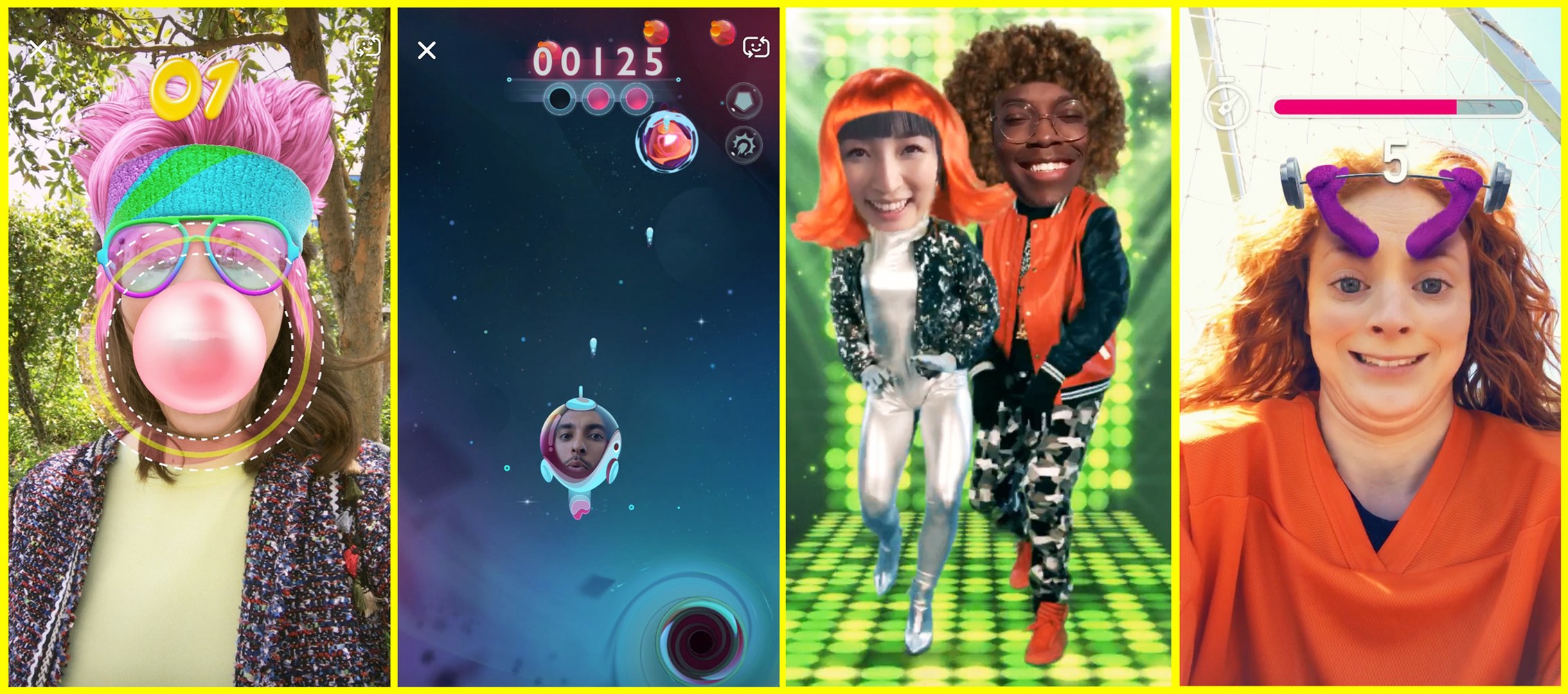 Now, the company has used those tools to build a deceptively simple product: Today Snapchat introduces games. The first set of these lenses, called Snappables, lets users do things like add friends to a rock band, challenge those friends to an emoji dance-off, or play basketball. Users can interact with the AR games through touch, motion and facial expression. In one completely weird game that I played when I visited the company’s New York office last week, a filter transformed my eyebrows into barbells. I lifted my real eyebrows to raise the barbells. I competed against Eeitan Pilipski, who runs Snap’s camera platform and whose eyebrows are gray wisps covering fast-moving practiced muscle, to see who could lift the most. (He won.)
The new feature is a tiny change to the company’s product, but it’s instructive in discerning Spiegel’s endgame. Later this week, the company will announce an updated spectacles product. While companies like Magic Leap and Microsoft are trying to build the next computing platform in one mind-blowing package—with a headset and software and content that will obliterate their competitor—Snapchat is attempting to piece together that next computing platform independently, from the bottom up by creating hardware and software separately. “We decouple them so that they’re all allowed to develop on their own until they come together,” Spiegel said.
As Spiegel sees it, hardware has been holding augmented reality back. There are tough technical problems that no company has cracked completely. Among other things, existing headsets have narrow fields of view, and the batteries, which bulk them up, don’t hold their charge for very long. We still don’t know how these devices will evolve, and whether most people will ever want to wear them. By developing Spectacles separately, says Spiegel, “we can still move forward at a really fast pace empowering very advanced augmented reality products within Snapchat.”
Which brings us to Snappables. To understand Snapchat’s new games, you need to see them as Spiegel sees them—as yet another opportunity for people to communicate with each other.
Pilipski, the guy who bested my brow reflexes, is charged with pairing computer vision with creative design to evolve the company’s augmented reality tools and help developers make the most of them. In addition to his strapping eyebrows, he brings nearly a decade of experience working in AR, joining Snap in 2016 from the AR startup Vuforia.
How secure is blockchain really?
 Even when developers use tried-and-true cryptographic tools, it is easy to accidentally put them together in ways that are not secure, says Neha Narula, director of MIT’s Digital Currency Initiative. Bitcoin has been around the longest, so it’s the most thoroughly battle-tested.
People have also found creative ways to cheat. Emin Gün Sirer and his colleagues at Cornell University have shown that there is a way to subvert a blockchain even if you have less than half the mining power of the other miners. The details are somewhat technical, but essentially a “selfish miner” can gain an unfair advantage by fooling other nodes into wasting time on already-solved crypto-puzzles.
Another possibility is an “eclipse attack.” Nodes on the blockchain must remain in constant communication in order to compare data. An attacker who manages to take control of one node’s communications and fool it into accepting false data that appears to come from the rest of the network can trick it into wasting resources or confirming fake transactions.
Finally, no matter how tamperproof a blockchain protocol is, it “does not exist in a vacuum,” says Sirer. The cryptocurrency hacks driving recent headlines are usually failures at places where blockchain systems connect with the real world—for example, in software clients and third-party applications.
...Since the DAO code lived on the blockchain, the Ethereum community had to push a controversial software upgrade called a “hard fork” to get the money back—essentially creating a new version of history in which the money was never stolen. Researchers are still developing methods for ensuring that smart contracts won’t malfunction.
The centralization question
One supposed security guarantee of a blockchain system is “decentralization.” If copies of the blockchain are kept on a large and widely distributed network of nodes, there’s no one weak point to attack, and it’s hard for anyone to build up enough computing power to subvert the network. But recent work by Sirer and colleagues shows that neither Bitcoin nor Ethereum is as decentralized as you might think. They found that the top four bitcoin-mining operations had more than 53 percent of the system’s average mining capacity per week. By the same measure, three Ethereum miners accounted for 61 percent.
Some say alternative consensus protocols, perhaps ones that don’t rely on mining, could be more secure. But this hypothesis hasn’t been tested at a large scale, and new protocols would likely have their own security problems.
Permissioned systems, however, raise their own questions. Who has the authority to grant permission? How will the system ensure that the validators are who they say they are?
So in the end, “secure” ends up being very hard to define in the context of blockchains. Secure from whom? Secure for what? “It depends on your perspective,” says Narula.
See the full story here: https://www.technologyreview.com/s/610836/how-secure-is-blockchain-really/?utm_source=newsletters&utm_medium=email&utm_content=2018-04-25&utm_campaign=the_download
Nanotechnology Researchers Are One Step Closer to the Perfect ‘Meta-lens’ for AR/VR Headsets
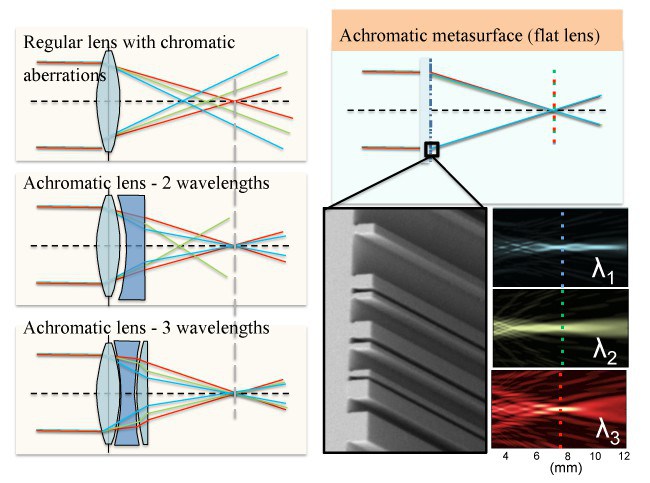 While 1mm thick meta-lenses capable of bending incoming light to a singular focal point have been previously demonstrated, the researchers say they’ve refined their design, allowing for arbitrarily adjustments to the transmission speed of light passing through different points on the lens. By modulating the transmission speed, the light can be made to arrive simultaneously at the focal point, resulting in a sharper image, the researchers say.
Once designed, meta-lenses can be created as part of a wider mass production process: for instance, of VR headsets or augmented reality glasses. They can also be used in place of more expensive ground-glass camera lenses on smartphones and laptops, reducing weight, thickness and cost of portable devices.
There’s no word yet on when the lens tech will be ready for production—or for what cost—but it’s possible that upgrades of this type could follow a similar path set out for future VR headset displays.
See the full story here: https://www.roadtovr.com/new-flat-lens-give-vr-headsets-better-image-quality-making-lighter-compact/?platform=hootsuite
and https://theconversation.com/delivering-vr-in-perfect-focus-with-nanostructure-meta-lenses-89726
Snapchat’s new Snappables let you play augmented reality games with friends
 Snappables are similar to Snapchat’s popular Lenses, which souped up selfies with rainbow vomit or puppy dog ears. Earlier this month, a Snap spokesperson told VentureBeat that more than 70 million of its users “play with Lenses in the Snapchat camera every day."
See the full story here: https://venturebeat.com/2018/04/25/snapchats-new-snappables-let-you-play-augmented-reality-games-with-friends/
VRstudios makes a compact virtual reality experience with VRcade Atom
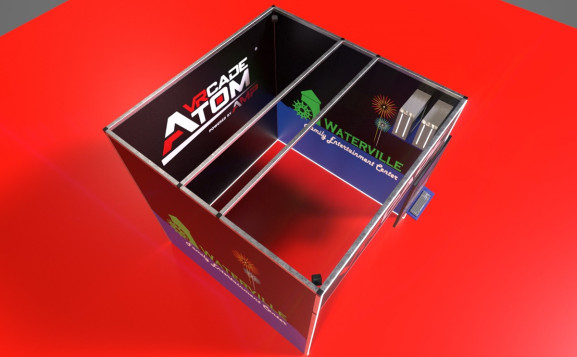 The VRcade Atom is a commercial wireless VR system built for location-based entertainment (LBE) arcades, and it costs less compared to previous systems. It’s a turnkey system that includes everything a VR arcade business needs to add room-scale, free-roaming, multiplayer VR attractions.
Built on the VRcade Attraction Management Platform (AMP), the Atom is the first VR arcade solution integrating best-in-class computing power, head-mounted display technology, wireless transmission, and positional tracking from industry leaders including Hewlett-Packard, HTC, and TPCAST.
... the Atom runs experiences from the company’s portfolio of VRcade wireless, multiplayer attractions expressly built for commercial arcade operations. This includes: VRcade’s classic Time Zombies, Barking Irons, planktOs and Drone Storm.
The Atom is easy to set up, take down, relocate, or reconfigure. Installations can be done quickly with no special facility requirements or additional infrastructure, such as rigid truss systems. The standard configuration requires only a 10 foot x 10 foot footprint for a multiplayer system,...
The VRcade Atom is available to demonstrate and order directly from VRstudios. VRstudios launched in 2014, and it has 55 VRcade installations in 14 countries. The company has 24 employees.
See the full story here: https://venturebeat.com/2018/04/25/vrstudios-makes-a-compact-virtual-reality-experience-with-vrcade-atom/
A universal infrastructure for augmented reality is closer than you think
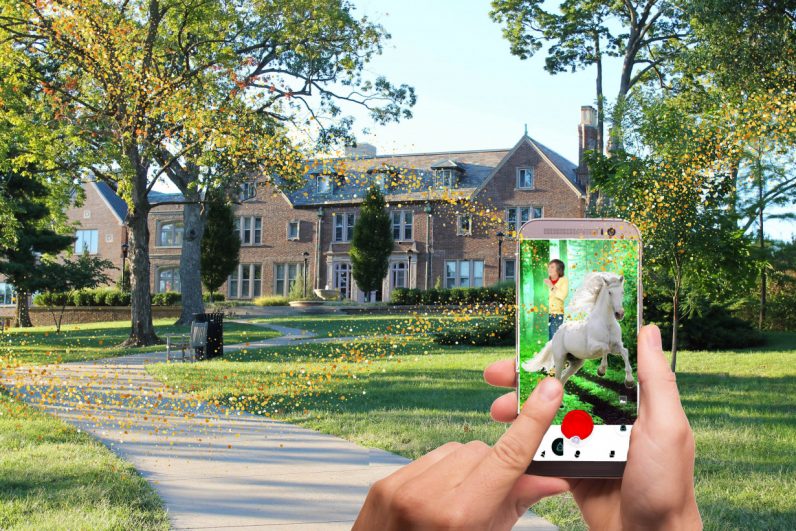 The AR Cloud, or Digital Land, as some experts call it, is getting ever closer to reality thanks to the innovative minds at Arcona, a startup creating a layer of AR on the surface of the planet. The company has already developed several algorithms to facilitate a massive adoption of mobile AR.
According to Hanke, the basic idea is that augmented reality would be even more intertwined with the real world. Even at a small coffee shop, patrons could receive virtual tasks or quests or interact with friends who are hundreds of miles away — and not exclusively for gaming, either.
The primary goal of Arcona’s team is to create a Digital Land of the world using a series of state-of-the-art algorithms. As Alexander Emelyanov, the company’s R&D Lead explained, “Our algorithms, based on neural networks and AI, allow for a much faster analysis of a huge amount of data and images to create the most accurate virtual impression of any physical environment in real time.”
“Our first joint projects will focus on tourism and entertainment. We’ll start from various historical reconstructions, presenting iconic landmarks, as well as ambitious construction sites, which are yet to appear in Dubai,” Daniil said.
He believes Arcona’s innovative AR technology will stimulate tourism and bring significant commercial and advertising revenue to the Middle East.
“The land in the central districts of Dubai has already been reserved for us. As soon as we complete ICO, our partners will start working on some large-scale AR projects. We expect they’ll be available for users in 2019.”
As Connor Blenkinsop explains, there are plenty of straightforward (and realistic) applications for this tech. “The construction sector could use AR to show their clients how a project will look upon completion, while the tourism trade has the opportunity to enthrall visitors by recreating lost historical objects.”
Tech pioneers are even looking into ways to incorporate AR technology into car windshields and medical training, highlighting how AR could soon be integrated into all aspects of daily life.
See the full story here: https://thenextweb.com/augmented-reality/2018/04/25/universal-infrastructure-augmented-reality-closer-think/
Aion launches first public blockchain network

A concept showing a network of interconnected blocks of data depicting a cryptocurrency blockchain data on a dark background - 3D render
If you believe blockchains will proliferate in the coming years, it stands to reason that you will need some sort of mechanism to move information between them — a network of blockchains with bridges and processes for sharing information between entities. That is exactly what The Aion Network is providing with a new blockchain network released today.
The company wants to be the underlying infrastructure for a network of blockchains in a similar way that TCP/IP drove the proliferation of the internet. To that end, the company, which originally began as a for-profit startup called Nuco, has decided to become a not-for-profit organization with the goal of setting up protocols for a set of interconnected blockchains. They now see their role as something akin to the Linux Foundation, helping third-party companies build products and creating an ecosystem around their base technology.
“The core design of network we have been building is to connect various networks, and route data and transactions through a public network. We are launching that network today. It allows you to build bridges to other blockchain networks. That public network acts as relayer between blockchains,” Matthew Spoke, CEO and co-founder at Aion Networks told TechCrunch.
While there clearly could be security concerns with a public by-way for blockchain data moving between systems, Spoke says that can be minimized. Instead of transmitting a medical record between a hospital and insurance company, you send a proof that the person had an operation, which the insurance company can check against the coverage rules it has created for that individual and vice versa.
The idea behind this venture is to provide the underlying plumbing to encourage more highly scalable blockchain use cases. Spoke and his team once ran the blockchain practice at Deloitte before starting this venture, and they saw roadblocks to scaling first-hand.
In order to drive adoption, the company is introducing a token or cryptocurrency to be used to move data across the network and build in a level of trust. Spoke believes if the users have skin in the game in the form of tokens, that could create a higher level of trust on the system.
“Instead of paying for infrastructure, you are going to pay to be part of a common trusted protocol.
“We still need a few years of pure focus on infrastructure to make sure we are getting these layers right. Every time you move data of any kind there are security vulnerabilities, and we need to make sure there are good specs and comfort in using it,” he said.
See the full story here: https://techcrunch.com/2018/04/25/aion-launches-first-public-blockchain-network/
Piracy 3.0: The Good, the Bad and Kodi (Guest Column)
 by Mitch Singer
When Hollywood filmmaker Jeremy Culver releases his next movie – the romantic indie comedy “No Postage Necessary” – in June, he will take title to having the first feature distributed with the help of blockchain technology.
As Culver put it in a press release announcing his movie, “There are many advantages to blockchain distribution, including immutable proof of intellectual property rights, transparent royalty payments and, since all data on the blockchain is resistant to duplication, we can now envision a world where films are no longer pirated.”
...it is ineffective as an anti-piracy tool.
That’s because humans are analog beings...
And if I can see it, I can copy it.
Welcome Kodi, which takes piracy to a whole new level. Let’s call it “Piracy 3.0” – after the earlier eras of Piracy 1.0 for discs and Piracy 2.0 for p2p/torrents – by offering an open-source streaming media player giving users a simple, easy-to-use media center to organize and access all of their digital media content.
As a media center application, there is nothing illegal about Kodi software, which provides plug-ins for you to add YouTube and other OTT channels. Regrettably, however, there are also downloadable add-ons that take advantage of Kodi’s open-source platform. They enable users to get free access to copyrighted live sports, pay television series such as “Game of Thrones,” along with unlimited Hollywood movies and television shows.
To make matters worse, the piracy-enabling add-ons are fairly easy to install and use – made even easier by the abundance of YouTube instructional videos showing you exactly how to install them. One notable example is “Exodus,” an add-on that gives you access to all new movies and TV shows. It is an app that locates versions of the movie or television content for which you are searching across thousands of global Internet servers. Looking for 1080p? 5.1 surround sound? No problem.
Take-downs of these add-ons are especially ineffective because they are not “channels” streaming content in the traditional sense. Rather, they are pirate directory services to provide only Internet links. Get rid of one “channel” and there are 10 more just like it with the same exact links.
See the full story here: http://variety.com/2018/digital/opinion/piracy-3-0-the-good-the-bad-and-kodi-guest-column-1202785603/