Original article (11/27/17): As reported by Reuters, the massive VR park spans 330 acres (134 hectares) and houses within its various sci-fi-inspired buildings 35 different VR attractions—including everything from shooters, virtual roller coasters, to guided spaceship tours of the region’s most scenic spots.
Its organizers have already spent $1.5 billion $470 million creating the park, and while it features a few non-VR attractions such as bungee jumping (from the arm of the robot), most rides will use some combination of VR headsets and motion platforms.
Occupying one of the poorest provinces in China, the park aims to revitalize the area when it partially opens February next year.
Yelena Rachitsky, executive producer of experiences at Facebook's VR giant, Oculus, describes it as indie video game phenom Journey meets immersive play Sleep No More. The project, tentatively expected for release next year, is inventing a new VR format that attempts to widen the audience for some of today's most exciting VR experiences -- installations with live actors.
As executive producer of experiences at Oculus, Rachitsky also helped produce Pixar's first virtual reality experience, based on the movie Coco.James Martin/CNET
"We're really interested in, how do you create that experience of live actors without needing to be in a site-specific location," Rachitsky said in an interview this month ahead of the Tribeca Film Festival. "It's a way to scale."
Earlier this year, Third Rail ventured into virtual reality, contributing to Wolves in the Walls, an experience that was also under Rachitsky's wing at Oculus. It premiered at the Sundance Film Festival in January.
CNET reports that Rachitsky noted such an experience is “a way to scale,” with the audience enjoying “the interactivity of a live actor without the limitations of a performance that occurs only in one place.”
And VR performances in real spaces with actors already exist, too, like Jack: Part One by Baobob Studios, and Draw Me Close, a coproduction between the National Theater and the National Film Board of Canada. Using motion-tracking in a space that's mapped onto a live performance area, audience and performers interact together as in immersive theater, but the audience's visuals are a virtual world instead.
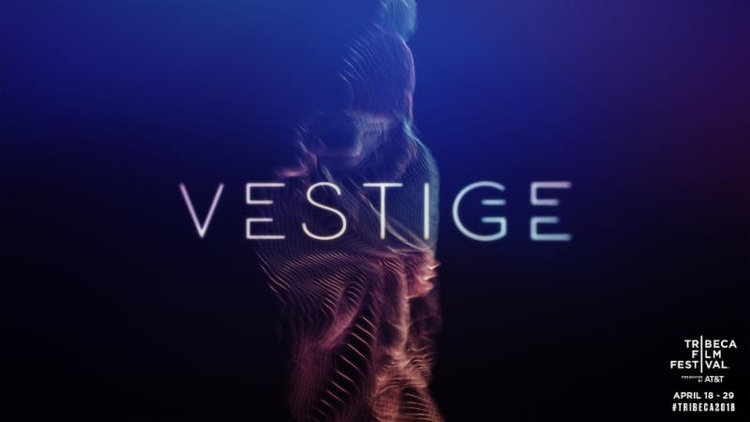
Premiered earlier this week at the Tribeca Immersive Virtual Arcade, Vestige is a nonfiction room-scale VR journey through the memories of Lisa Elin as she recalls both the best and worst moments of her time with Erik.
Starting my experience in a pitch black void, Lisa’s narration began to illuminate my surrounding as fragments of her past memories were manifested as moving images via colorful volumetric capture. As the multi-narrative journey continues, more memories are unlocked, activating new pathways through Lisa’s memory as she recalls her defining moments with Erik.
“Initially, when I got to speaking with Lisa, it was really research for a fictional piece,” spoke the project’s director Aaron Bradbury in an interview with VRScout. “It was probably the third interview in, and our interviews were really quite long (between 3-5 hours), and I had cut together bits of each interview and had started building a narrative and started to kind of understand how a multi-narrative would work within it.
Eventually however the good times end and we’re lead to the sobering conclusion of the experience that culminates in Erik’s tragic death. All of this visualized, thanks to some impressive use of volumetric capture and a whole bunch of green screen.
Vestige is much more than just a VR experience. The full installation presented on the Tribeca show floor consists of three main areas designed to keep the user immersed before and after they put on the headset.
Composed of two layers of projection mapped semi-transparent surfaces using 4 different HD projectors, the “pre-experience” surrounds the user in a colorful LED sphere capable of casting their shadow onto the screens depending on their physical position. This gives the user an external connection to the art piece as well as a visual spectacle for spectators on the show floor. Most interestingly however are the conventional telephones dangling from the installation by their cords. Each of which are playing an audio recording of a previous user recalling their own memories of lost loved ones.
Finally there’s the “post-experience.” A powerful look into the passionate recollections of Lisa’s fondest memories, Vestige was a real tear-jerker on the show floor.
Staring John Travolta, Kathleen Winnick, Kellan Lutz, and many other stars, the 360 degree experience was shot alongside the feature film, which will be out in the coming months, and offers a unique perspective inside the life of a notorious speed boat builder, who at one time made the fastest boats alive used by both the US Coast Guard and drug smugglers in the late 60's, 70's and early 80's. Inspired by a true story the experience covers the rise and fall of this world champion and multi millionaire whose life showcased in VR is one of the first VR period drama's to ever be released.
Apple’s answer is reportedly a full 8K resolution display for each eye. The headset would be completely untethered from either a computer or an iPhone, though not be entirely self-contained. Instead, it would rely on a short-range wireless connection to a dedicated piece of hardware that would do the heavy lifting.
According to CNET‘s source, said to be familiar with Apple’s plans, the project is known as T288. Currently in the early stages of development, it’s not expected to arrive in stores until 2020 at the earliest. That could still well change, of course.
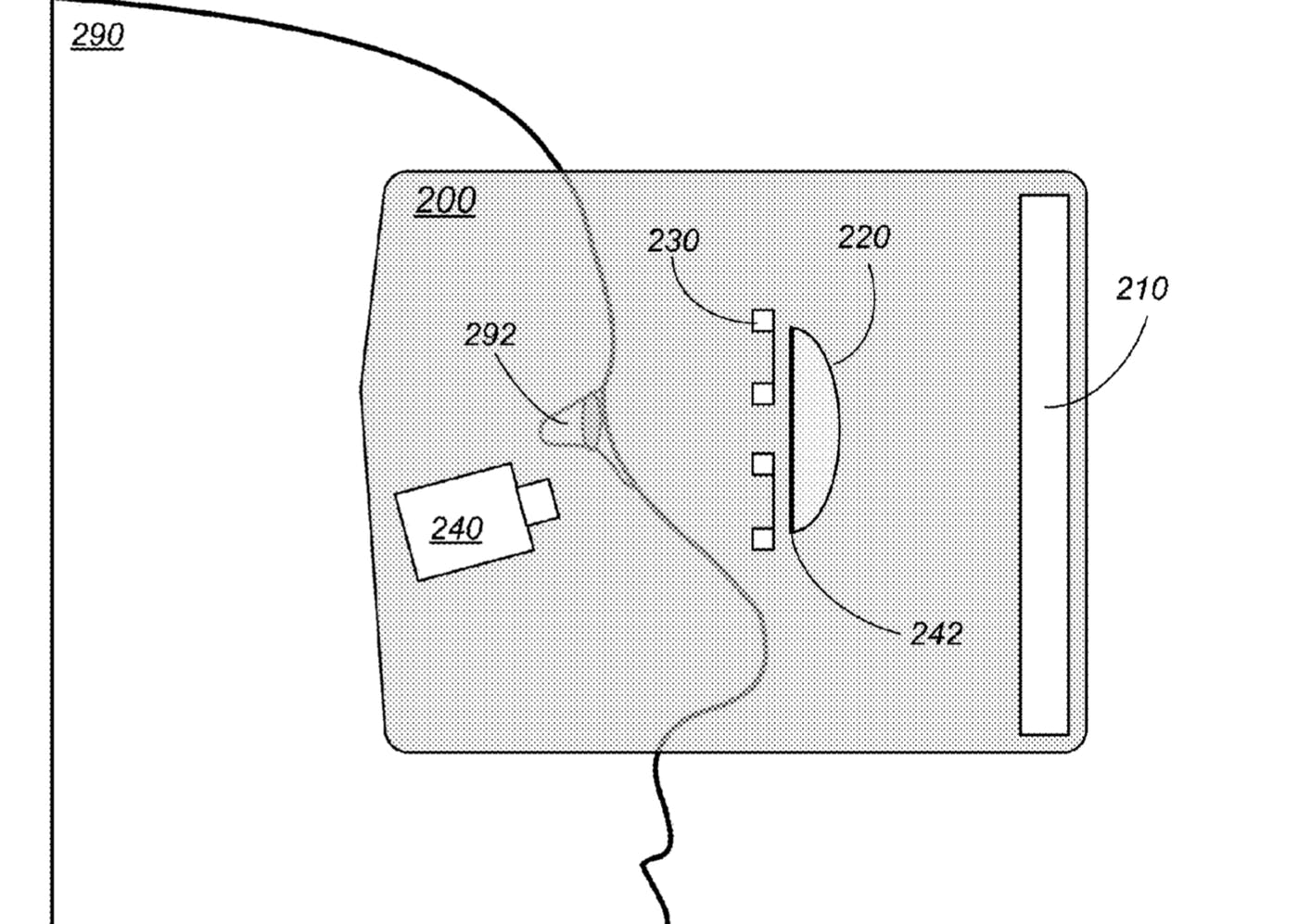
Recent reports suggest the company is working on a headset under the codename “T288”. The headset, rumored to run an operating system called “rOS,” is intended to play back 3D content in a package with respectable battery life, potentially launching in 2020. In Apple’s patent, a headset would use near-infrared cameras on either side of the wearer’s face, emitting infrared light and bouncing it off a mirror to allow the camera to track movement.
Apple has doubled down on its support for augmented reality in recent years. iOS 11, a free software update that launched last year, brings a set of developer tools called “ARKit” that makes it easier for app makers to produce AR-supported games for the iPhone 6S and later. Cook proclaimed augmented reality, which mixes a view of the real world with virtual objects, as an ideal technology for maintaining human contact.
This special jacket is being developed by researchers at Disney to help take the VR experience to another level at a time when the adoption rate has been slow. Connected to computer software that controls a series of inflatable compartments, the jacket can reproduce a variety of sensations, adding new kinds of perception and depth to VR. In collaboration with researchers at MIT Media Lab and Carnegie Mellon University, Disney hopes the jacket can augment VR experiences typically limited to visual displays seen through a headset and simple hand vibrations felt through joysticks.
“The primary motivation of this research was to enhance the entertainment value of [head-mounted display]-based visual VR experiences in games and movies, by providing on-body force feedback,” the researchers wrote in a paper published Wednesday.
The Force Jacket contains 26 inflatable compartments, which can reproduce more than a dozen "feel affects," such as a hug, a punch or a snake slithering across your body. These sensations are created by modifying the speed, force and duration of inflating or deflating the airbags. The pressure and vibrations can also correspond with visual displays, allowing users to feel the actions they perform and witness in a VR game.
The researchers developed three prototype VR simulations to showcase the jacket. One placed a person in a snow-covered front lawn in the middle of a snowball fight, while another allowed users to feel a “friendly” cartoon snake slither up their torso and squeeze their chest. The third simulation put the user's avatar shirtless in a bathroom, as they see and feel their bodies transform into a “muscular hero,” their arms bulging like a bodybuilder's.
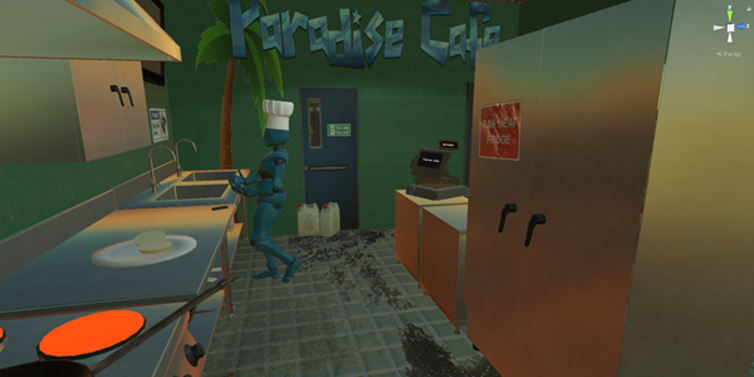
In our virtual reality training, the user acts as a chef with an endless queue of customers. She must prepare the food and ensure it is safe to eat. At the same time, she is being tested on whether she remembers to wash her hands or mop the floor. When rats begin to infest the kitchen, the user must decide upon the best course of action. If she fails to prepare the food in a safe or hygienic manner, she watches the customers become ill in front of her.
Augmented reality has enough gee-whiz dazzle to make a visit to “Now You See It . . .,” at Boston Cyberarts Gallery, simply fun. The best works also have conceptual traction.
Aim the viewfinder at the gallery’s tile floor to see Will Pappenheimer’s “Waters Rising.” A female superhero appears. Water fills the gallery, immersing her (and, by implication, us). The woman, toting a fur-covered sword and a shield, dodges and slashes at gem-like floating boulders and parakeets.
At Boston Cyberarts Gallery, 141 Green St., Jamaica Plain, through May 13. 617-522-6710, www.bostoncyberarts.org
On devices compatible with ARKit and ARCore, Instant Paint easily recognizes walls and can virtually paint them with more than 1,500 shades of color from the retailer's inventory.
Seeing how home improvements from water faucets and light fixtures to countertops and even awnings look can help consumers make more confident decisions. Now, previewing paint color in real world contexts will give homeowners yet another virtual tool, while helping another company move units.