Say hello to VIDIUS, the world’s smallest first-person-view camera drone
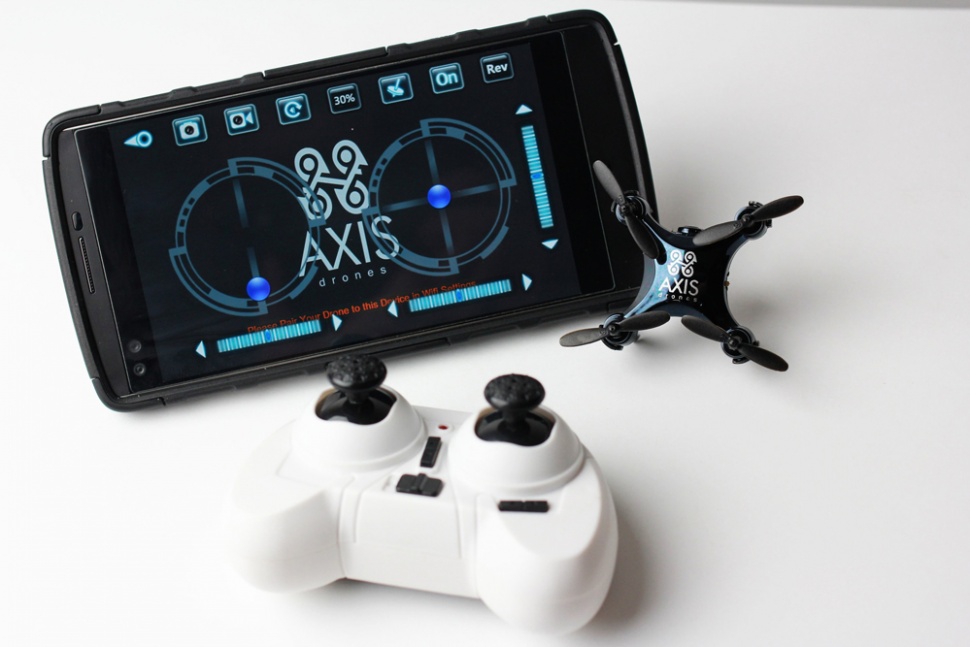 Measuring in at just 1.7 inches wide and standing just under an inch tall, the VIDIUS is a modern marvel of design and engineering. Due in large part to its diminutive size, owners need not register the VIDIUS with the FAA before flying.
Not only does the onboard camera boast the capacity to stream and record video in 420p, but it also allows pilots to snap stunning photos in-flight as well. Available next month on January 29, Axis currently allows preorders of the VIDIUS for $75 ($20 off its regular retail price).
See the full story here: http://www.digitaltrends.com/cool-tech/introducing-the-axis-vidius-drone/
DAQRI Smart Helmet Brings Augmented Reality to Heavy Industry
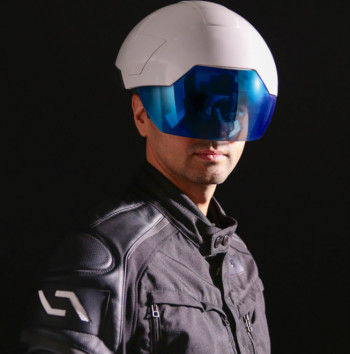 [Philip Lelyveld comment: this story does a really good job explaining the components of the HMD and how it works.]
Unveiled at CES 2016, the DSH is powered by a sixth-generation Intel Core m7 processor and Intel’s RealSense technology. As an industrial-grade human-machine interface, the DSH makes augmented reality (AR) practical in the workplace for the first time.
In addition to the Intel processor, the DSH utilizes multiple cameras: high-resolution, low-resolution and infrared.
A 13MP HD camera is used for photo and video capture, AR applications, 2D target recognition and tracking and object/color recognition.
Two infrared cameras are part of Intel’s RealSense technology. Combining them with the HD camera as well as an infrared laser projector allows the device to infer depth by detecting reflected infrared light.
The low-resolution camera works in conjunction with an industrial-grade inertial measurement unit (IMU) to calculate the helmet’s relative position in space. A second, commercial-grade IMU is included for additional applications.
The DSH’s four-microphone array includes integrated power, volume buttons and an audio output jack to accommodate protective headphones.
See the full story here: http://www.engineering.com/AdvancedManufacturing/ArticleID/11264/DAQRI-Smart-Helmet-Brings-Augmented-Reality-to-Heavy-Industry.aspx
Google’s Project Tango will enable cool augmented reality games (hands-on demo)
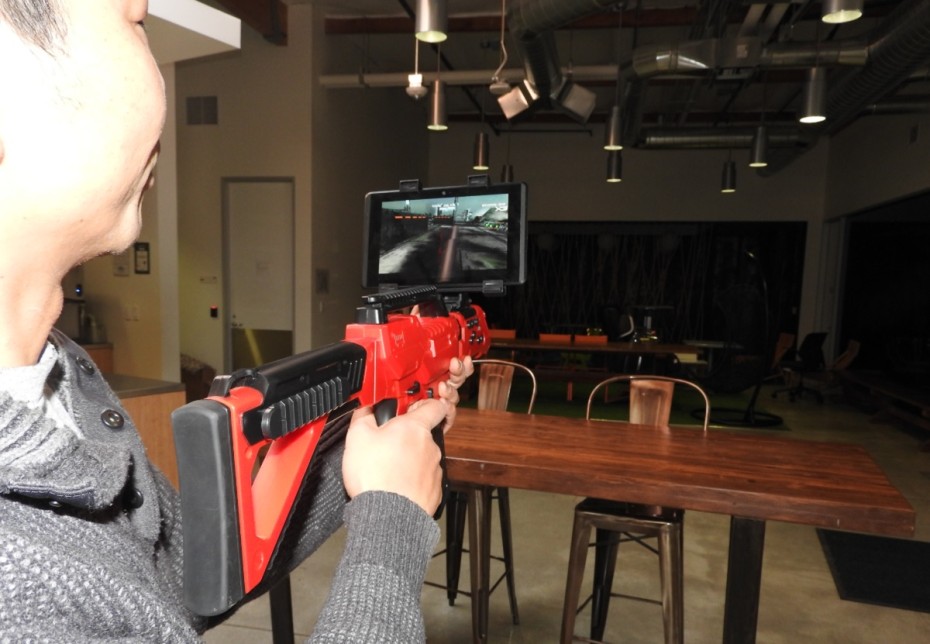 Larry Yang, a former member of Microsoft’s Xbox 360 hardware team, gave me a demo recently over at his new job at Google. Yang is the lead project manager for Project Tango, which equips a mobile device with 3D-sensing capabilities so that you can create games and other apps that are aware of their surroundings. He showed me a game that uses Tango, and it was like stepping into a future where games, 3D sensing, motion-sensing, cameras, and animated overlays all combine into a very cool augmented reality experience.
See the full story here: http://venturebeat.com/2016/01/07/googles-project-tango-will-enable-cool-augmented-reality-games/
HOW FOX’S “THE MARTIAN VR EXPERIENCE” BECAME HOLLYWOOD’S MOST AMBITIOUS VR EXPERIMENT
 "You’re building the plane while you’re flying it," says Ted Schilowtiz, 20th Century Fox’s futurist—and per his business card its "consiglieri"—of the Hollywood studio’s production of rich VR experience based on its recent mega-hit film, The Martian. "We didn’t have all the answers when we started, and we still didn’t have all the answers when we finished, but we know we created something meaningful. In scope and scale; it feels like a significant entertainment product."
At Fox’s request, so as not to spoil users’ surprise when they run through the experience, all seven will not be described here. But suffice it to say that each scene presents users with a scenario from the theatrical version of The Martian and tasks them with working their way through a challenge that Watney had to overcome in order to survive alone on Mars.
See the full story here: http://www.fastcompany.com/3054924/how-foxs-the-martian-vr-experience-became-hollywoods-most-ambitious-vr-experiment?curator=MediaREDEF
CAN VIRTUAL REALITY HELP KEEP ASTRONAUTS SANE IN SPACE?
 Former astronaut Jay Buckey wants to see if virtual reality can help. The Dartmouth physician and his team have sent Oculus Rift headsets deep into the Arctic to test whether exposure to nature through virtual reality can help improve mood and stress levels.
See the full story here: http://www.popsci.com/can-virtual-reality-help-keep-astronauts-sane-on-deep-space-journeys
CES 2016: HTC Vive virtual reality headset gets upgraded
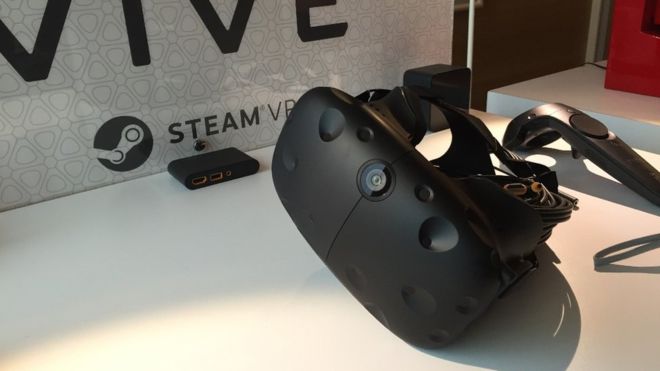 The headset's improvements over a version revealed in February include:
- A front-facing camera, so the user can view the world around them when desired
- A redesign of the headset and strap to make them more comfortable
- Interchangeable foam inserts and "nose gaskets" to better fit the shape of the wearer's face
- A brighter display with better clarity than before
- Handheld controllers feature a range of updates including textured buttons, grip pads and softer edges
HTC plans to launch the Vive in April.
See the full story here: http://www.bbc.com/news/technology-35229548
Virtual Reality Video Game Industry to Generate $5.1 Billion in 2016
[Philip Lelyveld comment: Ignoring the made-up 2016 projections, what constitutes $660M spent on VR in 2015?]
"Consumers will spend $5.1 billion on virtual reality gaming hardware, accessories, and software in 2016. That’s up from $660 million in 2015, says the marketing leader. Meanwhile, the global market is expected to grow to $8.9 billion in 2017 and $12.3 billion in 2018.
A breakdown of this year’s $5.1 billion global market shows Europe in the lead with a $1.9 billion share and North America close behind with $1.6 billion. That’s followed by Asia with $1.1 billion, and the rest of the world accounting for $0.6 billion."
 Consumers will spend $5.1 billion on virtual reality gaming hardware, accessories, and software in 2016. That’s up from $660 million in 2015, says the marketing leader. Meanwhile, the global market is expected to grow to $8.9 billion in 2017 and $12.3 billion in 2018.
"A breakdown of this year’s $5.1 billion global market shows Europe in the lead with a $1.9 billion share and North America close behind with $1.6 billion. That’s followed by Asia with $1.1 billion, and the rest of the world accounting for $0.6 billion."
See the full story here: http://fortune.com/2016/01/05/virtual-reality-game-industry-to-generate-billions/
PTC Expands Their Industrial Automation via the Internet of Things
 PTC has experienced a busy year with the Internet of Things (IoT). Only seven months ago they invested at least half a billion dollars into integrating third-party software and big data analytics for IoT.
Now, that investment has grown to about $750 million dollars thanks to their ongoing acquisition efforts. The latest IoT companies added to the PTC family appear to be the augmented reality software company Qualcomm (Vuforia) and industrial automation software company Kepware.
see the full story here: http://www.engineering.com/DesignSoftware/DesignSoftwareArticles/ArticleID/11238/PTC-Expands-Their-Industrial-Automation-via-the-Internet-of-Things.aspx
Innovation without Age Limits
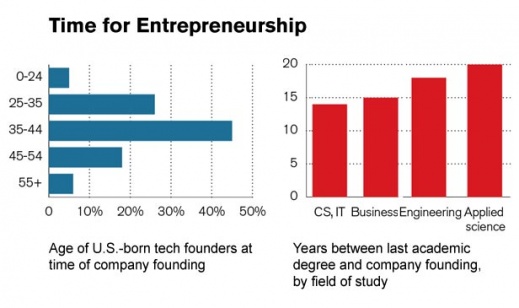 Research by my team revealed that the average and median age of the founders of successful U.S. technology businesses (with real revenues) is 39. We found twice as many successful founders over 50 as under 25, and twice as many over 60 as under 20. So everyone has a shot at success, but age provides a distinct advantage.
Are venture capitalists misguided, then, in funding companies with baby-faced CEOs? Perhaps one answer lies in the results of a study conducted by the Kauffman Foundation. It found that during the period when funding young technology entrepreneurs became the norm, from 1997 to 2007, the venture industry grew dramatically. But returns actually stagnated and then declined—precipitously. The returns of venture industry lagged those of the small-cap Russell 2000 Index by 10 percent over the 10-year time frame.
When you meet entrepreneurs in India, Ireland, Brazil, and other parts of the world, you find many of the same dynamics at play. The young have the outrageous ideas, but its older people who achieve business success.
So entrepreneurs all over the world are trying again and again. In the process, they are getting older and smarter, and eventually achieving success.
But understanding these diverse technologies isn’t the domain of the young. Though college dropouts may know all about social media, it is very unlikely that they understand the intricacies of nanotechnology and artificial intelligence as well as their elders do. These are complex technologies that require not only a strong education but also the ability to work across domains and collaborate with intellectual peers in different disciplines of science and engineering.
The reality is that there is no age requirement for innovation. The young and old can both innovate. The young dominate new-era software development, and software will be a key driving force in the convergence of other technologies that are expanding exponentially. So we badly need our young. And we need our older entrepreneurs to develop cross-disciplinary solutions that solve the grand challenges of humanity.
Vivek Wadhwa is VP of academics and innovation at Singularity University and has affiliations at Duke, Stanford, and Emory. He is 54 years old.
See the full story here: http://www.technologyreview.com/news/426760/innovation-without-age-limits/page/1/