Experience the future of Paris in 3D with Google
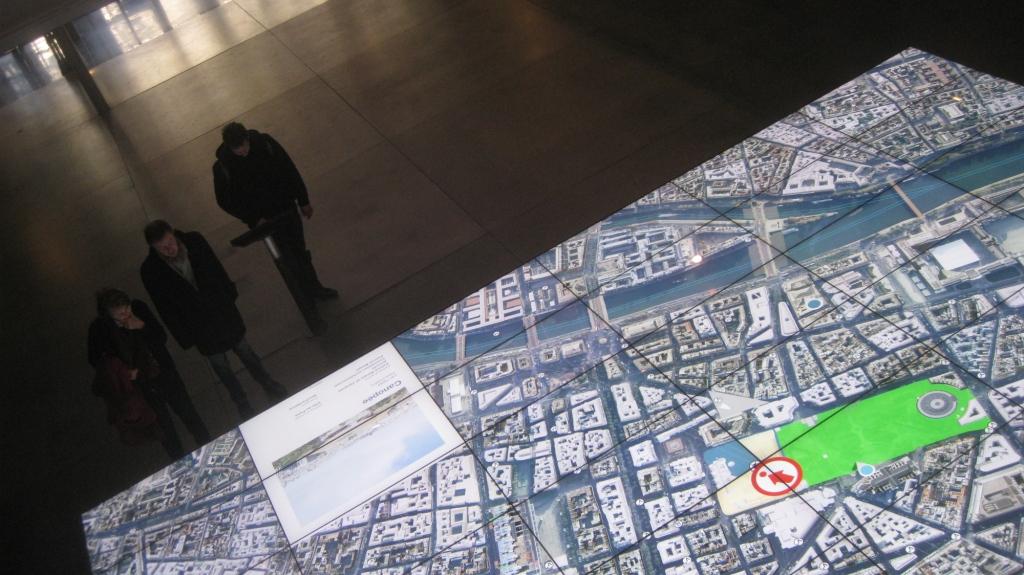 Google is taking over Paris one project at a time. Today, the web giant helped launch anew interactive exhibit at the Pavillon de l’Arsenal called Paris, le métropole et ses projets (Paris, a metropolis in the making). The highlight is a first-ever digital mosaic composed of 48 LED screens that feature 2D and 3D views of Paris through HD Google Earth images.
See the full story here:
Amon Tobin ISAM: A 3D projection electronica performance piece
 “One thing I’ve noticed,” says Tobin, “is that evolution of technology and technology-driven music isn’t always in sync. I think this is because, in the end, creativity doesn’t really need technology. It’s very much the other way around.”
Watch the video of this electronica concert performance piece here:
Trillion-frame-per-second video
 c
c
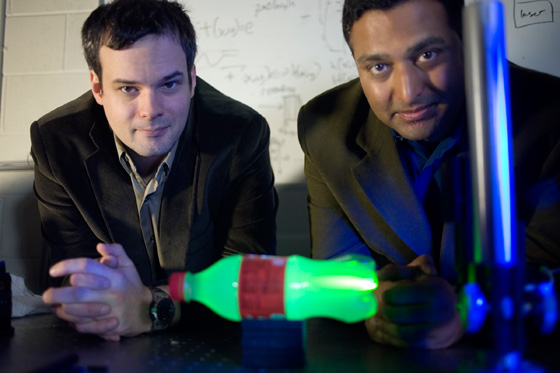
MIT researchers have created a new imaging system that can acquire visual data at a rate of one trillion exposures per second. That’s fast enough to produce a slow-motion video of a burst of light traveling the length of a one-liter bottle, bouncing off the cap and reflecting back to the bottle’s bottom. ...
The trillion-frame-per-second imaging system, which the researchers have presented both at the Optical Society's Computational Optical Sensing and Imaging conference and at Siggraph, is a spinoff of another Camera Culture project, a camera that can see around corners. That camera works by bouncing light off a reflective surface — say, the wall opposite a doorway — and measuring the time it takes different photons to return. But while both systems use ultrashort bursts of laser light and streak cameras, the arrangement of their other optical components and their reconstruction algorithms are tailored to their disparate tasks.
See the full story here:
QR codes allow quick access
 “Japan has been running QR codes for 15 years,” said Metroland Media Group Ltd.’s Digital Video Group sales manager Melanie Morgan. “Statistics show by the end of 2012 more than 50 per cent of Canadians will have a smartphone. That’s a 700 per cent increase in smartphone usage in the last year and a half. These trends speak for themselves. Canadians want information, they want it quick and they want it in the palm of their hands.”
QR codes do just that.
Read the full story here:
UltraViolet’s First Web Channels Are Now Live, Now It’s Going Global
 [Philip Lelyveld comment: it will be very interesting to see how this fits into the product mix. With the right business model behind it, it may be a light enough system to succeed.]
The new technology allowing consumers who buy entertainment in physical formats to consume it online for no additional cost has gone live and is going global, with launches in the UK this Christmas, Canada in 2012 and elsewhere in 2013.
Against a backdrop of piracy and the rise of subscription access services like Netflix (NSDQ: NFLX) and Spotify, UltraViolet is a defensive ploy to build online value around the same model entertainment has known for decades - ownership.
Read the full story here:
Online Learning, Personalized
- Khan Academy began six years ago when Salman Khan, an Ivy League-trained math whiz decided to train his cousin in high school math over YouTube lectures.
- The online math and science lessons currently attract up to 3.5 million viewers a month and include a database of 2,700 instructional videos and corresponding exercises.
- The lectures include footage of Khan writing on the screen while he talks the viewer through problems and follows with exercises for practicing concepts.
- For the first time, 36 schools nationwide have integrated the digital lessons into their school curriculum, allowing students to take math and science lessons through a combination of teachers and computers.
- "For teachers, there is an analytics dashboard that shows both an aggregate picture of how the class is doing and a detailed map of each student's math comprehension," reports The New York Times. The lessons are free for anyone with an Internet connection, and Khan's team is supported by donors such as Bill Gates and Google.
- Recently, Khan Academy extended its offerings to include art history lessons covering subjects such as the Rosetta Stone and Caravaggio.
NCM Turns Theater Audiences into ‘Human Joysticks’

NCM Media Networks is encouraging movie theater audiences to wave their arms around in the air. Working with Audience Entertainment Group, it has added a 90-second game to its programming that turns theatergoers into a virtual “human joystick” to control the on-screen action.
See the full story here: