... we need to strengthen the tools of democracy itself. A pause in further training of generative AI could give our democracy the chance both to govern technology and to experiment with using some of these new tools to improve governance. The Commerce Department recently solicited input on potential regulation for the new AI models; what if we used some of the tools the AI field is generating to make that public comment process even more robust and meaningful?
We need to govern these emerging technologies and also deploy them for next-generation governance. But thinking through the challenges of how to make sure these technologies are good for democracy requires time we haven’t yet had. And this is thinking even GPT-4 can’t do for us.
Ahead of the European Parliament’s vote on the AI Act in May, the European Union (EU) has a significant opportunity to regulate artificial intelligence (AI) technologies in order to protect and promote human rights, said Amnesty International in an open letter to Members of Parliament’s leading committees.
“The AI Act offers EU lawmakers an opportunity to put an end to the use of discriminatory and rights-violating artificial intelligence (AI) systems,” said Mher Hakobyan, Advocacy Advisor on Artificial Intelligence Regulation at Amnesty International.
“The EU must ban the use of discriminatory AI systems which disproportionately affect people from marginalized communities, including migrants, refugees and asylum seekers. Such technologies profile people and communities, claiming to ‘predict’ crimes, or ‘identify’ people who supposedly pose a security risk, even leading to them being denied the right to asylum. EU lawmakers must not miss this opportunity to prohibit the use of certain AI-based practices and protect the rights of migrants, refugees, and asylum seekers against harmful aspects of AI. ...
“The AI Act should also address the development of European technologies that are exported to third countries. Firstly, AI systems that are prohibited in Europe should not be allowed to be exported abroad. Secondly, permitted high-risk technologies that are exported must meet the same regulatory requirements as high-risk technologies sold in the EU.” ...
... part of the reason for generating untruthful content, which he calls “hallucinations,” is because the model doesn’t know that it’s allowed to say “I don’t know” or express uncertainty. If you tell a chatbot that it’s allowed to do that, he says, that partially fixes the problem. ...
“And then, another set of hallucinations, you could say, is that it’s just guessing wrong. ...
... reinforcement learning is part of the solution. ...
... “I’m on the board of a few AI companies,” Russo told Collider. “I’m gonna speak from my experience of being on the board of those companies, [so] there are AI companies that are developing AI to protect you from AI. And unfortunately, we’re in that world, and you will need an AI in your life because whether we want to see it developed or not, people who are not friendly to us may develop it anyways. So, we’re going to be in that future. The question is, then, how we protect ourselves in that future?” ...
When asked in “how many years” AI will be able to “actually create” a movie, Russo predicted: “Two years.” The director also theorized on how advanced AI will eventually give moviegoers the chance to create different movies on the spot. ...
... The AI developers devising this censorship are “just playing whack-a-mole” with the word prompts they’re prohibiting, said University of Washington AI researcher Bill Howe. They aren’t deliberately censoring information about female reproductive health. They know that AI mirrors our culture’s worst and most virulent biases, including sexism. They say they want to protect people from hurtful images that their programs scrape from the internet. So far, they haven’t been able to do that, because their efforts are hopelessly superficial: Instead of putting intensive resources into fixing the models that generate the offensive material, the AI firms attempted to cut out the bias through censoring the prompts. ...
Midjourney rationalizes bans by explaining that it limits its content to the Hollywood equivalent of PG-13. DALL-E 2 uses PG. ...
Feel the real world and the virtual world at the same time
... Researchers from the University of Chicago have figured out a clever way around this problem. In a paper that will be presented at the 2023 Conference on Human Factors in Computing Systems, or CHI 2023, (where it will also be honored with a best paper award), they demonstrate a wearable system that can generate tactile sensations across the bottom of your fingers and palm without any hardware getting in the way, by hacking into the nerves on the back of your hand instead.
This method depends on what’s called “referred sensation,” where stimulation of your body in one place gets felt in another place—it’s like when you accidentally bash your elbow against something but can feel tingling up through your fingers, because the signal has traveled along your nerves up through your hand. In some places, including in the fingers, referred sensation can be targeted with a reasonable amount of precision. With a signal electrode on the top of a finger and a ground electrode closer to the wrist, it’s possible to stimulate individual parts of each finger, creating 11 separately controllable tactile zones across five fingers and the palm. ...
... "AI is alarming and amazing all at once," said TED's head and curator Chris Anderson during the five-day conference's opening on Monday at the Vancouver Convention Centre.
Of the nearly 80 people who delivered talks at the conference, at least a fifth directly addressed developments in AI and its potential to uplift life on the planet with medical, environmental or communications breakthroughs — and also disrupt through misinformation, or worse. ...
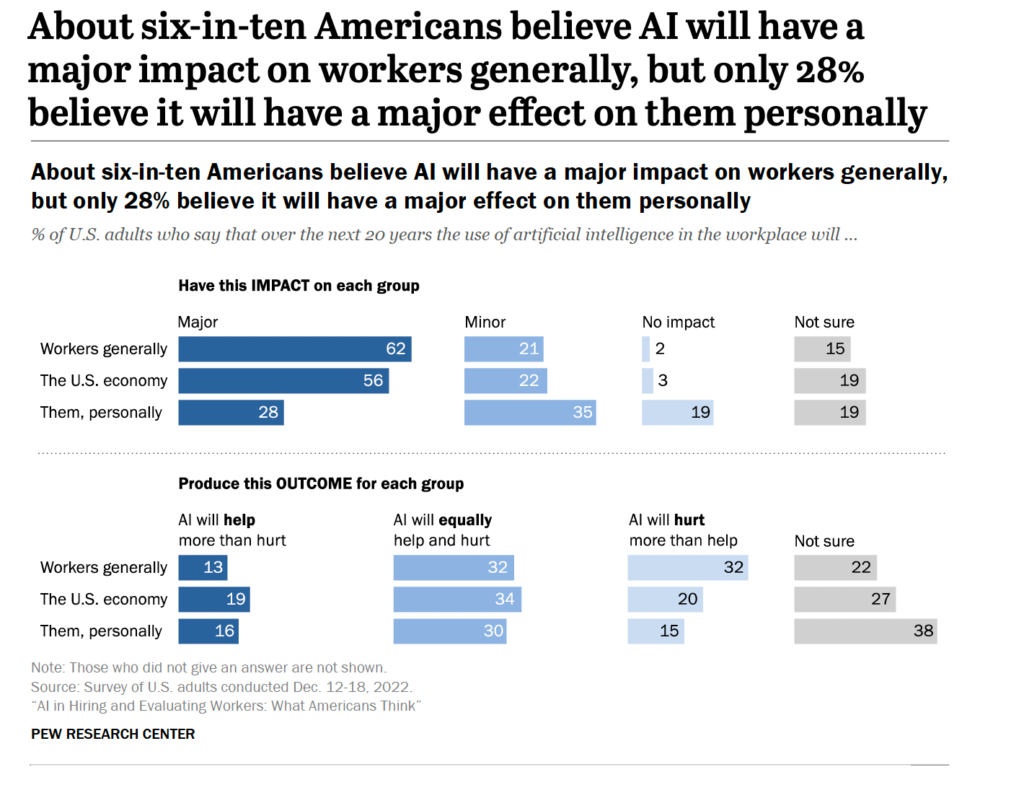
... While there’s no shortage of reports about people’s attitudes toward AI, Pew’s data is sizable and relatively fresh, drawing from 11,004 US adults who were consulted between December 12 and 18 of last year—just as ChatGPT mania was taking hold after its release at the end of November.
The report suggests that most workers expect AI to transform hiring, firing, and evaluations. Many people report feeling uncertain about what those changes might look like, and concerned about AI’s potential impacts. ...
National Association of Broadcasters president and CEO Curtis LeGeyt spoke out on the potential dangers of Artificial Intelligenceon Monday at the NAB Show in Las Vegas. “This is an area where NAB will absolutely be active,” he asserted of AI, which is one of the buzziest topics this week at the annual convention. “It is just amazing how quickly the relevance of AI to our entire economy — but specifically, since we’re in this room, the broadcast industry — has gone from amorphous concept to real.”
...We need to ensure that our stations, our content creators are going to be fairly compensated.”
He added that he worries for journalists. “We’re already under attack for any slip-up we might have with regard to misreporting on a story. Well, you’re gonna have to do a heck of a lot more diligence to ensure that whatever you are reporting on is real, fact-based information and not just some AI bot that happens to look like Joe Biden.” Finally, he warned of images and likenesses being misappropriated where AI is involved. ...
Synthetic media is drawing a lot of attention from the video game industry. Startups like Scenario use generative AI for video game art, while game developer Latitude created AI Dungeon to use advanced language models to produce the game’s text and interact with players through its characters. The game currently uses the Jurassic-1 model created by AI21 Labs. Meanwhile, Google has experimented with using its Imagen text-to-image AI tool to augment classic 1970s text adventure Zork with graphics. Roblox is also experimenting with generative AI tools for game creation, writing the code for objects and their behavior in a virtual environment.