Google Has Banned the Training of Deepfakes in Colab
Sometime in the last two weeks, Google has quietly changed the terms of service for its Colab users, adding a stipulation that Colab services may no longer be used to train deepfakes. ...
Of the two popular deepfake-creation distributions, DeepFaceLab (DFL) and FaceSwap, both of which are forks of the controversial and anonymous code posted to Reddit in 2017, only the more notorious DFL appears to have been directly targeted by the ban. According to deepfake developer ‘chervonij’ at the DFL Discord, running the software in Google Colab now produces a warning:
‘You may be executing code that is disallowed, and this may restrict your ability to use Colab in the future. Please note the prohibited actions specified in our FAQ.’
However, interestingly, the user is currently allowed to continue with the execution of the code. ...
Since deepfake training is a VRAM-hungry pursuit, and since the advent of the GPU famine, many deepfakers in recent years have eschewed home training in favor of remote training in Colab, where it’s possible, depending on chance and tier, to train a deepfake model on powerful cards such as the Tesla T4 (16GB VRAM, currently around $2k USD), the V100(32GB VRAM, around $4k USD), and the mighty A100 (80GB VRAM, MSRP of $32,097.00), among others.
The ban on Colab training seems likely to reduce the pool of deepfakers able to train higher-resolution models, where the input and output images are larger, more suited to high-resolution results, and capable of extracting and reproducing greater facial detail. ...
... Coral reefs have a complex soundscape - and even experts have to conduct painstaking analyses to measure reef health based on sound recordings. ...
In the study, University of Exeter scientists trained a computer algorithm using multiple recordings of healthy and degraded reefs, allowing the machine to learn the difference. ...
The computer then analysed a host of new recordings, and successfully identified reef health 92 per cent of the time. ...
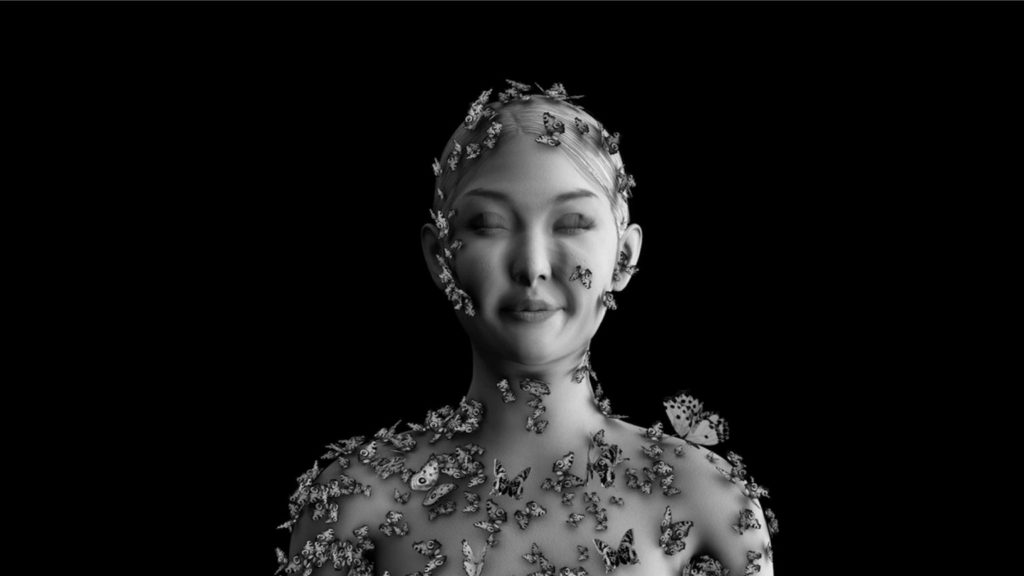
The City of West Hollywood announces the debut of the next exhibition in the Moving Image Media Art (MIMA) program and the worldwide debut of FLUTTER, a film in three parts, from artist Carrie Chen. MIMA is an ongoing exhibition series of moving image media artworks on multiple digital billboards at various locations along Sunset Boulevard.
FLUTTER, Part I will air for three-and-a-half minutes at the top of every hour and FLUTTER Parts II & III will follow at 20 and 40 minutes past each hour, respectively, on the Netflix Invisible Frame billboard, located on the Sunset Strip at 8743 Sunset Boulevard from Wednesday, June 1, 2022, through Wednesday, September 30, 2022.
Based on a stanza from the ancient poetry anthology Book of Songs: 虫飞薨薨,甘与子同梦 (Translation: “Insects sound like the fluttering of wings, I want to fall into a dream with you.”) Carrie Chen’s FLUTTER 虫飞薨薨 series describes the experience of existing in ambiguity and the flickering feelings that radiate across a corporeal surface. ...
Artist Carrie Chen is a Los Angeles-based artist working in simulation, projection, and Virtual Reality. With a background in Art History and Psychology, her moving image work explores our relationships with natural phenomena, virtual beings, architecture, and the sublime. ...
“Ethereum fees are so low last days,” the report wrote. “We could even notice they’ve been that low before previous bottoms…Low fees mean very little activity, no one is interested to do anything.”
Currently, Ethereum users are eagerly waiting for the merge. This will further lower ETH gas fees and minimise its environmental impacts as well. ...
Altered State Machine (ASM), the leader in web3 artificial intelligence, in partnership with Muhammad Ali Enterprises and Authentic Brands Group (ABG), today unveil details surrounding 'Muhammad Ali — The Next Legends.' In the world's first metaverse boxing game, thousands of unique boxers, in NFT "forms" with NFT "brains," will train and compete in a world rooted in the historic legacy of Muhammad Ali. ...
When 'Muhammad Ali — The Next Legends' launches, players will be able to collect unique NFT boxers powered by ASM's artificial intelligence, train them and compete for the first time in a fully AI, web3 combat experience. Players will eventually need to unite two NFTs to play the game – an ASM Brain, which is also an NFT, with their boxer. ...
Following in the footsteps of the 3-time world champion, the goal of the game will be to train and develop your boxer and win matches against other boxers to eventually become "The Next Legend." Each 3D boxer is completely unique in both the physical character model and its mental ability. Minting dates for boxers and additional game details about the game will be revealed in the coming months. ...
PhilNote: Matt Miesnieks has written a long and interesting piece describing his team's new start-up and how it fits in with Web 3.0
...
8 principles for connecting the real & virtual
People are the killer app. I’ve lived through two platform shifts in my career in tech. We’re now shifting from mobile into The Metaverse (in all its 3D, crypto, spatial, XR, decentralized messiness). When these shifts are in their early stages the mass-market skeptically asks, “What are the use cases? What’s the killer app?”. The reality is that there is no killer app for a platform shift. It’s the same use cases we already have today on today’s devices. What drives the shift is that the new platform enables people to express themselves in a new way. We’re most excited about the new forms of social expression that will reflect between the real world & the metaverse.
The Spirit of Place is what we want to capture, not the geometry, the textures, the semantics etc. Those are all the bricks that make a digital house, we want to build a home.
A big part of doing a research is collecting data, and I have spent countless hours doing that since Q3 2021. I have been reviewing NFT drops sponsored by or created by corporations to learn from their experience. Back in March, I published How To Create a Successful NFT Strategy For Your Company based on that work. ...
I thought it would be a good idea to create a new piece exclusively dedicated to list companies and their NFT projects, and to keep it as much updated as I can. So… here it is....
Disney NFT: Golden Moments (no link, you need to download the app)
Partner: Veve, app-based marketplace for licensed digital collectibles.
Blockchain: Immutable X (recently migrated from GoChain).
In the U.S., for instance, virtual reality (VR) has its deep roots as a form of military training technology. Later it took on a “techno-utopian” air when it started getting more attention in the 1980s and 1990s, as MIT Professor Paul Roquet observes in a new book about the subject. But in Japan, virtual reality has become heavily oriented around “isekai,” or “other world” fantasies, including scenarios where the VR user enters a portal to another world and must find their way back. ...
... And in the popular imagination, VR becomes this space where we can fix things like sexism, racism, discrimination, and inequality. There’s a lot of promises being made in the U.S. context.” ...
In Japan, though, ... virtual reality developed more in relation to forms of popular entertainment such as manga, anime, and video games. Roquet believes its Japanese technological lineage also includes the Sony Walkman, which created private space for media consumption.
One survey in Japan showed that 87 percent of social virtual reality users were male, but 88 percent of them were embodying female lead characters, and not necessarily in scenarios that are empowering to women. Men are thus “everywhere in control yet nowhere to be seen,” Roquet writes, while “covertly reinscribing gender norms.”
... It was back in 2021 that the company made its Lightship Augmented Reality Developer Kit available to developers worldwide. During today’s event, Niantic officially launched its Lightship VPS, allowing developers to anchor their original AR experiences to specific locations throughout the real world and track both the position and orientation with “centimeter-level precision.”
Niantic accumulated scans from existing developers, surveyors, and players and used the data collected to begin constructing its AR map. Once enough data on a specific location has been accumulated, Niantic can activate it on Lightship VPS so developers can begin developing their own location-based AR experiences for said location. ...
According to Niantic, all the system needs is a single frame from the user’s smartphone camera in order to pinpoint their specific location. Lightship VPS currently supports 30,000 locations across six major cities: San Francisco, Los Angeles, Seattle, New York, London, and Tokyo. The company plans on expanding to 100 global cities by the end of the year. ...
... Another challenge is even more fundamental. An ‘inventive step’ occurs when an invention is deemed ‘non-obvious’ to a ‘person skilled in the art’. This notional person has the average level of skill and general knowledge of an ordinary expert in the relevant technical field. ...
But if AIs become more knowledgeable and skilled than all people in a field, it is unclear how a human patent examiner could assess whether an AI’s invention was obvious. An AI system built to review all information published about an area of technology before it invents would possess a much larger body of knowledge than any human could. Assessed against all knowledge, almost everything would seem obvious4. If everyone has access to such AI tools in future, then the ‘inventive step’ criterion of patentability would be close to impossible to achieve, and almost nothing would be patentable. A complete rethink would be required. ...
Patents are registered separately in each jurisdiction, and enforcement disputes must normally be resolved by the legal system of the country of registration. ...
Instead, an AI-IP treaty could include dispute-resolution mechanisms, perhaps adjudicated by a specialist international court. Inspiration can be found in Europe’s new Unified Patent Court, which is due to commence in the next year (www.unified-patent-court.org), and various arbitration courts around the world. ...