Both Buchanan and Andrew Imbrie are senior fellows at Georgetown University’s Center for Security and Emerging Technology. Both have served in government. Buchanan recently served on the staff of the Office of Science and Technology Policy in the White House; Imbrie is currently a Senior Advisor in the State Department. Both are well qualified to examine what AI means for national security and for geopolitics more generally.
In the heart of the book, they look at cybersecurity, the spread of disinformation, and lethal autonomous weapon systems (LAWS). They also examine how government and the private sector have worked together to use AI both in times of war and times of peace.
Two themes run throughout the book. The first is the question of whether autocracies are better able to harness AI than democracies. The second is examing whether China has an advantage over the West when it comes to AI? ...
Many evangelists, they find, have an anti-military, anti-national security bias. Google found this out after they began work with DoD on Project Maven. Other firms have also hesitated to work with the Pentagon for similar reasons. The Chinese Communist Party, in contrast, can compel any company to work with the state. ...
In their discussion on cybersecurity, the authors linger on the offensive side. They show what attackers can do using AI, which is formidable. It can be used to find the vulnerabilities to attack, automate attacks, and deceive defenders. It can attack machine learning itself. ...
The technology improvements that are making deep fakes look even more real only promise to make the problems worse. Solutions are not obvious. ...
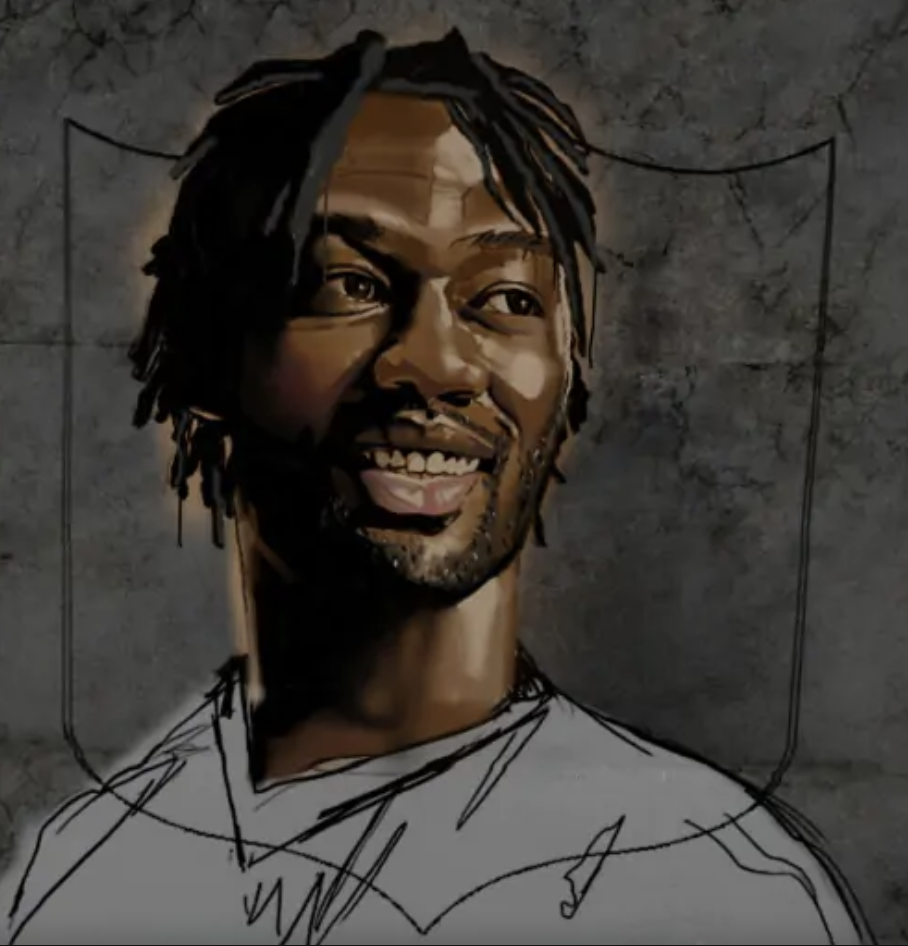
The league teamed up with metaverse artist Gabe Gault, son of former longtime speedy wide receiver Willie Gault, on an NFL Draft-inspired mural within the metaverse.
Gabe Gault will work backstage to create the real-time mural, which will highlight seven draftees, and the process will be livestreamed on the NFL Facebook and Instagram accounts, with draftees having the opportunity to visit the set and collaborate with the artist.
The Eluvio Content Fabric is an advanced, open protocol blockchain network purpose- built for digital content. The Fabric allows digital content to be stored, managed, and dynamically composed and served from the source asset, directly to the viewer without any middle systems or parties, and backs all aspects of the content’s ownership and access control with blockchain contracts. The Fabric is a very novel invention as content distribution and storage systems are concerned. Its protocol combines just-in-time video transformation and processing, decentralized storage and content routing, and radically efficient re-use of content parts to achieve a truly breakthrough efficiency compared to traditional content storage and distribution systems and compared to proof of work blockchains. It is an ultimately eco efficient and high quality content experience that makes possible creator to audience distribution models at scale for the first time. ...
The Content Fabric solves several of the biggest problems facing NFTs today: (1) Authenticity. The NFT contract has a direct, inseparable link to the original content object that was used to create it. ... The original content stored in the Fabric is also encrypted, and all authorization to it requires a valid blockchain transaction, making the original content tamper free and truly unique. Most NFTs today refer to storage of the digital content that is unprotected and sometimes, not verifiable. (2) Uniqueness and Rarity. Each NFT minted by the Content Fabric is guaranteed unique, as it refers to a unique version of the original content object, minted with a unique issue number among a finite set. ... (3) Any Content. Unlike traditional NFT platforms that require a third party media storage or distribution system to serve the digital content (static images, small videos), the Fabric can render any digital content — a full length movie, concert, or even a continuous performance — as an NFT. This opens up virtually unlimited possibilities for collectible experiences. (4) Chain of Ownership and Secondary Payments. Because the Fabric couples the transfer of ownership in NFTs to the content contract it is possible to have any royalty or other payments to creators part of every NFT transaction, and to enforce this in the availability of the content itself.
Lucas Rizzotto explained the murder threat from the AI microwave is one of the scariest and most transformative experiences in his life with the integration of the GPT-3 AI model. He was sort of success to bring his imaginary childhood friend back to the world with the help of artificial intelligence. The story is that Lucas had a very unusual imaginary friend— kitchen microwave. The microwave was called Magnetron as an English gentleman from the 1900s who was a WW1 veteran as well as an immigrant, a poet, and a proficient player of StarCraft. ...
AI microwave turned itself on while Lucas was inside it because it wanted to hurt him the same way Lucas hurt him during the 20-year-old abandonment of friendship. That being said, AI models are not meant for continuing friendships. GPT-3 model is only beneficial for industries to carry out work professionally. ...
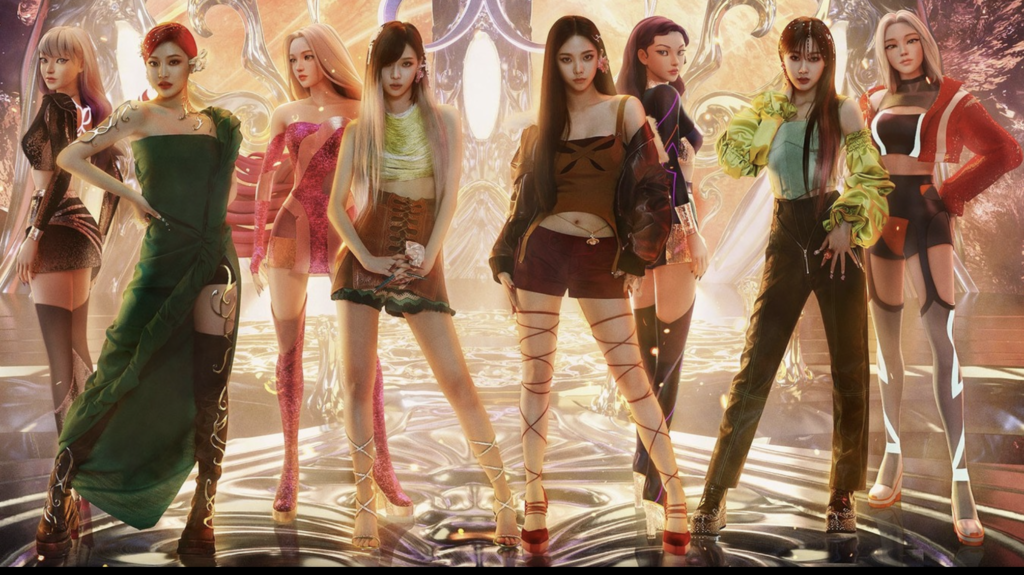
With the metaverse and AI being some of the hottest topics in art, fashion and more, we’re seeing the influence in the music space as well. From Riot Games‘ K-pop group K/DA to virtual hybrid quartet aespa, we’ve rounded up a list of music acts that are incorporating futuristic elements into their music and branding.
SM Entertainment‘s aespa is comprised of four human members, who each have a digital counterpart that connects them to a larger universe dubbed “KWANGYA.” Meanwhile, K/DA is a group featuring characters from the video game League of Legends. We’re also spotlighting NPC, Grimes‘ AI girl group, as well as ETERN!TY, a group entirely comprised of AI musicians created using deep-real technology. ...
NPC is an AI girl group created by Grimes in partnership with Chris Lake. According to the “Shinigami Eyes” artist, the music act features an “infinite” number of members and serves as “a vehicle for experimentation in new technologies as they become available such as generative characters and music, different types of animation, AI-assisted art as well as spiritual technology in that Grimes can create as other people in order to reduce the psychic pain of being in the public eye.” It’s described to be able to “do all the things humans cannot” and will “eventually be playable, customizable, and able to cater to each individual listener’s unique desires.” ...
Custom-produced by LEDY, the completed 3D replica property — called 607 Beverly Hills MetaHouse — sits on a 2×2 four-parcel piece of land in Decentraland. It includes a unique NFT of the house, and affords the new owner the ability to furnish it, display artwork and other NFTs inside, and have interactive experiences with guests. “it’s a two-fer,” Maize tells The Hollywood Reporter. “You buy a house in the flats of Beverly Hills and you get the house in the metaverse.”
“I’ve been working on this for months,” says Maize, who brought up the idea with the owner of the Beverly Hills house who subsequently got on board. The virtual house will be on display on TVs and monitors inside the physical property...
Maize — who sold a Santa Monica house last year in two weeks for $5.1 millionafter inviting a number of TikTok creators to film content on the property — ...
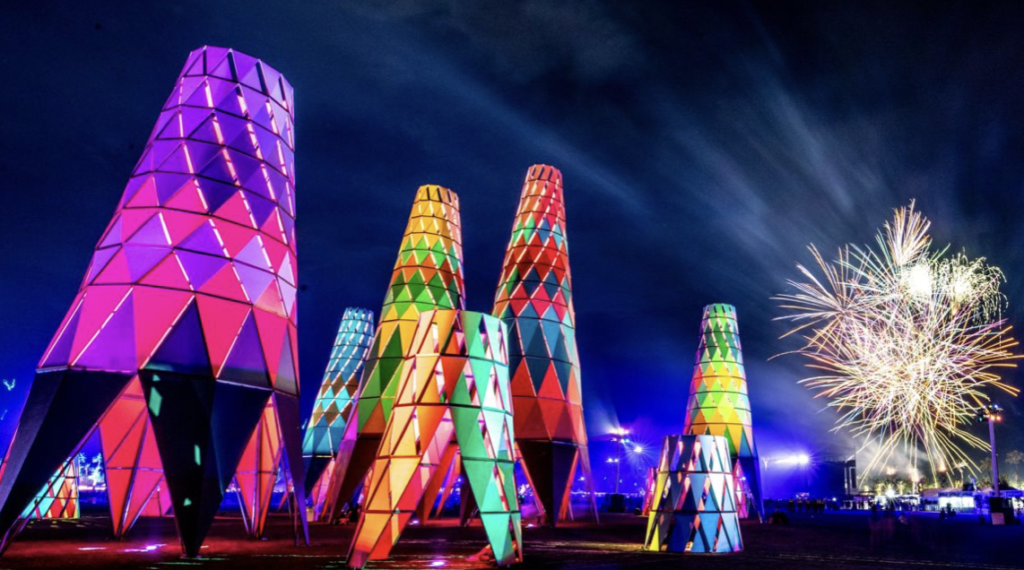
... This year, Coachella took its first steps towards creating its very own metaverse. Referred to by event organizers as the Coachellaverse, this incredible digital experience allows fans from all around the world to interact with the festival in a brand new way using a combination of immersive technologies. This virtual platform features everything from AR technology and video games to NFTs and an interactive online community where you can connect with attendees, both on-site and at home, as well as with artists, creators, and other surprise guests. ...
In an official press release, Sam Schoonover, Innovation Lead for Coachella said, “Coachella is a festival that has always enabled artists to innovate when it comes to their performance.” Schoonover adds, “The hybridization of music events through streaming platforms like YouTube is driving tune-in from around the world and bringing at-home and on-site audiences closer together in the process. For these reasons, we believe that Live AR will enable a massive evolution in performance visuals over the next few years.” ...
To bring their metaverse vision to life, organizers of Coachella worked with a number of agencies that included Epic Games, the independent music companyFuture Classic, Six Degrees, and the virtual production company All of It Now. ...
Given the controversial status of so many tangible monuments, augmented reality has obvious advantages over the physical world, appealing to monument builders and cultural institutions alike. A monument in augmented reality is less likely to cause offense than one made of stone or bronze. It doesn’t intrude. It can simply be ignored. ...
Although LACMA’s Monumental Perspectives Initiative is not unique, it represents a worthy attempt to creatively reimagine an important mode of civic engagement in a time of reckoning with deeply flawed precedents. However, the project, now in its second year, also shows the value of monuments that are more obtrusive and durable. ...
...Dozens of ecosystems throughout the United States, many now protected as national parks, were initially preserved through the presidents’ ability to create monuments by decree. More ethereal than computer code, legal code paradoxically gives monuments their fullest physicality.
The foremost value of the Monumental Perspectives Initiative is that it broadens our perspective on what constitutes a monument. Augmented reality is not an improvement over the physical reality of monuments wrought in bronze, but augments the potential of monumentality, much as monuments gained new ground through legal innovation a century ago. ...
Today’s consumer virtual reality (VR) systems offer limited haptic feedback via vibration motors in handheld controllers. Rendering haptics to other parts of the body is an open challenge, especially in a practical and consumer-friendly manner. The mouth is of particular interest, as it is a close second in tactile sensitivity to the fingertips, offering a unique opportunity to add fine-grained haptic effects. In this research, we developed a thin, compact, beamforming array of ultrasonic transducers, which can render haptic effects onto the mouth. Importantly, all components are integrated into the headset, meaning the user does not need to wear an additional accessory, or place any external infrastructure in their room. We explored several effects, including point impulses, swipes, and persistent vibrations. Our haptic sensations can be felt on the lips, teeth and tongue, which can be incorporated into new and interesting VR experiences. Vivian Shen, Craig Shultz, and Chris Harrison. 2022. Mouth Haptics in VR using a Headset Ultrasound Phased Array. In CHI Conference on Human Factors in Computing Systems (CHI ’22), April 29-May 5, 2022, New Orleans, LA, USA. ACM, New York, NY, USA, 14 pages. https://doi.org/10.1145/3491102.3501960
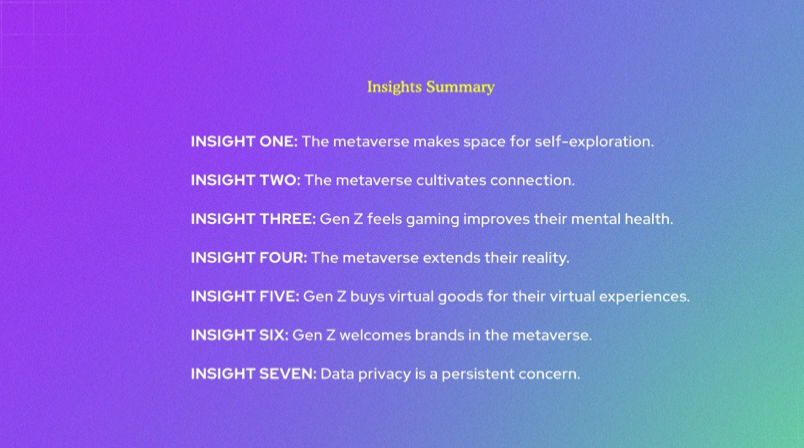
For a deeper dive into Web3 culture, we conducted a study with VICE Media Group surveying GenZ gamers about their habits, perspectives, and hopes for the future. Several questions focused on how this generation perceives itself, finding:
? Those in the metaverse are six times more likely to describe themselves as introverts vs. extroverts ? 52% feel more like “themselves” in the metaverse than IRL ? 65% believe that their online relationships are just as meaningful as offline ones ? Interestingly, 1 in 2 feels gaming improves their mental health
For a cohort this active in the metaverse, it’s no surprise that they’re willing to fund experiences there. Today, 15% of GenZ’s “fun budget” is spent in the metaverse. In five years, it’s expected to hit 20%.