Venice Film Festival Unveils Virtual Reality Lineup
The Venice Film Festival, one of the first major events to embrace VR, has unveiled its 2021 Venice VR Expanded line-up.
A total of 37 projects from 21 countries will screen during this year’s VR Expanded event, including 23 works in competition.
Competition works range in length from the seven-minute Italian-Spanish production Il Dubbio — Episode 2 from directors Matteo Lonardi, Javier Lajara, and Javier Martinez, to the one-hour immersive theater production The Severance Theory: Welcome To Respite from U.S. artist Lyndsie Scoggin.
Taiwanese VR artist Hsin-Chien Huang has two works in Venice’s VR Expanded competition: Samsara, which won the Best VR Story prize at the Cannes film market’s VR showcase earlier this month, and The Starry Sand Beach, produced together with French artist Nina Barbier.
Here is the full list of 2021 Venice VR Expanded:
In Competition
Angels in Amsterdam, dirs: Anna Abrahams, Avinash Changa
End of Night, dir: David Adler
The Starry Sand Beach, dirs: Nina Barbier, Hsin-Chien Huang
Caves, dir: Isabel Garcia Carlos
Bedlam, dir: Mat Collishaw
Genesis, dir: Joerg Courtial
Spirit of Place, dir: Dale Deacon
Tearless, dir: Kim Gina
Samsara Complete Part 1 and 2 Version, dir: Hsin-Chien Huang
Clap, dir: Keisuke Itoh
Le Bal de Paris de Blanca Li, dir: Blanca Li
Bliss in the Ear of a Storm, dirs: Adam Lieber, Hal Sorta
Il Dubbio — Episode 2, dirs: Matteo Lonaradi, Javier Lajara, Javier Martinez
Anandala, dir: Kevin Mack
Goliath: Playing with Reality, dirs: Barry Gene Murphy, May Abdalla
Montegelato, dir: Davide Rapp
The Severance Theory: Welcome to Respite, dir: Lyndsie Scoggin
Container, dir: Meghna Singh
The Sick Rose, dirs: Tang Zhi-Zhong, Huang Yun-Hsien
Myriad. Where We Connect, dirs: Lena Thiele, Sebastian Baurmann, Dirk Hoffmann
The Last Worker, dir: Jörg Tittel
Exploring Home, dir: Sara Lisa Vogl
The Final Wish, dirs: Wang Haipel, Wang Shanshan
Special Event – Out of Competition
In The Mist, dir: Chou Tung-Yen
See the full story here: https://www.hollywoodreporter.com/movies/movie-news/venice-festival-2021-unveils-vr-expanded-line-up-1234989327/
Media in 2030: It’ll Be a Universal Supermarket (Deloitte)
Digitalization is fundamentally changing production processes and the distribution of content. IP and 5G are enabling more mobile consumption of content. These are being joined by new AI recommendation and analytics to address consumers in a targeted way.
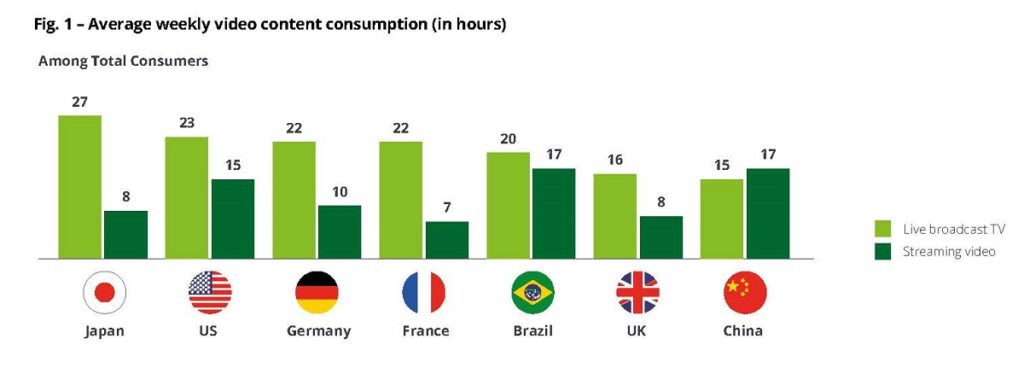
VOD gains ground, but linear TV continues to assert its role in live content such as sports and major events.
TV and video advertising adapts to new formats and relies more and more on the personalization of advertising content.
Market regulation in the media industry will be more moderate than it is today. In particular in the area of online and mobile services, this will reduce the regulatory pressure on all market participants, especially on traditional media companies.
See the full story here: https://amplify.nabshow.com/articles/media-in-2030-itll-be-a-universal-supermarket/?mkt_tok=OTI3LUFSTy05ODAAAAF-jYO7XGXLR9X4Wn10aGzjUqMVbopxQ_yXPqvv3qnYTUnRFbtivZdm1eIbfJBntAtk-Xei2Pcuat39WQwNKWahwy6KOie3AMlZilNTDghttps://amplify.nabshow.com/articles/media-in-2030-itll-be-a-universal-supermarket/
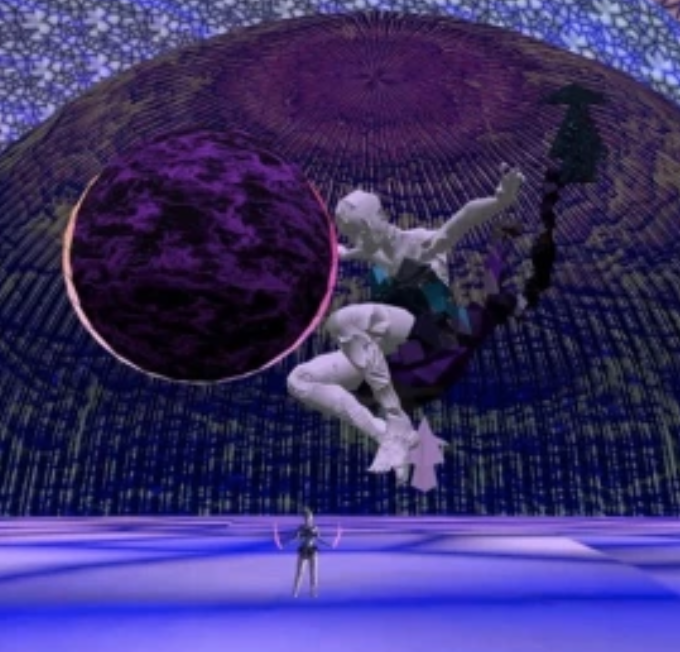
Concert from Bangladesh: virtual reality music event revives 1971 Beatles charity concert—but without the white saviour complex
In response to the 1971 concert, the British-South Asian artist Shezad Dawood in collaboration with the Bangladeshi New York-based music producer Enayet Kabir will launch Concert from Bangladesh 2021 on 1 August, a "mixed-reality" concert that merges video performances from 13 Bangladeshi and South Asian musicians in an eclectic range of styles, ranging from hip-hop to experimental electronic. Each musician will be green-screened onto a virtual reality stage, designed by Dawood, that tours notable architectural and natural sites in Bangladesh and celebrates a country that, against all odds, has become one of Asia's foremost creative hubs.
"It is important to address what it means to be 'from' something, rather than 'for' it," says Diana Campbell Betancourt, the concert's curator and artistic director of the Samdani Art Foundation (SAF), which is partially funding the project. "Effective change is rarely achieved unilaterally. It comes from collaboration," she adds. With this simple, linguistic turn, Concert from Bangladesh attempts to reverse a problematic power dynamic inherent in its progenitor's name: that of a former colonial power coming to the rescue.
Spanning six centuries of musical traditions, Concert from Bangladesh features among its performers the mystic Baul singer Arif Baul accompanied by instrumentalists Nazrul Islam, Saidur Rahman, and Sohel. The show will climax with the Bangladeshi hip-hop duo Tabib Mahmud and 12-year-old Gully Boy Rana, whose socially engaged lyrics broach topics around climate emergency and poverty.
For the concert’s visual elements, Dawood drew on his previous decade of research into 20th-century South Asian architecture and the non-aligned movement during the Cold War, in particular the architect Muzharul Islam who pioneered Bangladeshi Modernism.
Indeed, much has changed in the past 50 years, not only for Bangladesh, but also around attitudes towards aid and globalism.
See the full story here: https://www.theartnewspaper.com/feature/concert-from-bangladesh-virtual-reality

Virtual Reality Is the Rich White Kid of Technology
[PhilNote: the last two paragraphs capture the lengthy article.]
I’m sure the rigs and goggles of 2026 will be better and more affordable than the ones we have today. I’m just not sure what else we will use them for. The problem isn’t the technology—it’s the vision. And the trouble with imagining the future through sci-fi action adventures is that it obscures the mundane everyday uses of technology.
Are we ever going to start judging VR on its performance instead of its pedigree?
See the full story here: https://www.wired.com/story/virtual-reality-rich-white-kid-of-technology/

German startup Aleph Alpha raises $27M Series A round to build ‘Europe’s OpenAI’
With Microsoft now being an investor in OpenAI the field now more open for new insurgents into the open-source AI arena. Now a German company hopes to take on the next AI mantle and produce something akin to the success of the GPT-3 AI model.
German AI startup Aleph Alpha has now raised €23 million / $27 million in a Series A funding co-led by Earlybird VC, Lakestar, and UVC Partners. Following a seed round of €5.3 million from LEA Partners, 468 Capital, and Cavalry Ventures in November 2020, Aleph Alpha has now raised a total of €28.3 million (people in $33.3 million).
The idea behind Aleph Alpha is that it researches, develops, and “operationalizes” large AI systems towards generalizable AI, offering GPT-3-like text, vision and strategy AI models. The platform will run a public API enabling public and private sectors to run their own AI experiments and develop new business models.
The team says it will have a strong commitment to open-source communities (such as Eleuther.AI), academic partnerships, and will be pushing “European values and ethical standards,” it says, “supporting fairer access to modern AI research – aimed at counteracting ongoing ‘de-democratization’, monopolization, and loss of control or transparency.” The move is clearly meant to be a stake in the ground in the international world of AI development.
...In other words, they want to firmly center themselves in the EU under EU law, GDPR and regulation. They may well prove a useful “Fortress Europe” for the company.
See the full story here: https://techcrunch.com/2021/07/27/german-startup-aleph-alpha-raises-27m-series-a-round-to-build-europes-openai/

DuckDuckGo launches new Email Protection service to remove trackers
Email trackers exist in more than 70 percent of mailing lists, according to a highly cited 2017 study. Once implemented, they let advertisers figure out when you open email, where you are when you open it, and which device you’re using. Removing trackers from email removes data points from lists building hidden advertising profiles on you, which have become a priority for privacy advocates in recent years.
Weinberg said that consumer research showed that asking people to switch to an entirely new email address and provider would be a tough pitch. So instead of creating a new email service, the Email Protection tool acts as an intermediary layer guarding access to your inbox.
“Our high-level goal is to make simple privacy protection available for everyone anywhere they are,” CEO Gabriel Weinberg tells The Verge. “So we’re trying to build this into any major browser or operating system or email provider you use.”
iPhone users might recognize the concept of a relay email address, a feature that Apple introduced with iOS 14 called Hide My Email. When signing up for an app through an Apple device, your iPhone can suggest a randomized Apple email address. Emails hit the random address, preventing the app from knowing your real email. In Apple’s iOS 15, the company is introducing similar features to confuse email trackers and protect privacy.
Weinberg explains that DuckDuckGo’s Email Protection is different than Apple’s offerings because it’s cross-platform, meaning you have a unified experience with disposable email addresses on mobile, desktop, iPhone, or Android.
See the full story here: https://www.theverge.com/2021/7/20/22576352/duckduckgo-email-protection-privacy-trackers-apple-alternative

Data Visualization in UI Design Explained
For a far easier method of data interpretation, a human mind needs to take in the data’s visual representation.
...
While data visualization types vary and can be multi-purposeful, there are some prevalent and effective ways to use data visualization.
● Periodic Change Tracking: The most common and widely used data visualization method illustrates how the data collected changes over time.
● Frequency Identification: Typically working in tandem with the time-related changes are also data points that reflect variances in frequency.
● Correlation: Determining a relationship between two distinct variables is very challenging without being able to visualize it. Yet, it is a vital part of data analysis, one in which data visualizations’ involvement is paramount.
● Analyzing Risk/Value: With many complex metrics and variables involved, assessing the value or risk factor can be nearly impossible without the ability to visualize that data. Through charts or color-coding plot points via a formula, it is much easier to assess otherwise less apparent factors that could be game-changers in decisions made about a business.
● Study Of Networks: Marketers need to be able to break down their audience into segmented clusters, understand those clusters, assess the influencers in that sphere, and figure out how they relate to each other, as well as the outlier examples relevant to the particular area. Data visualization helps to classify this information into more evident, distinguished regions.
● Effective Scheduling: Complex projects entail the creation of often confusing schedules. This can be assisted by visual representations of the data, such as Gantt charts, helping to develop a more precise illustration of the projects, their stages, and the length required to complete them.
...
See the full story here: https://thenationroar.com/2021/07/26/data-visualization-in-ui-design-explained/