Snap Spectacles Used to Turn Spoken Word Poetry into an Augmented Reality Experience
New York-based poet and computer programmer Zach Lieberman managed to get his hands on a pair of Spectacles and decided to translate his words into immersive elements using Lens Studio.
The results of the experiment can be seen in a new video posted on Monday which shows Lieberman walking around New York City as his Spectacles smartglasses simultaneously deliver audio and visual presentations of his poetry.
See the full story here: https://next.reality.news/news/snap-spectacles-used-turn-spoken-word-poetry-into-augmented-reality-experience-0384810/

Snap buys another company to make AR shopping a reality
Snap is making a big bet on AR shopping.
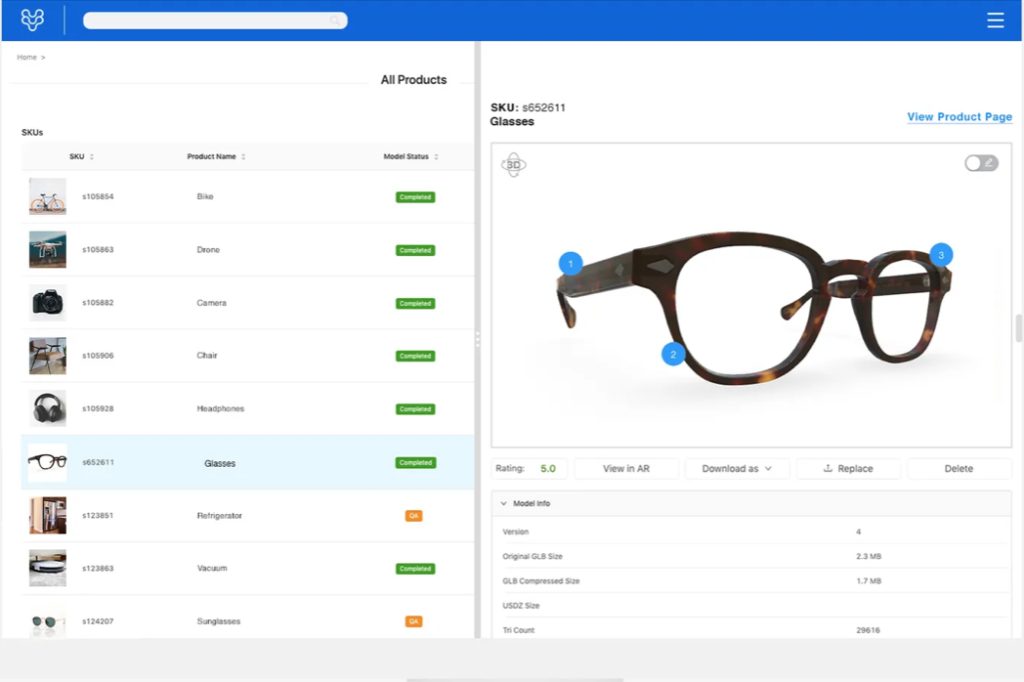
The parent company of Snapchat has bought Vertebrae, a company that lets brands create and manage 3D versions of their goods. Vertebrae’s 50-person team will keep developing the platform for existing and new clients, according to a Snap spokesperson. The idea is that a company can easily upload visuals and other information about an item into Vertebrae and have a 3D version made for shoppers to access, and potentially buy directly, within Snapchat.
When you piece together Vertebrae with Snap’s other shopping-related acquisitions and features, including Fit Analytics and Screenshop, it’s easier to get a sense of its ambitions to be a shopping destination. For brands, the company is setting up a self-service system to easily upload and manage AR versions of their goods that people can discover in Snapchat. For Snapchat users, imagine being able to scan just about anything in the real world and turn it into a virtual object that you can manipulate, resize, and then buy without leaving the app.
See the full story here: https://www.theverge.com/2021/7/19/22583827/snap-vertebrae-snapchat-ar-shopping-startup-3d-assets
HaptX raises another $12M for high-tech gloves, relocates HQ back to Seattle
The company just landed $12 million from existing investors including Verizon Ventures, Mason Avenue Investments, Taylor Frigon Capital Partners, and Upheaval Investments. Total funding to date is $31 million.
Founded in 2012 and previously known as AxonVR, the company’s tech promises to deliver realistic touch feedback to users reaching out for objects in VR, thanks to microfluidics in the glove system that physically and precisely displace the skin on a user’s hands and fingers.
The gloves work with a VR headset and tracker, connected to a central control box, and let users move through virtual environments and feel virtual objects with their hands.
The company is also moving its headquarters to back the Seattle area, where it originally launched before moving to California and will open a new 15,000 square-foot space. The 25-person operation will maintain two offices in Redmond, Wash., and San Luis Obispo, Calif.
See the full story here: https://www.geekwire.com/2021/haptx-raises-another-12m-high-tech-gloves-relocates-hq-back-seattle/

Think, fight, feel: how video game artificial intelligence is evolving
[PhilNote: this is primarily an article about diversity.]
In May, as part of an otherwise unremarkable corporate strategy meeting, Sony CEO Kenichiro Yoshida made an interesting announcement. The company’s artificial intelligence research division, Sony AI, would be collaborating with PlayStation developers to create intelligent computer-controlled characters. “By leveraging reinforcement learning,” he wrote, “we are developing game AI agents that can be a player’s in-game opponent or collaboration partner.”
...The recent Watch Dogs: Legion generates life stories, relationships and daily routines for every London citizen you interact with – so if you save a character’s life one day, their best mate may well join you the next. The experimental text adventure AI Dungeon uses OpenAI’s natural language modeller GPT-3 to create new emergent narrative experiences.
...The emphasis on diverse data is important, because it highlights a misconception about AI: that it is somehow objective because it is the result of computation. ...
AI engineers have as much responsibility to the player as the writers and designers. They create part of the experience, and they have a huge capacity to harm. We’ve seen recently how AI Dungeon is generating stories that are potentially traumatic for the player, without warning.” ...
“Having a diverse team is absolutely necessary for ensuring more design angles are being considered, but I think it’s important not to fetishise underrepresented and marginalised individuals as the solutions to problems that often have very deep roots in company and industry practices,” says Phillips. “It puts a tremendous amount of pressure on folks who often have less job security, clout and resources to educate their peers (and supervisors) about issues that can be very personal. This is what is popularly called an “add diversity and stir” approach, where companies bring in “diverse” individuals and expect them to initiate change without any corresponding changes to the workplace....
See the full story here: https://www.theguardian.com/games/2021/jul/19/video-gaming-artificial-intelligence-ai-is-evolving

Virtex Stadium – the First “True” Virtual Reality Stadium for Esports Launches Soon
How Will Users Experience Events in the Virtual Stadium?
The concept envisioned and developed by Virtex is simple: esports fans should be able to experience events as if they were happening in real life. They will be able to get together with their friends, go to the center of the stadium, and see the action in 3D.
Alternately, users can watch the games as a hologram in the Lobby of the virtual reality stadium. This area is designed as a shared, free movement social space, where users’ holograms can interact with each other and comment on the esports event.
The First Glimpse at the Virtual Reality Stadium
At the moment, the Virtex team is putting together the last details before announcing the first titles available in the virtual stadium. What we know so far is that the stadium will support a maximum of 200 users per server and that there will be as many servers as necessary for the entire audience.
The Open Beta version of Virtex Stadium will be launched later this year on Oculus PC-VR and SteamVR.
See the full story here: https://arpost.co/2021/07/16/virtex-virtual-reality-stadium-esports/

OpenAI disbands its robotics research team
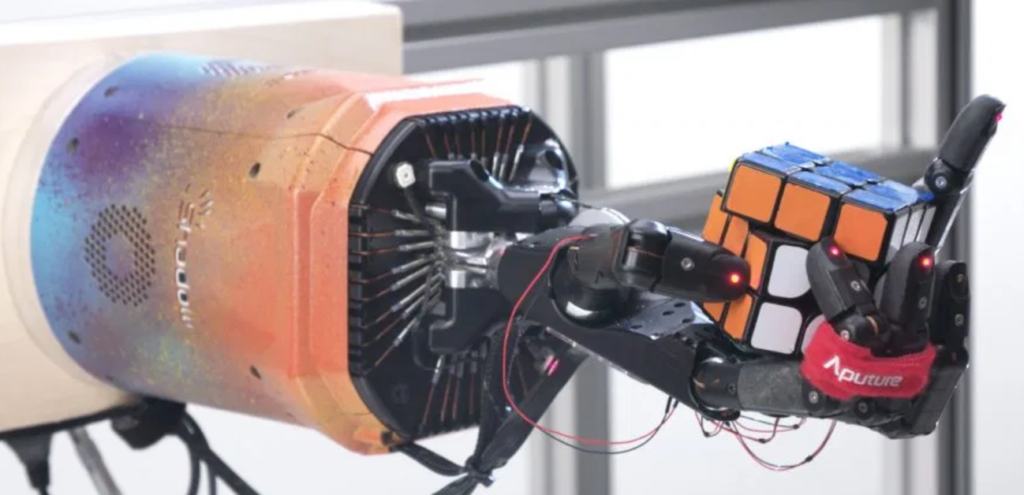
OpenAI has disbanded its robotics team after years of research into machines that can learn to perform tasks like solving a Rubik’s Cube. Company cofounder Wojciech Zaremba quietly revealed on a podcast hosted by startup Weights & Biases that OpenAI has shifted its focus to other domains, where data is more readily available.
“So it turns out that we can make a gigantic progress whenever we have access to data. And I kept all of our machinery unsupervised, [using] reinforcement learning — [it] work[s] extremely well. There [are] actually plenty of domains that are very, very rich with data. And ultimately that was holding us back in terms of robotics,” Zaremba said. “The decision [to disband the robotics team] was quite hard for me. But I got the realization some time ago that actually, that’s for the best from the perspective of the company.”
...Brockman and Altman in particular believe AGI will be able to master more fields than any one person, chiefly by identifying complex cross-disciplinary connections that elude human experts. Furthermore, they predict that responsibly deployed AGI — in other words, AGI deployed in “close collaboration” with researchers in relevant fields, like social science — might help solve longstanding challenges in climate change, health care, and education.
...OpenAI’s move away from robotics might be a reflection of the economic realities the company faces. DeepMind, the Alphabet-owned AI research lab, has undergone a similar shift in recent years as R&D costs mount, moving away from prestige projects in favor of work with commercial applications, like protein shape prediction.
See the full story here: https://venturebeat.com/2021/07/16/openai-disbands-its-robotics-research-team/
Building ethical A.I. products can put businesses at a competitive advantage
A competitive advantage
Building trusted and ethical AI systems and the governance around them could potentially become a competitive strength for companies, according to Hiroaki Kitano, president and CEO at Sony Computer Science Laboratories.
For Norwegian telecommunication giant Telenor, ethical AI is “responsible business in the making,” according to Ieva Martinkenaite, a vice president at Telenor Research. She pointed out that many of the next-generation telecommunication networks will be driven by AI-embedded software and that technology will be crucial for new growth opportunities.
That requires a set of global rules and trust principles built around AI that are followed not only by the telecom companies, but also by global vendors that they outsource parts of their operations to, according to Martinkenaite. Vendors may include stakeholders like equipment providers, software firms and service assurance companies, he added.
See the full story here: https://www.cnbc.com/2021/07/15/building-ethical-ai-products-can-put-businesses-at-competitive-advantage.html
Looking Glass 8K Holographic Display Is Absolutely Massive
This past December, the company launched the Looking Glass Portrait, its first-ever “portrait-orientated” 3D display engineered specifically to display people and characters. This was followed by the reveal of a cloud-based conversion service that transforms standard 2D images into 3D holograms within a matter of seconds.
Today, the company revealed the latest additions to its next-generation lineup, the Looking Glass 4K Gen2 and Looking Glass 8K Gen2. These second-gen displays feature a new “blockless” design, resulting in thinner, lighter hardware as well as improved optics designed to reduce ambient reflections and improve group viewability.
The Looking Glass 4K Gen2 features a solid 15.6” display. Like the Looking Glass Portrait, the 4K Gen2 can run in standalone mode, removing the need for a tethered PC. The Looking Glass 8K Gen2, on the other hand, boasts a massive 32” display, making it “the largest available holographic interface on the market” according to the company.
The Looking Glass 4K Gen2 features a price tag of $3,000. Those interested in the Looking Glass 8K Gen2 can pick one up for $17,500 ($15,000 for a limited time). Both products are available for preorder and will begin shipping this Fall.

Severely paralyzed man communicates using brain signals sent to his vocal tract
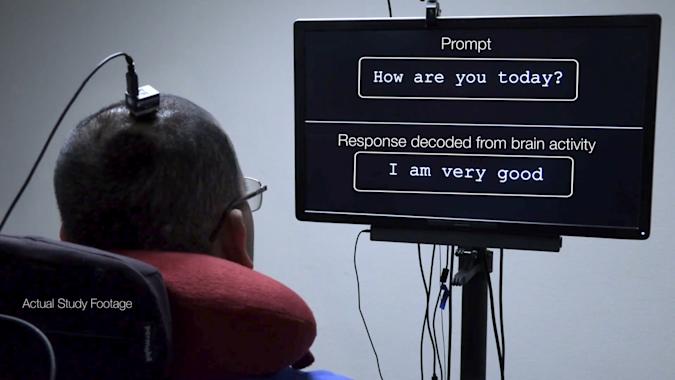
The USCF system, however, uses an implant that's placed directly on the part of the brain dedicated to speech. That way, the subject can mentally activate the brain patterns they would normally use to say a word, and the system can translate the entire word, rather than single letters, to the screen.
To make it work, patients with normal speech volunteered to have their brain recordings analyzed for speech related activities. Researchers were then able to analyze those patterns and develop new methods to decode them in real time, using statistical language models to improve accuracy.
However, the team still wasn't sure if brain signals controlling the vocal tract would still be intact in patients paralyzed for many years. To that end, they enlisted an anonymous participant (known as Bravo1) who worked with researchers to create a 50-word vocabulary that the team could decipher using advanced computer algorithms. That included words like "water," "family" and "good," enough to allow the patient to create hundreds of sentences applicable to their daily life. The team also used an "auto-correct" function similar to those found on consumer speech recognition apps.
The system was able to decode their speech at up to 18 words per minute with 93 percent accuracy, with a 75 percent median accuracy. That might not sound great compared to the 200 words per minute possible with normal speech, but it's much better than the speeds seen on previous neuroprosthetic systems.
The team said the trial represents a proof of principal for this new type of "speech neuroprosthesis." Next up, they plan to expand the trial to include more participants, while also working to increase the number of words in the vocabulary and improve the rate of speech.
See the full story here: https://www.engadget.com/severely-paralyzed-man-communicates-using-brain-signals-sent-to-his-vocal-tract-110524126.html