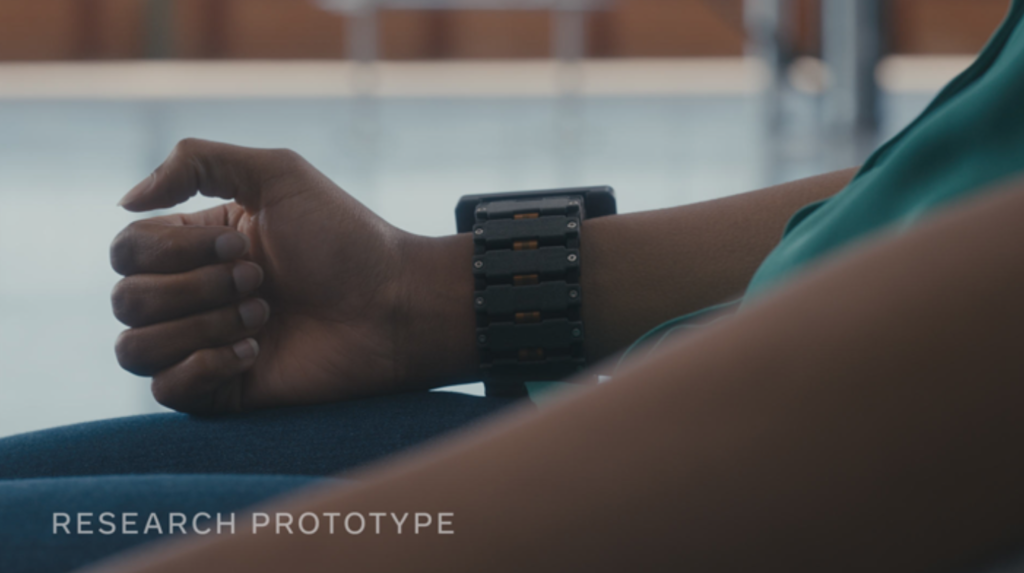
Facebook Reality Labs, its AR/VR research division, showed off its futuristic wristband for controlling AR glasses to the media this week. The prototype device, still years away, can scan electrical signals traveling from the spinal cord to the hand and fingers, enabling it to predict what a user wants to do and replicating that in AR/VR environments.
While wearing the band and glasses, users could interact with the VR world through subtle finger movements — such as using a "click" gesture to indicate that they want to hear a podcast.
The technology could allow users to type on a virtual keyboard and generally manipulate AR objects overlaid in the real world.
During a demonstration, researchers showed how a wearer could pinch their fingers to hold and control AR objects, which Facebook dubbed "force" movements after "Star Wars."
The device detects finger motion of only a millimeter, using electromyography to translate electrical sensors from our nerves into digital commands.
Though there's no timeline for release, the company previously said it hopes to get such a device "into people’s hands over the next 10 years, even as it continues to evolve for decades to come."
While Facebook's smart glasses will arrive later this year, they won't have traditional augmented reality features. The company is developing the glasses with Ray-Ban and its parent, Luxottica Group SpA.
The Department of Homeland Security (DHS) Science and Technology Directorate (S&T) announced the grand-prize winner of the Digital Wallets Challenge. The prize challenge sought a design concept for an easy-to-use, trusted user interface (UI) for digital wallets that improves the overall user experience (UX) for the management of digital wallet-based credentials. The goal was to find a UI design that supports best practices for visual consistency, ensures security and privacy, is interoperable, and can be integrated with existing back-end processes.
“Through this challenge we worked with graphic designers to create a UI that is useful to DHS-specific applications and is readily accessed and usable by anyone in the verifiable credential community,” said Anil John, Silicon Valley Innovation Program Technical Director. “While all the finalists deserve recognition for their efforts, one winner stood out in their innovative approach, combining both an effective end-user experience and shareable back-end functionality for the verifiable credential community. We will post the winning UI for the global community to use and rework the UX of digital wallets.”
The grand-prize winner is Dignari, a woman-owned small business from Alexandria, Virginia. ...
Dignari was one of three finalists who presented their UI designs to federal government partners and the World Wide Web Consortium (W3C), an international standards body. As part of the challenge, finalists were encouraged to work with the standards community and blockchain technology developers, then incorporate their feedback into the final designs.
There is a controversial discussion happening at the moment around psilocybin, a key compound found in magic mushrooms capable of sending people on mind-altering trips that often result in visual and auitory hallucinations and dramatic emotional changes. Data shows those suffering from chronic depression or anxiety can actually benefit from small microdoses of the psychedelic, with some even reporting long-term relief. Of course, not everyone agrees.
Created by Radix Motion and Red Light Holland Corp, Wisdom is an educational VR experience designed to explain the effects of magic mushrooms by allowing users to step into a 3D model of the human brain to see exactly how psilocybin changes the way your brain operates within the predictive coding neuroscience framework. It sounds complex, but that’s only because it is.
As easy to follow as tennis is visually, on an audioscape level, it’s as tough to follow as an episode of Twin Peaks you’ve switched on halfway through. That’s a challenge engineers from Tennis Australia, digital design and communications agency AKQA, and Monash University in Melbourne, Australia are working to solve with something called Action Audio. It’s an online audio stream that was developed for last month’s Australian Open broadcasts to assist the 285 million people globally — many of whom are tennis fans — living with blindness or a visual impairment.
“[We wanted people to be able to] make their own appraisal of what’s happening on the court,” Devine said. “So they can have their own insights, rather than just having the insights created by a commentator. They have more information. They’re able to say, ‘wow, Federer’s really hammering the backhand tonight.’
Over the past month, established artists and newcomers alike have complained about their publicly viewable work being transformed into NFTs and peddled to potential buyers at eye-watering prices, without their permission. Those responsible sometimes hide behind anonymous Twitter accounts, making it difficult to know where to start in order to contest copyright violations.
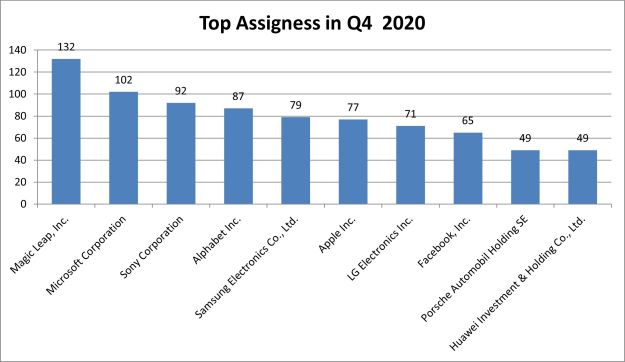
In this series, we track the growth in AR/VR patents worldwide that we expect will accompany the rapid innovation in this technology space. We highlight trends in patenting AR/VR technologies—who is obtaining AR/VR patent protection, and where. We track the various technology centers at the United States Patent and Trademark Office that handle AR/VR applications. And, from time to time, we shine the spotlight on interesting new AR/VR patents.
Over the past few months, music stars have been scrambling to cash in on the latest craze in collectibles by selling art, merch and even albums in the form of non-fungible tokens, or NFTs. But this week, the phenomenon became more confusing than ever for the music industry, when many of the top artists went on sale as pseudo-NFTs themselves.
The culprit: BitClout, a new platform that promises to allow creators and musicians to monetize their celebrity. The decentralized social network and marketplace has been quietly bubbling under the radar, with backers rumored to include big-name venture capital firms. Over recent weeks, the platform had uploaded the top 15,000 influencers from Twitter and issued coins for each, allowing early site users to buy and sell them. Prices for the coins of celebs like Billie Eilish and Elon Musk soared.