‘MYST’ for Quest Review – Iconic Point & Click Gameplay Adapted for the Virtual Age
I was 10 years old when I first, and probably last saw Myst in the flesh. My mom admits she never finished it; she was too busy writing novels and trying to not go insane from the constant moving around the country with two rambunctious kids in tow, a built-in feature of my dad’s former life as an officer in the US Air Force. My nostalgia for Myst is pretty surface level, since I never actually played the game and only have fleeting memories of spaceships, switches, and two fantastical brothers locked inside books who would shout at you. They didn’t seem very nice.

Forget the nostalgia though. Playing the new Myst on Quest feels a bit like teleporting inside a giant mechanical clock that someone’s intentionally broken, and then filled with scraps of paper on how to fix it. You can’t break the clock any worse than it’s already been broken by fiddling with its gears, but you can’t fix it that way either. You need to look everywhere and write down clues. If you’re looking for a new challenge, the new Myst also lets you randomize puzzle solutions.
However fastidious, there’s still something to Myst, and even more so now that it’s in VR. In an age of constant voice overs and omnipresent ‘helpful’ NPCs telling you where to go next, I found the old school approach to game design to be surprisingly refreshing on some level, and actually more immersive at points. I was alone—truly alone—and if I wanted to get off this damn island, I would have to dig deep and do something I normally hate to do in games: read and pay close attention.
Immersion
One of the biggest things you’ll notice is how the world has been rebuilt for real-time gameplay. You can physically pick up books, pull levers, and slide open doors. Object interaction is really very basic though; your hand disappears when you grip an object, becoming an orange orb that only returns to its grey plastic mitt when you’ve released something. Physical objects also magically snap back to their anchored location when you let go of them, which is understandable, if not a bit immersion-breaking when you just want to switch a book or note between hands.
Comfort
Myst features both variable snap-turn and smooth turning. You can also toggle smooth forward locomotion and teleportation on the fly, which can be helpful when ascending winding staircases, which normally make me queasy. There aren’t any vomit-inducing rides to worry about either, so Myst can be a very comfortable experience.
Thankfully, Myst can be played either seated or standing, as it includes and both an auto height detection feature and manual adjustment to keep you where you need to be.
Gameplay: 6 | Immersion: 6 | Comfort: 7
See the full review here: https://www.roadtovr.com/myst-vr-quest-review/
Trend of virtual reality technology museum
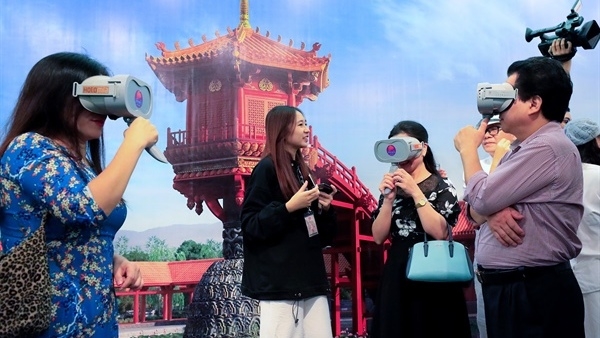
Using 3D glasses, visitors can admire architectural models of Dien Huu Monastery Platform and its One Pillar Structure from the Ly Dynasty through 3D paintings, movies and VR3D products. With this technology, viewers can enjoy experiences perhaps not previously known: a virtual reality experience, architectural forms and the scale of the One Pillar – Dien Huu Pagoda. This method will help museums bring the artifacts closer to viewers so that they can discover its ancient heritage.
In fact, in recent years, museums in Vietnam have been trying hard to use technology to attract the public, especially the young people. Vietnam National Museum of History is the pioneer in building 3D interactive virtual museums to increase the experience and interactive capacity of the real museum. Since 2013, catching up with the modernisation trend through the application of technology in displaying the activities of modern museums around the world, the Vietnam National Museum of History has introduced many exhibitions and collections to the public using 3D virtual reality technology. Visiting the museum’s website, viewers see the subject “3D Exhibition” with four virtual contents including “Vietnam in Prehistoric Times”, “The Dong Son culture”, “Ngo - Dinh - Anterior Le Dynasties, Ly – Tran Dynasties” and “Oc Eo – Phu Nam”. So far, the public has gradually become accustomed to using technology, smart phones and computers to access and enjoy online exhibitions and virtual interactions. Viewers can sit, watch and study the exhibits on display. The space between the museum artifacts and the public has narrowed. With just one click, the public have the chance to view heritage treasures and thematic exhibitions with narration and auxiliary sounds. Feedback from many viewers shows that virtual displays provide them with more detailed information than real exhibitions.
See the full story here: https://en.nhandan.org.vn/culture/item/9373002-trend-of-virtual-reality-technology-museum.html
5 Things To Know About Balenciaga’s Virtual Reality AW21 Show
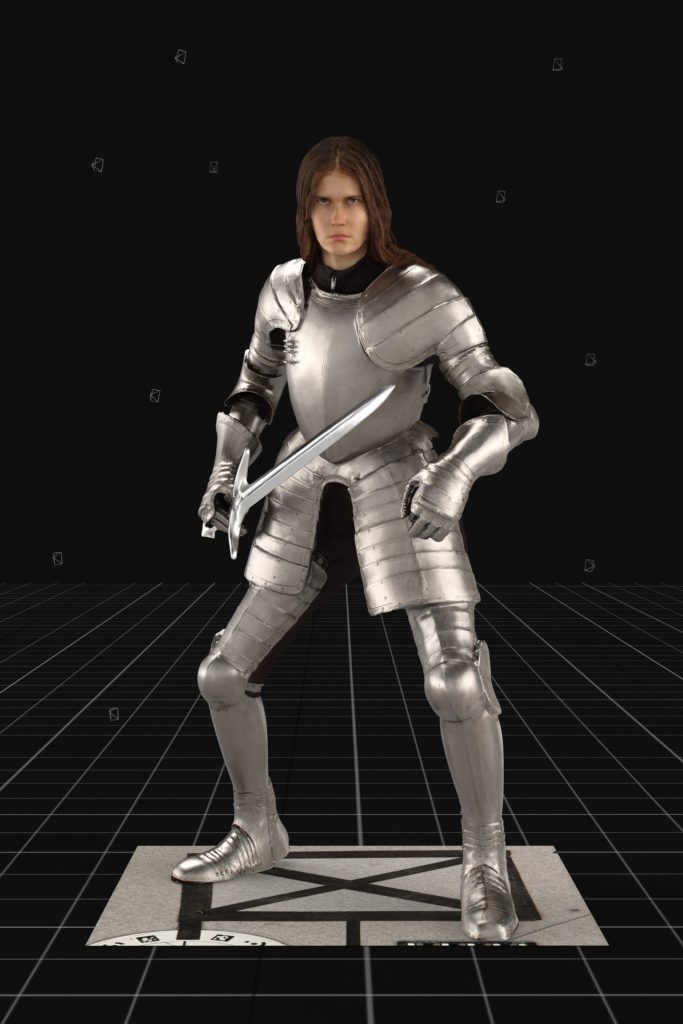
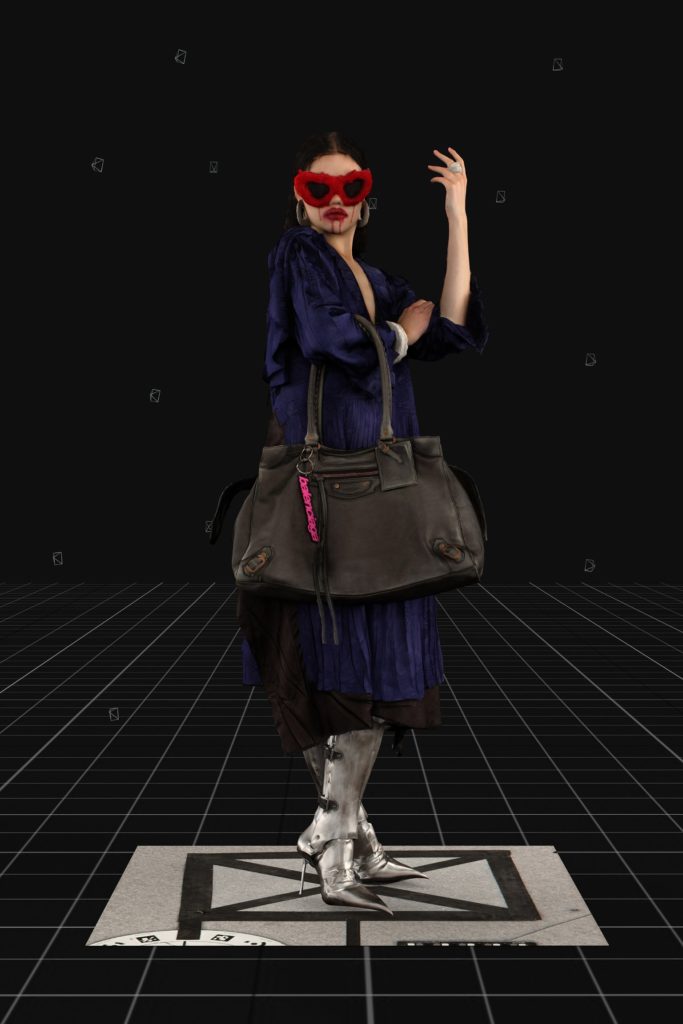
Balenciaga staged its dystopian autumn/winter 2021 collection as a virtual reality runway show presented through Oculus glasses sent to 330 guests worldwide, and released the video game, Afterworld: The Age of Tomorrow.
See the full story https://www.vogue.co.uk/news/gallery/balenciaga-autumn-winter-2020?image=5fcd11d794cc0b65da0f151d
Facebook Accused of Squeezing Rival Startups in Virtual Reality
Facebook has a 39% share of the virtual-reality hardware market, making it the industry’s largest player, according to data from market intelligence firm International Data Corporation. Smaller players include Lenovo Group Ltd., Sony Corp. and HTC Corp., while Apple is developing its own mixed virtual and augmented reality headset for launch as early as 2022, Bloomberg has reported. Facebook launched its latest headset, the Quest 2, in October, cutting the price to $299 from $399.

At the core of the complaints is the way Facebook runs the platform and competes against software developers who build apps and depend on the platform for their business.
“Our industry is getting eaten alive by Facebook,” said Cix Liv, who co-founded startup Yur Inc., which makes technology that can be integrated into Oculus games to track fitness metrics. “Any application that has a chance of being mildly competitive with them, they have to kill it somehow.”
Yur released its fitness tracking app for Oculus in September 2019 and spent months working to satisfy Facebook’s security, privacy and performance benchmarks to get the app into the Oculus app store. While the app was available to users on another marketplace, Liv said, Yur couldn’t get it into the Oculus store even though he said the startup met Facebook’s requirements.
Facebook in the spring released a software update for Oculus that prevented Yur’s technology from working within games, according to Liv. Liv said Yur was the only company that experienced such an issue. Subsequent updates required users to delete the Yur app in order to get the Oculus headset working again.
...
Developers also complain that Facebook squeezes them by forcing them to pay a commission on sales, a complaint also leveled at Apple. One of them is Darshan Shankar, the founder and CEO of Bigscreen Inc., which lets users stream movies on the Oculus headset and interact virtually with friends as they watch together.
When a user rents a movie on Bigscreen, they have to use the Oculus in-app purchase system, which collects 30% of the rental fee. That ultimately makes the economics of the business unworkable for the start-up, he said. Shankar said Facebook refuses to negotiate on the 30% commission that Bigscreen has to pay.
“It’s literally impossible for anyone to start an e-commerce or media business in VR because these walled gardens are gatekeepers,” he said. “Entire industries are impossible because of them.”
See the full story here: https://www.bnnbloomberg.ca/facebook-accused-of-squeezing-rival-startups-in-virtual-reality-1.1531098
Scale AI hits $3.5B valuation as it turns the AI boom into a venture bonanza
Kirsten KorosecTue, December 1, 2020, 1:35 PM PST·3 min read

Scale AI, the four-year-old data labeling startup, has discovered that selling the picks and shovels needed to develop and apply artificial intelligence is big business.
The company, which created a visual data labeling platform that uses software and people to label image, text, voice and video data for companies building machine learning algorithms, has raised another $155 million. The funding round, led by Tiger Global, pushes Scale's post-money valuation to more than $3.5 billion.
Importantly, Scale is now a "break even" business and is set up to continue to add employees and expand into new markets in a sustainable way, Scale's CEO and co-founder Alexandr Wang told TechCrunch. Scale will use the funds to grow its workforce from 200 people to about 350 by the end of next year. (Those employee numbers don't include the tens of thousands of contractors it uses to label data.) It's also focused on new markets and adding products and platform capabilities.
Scale got its start by supplying autonomous vehicle companies with the labeled data needed to train machine learning models to develop and deploy robotaxis, self-driving trucks and automated bots used in warehouses and on-demand delivery. Legacy automakers such as General Motors and Toyota, chipmaker Nvidia and a slew of AV startups, including Nuro and Zoox, have used its platform.
More recently, Scale's customers have spilled over into government, e-commerce, enterprise automation and robotics. Airbnb, OpenAI, DoorDash and Pinterest are some of its customers. That pace of expansion has accelerated in 2020, according to Wang.
See the full story here: https://www.yahoo.com/entertainment/scale-ai-hits-3-5b-213539913.html
Understanding the AI factory
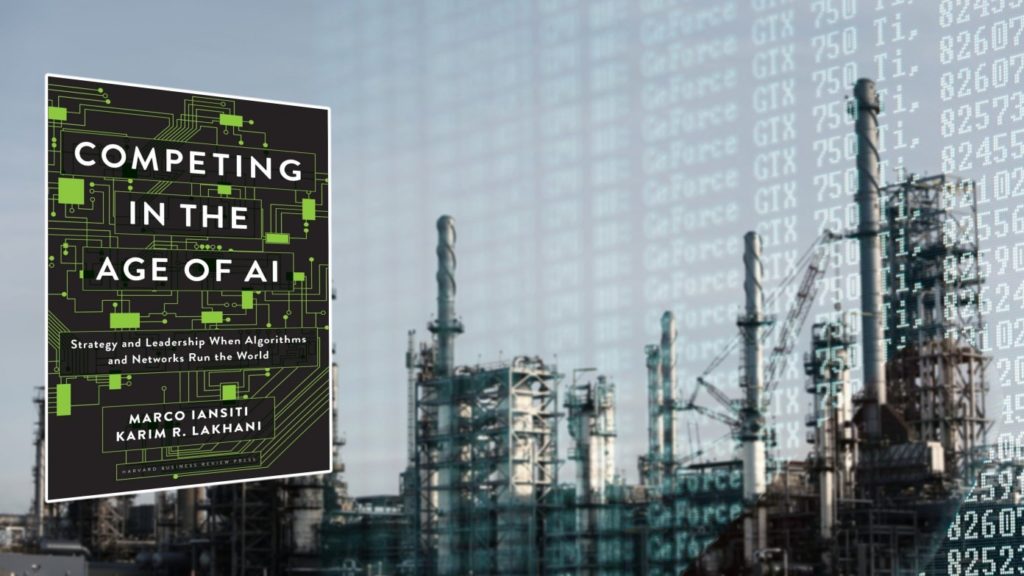
In Competing in the Age of AI, the authors introduce the concept of the “data pipeline,” a set of components and processes that consolidate data from various internal and external sources, clean the data, integrate it, processes it, and store it for use in different AI systems. What’s important, however, is that the data pipeline works in a “systematic, sustainable, and scalable way.” This means that there should be the least amount of manual effort involved to avoid causing a bottleneck in the AI factory.
Iansiti and Lakhani also expand on the challenges involved in the other aspects of the AI factory, such as establishing the right metrics and features for supervised machine learning algorithms, finding the right split between human expert insight and AI predictions, and tackling the challenges of running experiments and validating the results.
See the full story here: https://bdtechtalks.com/2020/12/02/competing-in-the-age-of-ai/
New artwork uses artificial intelligence and gaming tech to create worlds

You could stand immersed forever in a new artwork at the Christchurch Art Gallery and never see the same thing twice.
In just one brief glimpse, three large projectors show a computer-generated giant egg with legs running precariously across a surreal and colourful virtual landscape. Then a figure with a polka dot face and a 1980s video projector with a head enter the scene and collide with the egg.
In Kahoots, a collaboration between artists Sean Kerr and Judy Darragh, is a humorous, surreal and surprising artwork that uses video game technology to immerse viewers in a self-generated virtual world.
Kerr used the artificial intelligence and machine learning functions of software designed to make video games to create a work that seems to have a mind of its own.
Live feeds from the virtual world are projected on three large walls in an exhibition space at the Christchurch Art Gallery. A fourth wall is covered in reflective foil and LED signs in the middle of the room feature animated flames.
See the full story here: https://www.stuff.co.nz/entertainment/arts/123516534/new-artwork-uses-artificial-intelligence-and-gaming-tech-to-create-worlds