Tom Hall interview — Why Doom co-creator is making virtual reality games
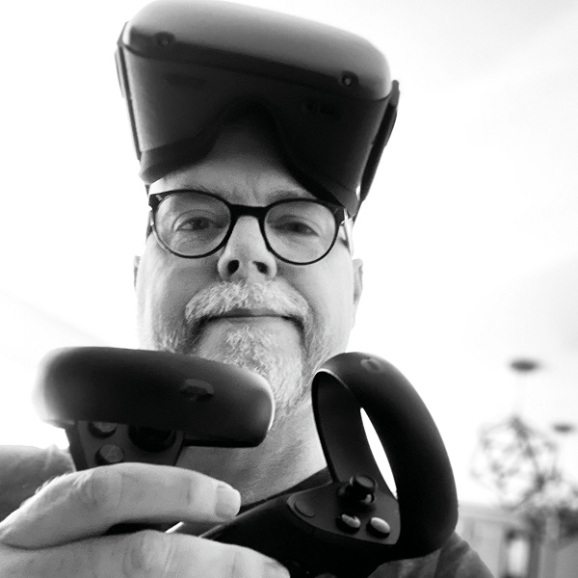 Tom Hall is a versatile game designer with over three decades of experience. He has worked on note games such as Doom, Duke Nukem, Rise of the Triad, Wolfenstein 3-D, and Anachronox (all traditional games). But he has also shown interest in the broader craft of making games for other platforms, working on the Diner Dash mobile games at PlayFirst and later at Glu Mobile.
Now he’s shifting his focus to virtual reality games. This week he announced he’s joining Resolution Games, the Stockholm, Sweden-based company that Candy Crush Saga co-creator Tommy Palm runs. Hall has joined as a senior creative director and said he’s happy to work on “de-stressors,” or games that reduce daily stress.
Hall’s endorsement comes at an interesting time for VR, which has struggled to find its footing. Initial sales are far below what advocates hoped for around 2014, but passion for VR abides, and headsets such as the Oculus Quest have been selling out during the pandemic.
See the full story here: https://venturebeat.com/2020/06/27/tom-hall-interview-why-doom-co-creator-is-making-virtual-reality-games/
Stuart Russell on AI Governance – AI Futures Podcast (S1E1)
 In this episode, Stuart explores some of the correlates between AI governance and the governance and control of other technologies – including electricity and nuclear materials. He also explores some of his thoughts about international AI transparency and governance.
Interview Questions
(3:15) You believe that at some point we’ll need global governance of AI – can you summarize your position on this topic?
(8:15) Are there existing standards, procedures, or laws for other technologies that might apply well to AI as well?
(13:00) Do you think that early AI governance progress will begin with individual, discrete governance instances (say, around using AI to market to children)?
(19:10) Do you think that AI principles can be the right starting point for drilling down to more concrete governance?
(22:10) How can we develop an international AI values consensus with nations that don’t share values such as individualism, privacy, freedom of speech, etc?
(27:00) What does near-term international AI convening look like? How could nations begin to come together?
(33:30) Do you believe that the shared prosperity from beneficial strong AI would relieve the tensions towards violent international competition?
(38:00) What is the role for the private sector in helping to bring us closer to a better AI future?
(41:15) Do you believe that the “new normal” for AI governance and ethics in industries (like insurance or banking) can set a precedent for the bigger picture of AI ethics and governance?
Every Saturday from June 27th to September 12th, we’ll be covering a new AI Futures episode about AI governance.
The podcast can be found here: https://emerj.com/ai-podcast-interviews/stuart-russell-ai-governance/
A reflection on artificial intelligence singularity
 Should you feel bad about pulling the plug on a robot or switch off an artificial intelligence algorithm? Not for the moment. But how about when our computers become as smart—or smarter—than us?
Jalsenjak takes us through the philosophical anthropological view of life and how it applies to AI systems that can evolve through their own manipulations. He argues that “thinking machines” will emerge when AI develops its own version of “life,” and leaves us with some food for thought about the more obscure and vague aspects of the future of artificial intelligence.
This is not a discussion about how and when we’ll reach AGI. ... Jalsenjack rather speculates of how the identity of AI (and humans) will be defined when we actually get there, whether it be tomorrow or in a century.
According to philosophical anthropology, the first signs of life take shape when organisms develop toward a purpose, which is present in today’s goal-oriented AI. The fact that the AI is not “aware” of its goal and mindlessly crunches numbers toward reaching it seems to be irrelevant, Jalsenjak says, because we consider plants and trees as being alive even though they too do not have that sense of awareness.
Another key factor for being considered alive is a being’s ability to repair and improve itself, to the degree that its organism allows.
An ideal self-improving AI, however, would be one that could create totally new algorithms that would bring fundamental improvements. This is called “recursive self-improvement” and would lead to an endless and accelerating cycle of ever-smarter AI.
Recursive self-improvement, however, will give AI the “possibility to replace the algorithm that is being used altogether,” Jalsenjak notes. “This last point is what is needed for the singularity to occur.”
See the full story here: https://bdtechtalks.com/2020/06/29/artificial-intelligence-singularity/
Robot with I.A Erica will be the first to star in a movie
 Erica will become the first robot with the use of artificial intelligence to have a leading role in a movie as if it were a real actor.
This robot was created practically to act like a real actor and finally he will have his chance to demonstrate everything he is capable of in the seventh art.
See the full story here: https://www.explica.co/robot-with-i-a-erica-will-be-the-first-to-star-in-a-movie/
VR System Hacks Your Nose to Turn Smells Into Temperatures
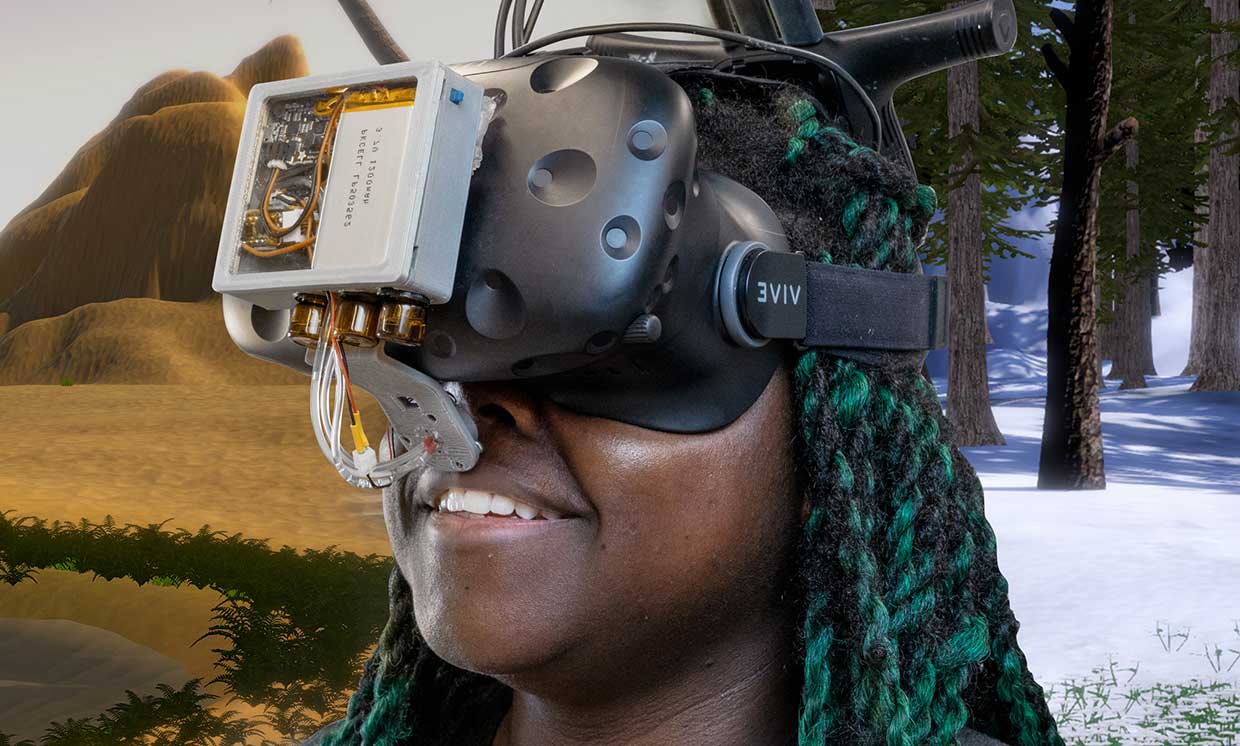 By using very specific chemicals to access the trigeminal nerve in your nose, they can make you feel hot and cold through smells without realizing you’re smelling anything at all.
Apple patents reveal ambitions
 A review of Apple’s AAPL, -1.47% patent library reveals a deep focus on wearables, health, augmented reality and autonomy, according to Bank of America analyst Wamsi Mohan.
Apple has applied for patents for Apple Watch technology that would measure dyskinesia and tremor symptoms, and it’s been granted one for blood-pressure detection. The company also seems interested in technology like a mat that could measure vital signs and track sleep, augmenting the Apple Watch and other existing iOS devices.
Outside of health, Apple has received a patent for an Apple Watch band that could take photos and videos through an optical sensor.
Apple’s patents also show wide-ranging ambitions for augmented and virtual reality. The company has applied for patents focused on AR navigation systems and AR technology for virtual meetings, both features that could come to a designated AR headset. In addition, Apple has received a patent for an AR device that could warp images so that people who are partially visually impaired could see more clearly.
In autonomous driving, Apple has sought a patent for sensor technology that would gauge stress levels through measures of heartbeat, body temperate and eye movement in order to increase comfort in an autonomous vehicle. The company has been granted a patent for a system that would let drivers give autonomous cars direction about where to park and even use hand gestures to instruct cars to park in a certain lot.
See the full story here: https://www.marketwatch.com/story/apple-patents-reveal-ambitions-in-augmented-reality-and-more-2020-06-25
Down the rabbit hole: how QAnon conspiracies thrive on Facebook
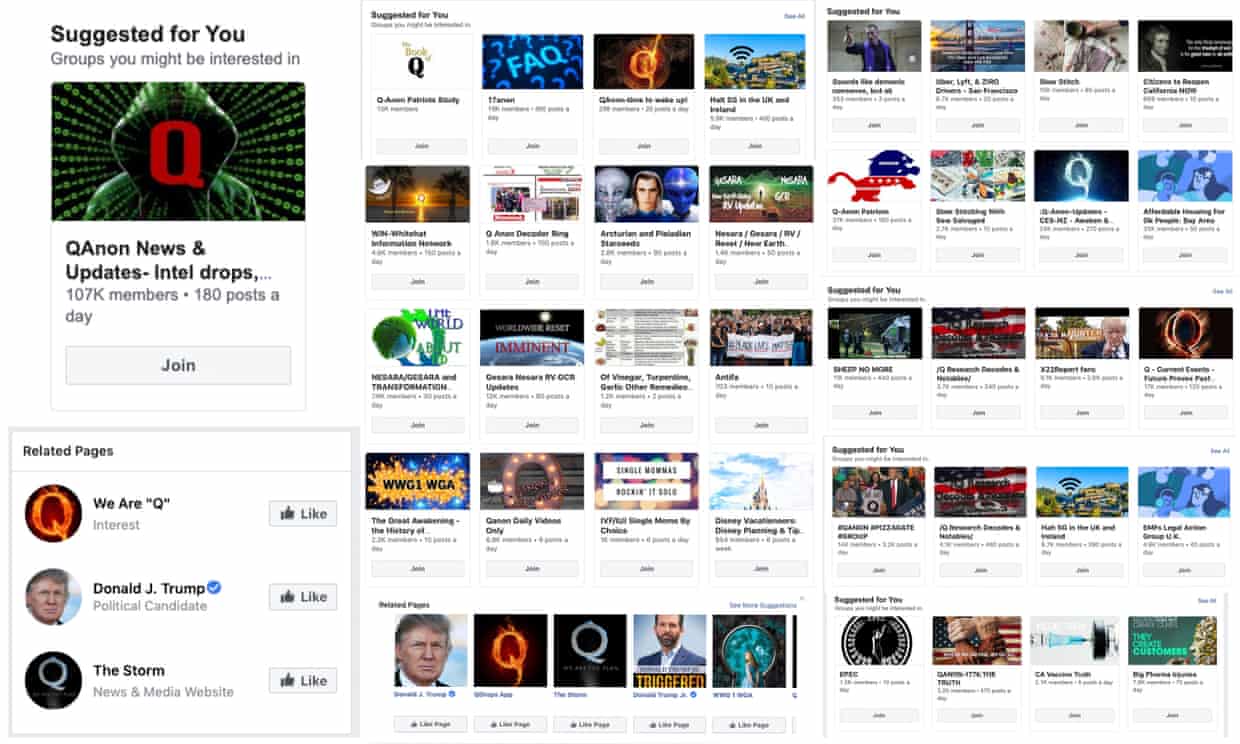 “Facebook is a unique platform for recruitment and amplification,” said Brian Friedberg, a senior researcher at the Harvard Shorenstein Center’s Technology and Social Change Project who has been studying QAnon for years. “I really do not think that QAnon as we know it today would have been able to happen without the affordances of Facebook.”
Moreover, Facebook is not merely providing a platform to QAnon groups. Its powerful algorithms are actively recommending them to users who may not otherwise have been exposed to them.
A ban that stuck
While QAnon thrives on Facebook, another social media site took timely and decisive action against it. Nearly two years ago, Reddit, the link-sharing network of interest-based message boards, carried out a site-wide purge of QAnon – and made it stick.
‘Taking the red pill’
QAnon did not disappear after Reddit pulled the plug, however. Instead, its believers moved on to other platforms, including YouTube, Twitter, Discord and – crucially – Facebook. At the time of the Reddit ban, one of the largest closed Facebook groups dedicated to QAnon, “Qanon Follow the White Rabbit” had 51,000 members, according to NBC News. Today that group has grown to more than 90,000 members.
Will Partin, a research analyst with Data & Society, and Alice Marwick, a professor of communication at the University of North Carolina, describe QAnon as a “dark participatory culture”, which is to say that it is a community that takes advantage of the infrastructure of social networking sites to bring disparate people together and foster discussion, collaboration, research and community, but directs those energies toward anti-democratic, regressive and even violent ends.
“Everything about our research suggests that these people are not irrational; they’re hyper-literate, even if they’ve come to beliefs that are empirically inaccurate ,” Partin said. “That’s partly because they have a fundamentally different epistemology to judge what is true and false.”
There are innate societal and individual harms to convincing people of a version of reality that is simply false, as QAnon does, said Data & Society research analyst Will Partin. “When a common sense of what is real and what is correct breaks apart, it becomes nearly impossible to reach a democratic consensus.”
Uscinski is skeptical of the idea that kicking QAnon off Facebook would help anyone. He regularly polls conspiracy theories and consistently finds that QAnon is “one of the least believed things” out there, well below belief in theories about Jeffrey Epstein’s death, anti-vaccine hoaxes, and Holocaust denialism. Uscinski also cautions against overly exoticizing the QAnon narrative, noting that “most of the component parts of QAnon have been around forever”,...
See the full story here: https://www.theguardian.com/technology/2020/jun/25/qanon-facebook-conspiracy-theories-algorithm