NEWS 5G augmented reality bus tour trialled in Barcelona
 The tour displays real-time visual content on the front window of the bus, creating what is said to be a unique tour experience for the passengers.
For example, the tour included a display of the inactive Montjuic fountains, and although they’re not currently functioning, the screen displayed them as if they were. It also displayed historical information on buildings and monuments as the bus moved through the city.
Mediapro Group designed the experience, selected and generated the tourist information, and developed the software and augmented reality content. It was also responsible for the installation of the transparent screens.
Telefónica arranged the high-speed network that provides 5G large bandwidth downstream and upstream, allowing optimised quality of content and real-time broadcasting.
See the full story here: https://www.intelligenttransport.com/transport-news/97639/5g-augmented-reality-bus-tour-trialled-in-barcelona/
Live Shows Are Canceled—More Virtual Reality Concerts Are Coming
 A story about The Wave, Jadu, and digitally connecting with artists.
See the full story here: https://www.complex.com/music/2020/03/virtual-rap-shows-coronavirus
David Byrne – This virus is showing us just how tenuous our existence becomes when we distance ourselves from each other
 I ask myself, is there something we can learn from this, something that will allow us to better weather the next crisis, some different way of being that might make us stronger? Is this an opportunity to change our thinking, our behavior? Are we capable of doing that?
These interventions have been effective, but there was a price. Freedoms were curtailed, as they have been, to some degree, in virtually every place that has contained the virus. In some of these places, surveillance cameras and contact-tracking teams were used, and people have shown a willingness to share information with authorities and do what is necessary for the greater good.
Some might find these measures intrusive. But the outcome they led to—that is freedom. To be able to return to one’s life, with a job, healthy and safe—that is national security. When you’re stuck in your house, as I am, you realize that surrendering some individual freedoms so that others might remain healthy and safe is another way of connecting. You see that we’re not a bucket of crabs, we’re a community.
See the full story here: https://www.wsj.com/articles/connect-and-connect-and-connect-11585318513
Hospital uses VR to show how the coronavirus impacts the lungs
 Earlier this month, doctors at George Washington University Hospital encountered their first patient with COVID-19, the respiratory illness caused by the coronavirus. Now they're using VR technology to see into the patient's lungs, the hospital demonstrated in a video posted to YouTube last week.
In the simulation, you can see healthy lung tissue in blue, and the virus-infected lung tissue in yellow.
"There is such a stark contrast between the virus-infected abnormal lung and the more healthy, adjacent lung tissue," Dr. Keith Mortman, chief of thoracic surgery at GW Hospital, said in an interview for the hospital's podcast, HealthCast. "And it's such a contrast that you do not need an MD after your name to understand these images ... the damage we're seeing is not isolated to any one part of the lung. This is severe damage to both lungs diffusely."
See the full story here: https://www.cnet.com/news/hospital-uses-vr-to-show-how-coronavirus-impacts-the-lungs/
AVATOUR Brings Reality To Virtual Reality
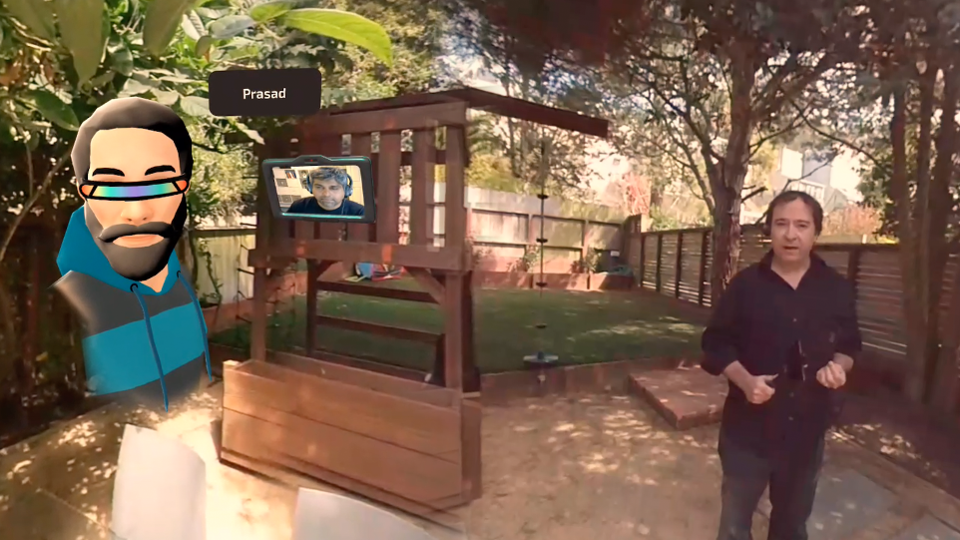 AVATOUR [sic] is a new group collaboration system that allows a remote host to bring virtual teammates, customers and/or workers to the job site for group collaboration. The ‘Host’ is in the physical world using a consumer grade, 360° camera attached to a selfie stick and an android device. The remote guests, up to 5, join the host using an Oculus Go head mounted display or desktop/laptop computer or a mobile phone, where they share the 360° view broadcast as if they were present. The 360° view IS the room in which the simulation takes place.
Participants see each other as three dimensional spatial avatars, blended with the live 360° video broadcast by the host. In a sense, the broadcast becomes the “room” in which the simulation takes place for the participants. The host and participants can then communicate in real time, looking at the same images though they may be distributed around the world. An unlimited number of parties can observe the session, which can be taped and annotated. During a demo earlier today, we felt an extraordinary sense of presence.
With its launch today, which consists mainly of “calling journalists and buying $500 worth of Google ad words” Copley says the company is ready to scale its sales and engineering teams and is now actively reaching out to VCs.
Georgia Tech Professor Uses Virtual Reality to Move Major Conference Online
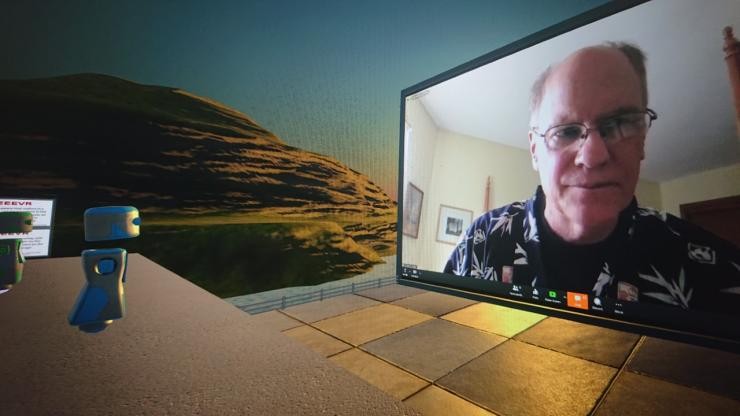 This week, 1,800 scientists, engineers, designers, and other experts gathered for the IEEE Conference on Virtual Reality and 3D User Interfaces (IEEE VR). The event brings together people from around the world to examine the latest research and advancements in the area of virtual reality (VR).
Blair MacIntyre, a professor in Georgia Tech’s School of Interactive Computing and IEEE VR conference co-chair, proposed transitioning to an all-virtual event to support social distancing recommendations related to the COVID-19 pandemic.
The entire five-day event convened in Mozilla Hubs, an online platform for remote virtual experiences. IEEE VR marks the first time that a major academic conference of this scale will move online and depend solely on a virtual environment platform, including the social networking sessions that are an essential part of conferences.
“If we can take something like IEEE VR, which is normally around 1,000 people, and turn it into an event where 10,000 people can attend, we’ll have a much more diverse and inclusive event.”
See the full story here: http://www.news.gatech.edu/2020/03/24/georgia-tech-professor-uses-virtual-reality-move-major-conference-online
FuboTV to Merge With Facebank, Which Takes Out $100M Loan to Fund Fubo’s Operations
 Over-the-top TV provider FuboTV is getting a lifeline in the form of a proposed merger with virtual entertainment company Facebank Group.
Following the closing of the merger, expected by the end of March, FuboTV will become a wholly owned subsidiary of Facebank, and Facebank will be renamed FuboTV Inc. The combined company is expected to be based in New York and led by current FuboTV CEO David Gandler (pictured above) as chief executive. The companies said they will announce additional details of the combo’s management structure and board of directors.
Facebank Group (facebankgroup.com), based in Jupiter, Fla., develops what it calls “hyper-realistic digital humans,” based on the likenesses of celebrities and sports stars, for use in applications including entertainment and artificial intelligence. Facebank was formerly Pulse Evolution, the company behind the computer-generated holographic images of Tupac Shakur at 2012 Coachella and Michael Jackson at the 2014 Billboard Music Awards. Pulse technology also was used for VFX in such movies as “The Curious Case of Benjamin Button,” “Star Wars: Episode III – Revenge of the Sith,” “Rango” and “Transformers.”
See the full story here: https://variety.com/2020/digital/news/fubotv-facebank-merger-100-million-loan-1203542156/
Ironman assembles virtual reality triathlon series
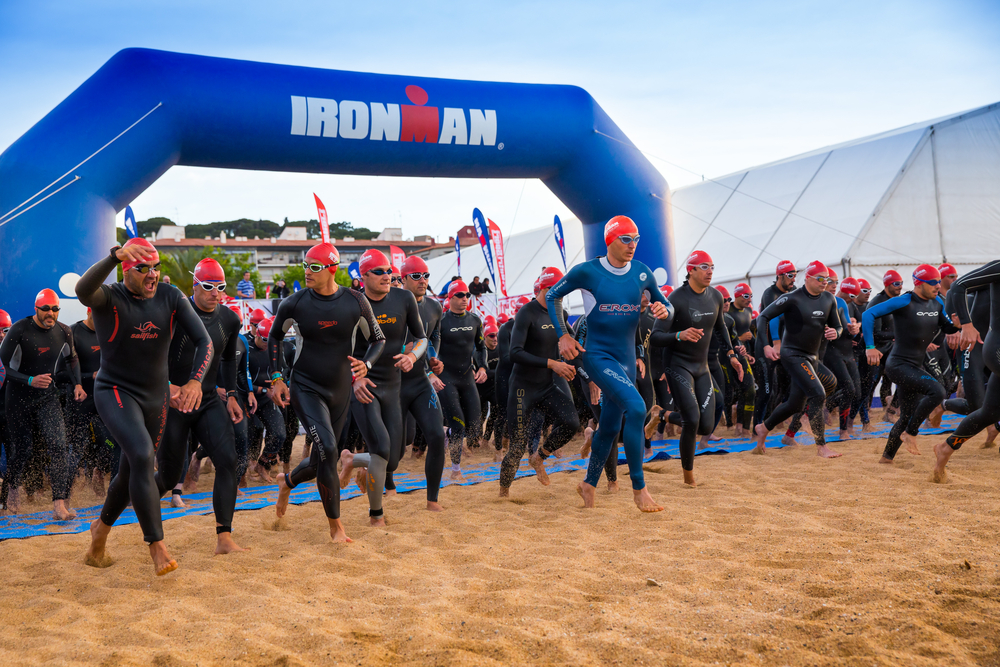 Extreme running and triathlon organisation, the Ironman Group, has revealed it will launch a virtual reality triathlon series in order to allow athletes to compete and train during events remotely.
The aptly named Ironman VR Series will launch on April 1 through the organisation’s Ironman Virtual Club and will use wearable technology and fitness tracker apps to record an athlete’s data.
Andrew Messick, chief executive of the Ironman Group stated: “We believe that under extraordinary circumstances such as these, athletes should be able to maintain the structure and continuity that training and competition provides.
The Ironman VR Series could revolutionise how competitive sport is conducted in the future. With the help of virtual reality and wearable technology, the event has been able to fully transition itself onto a digital landscape, providing many athletes with a safe and efficient way to remain active whilst also taking part in self-isolation due to COVID-19.
See the full story here: https://www.insidersport.com/2020/03/23/ironman-assembles-virtual-reality-triathlon-series/