AmazeVR launches LBE at Incheon International Airport
 AmazeVR, a premium virtual reality (VR) entertainment platform, has launched its first location-based VR experience with an installation at Incheon International Airport in Seoul, South Korea. The company hopes to expand its immersive LBE offering.
AmazeVR has now obtained an additional $2.5 million commitment to expand its total funding to approximately $9 million (via TechCrunch).
The company’s entertainment hub is located at Incheon’s airtrain station, on the way to Terminal 1. The attraction has 11,000 square feet of space and features meditation areas and relaxation-focused VR videos.
Leading the way in airport attractions is Jewel Changi Airport, an entertainment destination with shops, restaurants, play attractions, accommodation, and the world’s biggest waterfall.
At Vienna International Airport, Christie’s laser projectors are providing a panoramic cockpit view at a multimedia visitor experience, while Emaar is developing a business and tourism complex in the aero-economic area of Beijing Daxing International Airport.
See the full story here: https://blooloop.com/news/amazevr-incheon-airport/?fbclid=IwAR1dh0LnP_frf6RZ_LfhkhAjd3WDcT2Z0LLrhqK-k7X2U19VS6euzQpSAqM
Artificial Intelligence Will Do What We Ask. That’s a Problem.
 The danger of having artificially intelligent machines do our bidding is that we might not be careful enough about what we wish for. The lines of code that animate these machines will inevitably lack nuance, forget to spell out caveats, and end up giving AI systems goals and incentives that don’t align with our true preferences.
As a result, research suggests, YouTube’s algorithm has been helping to polarize and radicalize people and spread misinformation, just to keep us watching.
YouTube’s engineers probably didn’t intend to radicalize humanity. But coders can’t possibly think of everything.
A major aspect of the problem is that humans often don’t know what goals to give our AI systems, because we don’t know what we really want.
Asking a machine to optimize a “reward function” — a meticulous description of some combination of goals — will inevitably lead to misaligned AI, Russell argues, because it’s impossible to include and correctly weight all goals, subgoals, exceptions and caveats in the reward function, or even know what the right ones are. Giving goals to free-roaming, “autonomous” robots will be increasingly risky as they become more intelligent, because the robots will be ruthless in pursuit of their reward function and will try to stop us from switching them off.
Instead of machines pursuing goals of their own, the new thinking goes, they should seek to satisfy human preferences; their only goal should be to learn more about what our preferences are.
- The machine’s only objective is to maximize the realization of human preferences.
- The machine is initially uncertain about what those preferences are.
- The ultimate source of information about human preferences is human behavior.
The approach pins the success of robots on their ability to understand what humans really, truly prefer — something that the species has been trying to figure out for some time.
There was just one question: “If the obligation of machines is to try to optimize that aggregate quality of human experience, how on earth would they know what that was?”
Russell theorized that our decision-making is hierarchical — we crudely approximate rationality by pursuing vague long-term goals via medium-term goals while giving the most attention to our immediate circumstances.
“It turns out that uncertainty about the objective is essential for ensuring that we can switch the machine off,” Russell wrote in Human Compatible, “even when it’s more intelligent than us.”
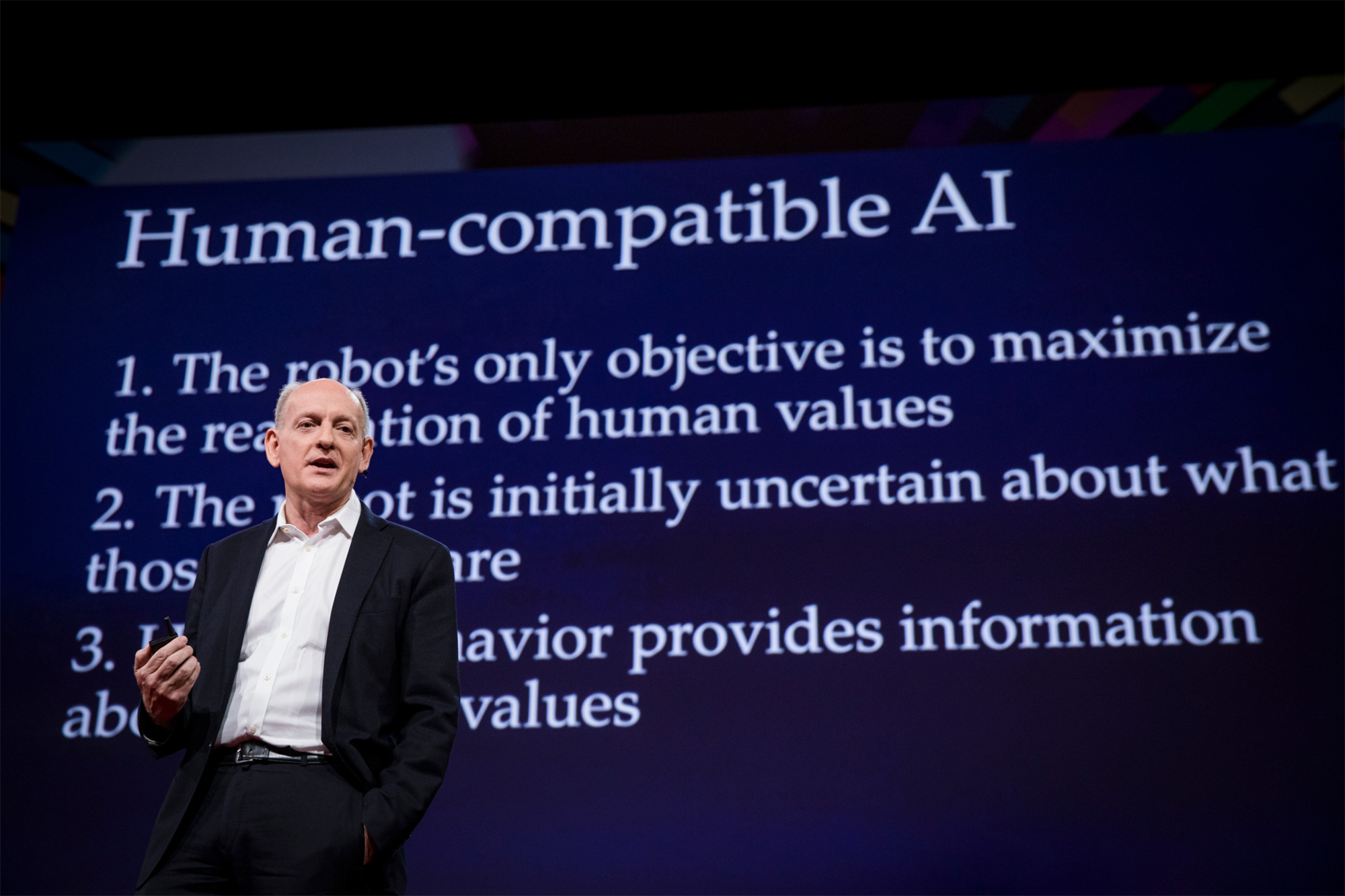
Stuart Russell speaks at TED2017 - The Future You, April 24-28, 2017, Vancouver, BC, Canada. Photo: Bret Hartman / TED
Russell sees two major challenges. “One is the fact that our behavior is so far from being rational that it could be very hard to reconstruct our true underlying preferences,” he said.
The second challenge is that human preferences change.
... However, there’s a third major issue that didn’t make Russell’s short list of concerns: What about the preferences of bad people? What’s to stop a robot from working to satisfy its evil owner’s nefarious ends? AI systems tend to find ways around prohibitions just as wealthy people find loopholes in tax laws, so simply forbidding them from committing crimes probably won’t be successful.
See the full long article here: https://www.quantamagazine.org/artificial-intelligence-will-do-what-we-ask-thats-a-problem-20200130/
The Future of Food Is on Instagram
 There’s no consensus about what the term “digital food” really means. To some, it’s the sharing of images of food on social media to represent culture, calories, presentation, preparation, and taste.
Through this “digital food,” we can use new technologies to explore and represent who we are. Augmented reality (AR) provides a unique way to experience digital food. AR experiences by artists such as Robbie Conceptuel on Instagram allow you to become the food itself. With his filter, Bubble Tea, available on Instagram, your face is transformed into a trendy drink, and jelly bubbles pour out of your mouth when you open wide.
Designers also create photo-realistic 3D food models specifically for AR. Design company QReal has created several AR experiences, such as Lobster, an Instagram filter where a user can place a photorealistic 3D model of a lobster with macaroni and cheese on a flat surface.
It’s also already possible to order food using augmented reality. AR company Kabaq has partnered with Snapchat to offer users the ability to view a Domino’s pizza in AR, then order that pizza online. Ordering food in AR allows us to see examples of what our food will look like before we see it in real life. When the already popular Uber Eats eventually adopts ARwithin its app, it is likely there will be a surge in orders, if only for the initial novelty alone. By using what is known as persistent AR, you could share the same digital food with another person or share the ordering process with a group of people.
The future of food could also exist in digital restaurants. I used Instagram to create Fresh Hot Delicious, a completely digital restaurant specializing in digital desserts. Each dessert exists as a freely available AR filter on Instagram.
Digital food can be funny, satirical, or political, as seen with Peached by Beth Wickerson.
Food designers and sensory scientists have been using virtual reality (VR) to explore digital food since at least 2016. Project Nourished, a “gastronomical virtual reality experience,” replicates existing foods and produces new kinds of food experiences. They aim to help people “eat whatever they want” with no allergies, no intolerances, and no regrets.
See the full story here: https://onezero.medium.com/the-future-of-food-is-on-instagram-223790dd5c5c
Spatial raises $14M more for a holographic 3D workspace app, a VR/AR version of Zoom or Hangouts
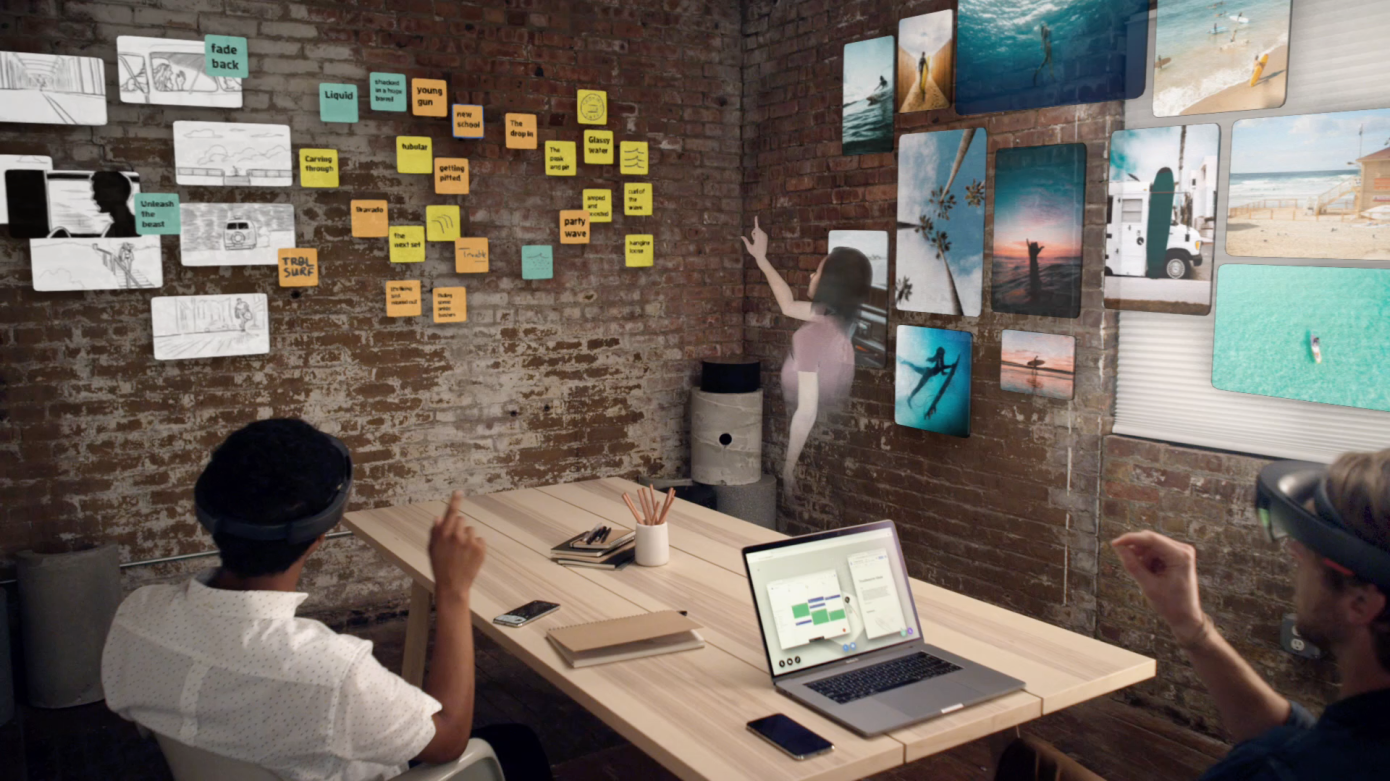 Spatial, which has developed a “holographic” collaboration platform that people use to speak and work together in virtual rooms through the use of strikingly effective avatars — think of a supercharged, virtual reality version of Zoom or a Google Hangout — is today announcing that it has raised $14 million, a Series A that it will be using to continue building out the functionality of its application and its interoperability with a wider range of hardware, as well as to start looking at how it can turn its tech into a platform that could be used by others, for example by way of an SDK.
The funding is being led by White Star Capital, iNovia and Kakao Ventures, with participation from Baidu and individual investors, Instagram cofounder Mike Krieger and Zynga’s Mark Pincus, also participating. Together with Spatial’s last round, $8 million in October 2018, the company has now raised $22 million.
See the full story here: https://techcrunch.com/2020/01/30/spatial-raises-14m-more-for-a-holographic-3d-workspace-app-a-vr-ar-version-of-zoom-or-hangouts/
VR World opens Midtown flagship
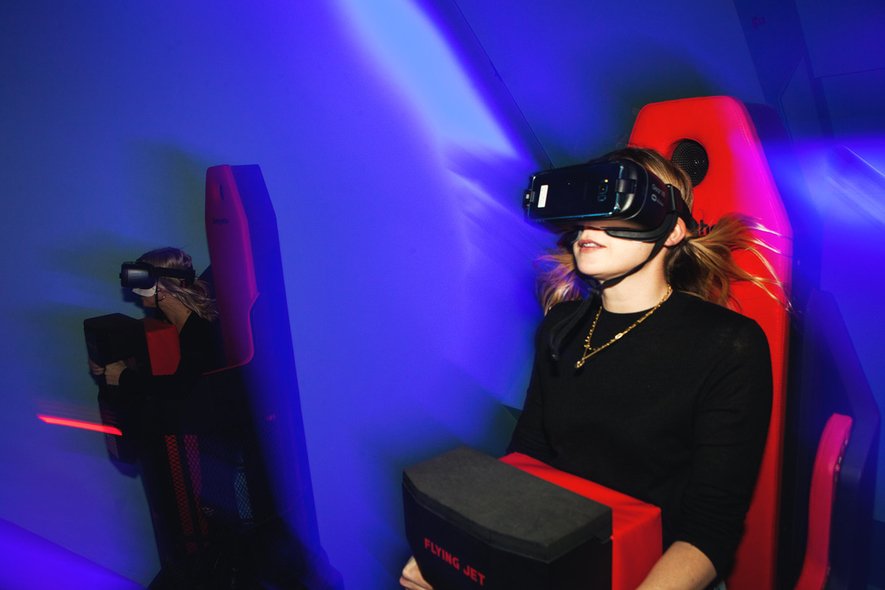
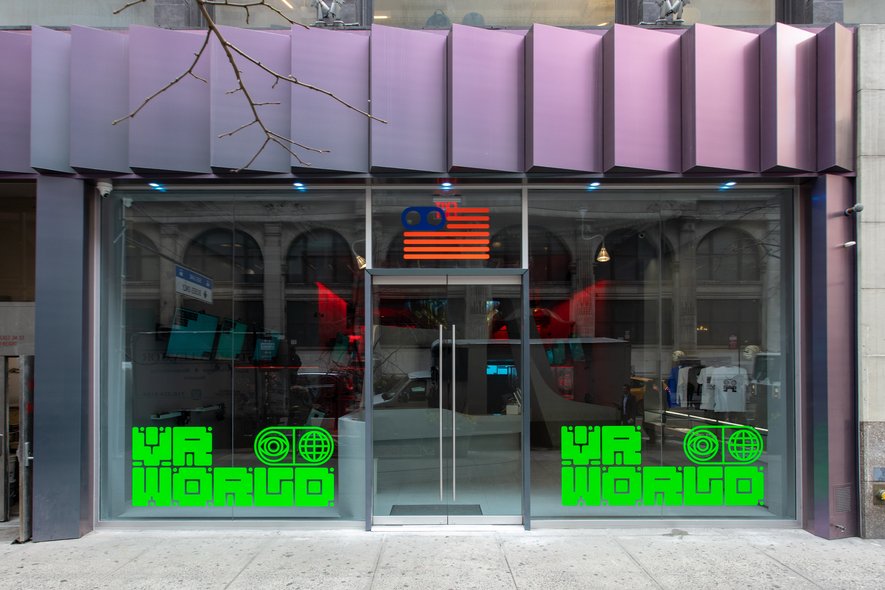 VR World opened its flagship location at 8 E. 34th St. this week, three years after opening its first location in 2017.
The three-floor, 12,000-square-foot space looks to create a “social entertainment experience of the future.”
The venue offers two-hour admission at $44 and an all-day pass for $64.
See the full story with pictures here: https://www.crainsnewyork.com/entertainment/vr-world-opens-midtown-flagship
Better than reality: NASA scientists tap virtual reality to make a scientific discovery
Using a customized, 3D virtual reality (VR) simulation that animated the speed and direction of 4 million stars in the local Milky Way neighborhood, astronomer Marc Kuchner and researcher Susan Higashio obtained a new perspective on the stars’ motions, improving our understanding of star groupings.
Astronomers have come to different conclusions about the same groups of stars from studying them in six dimensions using paper graphs, Higashio said. Groups of stars moving together indicate to astronomers that they originated at the same time and place, from the same cosmic event, which can help us understand how our galaxy evolved.
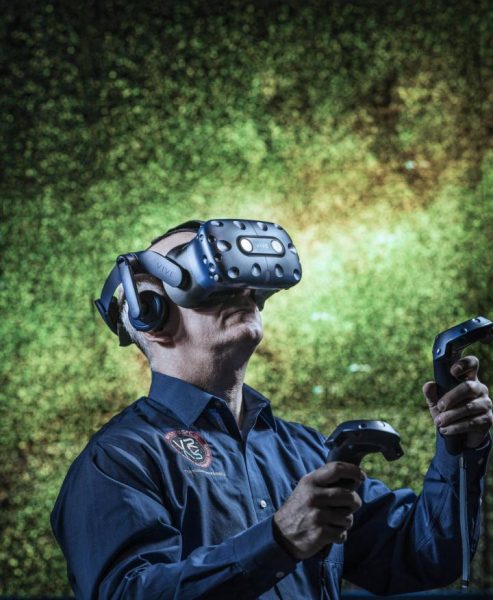
Goddard’s virtual reality team, managed by Thomas Grubb, animated those same stars, revolutionizing the classification process and making the groupings easier to see, Higashio said. They found stars that may have been classified into the wrong groups as well as star groups that could belong to larger groupings.
REALIZING A VISION
The discovery realized a vision for Goddard Chief Technologist Peter Hughes, who saw the potential of VR to aid in scientific discovery when he began funding engineer Thomas Grubb’s VR project more than three years ago under the center’s Internal Research and Development (IRAD) program and NASA’s Center Innovation Fund [CuttingEdge, Summer 2017]. “All of our technologies enable the scientific exploration of our universe in some way,” Hughes said. “For us, scientific discovery is one of the most compelling reason to develop an AR/VR capability.”
See the full story here: https://www.advancedsciencenews.com/better-than-reality-nasa-scientists-tap-virtual-reality-to-make-a-scientific-discovery/
This Digital Evolution May Lead to Disruption
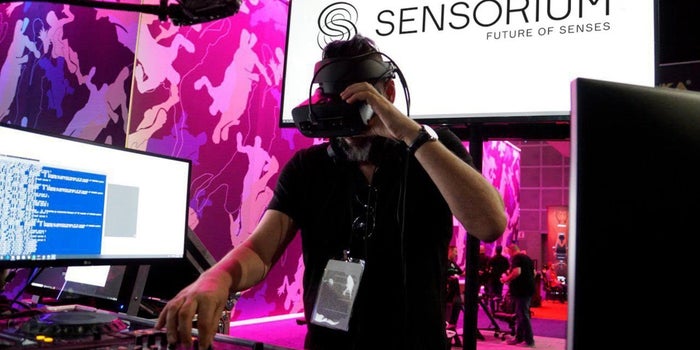 Today we live in little bubbles of digital solitude, which are ironically amplified by modern social networks and existing VR experiences that you engage with as an isolated individual. Social VR, on the contrary, is a portal into an environment wherein people from all over the world can gather together and share new experiences.
...
The Galaxy is also inhabited by computer-controlled characters. Their behaviors are driven by genetic algorithms, so they evolve and acquire skills and interests not unlike their real-life counterparts. Each artificial character is an individual, with a set of traits, and personal relationships with real users. Content and platform developers don’t control the evolution of the characters and do not define their characteristics, they occur naturally over a period of time. They socially engage with users: talking to them, going to events together, introducing people to each other, matching interests and so on. And these characters will inhabit each planet, further reflecting the different planetary themes. ...
Between 2018 and 2023, the compounded annual growth rate (CAGR) of the spending on the VR/AR sector in China will reach 84.6 per cent, according to IDC. In contrast the CAGR of the global market is only 78.3 per cent. So in terms of VR/AR, it clearly offers enormous potential but is there a corresponding broadband infrastructure that will help you reach a wide audience?
Broadband infrastructure demands for Sensorium Galaxy VR client are only slightly more demanding than for any of the 3D multiplayer online games currently on the market such as Fortnite and Call of Duty. 2D streaming, on the other hand, requires substantially more bandwidth than an average video stream on YouTube. Global roll-out of 5G networks would make it possible for us to stream 6K and even 8K panoramic content to users who experience Sensorium via smartphones, laptops and so on, instead of VR hardware.
See the full story here: https://www.entrepreneur.com/article/345688
New Streaming Service Quibi Set To Incorporate Artificial Intelligence
 Quibi was launched in Las Vegas this month, where Whitman said the service already had the support of big US companies, including Walmart, Taco Bell, Google and T-Mobile.
But Quibi’s streaming structure has already positioned the company differently to other similar services. It’s news, movies and TV shows are set to be sliced into ten-minute digestible segments on a phone device.
These entertainment bites – set to be between six to 10 minutes long – are suited for the new age of media viewing, for people with short attention spans, on the go or are simply watching during breaks.
But Quibi’s segmented episodes aren’t just about length – they also create content designed exclusively for mobile or tablet viewing, which primarily targets millennials and Gen Z audiences.
Whitman said the phone has created new opportunities for storytelling and that producers can now incorporate the use of touch screen, camera or GPS to engage viewers in a story.
For example, Whitman said Steven Spielberg is considering making a scary show that can only be viewed after dark. A producer may make the viewers phone to vibrate during a scene of an earthquake.
All content will also be downloadable under plans for offline viewing, similar to Spotify’s music downloading service for paid users.
Quibi is also leveraging Artificial Intelligence (AI) through machine learning, which will examine what viewers are watching and will then recommend content at certain times of th day.
The new streaming service will be launched in the US on 6 April for US $5 a month with ads or US $8 a month without them.
See the full story here: https://www.channelnews.com.au/new-streaming-service-quibi-backed-hollywood-silicon-valley/