New York tenants fight as landlords embrace facial recognition cameras
 At Atlantic Plaza Towers in the Brownsville neighborhood of Brooklyn, the landlord, Nelson Management Group, is moving to install a new system to control entry into the buildings. It would use facial recognition to open the front door for recognized tenants rather than traditional keys or electronic key fobs.
More than 130 tenants have, however, filed a formal complaintwith the state seeking to block the application.
“We do not want to be tagged like animals,” said Icemae Downes, who has lived at Atlantic Plaza Towers since it opened 51 years ago. “We are not animals. We should be able to freely come in and out of our development without you tracking every movement.”
“The vast majority of commercial deployments are secret,” said Alvaro Bedoya, the founding director of the Center on Privacy & Technology at Georgetown Law.
“This turns people’s expectations upside down about their privacy. In 2019, most people expect that when they log online, they’re going to be tracked in some way,” he said. “In public, in real life, most people still think they can be a face in the crowd. And up until the deployment of facial recognition technology, they were right … This lets people be tracked in the real world like they are online, and I think that is a pretty basic invasion into our lives.”
The Looking Glass Pro might be the weirdest all-in-one PC ever

Copyright 2006 Phoebe Cheong, all rights reserved
The Looking Glass Pro is an all-in-one gaming PC that’s focused on one thing, visualizing 3D content on its bizarre lenticular display that makes you feel like you’re staring into a glass box filled with pixels. The embedded 4K display renders dozens of potential views and pipes them out as lower-res slices through some bizarre lens wizardry so that users can see the onscreen content in volumetric 60fps 3D without needing glasses.
The whole premise for this thing is weird and cool but also super expensive. The original 15.6″ Looking Glass display was $3,000; this thing is $6,000. The workstation is available for pre-order now and ships in July.
see the full story here: https://techcrunch.com/2019/05/28/the-looking-glass-pro-might-be-the-weirdest-all-in-one-pc-ever/
Leap Motion, Once a Virtual-Reality High Flier, Sells Itself to U.K. Rival
 Leap Motion Inc., a virtual-reality startup that helped pioneer gesture tracking technology, has agreed to sell itself to British rival UltraHaptics Ltd. for approximately $30 million, according to people familiar with the matter—about a 10th of its valuation just a few years ago.
UltraHaptics will take on Leap Motion’s patents and staff, mostly engineers who now number close to a dozen people, including co-founder and Chief Technology Officer David Holz. Leap Motion’s chief executive and co-founder, Michael Buckwald, won’t stay at the company.
UltraHaptics, a 116-person company based in Bristol, England, has been licensing Leap Motion’s technology for the past six years for its own hardware technology: using focused sound waves to create the sensation of touch in midair.
One of the company’s recent contracts is a proof of concept project for a car maker that will allow drivers to control their entertainment system by “feeling” buttons in the air above a dashboard, said Chief Executive Steve Cliffe. “Humans generally interact by talking and gesturing,” he said. “It’s about human interfaces going forwards.”
See the full story here: https://www.wsj.com/articles/leap-motion-once-a-virtual-reality-high-flier-sells-itself-to-u-k-rival-11559210520
HOLLYWOOD IS QUIETLY USING AI TO HELP DECIDE WHICH MOVIES TO MAKE
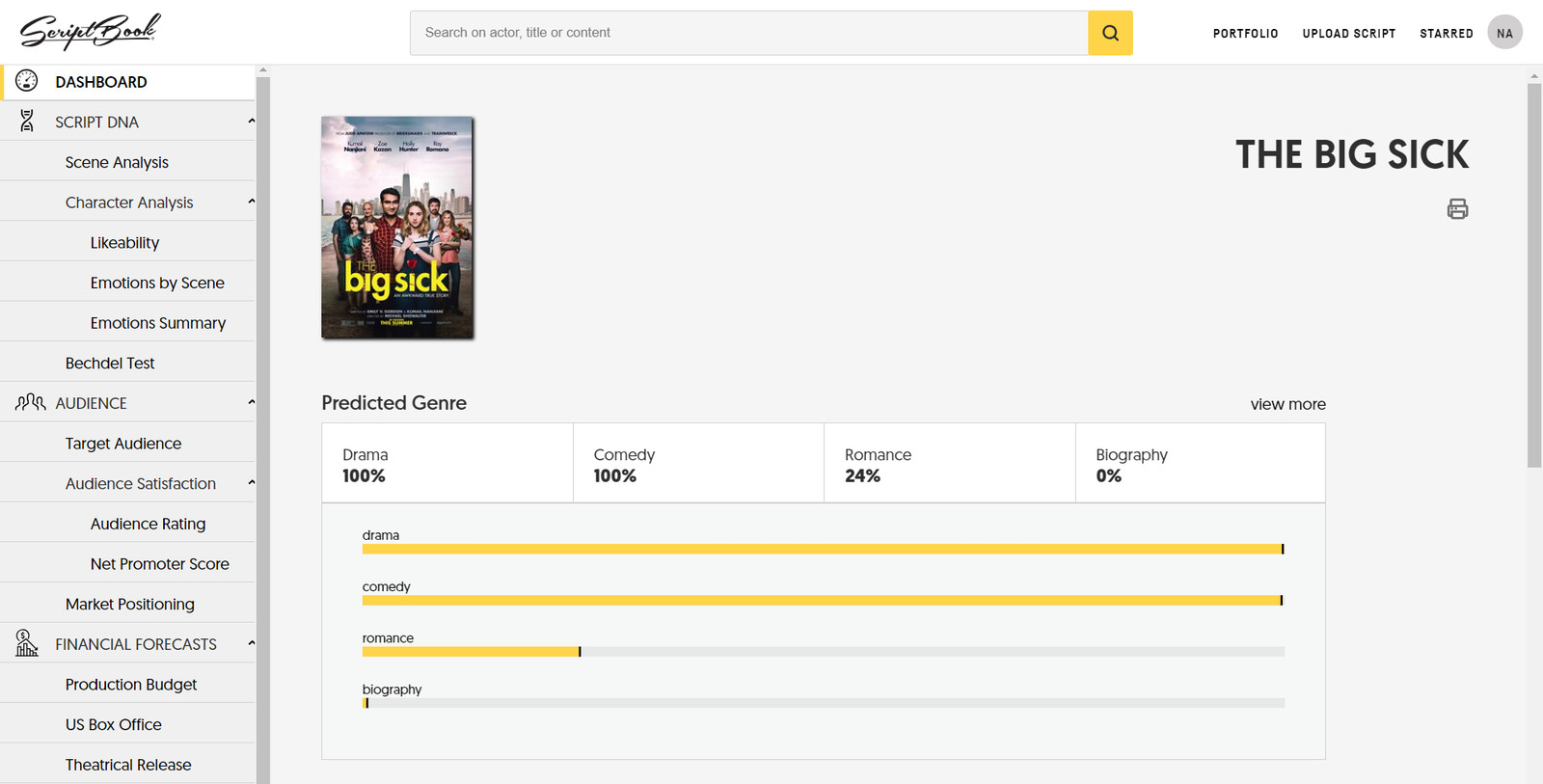
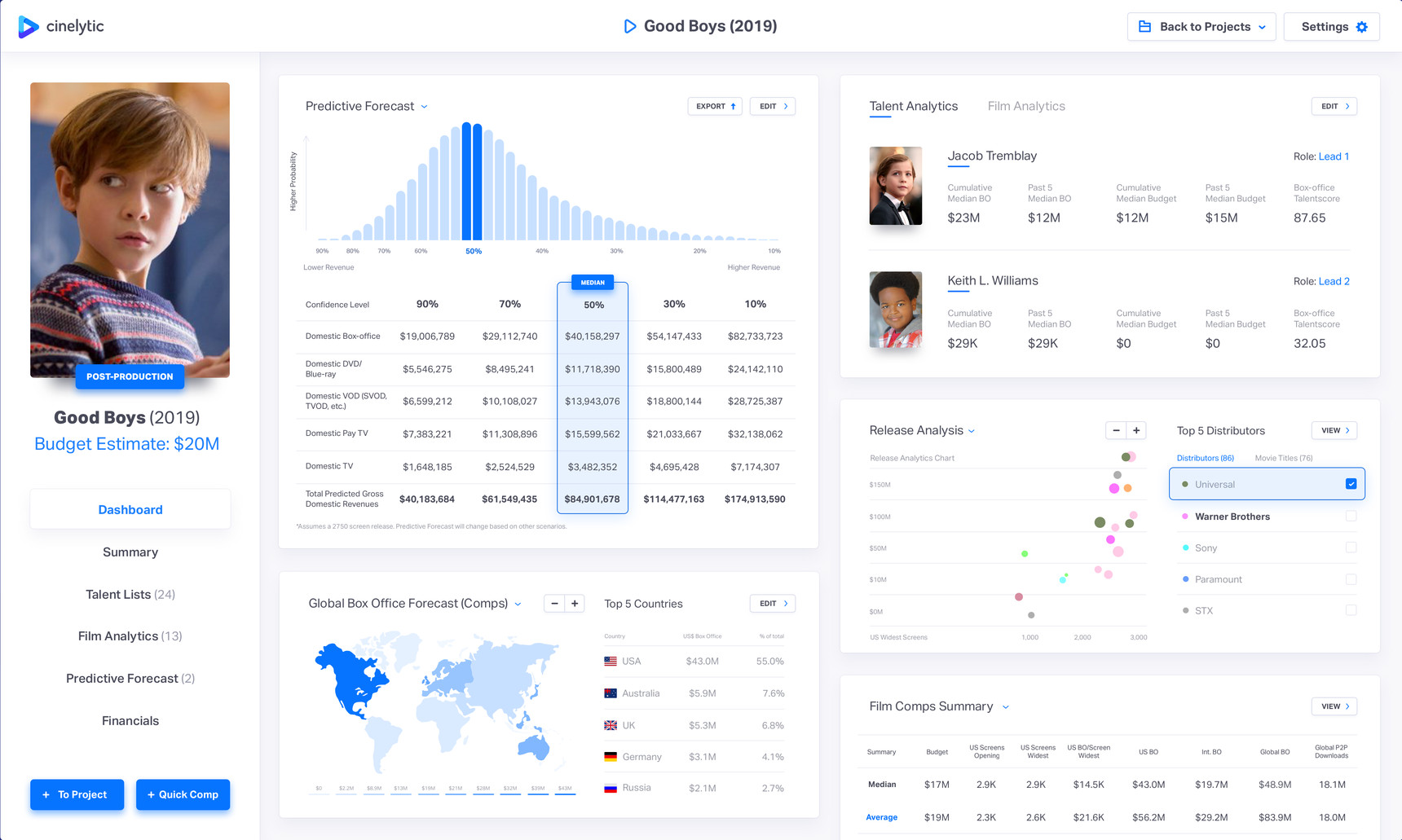 Los Angeles-based startup Cinelytic is one of the many companies promising that AI will be a wise producer. It licenses historical data about movie performances over the years, then cross-references it with information about films’ themes and key talent, using machine learning to tease out hidden patterns in the data. Its software lets customers play fantasy football with their movie, inputting a cast, then swapping one actor for another to see how this affects a film’s projected box office.
Cinelytic isn’t the only company hoping to apply AI to the business of film. In recent years, a bevy of firms has sprung up promising similar insights. Belgium’s ScriptBook, founded in 2015, says its algorithms can predict a movie’s success just by analyzing its script. Israeli startup Vault, founded the same year, promises clients that it can predict which demographics will watch their films by tracking (among other things) how its trailers are received online. Another company called Pilot offers similar analyses, promising it can forecast box office revenues up to 18 months before a film’s launch with “unrivaled accuracy.”
The water is so warm, even established companies are jumping in. Last November, 20th Century Fox explained how it used AI to detect objects and scenes within a trailer and then predict which “micro-segment” of an audience would find the film most appealing.
But Kang Zhao, who co-authored the paper along with his colleague Michael Lash, cautions that these sorts of statistical approaches have their flaws.
One is that the predictions made by machines are frequently just blindingly obvious. You don’t need a sophisticated and expensive AI software to tell you that a star like Leonardo DiCaprio or Tom Cruise will improve the chances of your film being a hit, for example.
Algorithms are also fundamentally conservative. Because they learn by analyzing what’s worked in the past, they’re unable to account for cultural shifts or changes in taste that will happen in the future. This is a challenge throughout the AI industry, and it can contribute to problems like AI bias. (See, for example, Amazon’s scrapped AI recruiting tool that penalized female candidates because it learned to associate engineering prowess with the job’s current male-dominated intake.)
See the full story here: https://www.theverge.com/2019/5/28/18637135/hollywood-ai-film-decision-script-analysis-data-machine-learning?_hsenc=p2ANqtz-9G5YyV6LtFvbShOjLSt2NyrZgKGOL9bSR_9FqeNbM4hIHJ4PxAOGVjsDjsQra6WT9Jj7jTgj16JUos457fvyzjvB-YIw&_hsmi=73140734
Virtual reality: how women are taking a leading role in the sector
 Despite a well-documented gender imbalance within the tech industry, a recent survey suggests that when it comes to VR, women are starting to take up leadership roles in greater numbers
See the full story here: https://www.theguardian.com/careers/2019/may/28/virtual-reality-how-women-are-taking-a-leading-role-in-the-sector
How Games Conquered the Movies

Keanu Reeves stars as 'John Wick' in JOHN WICK: CHAPTER 3 - PARABELLUM.
I thought of this while watching John Wick 3 last night. (Which I loved, as I did 1 and 2.) It’s not just that its ballet of bullets — especially the one with the dogs — are so like video games, in both structure and form, that they seem to have been practically been torn from a controller; you can practically see health bars and Stun markets hovering over the heads of the characters.
It’s also that the series’s primary costars, after Keanu — with apologies to Halle Berry and Ian McShane — is not any other individual character, but the world of John Wick, the Continental, and the High Table. Worldbuilding has long been a first-class citizen in video and tabletop role-playing games; now it has graduated to movies as well.
Jason Bourne and James Bond were superspies, but they didn’t really get better over the course of their series, or become so ridiculously puissant that they can casually take out a dozen heavily armed/armored expert fighters in thirty seconds, singlehandedly, as Shaw does in the trailer of the new Fast & Furious movie. Most of Jason Bourne’s action sequences are escapes; most of John Wick’s are hunts. And of course “one hunting a horde” has been the basic mode of first-person shooters since long before Doom.
Ultimately, video games have expanded Hollywood’s possibility space, and to my mind that’s always a good thing. Is it a universal rule that when technology introduces a new medium of storytelling, old media soon adopts the new medium’s styles and tropes? Did plays become more like novels after Don Quixote? Did radio become more like television after TV was introduced? And if/when we figure out the most compelling structure(s) for AR/VR storytelling, will video games become more like that? It seems fairly inevitable to me that the answer is yes.
See the full story here: https://techcrunch.com/2019/05/26/how-games-conquered-the-movies/
Google Uses AI Classifier to Sanitize YouTube Home Page
 The system “analyzes feedback from users who report videos that are misleading, clickbait-y and sensational … [and] also taps other data on audience retention, likes and dislikes.” A Google spokesperson noted, “It looks for titles or thumbnails that misrepresent the content of the video or include offensive language, among other things.”
According to Bloomberg, however, “current and former employees say the company has only seriously focused on the problem when money is at stake, or — in the case of terrorist content — when outside pressure has forced it to act.” The classifier system has been successful, and “Google recently told marketers that ‘watch time’ on YouTube’s homepage and app grew tenfold in the past three years.”
See the full story here: http://www.etcentric.org/google-uses-ai-classifier-to-sanitize-youtube-home-page/
Move over Ready Player One — the future of AR might be in furniture
 Modsy is developing a platform that lets property owners create virtual renderings of rooms and restyle them in real time. So that means 3D automation, plus virtually positioning furniture items, combined with a marketplace where you can buy the items. Modsy’s tech replicates rooms in 360 degrees, with furniture from dozens of well-known brands. It’s a powerful combination.
Planner 5D is a design tool that lets you create floor plans and interior designs using VR and AR. But its approach is different.
It first learns about how the house is used and then automatically creates a design. The startup claims its users have already designed more than 80 million projects without requiring any special design or software skills.
In the meantime, it’s easy to see why apps like this are taking off. The average interior design costs for a U.S. homeowner are between $2,000 and $8,300, so using these apps can be a huge cost saving.
See the full story here: https://techcrunch.com/2019/05/28/move-over-ready-player-one-the-future-of-ar-might-be-in-furniture/?ncid=tcdaily&utm_medium=TCnewsletter&tpcc=TCdailynewsletter
IBM-Maersk blockchain shipping consortium expands to include other major shipping companies
 Last year IBM and Danish shipping conglomerate Maersk announced the limited availability of a blockchain-based shipping tool called TradeLens. Today, the two partners announced that a couple of other major shippers have come on board.
The partners announced that CMA CGM and MSC Mediterranean Shipping Company have joined TradeLens. When you include these companies together with Maersk, the TradeLens consortium now encompasses almost half of the world’s cargo container shipments, according to data supplied by IBM .
The hope is that by using blockchain to solve the problem, all the participants can easily follow the flow of shipments along the chain and trust that the immutable record has not been altered at any point.
The blockchain provides a couple of obvious advantages over previous methods. For starters, [Wieck said] it’s safer because data is distributed, making it much more secure with digital encryption built in. The greatest advantage though is the visibility it provides. Every participant can check any aspect of the flow in real time, or an auditor or other authority can easily track the entire process from start to finish by clicking on a block in the blockchain instead of requesting data from each entity manually.