Social VR App vTime Opens a Window to Augmented Reality Users with iOS & Android App
 Battle tested for years in the realm of virtual reality, vTime is finally bringing its immersive social chat experience into AR.
In order to wrap your head around this idea, first it's important to explain what vTime is. For the last few years, vTime has allowed VR users to meet each other in VR using avatar bodies via headsets like the Oculus Rift, Samsung Gear VR, Oculus Go, Google Daydream, and Windows Mixed Reality headsets.
Also, the VR app doesn't just allow you to meet other people (well, their avatars) in VR, but you can all move to different environments and rooms while talking (on a beach, on a mountain top, around a campfire, or on a moving train), which makes the VR experience feel a lot more immersive and not unlike using a Star Trektransporter to hold meetings in various virtual places.
Now, the new AR Mode in the vTime mobile app for iOS and Android devices supporting ARKit and ARCore allows users to interact with social VR users without the need of a VR or AR headset. This new dynamic, which was teased about a year ago, opens vTime's hidden VR world up to AR users who prefer to keep one foot in the real world while engaging other vTime users.
Like many ARKit and ARCore apps, the process starts by using your smartphone to scan for a nearby surface. After you've established a surface scan, you place the virtual environment in your real world space and either monitor or engage various vTime virtual chat sessions.
The app is free and only requires the creation of a user account.
See the full story here: https://mobile-ar.reality.news/news/social-vr-app-vtime-opens-window-augmented-reality-users-with-ios-android-app-0194004/
Zuckerberg to meet UK minister after damning ‘digital gangsters’ report
 BBC News reports that Wright will have just 30 minutes to talk with Zuckerberg. However, he should be able to hold the CEO’s attention given that the UK is currently preparing new regulations that will make online platforms more responsible for the content published on their sites and apps. Wright said as much in his press statement, noting that “the era of self-regulation is coming to an end.”
The UK is expected to announce its new regulatory framework in the coming weeks. Reports suggest that the framework won’t make platforms as liable for content as traditional publishers, but that there will be new restrictions, as well as a possible independent regulator and mandatory code of ethics.
See the full story here: https://www.theverge.com/2019/2/21/18234439/zuckerberg-meet-uk-minister-jeremy-wright-regulations-platforms
Diller and Spielberg on the Growing Dominance of Streaming
 In the debate over whether a streaming release, such as Netflix’s “Roma,” should be considered for an Oscar for Best Picture, “Spielberg seems to be on the side that feels that streaming-service releases shouldn’t be eligible at big awards shows because, regardless of length or storytelling mode, they’re primarily intended for a home viewing platform.”
“Once you commit to a television format, you’re a TV movie,” Spielberg said last year. “You certainly, if it’s a good show, deserve an Emmy, but not an Oscar.” But Spielberg has also championed the kind of smaller films made by outlets like Netflix and HBO, expressing concerns over the studios’ focus on blockbusters based on franchises.
See the full story here: http://www.etcentric.org/diller-and-spielberg-on-the-growing-dominance-of-streaming/
Amazon Aims for Quality Not Quantity With 30 Films Per Year
 The New York Times reports that Salke, who was previously a successful executive at NBC and 20th Century Fox Television, said Amazon didn’t have “diverse-enough points of view in the storytelling.” Moving forward, Amazon plans to release about 30 original movies a year, with budgets ranging from “a few million dollars up to $50 million or more,” not all of which will be released in theaters.
Ten movies a year will have “exclusive runs in theaters,” including “The Aeronauts,” an upcoming movie that stars Eddie Redmayne and Felicity Jones as hot air balloon adventurers, and the comedy “Late Night,” starring Emma Thompson and Mindy Kaling. The exclusivity window in movie theaters may be shortened to bring them to Prime Video more quickly.
According to Amazon’s Matt Newman, who along with Julie Rapaport and Ted Hope is one of three such execs Salke named to co-head the film division, “it’s really about creating that right marketing campaign, right distribution plan for each movie, allowing us to break through the cultural noise and really resonating with customers.”
See the full story here: http://www.etcentric.org/amazon-aims-for-quality-not-quantity-with-30-films-per-year/
Hoorah Digital acquires Ritual Studio
Digital consultancy, Hoorah Digital, has acquired creative storytelling agency, Ritual Studio, the agency founded in 2017 by creative and former Hellocomputer ECD, Simon Spreckley. Under the terms of the deal, Ritual Studio will be fully merged into Hoorah Digital.

Shaune Jordaan
According to Shaune Jordaan, Hoorah Digital CEO and co-founder, the acquisition is a chance for the consultancy to ramp up its creative capabilities. Ritual Studio combines expertise in user experience (UX), user interface (UI) design, CGI, animation, and gaming to enhance storytelling; since its founding, it has worked on projects for Standard Bank, Dragon Energy Drink, and Sneaker Lab.
“Most people think of performance marketing as being all about data and dry numbers,” says Jordaan, “but the truth is that data is most powerful when its combined with world-class creativity and storytelling. By bringing Ritual Studio in the Hoorah Digital family, we’re getting a wealth of creative talent that also understands how brands can translate great customer interactions into tangible business.”
See the full story here: http://www.marklives.com/radar/hoorah-digital-acquires-ritual-studio/
Facebook’s Kate McKinley to speak about augmented and virtual reality
 Engineers week continues Thursday with Kate McKinley, a security leader at Facebook Augmented Reality/Virtual Reality, giving the keynote lecture discussing her work of Virtual Reality (VR) technology and what the future holds for the platform.
"[McKinley] has worked previously at Mozilla, Netflix, iSEC Partners, and more as a developer, security engineer, and security expert," according to the Lectures Program website. Since then, she has been with Facebook to help develop virtual reality and augmented reality technology for the general public to use.
See the full story here: http://www.iowastatedaily.com/news/engineer-keynote-kate-mckinley-lecture-vr-virtual-reality/article_6e927012-349e-11e9-8bf7-f34878c747d3.html
A Virtual Reality App that Reconstructs Ancient Rome May Have Exploited Its Developers
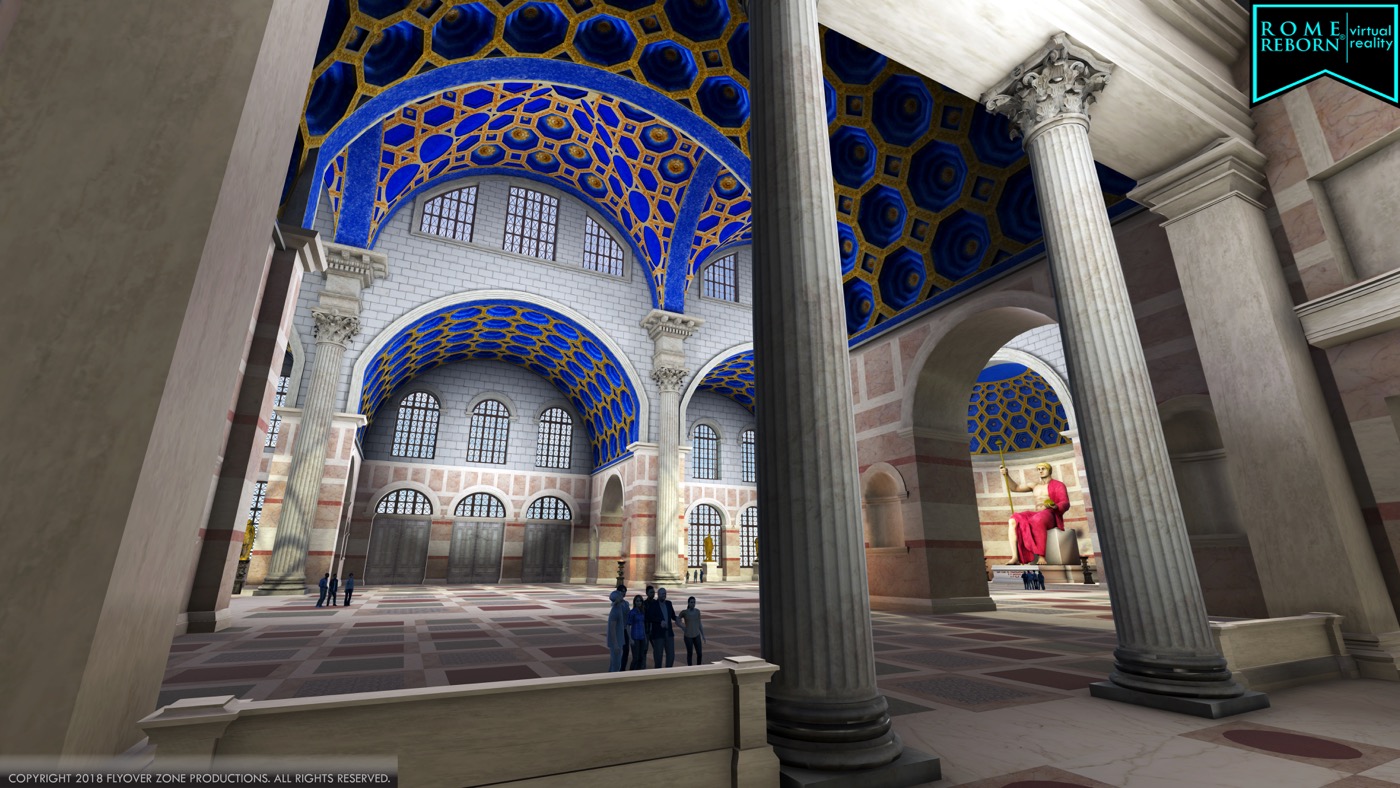
 Ancient Rome wasn’t built in a day and neither was Rome Reborn. Since 1996, the Rome Reborn project has depended upon dozens of researchers to build sophisticated three dimensional models of antique structures that capture the dynamic architectural history of the Eternal City. Details such as painted (i.e. polychromatic) marbles and statues have been painstakingly inserted into the urban city plan. As a result, not only the structures, but also the vibrant color of the ancient world have been revivified. Helmed by project director and classicist Bernard Frischer, the ultimate goal of the project is to rebuild a shifting, interactive model of the city that extends from just before its mythical founding date in 753 BCE to the middle of the reign of the late Roman emperor Justinian around 550 CE, during the period of the Gothic Wars. Right now, viewers are limited to a bird’s eye flyover of the entire city, a tour of the Roman Forum, and a walk-through of the Basilica of Maxentius in the early 4th century CE.

La maquette de Rome à l'époque de Constantin (306-337) réalisée par Italo Gismondi entre 1933 et 1937. Cette maquette de 200 m de long est présentée au musée de la civilisation romaine à l'EUR à Rome. Elle est à l'échelle 1/250.
Over two decades, the various versions of Rome Reborn have been developed by dozens of artists, classicists, archaeologists, and 3D modelers at numerous institutions. The virtual reality tour of the city started as a digital humanities project at the University of California at Los Angeles, where architectural historians like Diane Favro and 3D modelers such as Dean Abernathy contributed to its early development and later launch. Frischer then moved the project to the University of Virginia and then finally to Indiana University, while also developing a for-profit company that created games and media focused on ancient Rome.
Looking at the modest (but still not paltry) cost of the products connected to Rome Reborn, some digital humanists have questioned whether it is ethical to profit personally from a virtual project that has benefitted so mightily from the public investment in digital humanities and heritage preservation made over the last few decades. Although universities and funding agencies have developed mechanisms for allowing project directors to acquire the copyright to cultural heritage models, debates over this area of 3D modeling are still being waged. In comments to Hyperallergic, Ethan Gruber, now the Director of Data Science at the American Numismatics Society, noted his current unease with the project, which he previously worked on from 2007 to 2008, while at UVA:
As a staunch proponent of open data and open access to cultural heritage, I am disappointed to learn that the contributions made in good faith to promote the free and open proliferation knowledge have been commercialized. I am shocked that a project developed largely with taxpayer funding has been trademarked by a private company registered to Bernie Frischer himself.
In the future, Rome Reborn plans to expand into the area of the Colosseum and sell an interactive experience centered on the Roman Pantheon, as well as other well-known sites in Rome. The project is itself a testament to how far the field of digital cultural heritage has come and will no doubt spark interest anew in 3D interactions with the cities of the past. Yet for all the majesty that this virtual experience brings, the project and its products still pose questions about how we cite and credit those who have developed long-term digital heritage projects over the longue durée, who should profit from their sale, and whether such cultural heritage content should be more available to the public in an open-access repository.
See the full story here: https://hyperallergic.com/480239/a-virtual-reality-app-that-reconstructs-ancient-rome-may-have-exploited-its-developers/
Walmart subsidiary Spatial& has crafted a VR experience for store parking lots
Walmart is bringing 50-foot tractor trailers to a few of its stores' parking lots that will contain a virtual reality (VR) experience with a "How to Train Your Dragon" theme, CNBC reports.
 Business Insider Intelligence
 By sitting in VR-powered chairs and wearing VR headsets, users can see, feel, and smell sensations that make them feel like they're in the movie.
And the new Spatial& VR technology has potential for future applications such as letting users test camping gear or visit the vineyard that Walmart's wine comes from, CEO of Spatial& Katie Finnigan told CNBC.
See the full story here: https://www.businessinsider.com/walmart-subsidiary-spatial-how-to-train-your-dragon-virtual-reality-experience-2019-2