More than paint on a wall: Hands-on with VR and AR in art museums from Chicago to Seattle
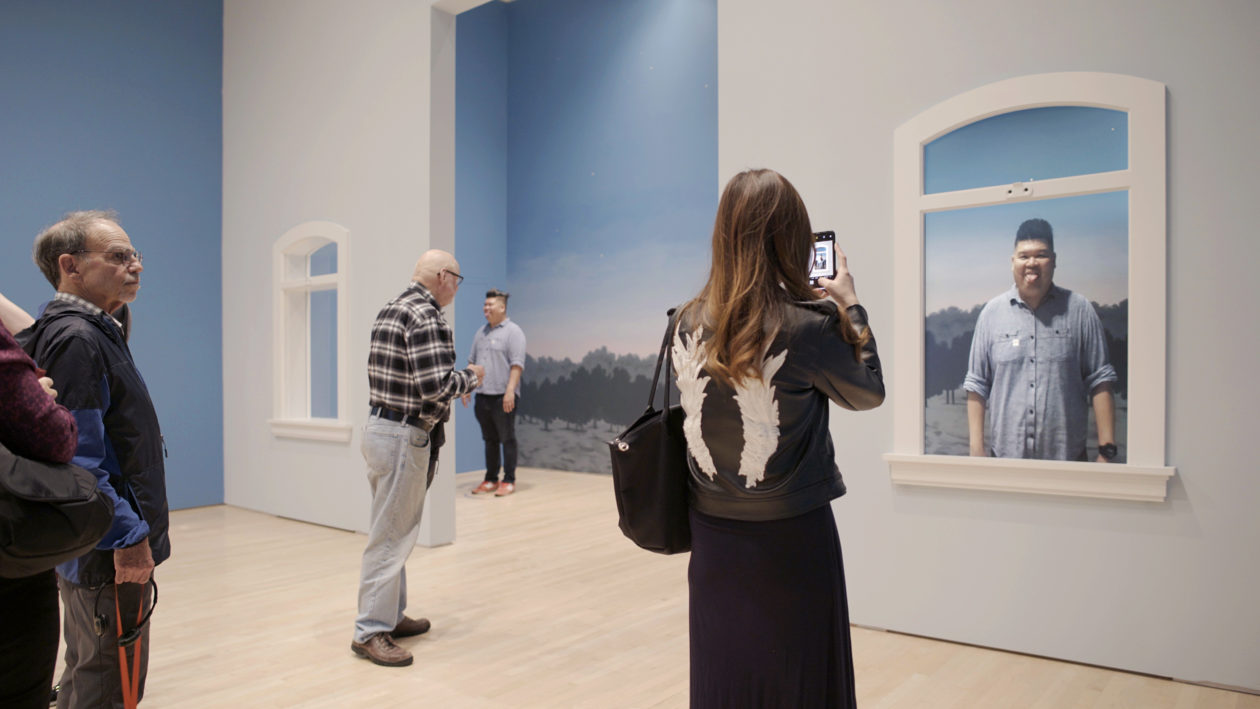 My juried verdict? AR/VR applications can be be startling and cool, or just museum pieces that don’t do much more than add a layer of technological lacquer to the art.
Seattle Art Museum’s “Double Exposure”
But the portrait animations were mesmerizing, adding a magical depth to the work on the wall. A static figure holding a violin was now playing it. A woman wearing an elaborate Native dress was suddenly dancing in it.
Museum of Contemporary Art Chicago’s “I Was Raised on the Internet”
However, neither VR experience appeared real enough to fully immerse me, and the reason may have to do with how quickly our expectations of technology change. Daniel Steegmann Mangrané’s Phantom was created in 2014-15; Jon Rafman’s Transdimensional Serpent, in 2016.
As to my observation of the outdated appearance of some of the VR, Wexelblatt said it actually may provide useful context. “If anything, the aging process opens the door for future viewers and art historians to contend with the convergence of technology and aesthetics at a particular moment in time,” she said.
San Francisco Museum of Modern Art’s “René Magritte: The Fifth Season”
Maybe the best way to understand surreality and abstraction in art is to become one with it, inside a participatory gallery at the end of a special exhibition. That’s what the well-known San Francisco-based design firm Frog (it helped shape the Apple IIc and several early Macintosh models), has done for the San Francisco Museum of Modern Art’s wide-ranging retrospective of the surrealist Rene Magritte.
See the full story here: https://www.geekwire.com/2018/paint-wall-hands-vr-ar-art-museums-chicago-seattle/
I rode half of the world’s longest zipline in virtual reality
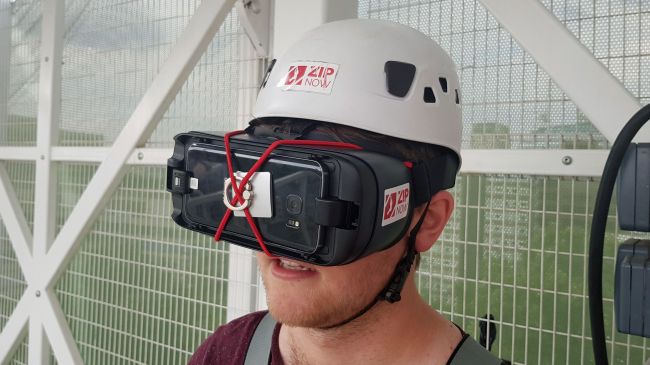 It was a modified version of the headset with the plastic casing from the front removed and some super secure bungee ropes holding in a Samsung Galaxy S7 so it wouldn't fall down and smash on someone's head. I was then asked to put it on at the top of the 35 meter tall tower for my second ride.
If I hesitated after it told me to jump, the video would just go ahead anyway and resetting the headset would mean holding up the queue of paying customers stood behind me. That was it – I had to jump.
I had that slight moment of panic as I set off and the rope became taught. Suddenly I had the surreal moment of being transported to a gorge full of sand in the United Arab Emirates.
This is by far the most terrifying experience I've had in virtual reality, and while I won't be clamoring to jump out of a plane or parasailing with a Samsung Gear VR on my face.
You can now ride the VR zipline at Zip Now in Archbishop's park in London and is open now everyday until September 9, 2018.
See the full story here: https://www.techradar.com/news/i-rode-half-of-the-worlds-longest-zipline-in-virtual-reality
Magic Leap Gives the World a Peek at Lumin OS
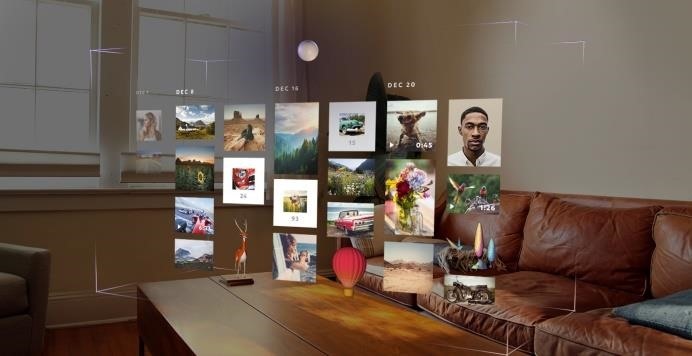 The screenshots follow on the heels of the preview release of the Lumin Runtime, which enables multiple apps to run within the user's field of view, or landscape. Note that access to the more detailed information requires registration with the Creator Portal, but that's basically just sharing your email address.
"Like desktop computing, you can use one app at a time, or you can also have many apps open simultaneously. Since this is spatial computing, to use an app you simply look at it and then interact with it. You can naturally spread your apps around in actual space, just like you would with furniture or posters on a wall. This is your mixed reality landscape," states Magic Leap's technical documentation.
One very interesting revelation is casting, which enables ML1 users to share their view with others, who are able to view the host user's displayed content relative to the ML1's position. While the cast icon looks similar to the share icon in Android, actual media sharing will occur through the Gallery app.
We get a look at the app launcher in motion, voice detection feedback, and gesture-based menu selection, as well as LEDs on the Lightpack and controller reminiscent of the Amazon Echo.
The Macallan Created a Virtual Reality Tour in Grand Central Station of Its New Whisky Distillery
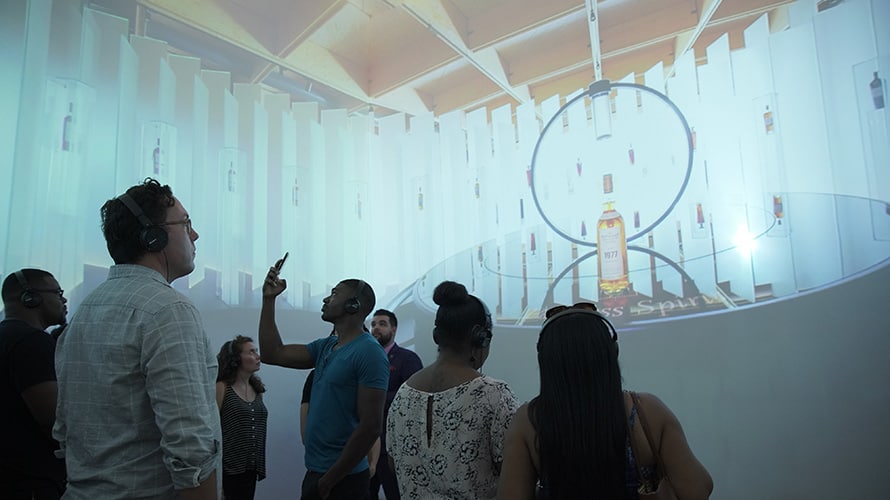 To celebrate the opening of its new $186 million distillery, Macallan has taken over a wing of Grand Central Station in Manhattan with a VR tour that lets New Yorkers and visitors alike see at least a few scenes of the 194-year-old brand’s new location in Speyside.
From Wednesday until Friday afternoon, visitors can stop by the Vanderbilt Hall to walk inside a 15-foot cube, which uses six projectors to immerse viewers inside VR scenes that bring the viewers high above the hills of northern Scotland and deep within the aisles of casks. Meanwhile, the scent of grass and oak are diffused into the cube to provide a sensory addition to the visuals.
The VR experience isn’t just about smelling and seeing the distiller—there’s also a taste component. Each visitor gets a small quarter-ounce glass of either The Macallan’s newly released Edition No. 4 or its 12-year double cask. There’s also a wall of scents that help to further accentuate the notes within the whisky such as fig, sandalwood, orange blossoms and vanilla.
See the full story here: https://www.adweek.com/digital/the-macallan-created-a-virtual-reality-tour-of-its-new-whisky-distillery/
Virtual reality paintings possible in Moscow art gallery
 Goncharova died in 1962 in Paris where she spent much of her life. Malevich died in 1935 in the Soviet Union.
In Goncharova's studio, users can arrange items on a table and use a VR paintbrush to add colour to their design.
In Malevich's studio, it is possible to throw items at the canvas, where they turn into colourful shapes, in the style of the supremacist style which he founded.
The use of virtual reality in art has been on the rise in recent years with galleries looking for ways to use new technology to attract visitors.
The Tate Modern in London recently held a VR exhibition based on the later life of Italian artist Amedeo Modigliani.
In Moscow, the Garage art gallery put on a Bidding for Glasnost exhibition which featured a virtual reality auction.
As the technology develops, Ms Tregulova is hopeful that the Tretyakov can reach people in more remote parts of Russia.
"This could be a strong impetus for children in schools placed in towns or regions where there are no real museums, to understand that art is not something which is an obligation which is imposed on them that it's a very involving, interesting world to experience," she said.
See the full story here: https://www.bbc.com/news/technology-44977902
The New York Times’ Graham Roberts on why augmented reality is suited for hard news
 See the full story here: http://www.storybench.org/new-york-times-graham-roberts-augmented-reality-suited-hard-news/
On April 7, 2018, a chemical bomb was dropped onto the rooftop of a residential building in the Syrian city of Douma, near Damascus, killing dozens of people, many of them children. While the Syrian regime flatly denied that it had launched the attack, the United States and its allies claimed that a chlorine bomb had been dropped by the Syrian government.
In an attempt to get to the truth of the attack, The New York Times last month published an interactive investigative story that reconstructs the virtual scenes of the chemical attack and walks the readers through the key pieces of evidence – all in augmented reality.
Storybench spoke with Graham Roberts, the director of immersive platforms storytelling at The New York Times, to understand how new technologies like AR can be used for powerful news stories.
New App for Manufacturing Workers Adds AI to Google Glass
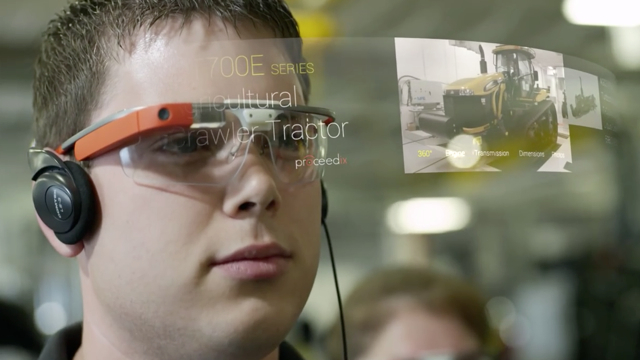 At this week’s Google Cloud Next conference, Israeli company Plataine demonstrated a new app for Google Glass, pointing to artificial intelligence as the technology that will drive the success of the spectacles. The easy-to-use app, which is aimed at factory workers, understands and replies in spoken language. Plataine’s clients already include Airbus, Boeing and GE, and the company is now working on adding image recognition capabilities to the app, which was built using Google Cloud AI services and support from the tech giant.
Wired reports that “Google is betting that charging other companies to tap AI technology developed for its own use can help the cloud business draw customers away from rivals Amazon and Microsoft.”
The app comes “roughly one year after Google abandoned its attempt to sell consumers on Glass and its eye-level camera and display, which proved controversial due to privacy concerns.”
The gadget was relaunched as Google Glass Enterprise Edition, a tool for business, and “pilot projects have involved Boeing workers using Glass on helicopter production lines, and doctors wearing it in the examining room.”
Plataine product lead Anat Karni demonstrated the app, showing how it “could tell a worker clocking in for the day about production issues that require urgent attention, and show useful information for resolving problems on the device’s display,” and also “talk to Plataine’s app to get help.” “A worker’s actions could be instantly visible to factory bosses, synced into the software Plataine already provides customers, such as Airbus, to track production operations.”
Plataine built the app by “plugging Google’s voice-interface service, Dialogflow, into a chatbot-like assistant it had already built,” and also getting support from Google partner, software contractor Nagarro.
“Spaces like manufacturing floors, where there’s no social norm saying it’s not OK to use this, are the spaces where I think it will do really well,”...
See the full story here: http://www.etcentric.org/new-app-for-manufacturing-workers-adds-ai-to-google-glass/
Facebook Launches Watch Party for Shared Viewing of Video
 In January, Facebook debuted Watch Party, an experimental feature that allows shared simultaneous viewing of videos, to a select number of users. Now, the company is opening access of the feature to all groups on the site, in an attempt to make video viewing a social experience. Groups has become an important product for Facebook’s more than 1.4 billion monthly users, and Watch Party is intended to add another compelling reason for users to stick with those who share similar interests.
With Watch Party, users can comment and add emoji in real time. In internal tests, Watch Parties generated “thousands of comments” from people watching simultaneously, “with some groups dedicating over 10 hours to a single Watch Party.” Facebook also stated that it is testing Watch Parties “with profiles, while pages (public profiles for businesses and other organizations) could get it in the near future, as well.”
In light of Facebook’s struggle with “the spread of toxic content on its site,” product manager of social video Erin Connolly noted that the company will use “all the tools at its disposal (including artificial intelligence) to ensure that Watch Parties are safe for everyone.”
Engadget points out that, “the success of Twitch has already proven that there’s a dedicated audience looking to watch Internet video with others, regardless of the genre,” making Watch Party a likely success among profiles and pages for brands and news outlets.
See the full story here: http://www.etcentric.org/facebook-launches-watch-party-for-shared-viewing-of-video/