Highly-Anticipated VR Stealth Game ‘Budget Cuts’ Arrives This Week
 Budget Cuts steps you into the shoes of an average employee-bot of mega conglomerate TransCorp, where you’re tasked with the crucial work of stamping papers and filing files. Unlucky for you however, Transcorp is infamous for its ability to pump out cost-effective robots, and as you watch as one of your fellow mechanical coworkers is banished to the horrifying HR department, you begin to realize you’ll soon be sharing the same fate. That’s when a mysterious package arrives, and you’re action-packed ninja mission through a corporate hell hole begins.
Budget Cuts is centered around stealth-based combat, having you sneak your way around enemies using an assortment of deadly weapons, and office supplies, to take down your battery-powered pursuers. The ambitious title features a full-fledged single player campaign including some top-tier voice acting.
However its the use of room-scale technology that is sure to impress you the most. You’ll find yourself constantly moving around your play space as you peak around walls, duck behind cover, dodge incoming fire, even climbing on your hands and knees to look through holes in the floor (It’s more exciting than it sounds).
Budget Cuts will be available for $30 on Steam as well as the Oculus Store when its page goes live May 31st.
NextVR Finally Launches On Vive, Rift Coming Soon
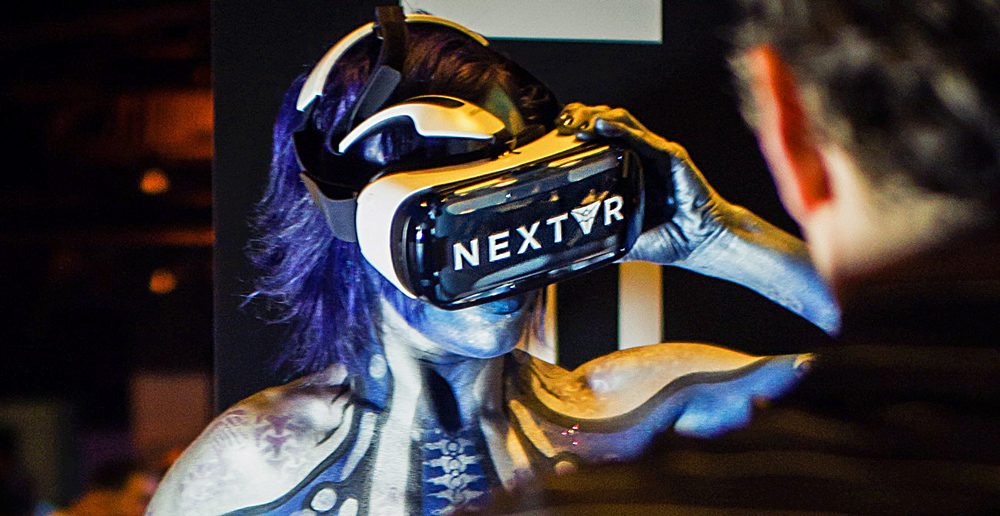 NextVR, a service that offers live sports and entertainment broadcasting in 360 degrees, this month launched on Viveport with support for both the HTC Vive and the Vive Pro. Despite launching on Gear VR years ago and even coming to Microsft’s Windows-based mixed reality devices last year, this is the first time the platform has been available on HTC’s headset. The company also told Road to VRthat a version for the Oculus Rift will be coming soon and a Steam release is on the cards too. It’s free to download on Viveport.
NextVR offers a range of 360 degree experiences as well as live programming. The app’s current lineup includes ringside viewing of WWE and boxing matches, front row access to Live Nation concerts and sideline locations for NFL games among others. In these videos, users can twist and turn their heads to look in any direction, though can actually move their heads through virtual space.
See the full story here: https://uploadvr.com/nextvr-finally-launches-vive-rift-coming-soon/
GDPR, China, and data sovereignty are ultimately wins for Amazon and Google
 However, the more interesting analysis is around who the winners of these laws will be (besides the lawyers of course). To me, it’s clear that the complexity around these data sovereignty laws ultimately benefits highly-scaled service providers who can manage the nuanced regulations around these laws in an automated fashion. That means, ironically, that Google will likely win long-term on its cloud side, along with other major cloud providers like Amazon and Microsoft Azure.
That free market in data is rapidly disintegrating as governments increasingly take an interest in data, not just for privacy reasons, but also for population thought control and economic growth purposes. For software developers writing applications, that portends a complicated world for managing global and even potentially national data laws — a context that is going to be deeply enriching for service providers who can successfully help clients navigate this new world.
These new laws can be broadly grouped under the term “data sovereignty,” which is one of those terms you say at the World Economic Forum to sound like you are in the know.
While the European Union’s GDPR regulation has gotten the most press (probably because of the several dozen emails you received about it), the EU is hardly the only government enhancing its data sovereignty. China placed into force a law requiring all cloud computing and Chinese customer data to be hosted on China-based servers, and Russia has also been blocking Google and Amazon cloud services in an increasing war with Telegram. Many other countrieshave laws affecting how data can be stored and transmitted as well.
These laws are quite different, but they all serve the same purpose — to bring data back home and ensure that the desires of a country’s people (and, of course, its leaders) can be imprinted on how that data is used.
Here’s the challenge: these laws are enormously complicated and completely incompatible with one another.
Storing your own data isn’t just risky from a security perspective, it is also increasingly untenable in the fast currents of this data sovereignty world.
GDPR has been described as an anti-Google law, but it may turn out to be the greatest forcing function to drive adoption of Google Cloud. The irony may be that the supposed losers may well turn out to be the biggest winners after all.
See the full story here: https://techcrunch.com/2018/05/29/gdpr-and-the-cloud-winners/?utm_medium=TCnewsletter
Location-based virtual reality is increasing its footprint in the U.S.
 At Two Bit Circus, which raised $15 million from investors last January, virtual reality will be about 20% of the experiences on offer. The company’s inaugural space in Los Angeles will also avail itself of projection mapping, augmented reality and other ways to immerse and entertain, Bennett promises.
It’s one reason why companies like Cinemark have announced that they’re working with The Void and other immersive, location-based virtual reality companies to create experiences in their theaters.
“Really it’s about what serves the creative goal,” says Bennett. “What I think is really cool is the opportunity to mash up the fast prototyping of the community into one space to get people to play. It isn’t just VR. There’s also new forms of play and arcades that are possible and interactive audience participation for content creation.”
See the full story here; https://techcrunch.com/2018/05/26/location-based-virtual-reality-is-increasing-its-footprint-in-the-u-s/
The birth of the Universal Digital Profile
 One key article is the right to personal data portability. In a nutshell, it states that users of a service can request their personal data to be transferred to another provider, without hindrance (read: in the format the other provider requests). This means that if you are no longer happy using a social network, you can switch to another one and have all of your personal data (profile, pictures, messages, posts, likes…) sent to the new provider. It’s the same idea as being able to keep your phone number when you change carrier, but applied to all of your personal data.
Although the definition of what constitutes your personal profile is still being debated (is it just the data you uploaded, or all the data that was derived from it? Does it include metadata?), it is safe to say that a big part of your online identity will soon be transferable across multiple providers.
As these data transfer requests become more and more common, companies will necessarily want to minimize the effort it takes to comply. The only logical thing to do to avoid having to convert data into each provider’s format is to eventually agree on standardized formats for personal data and APIs used to access them.
As this Universal Digital Profile (UDP) starts becoming mainstream, an entire new economy will emerge, from personal data clouds to personal identity aggregators or data monetization platforms.
See the full story here: https://techcrunch.com/2018/05/22/the-birth-of-the-universal-digital-profile/
Virtual reality and blockchain are taking art to the next level
 Then, of course, there’s the artwork that doesn’t exist at all, neither in this world nor a virtual one: Kevin Abosch, who famously sold a real-life photograph of a potato in 2016 for €1 million (HK$9.65 million), this Valentine’s Day sold the concept of a rose for US$1 million worth of cryptocurrency to a group of 10 collectors. The Forever Rose is an ERC20 token called ROSE on the Ethereum blockchain that is based on Abosch’s photograph of a rose. In other words, the artwork doesn’t physically exist, nor even have a virtual visual representation.
“Potato #345 and Forever Rose pose questions pertaining to identity, existence and value. They are both proxies. The former for the human experience and the latter for love,” Abosch says.
“The Forever Rose, however, is further abstracted from the photographic representation in that it doesn’t exist in a physical sense. It is the result of using blockchain technology to create a virtual proxy of the photographic work.”
....In other words, art should be put to the same scrutiny, whether it uses advanced technology or primitive tools – pigment and paper.
“Art goes beyond technology when it conveys messages and poetry, questions and emotions, dialogue and action.”
See the full story here; http://www.scmp.com/magazines/style/news-trends/article/2145198/virtual-reality-and-blockchain-are-taking-art-next-level
Students develop virtual reality program to help ex-inmates
 Graphic and industrial design students at the University of Illinois have created “immersive reality scenarios” to help prison inmates on the verge of release navigate the world outside.
Scenarios include navigating public transportation, paying for gas at the pump and ordering from a fast-food restaurant’s digital kiosk.
See the full story here; http://fox2now.com/2018/05/28/students-develop-virtual-reality-program-to-help-ex-inmates/