AR could find its way to the courtroom
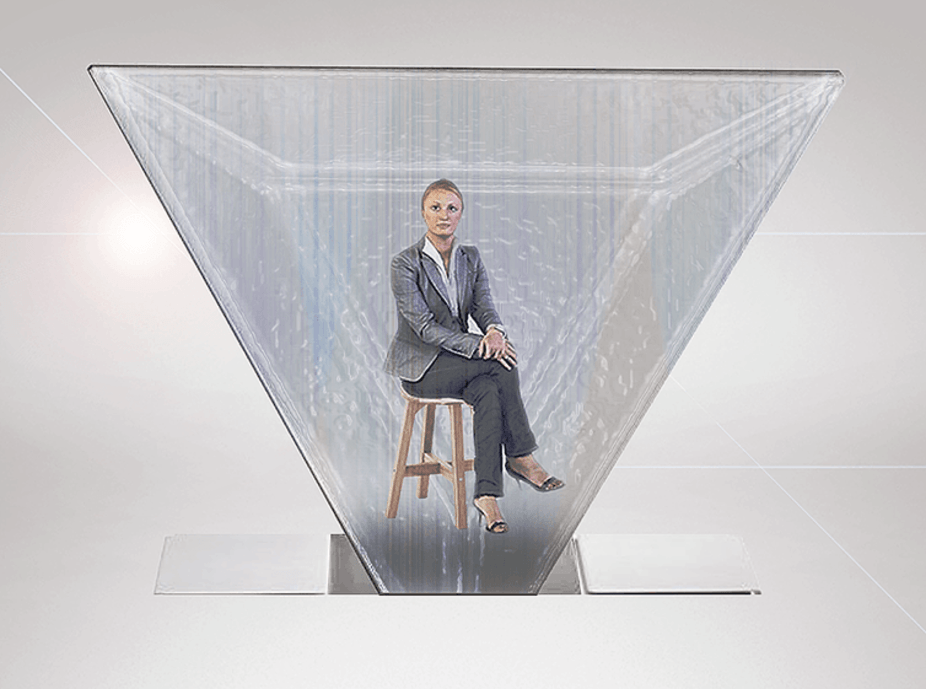 Studies have found that secondary victimisation – such as victim-blaming and insensitive behaviour from police, judges and social workers – can make victims feel violated and traumatised. Special measures and other means to testify are available but lawyers have argued that the demeanour of complainants, especially when testifying, can affect the jury’s perception and hinder their case.
Non-verbal communication such as body language plays a significant role in criminal trials, especially in sexual assault cases. Jurors use “intuition” to judge demeanour, deception and credibility from the posture, gaze and expression of witnesses. This poses a challenge in cases where special measures have been used.
A system for use in court would superimpose augmented graphic elements in specific locations, so that individuals could appear in the witness box without having ever entered the courtroom. This approach would shield vulnerable witnesses from the stress of giving testimony in person, but ensure that the jury sees a more realistic testimony. The same technology could be used in situations where evidence is given to the jury alone.
Regardless of the technology adopted, audio plays a massive part in creating realistic engagement with virtual or augmented reality environments. For jurors to feel like they are hearing a witness as if they were physically in the witness stand, spacial audio is essential. It would allow jurors to note every vocal cue or inflection during testimony.
See the full story here: http://theconversation.com/augmented-reality-how-the-technology-behind-pokemon-go-could-find-its-way-to-the-courtroom-72896
What could possibly go wrong? New augmented reality app projects messages onto nearby drivers’ windshields in a bid to end road rage
- The app projects information from a smartphone to the driver's windshield
- Users can choose a sign to display in situations where you may need to rush
- There are signs to let drivers know if you're rushing to the hospital or the airport
- To stop people from using the feature excessively to excuse speeding or bad driving, there would be a limit to how many times a user could use one of these
- The app would also allow users to send 'likes' and 'dislikes' to other drivers and the ratings could be used by insurance companies to help inform their pricing
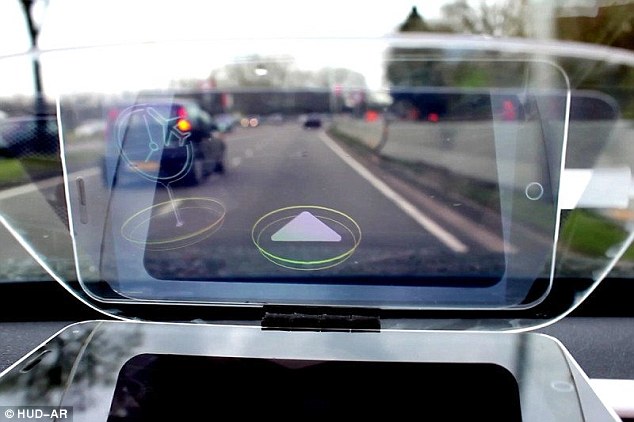 The system projects information from a smartphone add-on to the driver's windshield without blocking their view.
The app, called 'CarNote,' could be useful in situations where you're rushing to the hospital or the airport, allowing to you notify drivers as to why you're speeding or cutting them off.
See the full story here: http://www.dailymail.co.uk/sciencetech/article-4265724/Augmented-reality-display-help-reduce-road-rage.html
Beyond the Screen: The Future of Virtual & Augmented Reality in Design
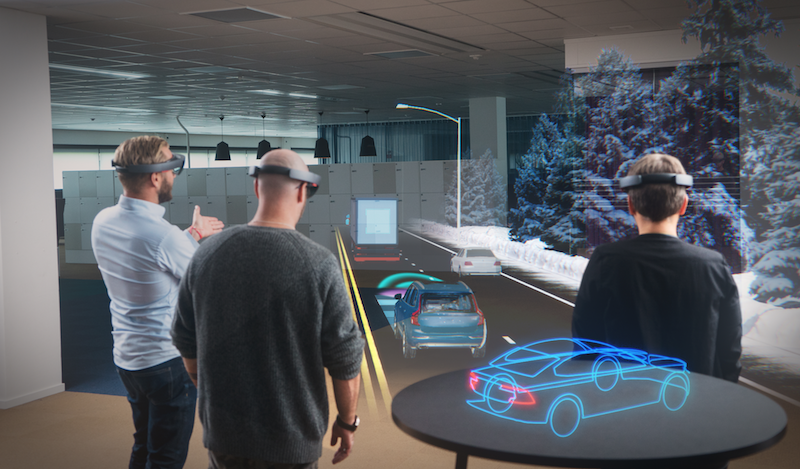 “While I fully support the idea of students becoming more familiar with programming and software development tools, I believe that it is creatives and visionaries that are needed to identify the ways in which the technology can be used.”
According to Vaughan, they will be the ones who will identify problems that can be solved using
AR technology.
Then again, why can’t students—or children, for that matter—be creative and visionary, as well as problem-solvers? AR and VR tools should enable students of all ages, especially children, to not only experience the world they live in, but also to play around and create new experiences. After all, play is serious business. And if there’s one thing children know how to do, it’s play.
See the full story here; http://www.howdesign.com/web-design-resources-technology/beyond-the-screen-the-future-of-virtual-augmented-reality-in-design/
Market for Virtual Reality Art Gets Tested at Moving Image Fair
 “I can count on two hands the collectors who are buying immersive media works,” said Moving Image fair co-founder Edward Winkleman at a preview on Monday, kicking off Armory Arts Week in New York. “But I’m encouraged for the future by the number of lawyers and doctors who are buying virtual reality headsets for their kids, and might want to use them for something more than gaming!”
All that work comes at prices that, Winkleman pointed out, are comparable to those for video works. The VR and AR works come in editions of between three and eight, and prices range from $5,000 to $25,000.
For me, the most compelling piece was one without any such overt topical concerns. Brenna Murphy’s mesmerizing installation Lattice~Domain_Visualize (2017), on view with Portland, Oregon’s Upfor Gallery, places the participant in a swirling, kaleidoscopic, bright-hued tower that seems to extend nearly infinitely above and below, with a rushing soundtrack. It comes in an edition of three plus an artist’s proof, with a price tag of $8,500 including computer, HTC Vive, and floor prints.
See the full story here: https://news.artnet.com/market/moving-image-virtual-reality-art-873725
VR industry faces reality check on sales growth
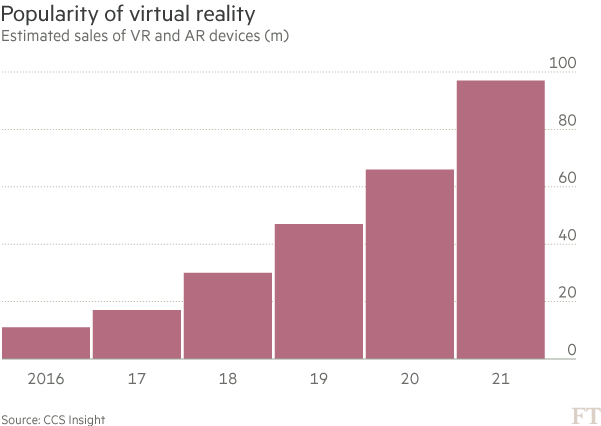
Tipatat Chennavasin, general partner at The Venture Reality Fund, an investment firm focused on the sector, has calculated that at least eight VR-only titles have generated more than $1m in revenues so far. “Even if adoption is a little slower than we’d like, the fact that people are spending in VR will continue to create a healthy ecosystem for VR developers who are smart and thinking about it carefully,” Mr Chennavasin said.
See the full story here: https://www.ft.com/content/f7e231ee-fc84-11e6-96f8-3700c5664d30
Worldwide Spending on Augmented and Virtual Reality Forecast to Reach $13.9 Billion in 2017, According to IDC
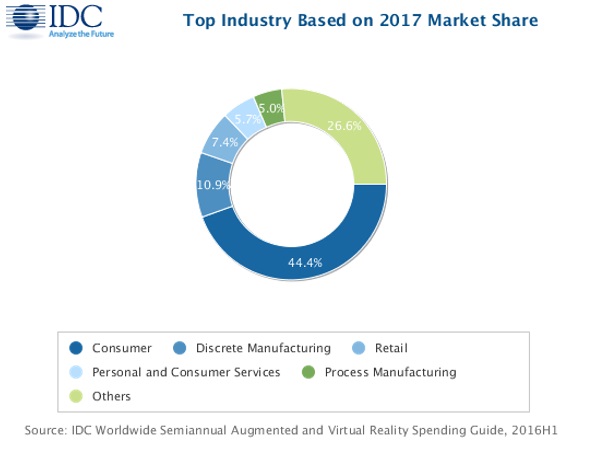 The industry use cases that will attract the largest investments in 2017 are retail showcasing ($461 million), product development ($267 million), and industrial maintenance ($249 million). By 2020, online retail showcasing will join retail showcasing and produce development as one of the largest use cases with a five-year CAGR of 403%. On the consumer side, AR games will experience a CAGR of 287.4%, making it one of the fastest growing AR/VR categories over the forecast period.
Spending on VR systems, including viewers, software, consulting services, and systems integration services, are forecast to be greater than AR-related spending in 2017 and 2018, largely due to consumer uptake of games and paid content. After 2018, AR spending will surge ahead, hitting stride in healthcare delivery, product design, and management-related use cases.
See the full story here: https://www.idc.com/getdoc.jsp?containerId=prUS42331217
UCLA Lecturer’s classes, presentation explore limits of virtual reality
 A Nikon 360-degree camera stood on a tripod, unattended, in the middle of Bruin Plaza.
“We were really interested in playing with the idea of surveillance because we live in a time when cameras are everywhere, and we don’t even know they exist and are documenting our presence,” said the fourth-year Design | Media Arts student.
Projects like Bashiri’s, which use technology to tackle real-world issues like surveillance, are the norm in UCLA Game Lab lecturer Daniel Landau’s Design | Media Arts class, “Topics in Video and Animation: Art and Science of Virtual Reality,” this quarter.
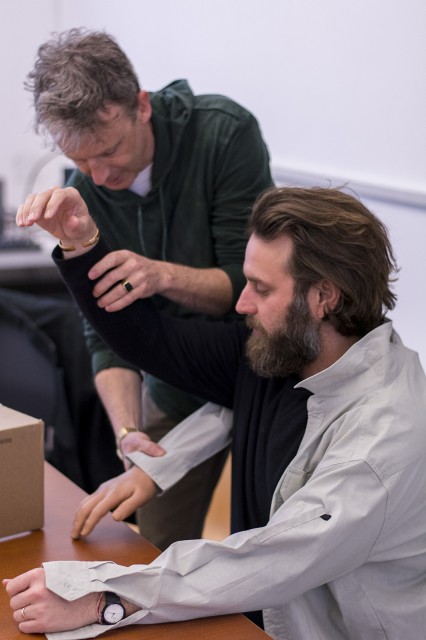
Landau’s work focuses on how technology can affect the human race on an emotional level. His “Time-Body Study” performative experiment demonstrates the adaptability of the human mind in response to its technological environment.
At the presentation, participants will be chosen from the audience to demonstrate the effects that virtual reality technology can have on the mind.
Participants in Landau’s presentation cognitively believe they are in the body of a 7-, 40-and 80-year-old person by using a headpiece programmed with virtual reality technology.
The illusion is known as re-embodiment. The effect places the participant in a virtual world, which is also projected on a screen for the audience to see.
See the full story here: http://dailybruin.com/2017/02/26/lecturers-classes-presentation-explore-limits-of-virtual-reality/
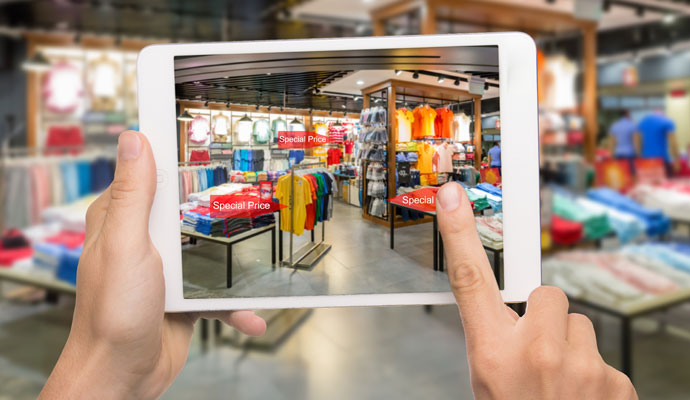
Why Augmented Reality Will Be the Next Revolution in Retail
 The New Table Stakes
Creating awareness
Growing engagement.
Converting attention to action.
Building enduring loyalty.
See the full story here: http://www.strategy-business.com/article/Why-Augmented-Reality-Will-Be-the-Next-Revolution-in-Retail?gko=dbc10