ABBA Plan ‘Previously Unimagined’ Virtual Reality Experience
 ABBA and Fuller announced the project Wednesday, promising "a groundbreaking venture that will utilize the very latest in digital and virtual-reality technology ... which will enable a new generation of fans to see, hear and feel Abba in a way previously unimagined," The Guardian reports.
The group promises to share more details regarding the project in 2017, with the experience itself scheduled to launch in 2018.
According to Billboard, Fuller has been investing in virtual reality companies in recent years – as opposed to the industry's trend toward holograms – and approached ABBA about partnering on a project that would utilize the emerging technology; video games systems like Playstation and Nintendo have recently unveiled VR systems.
See the full story here: https://www.yahoo.com/music/abba-plan-previously-unimagined-virtual-144803573.html
First AR phone finally coming Nov. 1st
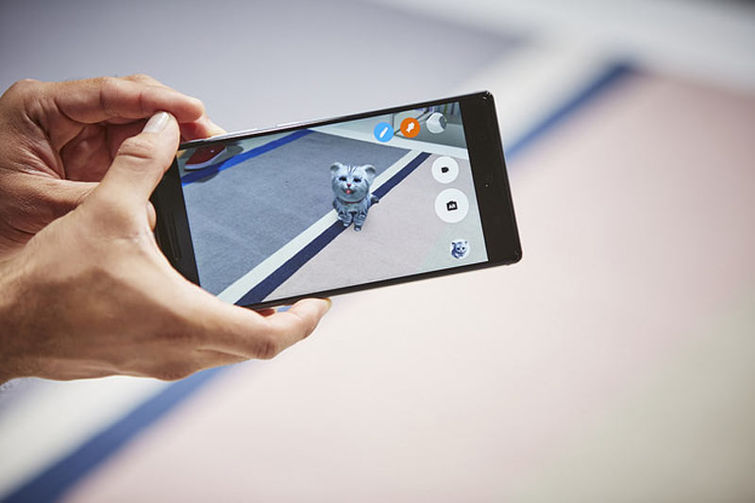 Lenovo's Phab 2 Pro, the first phone to feature Google's 3D-imaging Tango technology, will finally be available for purchase starting Nov. 1 for $499.
The Phab 2 Pro packs a special depth-sensing camera, which turns the otherwise normal-looking phablet into a robust AR machine.
See the full story here; http://www.tomsguide.com/us/lenovo-phab-2-pro-price-release-date,news-23743.html
AR – Top 100 influencers and brands
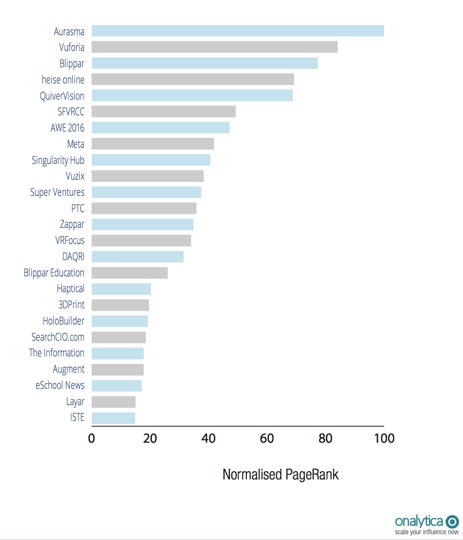
See the full story here: http://www.onalytica.com/wp-content/uploads/2016/10/Onalytica-Augmented-Reality-Top-100-Influencers-and-Brands.pdf
Startup commercializing virtual reality sickness solutions, helps move virtual reality mainstream
 "Motion-to-photon latency, which is the time it takes for you to turn your head and the screen to refresh at the same rate, is one of the main culprits of VR sickness. If latency is present then the photons that represent the scene strike your retina out of sync with your head's motion. This lag causes your body to react negatively, inducing vertigo and sometimes nausea," he said. "Another factor is dissonance between the inputs received by the vestibular and visual systems. We call motion in virtual spaces vection. Vection is when your body moves forward and backward, left and right, or up and down, as opposed to rotating in a fixed position. The VR developer community has put forth a set of app design principles that recommends users primarily rotate in the virtual space rather than allow free vection. Discouraging vection reduces the degree of dissonance between the ocular and visual systems, and thus helps avoid simulator sickness."
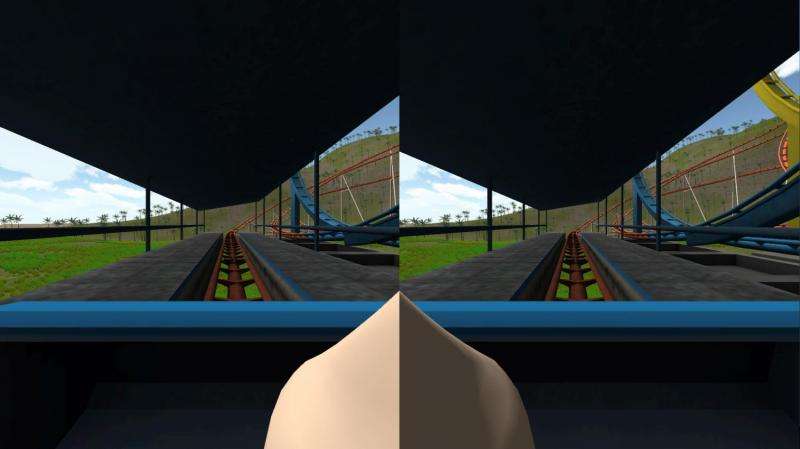
...in the animal kingdom every terrestrial predator can see its nose, so if it were a problem it seems like it would have evolved out. We surmised that being able to see one's nose was likely adaptive – a feature rather than a bug."
"What was interesting was that when we asked how distracting the nose was, the participants were baffled because they didn't even realize the nose was there. Just like one's own nose they didn't perceive it," he said. "We observed a 13.5 percent drop in severity of sickness and an increase of time in the simulator, just by adding a simple component that doesn't interfere with the game and is computationally very cheap."
Virtualis is a member of the Purdue Startup Class of 2016. Purdue has 27 startups based on Purdue intellectual property that were launched in the 2016 fiscal year.
Virtualis' virtual reality nose is patented through the Purdue Office of Technology Commercialization and currently available for license.
See the full story here: http://phys.org/news/2016-10-startup-commercializing-virtual-reality-sickness.html
‘Invisible’: A rousing all-round thriller in virtual reality
 Here's a series that aims to break rules in every direction.
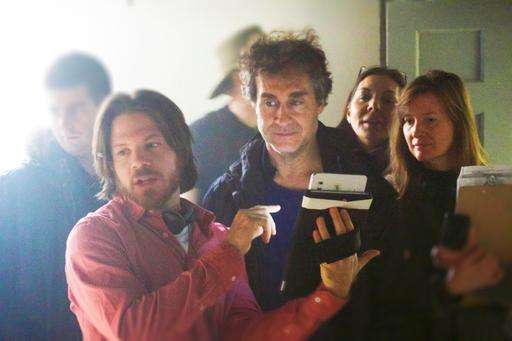
Though it unfolds in 360-degree virtual reality, "Invisible" is a scripted tale of sci-fi corporate treachery that draws from a century's worth of 2-D filmmaking lore.
The first season of five six-minute episodes is a co-production of Samsung, Jaunt, Conde Nast Entertainment and 30 Ninjas, and, sponsored by Lexus, is available free.
But even as it lets viewers roam its panoramic 3-D canvas, "Invisible" spins out a narrative governed not by each viewer but by its filmmakers.
The "Invisible" producers have declared a few of the VR "rules" the series defies in favor of mainstream Hollywood technique: Never move the camera. Never cross-cut between scenes occurring at the same time. Avoid split-screens. And keep the camera poised at a normal eye level. (Instead, at one point, "Invisible" hovers overhead for an aerial shot while, at another moment, it plants the viewer gazing up from a freshly dug grave.)
"Everything about VR is different," says Liman before swiftly backtracking: "If scripted VR was going to work, we knew we were going to have to bring in some of the vocabulary from traditional storytelling."
Like edits.
"I liken VR to being on a subway car, where there are conversations going on all around. You could eavesdrop on any of them. But for someone who wants to tell scripted VR, one of those conversations will be essential—and it has to be so compelling the viewer will be sure to zero in on it and on those characters."
How to spare the viewer from distractions? It all comes down to writing, staging and performances, Liman explains.
"Our goal wasn't a proof of concept for VR," Liman agrees. "It was to tell something fun and entertaining."
See the full story here: http://phys.org/news/2016-10-invisible-rousing-all-round-thriller-virtual.html
Meeting ‘the Other’ Face to Face
 ...when I stand, I quickly find myself in a featureless all-white room, a kind of Platonic vestibule. On the walls at either end are striking poster-size black-and-white portraits taken by the noted Belgian-Tunisian photographer Karim Ben Khelifa, one showing a young Israeli soldier and another a Palestinian fighter about the same age, whose face is almost completely hidden by a black hood.
Then the portraits disappear, replaced by doors, which open. In walk the two combatants — Abu Khaled, a fighter for the Popular Front for the Liberation of Palestine, and Gilad Peled, an Israeli soldier — seeming, except for a little pixelation and rigid body movement, like flesh-and-blood people who are actually in the room with me.
Their presence, in a deeply affecting experiment in communication, called “The Enemy,” underway at M.I.T., is the result of a collaboration between Mr. Ben Khelifa and Fox Harrell, an associate professor of digital media. It holds the promise of opening up new frontiers for the integration of journalism and art in a socially oriented 21st-century performance piece poised at technology’s cutting edge.
...What he saw there was a culture of warfare that often perpetuated itself through misunderstanding and misinformation, with no mechanism for those of opposing sects or political forces to gain a sense of the enemy as a fellow human being. ...
Over the last two years, as a visiting artist at the university’s Center for Art, Science and Technology, he transformed what he initially conceived of as an unconventional photo and testimonial project involving fighters into a far more unconventional way of hearing and seeing his subjects, hoping to be able to engender a form of empathy beyond the reach of traditional documentary film. He interviewed Mr. Khaled in Gaza and Mr. Peled in Tel Aviv, asking them the same six questions — basic ones like “Who’s your enemy and why?”; “What is peace for you?”; “Have you ever killed one of your enemies?”; “Where do you see yourself in 20 years?”
Then he and a small crew captured three-dimensional scans of the men and photographed them from multiple angles.
He added: “You have something here you don’t have in any other form of journalism: body language.”
...your body viscerally senses a person standing a few feet away from you, his eyes following yours as he talks, his chest rising and falling as he breathes. ...
See the full story here: http://www.nytimes.com/2016/10/30/arts/design/meeting-the-enemy-face-to-face-through-virtual-reality.html?_r=0
Unveiling the first major virtual reality TV series, ‘Invisible,’ from director Doug Liman
 Over its short but eventful life, modern virtual reality has yielded notable pieces involving concerts, sports, outdoor-adventure experiences, vérité documentary, Hollywood movie marketing and Pixar-esque shorts.
Rarely, though, has it seen a traditional scripted series.
A new production, "Invisible," from the director Doug Liman, Condé Nast Entertainment and the VR company Jaunt, will change all of that.
The series, which is being formally released Thursday on many major VR headset systems — including Samsung's Gear VR, Oculus' Rift and the HTC Vive — offers five episodes of about six minutes each. It follows the episodic format of a network prime-time soap, with the plot turns, cliffhangers and — maybe most important — editing common to the form. In so doing, it brings mainstream Hollywood and VR as close as they've ever been.
See the full story here: http://www.latimes.com/entertainment/movies/la-et-mn-invisible-doug-liman-vr-20161026-story.html
Google gets into the whiteboard business
 “Jamboard,” Rochelle explained, ahead of the unveil, “is the whiteboard now in Google Cloud.” It’s a 55-inch 4K touchscreen hub for workplace collaborations designed from the ground up. A director competitor to Microsoft’s Surface Hub built around Google apps. It’s a familiar sort of interface whose output lives in Google Drive, connecting to users in person or via smartphone or tablet using the company’s companion apps for iOS and Android (nope, no Windows yet).
It’s a familiar sort of interface whose output lives in Google Drive, connecting to users in person or via smartphone or tablet using the company’s companion apps for iOS and Android (nope, no Windows yet).
See The full story here: https://techcrunch.com/2016/10/25/google-jamboard/?ncid=tcdaily