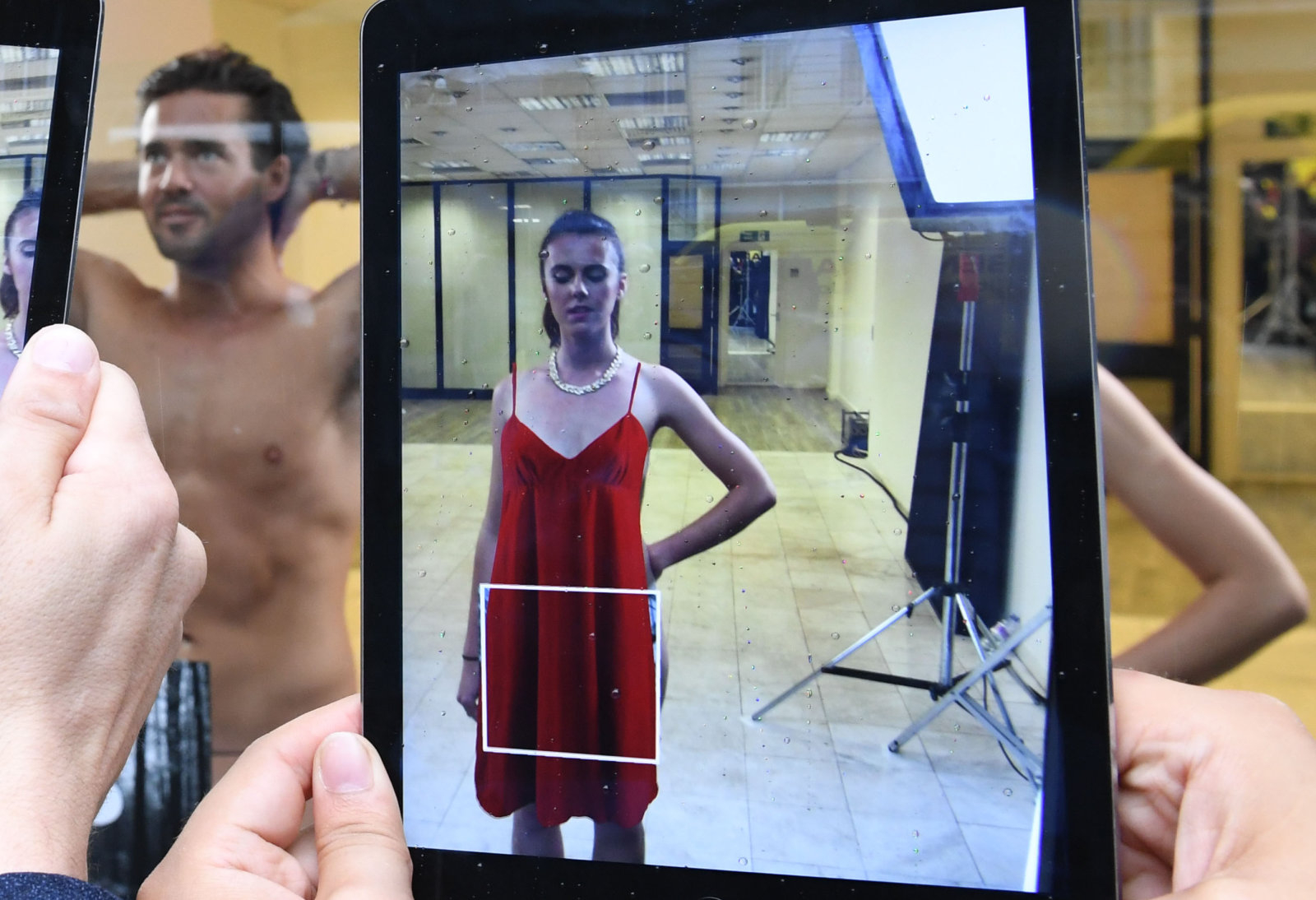
 Internet retailer Lyst marked the start of London Fashion Week by using AR to clothe near-naked models in a shop window -- effectively, they were living mannequins. You only had to point a phone or tablet at the models to see what they would look like donning some athletic wear or a formal dress, no matter the pose or the viewing angle.
20Sep/16Off
Disney patent turns hotel rooms into interactive environments
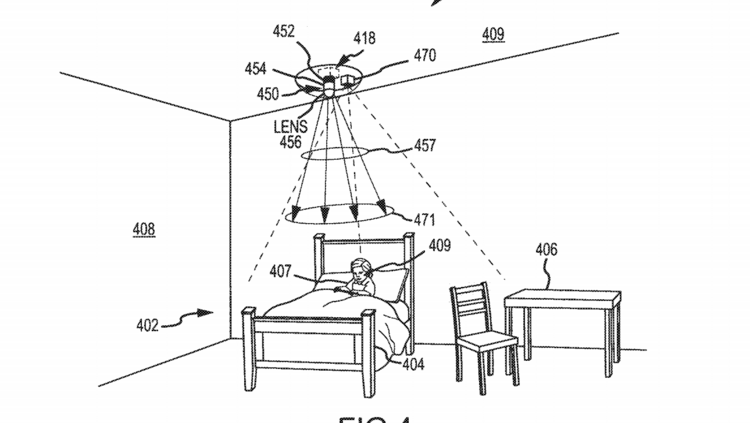 The company last month was issued a patent, dubbed Image Projecting Light Bulb, that could be used in hotel and household light sources like desk lamps or ceiling fixtures to project animated images into a desk, bed or walls. It could be used to turn a regular hotel room into a scene from a game or movie that children can play in, patent documents showed.
...
The goal of the projector with its camera and audio attachments of the display systems described herein is to allow a room, where ever the room is located, to become as immersive as any screen environment or even more so.
To this end, the display system is a device that can be both an input and an output device. On the output side, the display system is a projector of still or animated visual imagery, and the display system may include a speaker or otherwise be capable of sending audio signals to speakers elsewhere in the room. In this way, the display system may provide an audio track to projected imagery to enhance the display and/or gaming experience.
See the full story here: http://www.bizjournals.com/orlando/news/2016/09/19/disney-patent-turns-hotel-rooms-into-interactive.html?ana=yahoo&yptr=yahoo
15Sep/16Off
IMAX Reveals Details of Virtual Reality Rollout, Ticket Bundling Plan
 IMAX virtual reality stations will start appearing in pilot locations as early as the end of the year, IMAX Entertainment CEO Greg Foster said during the Bank of America Merrill Lynch Media, Communications & Entertainment Conference on Wednesday in Los Angeles.
The future vision, according to Foster, will allow moviegoers to purchase a bundled ticket — for both a theatrical release and also admission into a VR experience located at the multiplex.
Disney-Marvel’s upcoming comic book movie “Doctor Strange” features special footage optimized for IMAX, Foster also revealed Wednesday.
Foster also discussed international strategy, underscoring the importance of local language content in China, India, Korea and Japan. “We can’t keep our theaters dark,” he said, referring to lulls in certain international markets that occur when blockbuster Hollywood titles aren’t in theaters. “Our job is to provide 52 weeks of compelling content in every theater we have.”
With 1,100 IMAX theaters open all over the world, that number will continue to grow, said Foster, citing a 500 to 600 backlog.
See the full story here: http://www.thewrap.com/imax-reveals-details-of-virtual-reality-rollout-ticket-bundling-plan/
15Sep/16Off
Virtual Reality May Help You Control Your Dreams
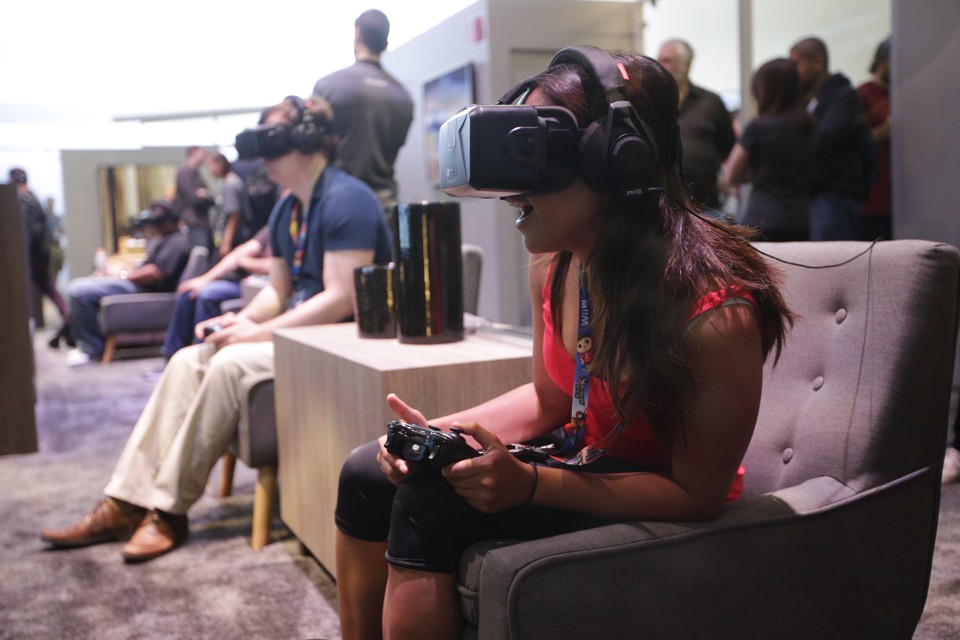
People try out the Oculus Rift virtual reality headsets at the Oculus booth at the Electronic Entertainment Expo on Wednesday, June 11, 2014, in Los Angeles. (AP Photo/Jae C. Hong)
Put down your phone after an intense Pokémon Go session, and you might find yourself thinking about “catching” the dog across the street as if it were a character in the game. That momentary mix-up between the world on the screen and the physical reality of the street is called game transfer phenomenon, and it’s a common effect among gamers. As Gackenbach puts it: “Your brain’s kind of stupid, at least when it comes to reality.”
The effect isn’t confined to waking life. It also shows up in dreams, as well as during the blurry, hypnagogic period between sleep and waking. “Gamers have seen images from the game in front of their eyes, or felt involuntary movements as if their fingers were pushing the gamepad,” says Angelica B. Ortiz de Gortari, a postdoctoral fellow at the University of Liège who co-authored the first report on the phenomenon. Other researchers have documented similar effects in players of World of Warcraft and Tetris.
Gackenbach’s research found that gamers report a greater sense of control in their dreams than non-gamers, as well as more awareness that they are dreaming—what researchers term “lucidity.” This suggested that spending time in a fictional, controllable world might teach gamers to view dream worlds through the same lens.
In a study she presented at a conference in June, participants played a 15-minute car-racing game on a computer, then described a dream from the previous night. Half the group donned the Rift to play the game; they remembered those dreams as higher in lucidity than the control group, which did not use the device. This difference disappeared when both groups reported on their dreams again the following week.
“All this points to one thing,” Gackenbach said. “When you alter people’s waking realities, their memory changes. The more you think you’re in one reality, it alters your memory of other realities.”
See the full story here: http://www.theatlantic.com/science/archive/2016/09/virtual-reality-may-help-you-control-your-dreams/500156/
14Sep/16Off
Razer launches $20 million fund for virtual and augmented reality startups
 Razer co-founder and CEO Min-Liang Tan still considers his tech company a startup, even with over 1,000 employees spread across 10 global cities. He believes that puts Razer in a good position to help much smaller startups in e-sports, virtual reality (VR), augmented reality (AR), robotics, and gaming connect with Razer’s massive audience. Accordingly, Razer used TechCrunch Disrupt in San Francisco to launch Zventures, a $20 million investment fund that’s officially open today here for any company to pitch.
Tan told Digital Trends that Razer will invest anywhere from $100,000 to $1 million in companies across key growth areas, including the Internet of Things, e-sports, VR and AR, software (both gaming and gaming tools), robotics (including drones) and manufacturing and engineering.
Razer has its own virtual reality headsets, the OSVR Hacker Development Kit, available to both developers and consumers.
“We have one of the largest active user bases in the world specifically targeted at the gamer community, which tends to be very tech savvy and are technology evangelists,” Tan said. “Most of the new technology that’s been introduced recently, like motion sensing and VR, have grown from roots in the gaming community. We can introduce this audience to the startups we work with.”
See the full story here: https://www.yahoo.com/tech/razer-launches-20-million-fund-172426051.html
14Sep/16Off
Can HiMax Technologies Stake Its Claim in Augmented Reality?
 CEO Jordan Wu has specifically noted that AR will increase HiMax's liquid crystal on silicon (LCOS) and wafer-level optics (WLO) revenue for the second half of 2016, adding that the company "believes this is just the beginning of a long-term growth story."
According to Wu earlier this year, "We believe applications for AR expanding from AR glasses and head-up displays for automotive applications to smartphones will advance the evolving AR market to become a multi-billion dollar industry."
Technology CEOs are rarely negative about their prospects in emerging technologies, but there are a handful of good reasons why Wu is bullish on HiMax's AR position.
The first is that the company has been working on AR-related technologies for 15 years, ...
HiMax is also widely believed to have a spot in Microsoft's forthcoming augmented reality headset, HoloLens.
HiMax already works with more than 30 AR customers right now, and the news from this year shows that the company is serious about improving its AR revenue.
See the full story here: http://www.fool.com/investing/2016/09/13/can-himax-technologies-stake-its-claim-in-augmente.aspx
14Sep/16Off
‘Blair Witch’ Gets a Virtual Reality Trailer, Ushering In VR Ad Age
 [Philip Lelyveld comment: Vertebrae makes native VR ads that look like content and (by the way) defeat ad-blockers.]
The 90-second “experience” is available now on the Sisters VR app, which you can download on your phone for use via Google Cardboard or the Samsun Gear VR headset. The VR trailer comes out of a joint venture between Lionsgate, new ad tech company Vertebrae and production house Otherworld Interactive, which created the Sisters app.
Vertebrae, however, focuses on serving and tracking VR ads, particularly “native” advertising that plays just like the regular, non-branded content it lives with — à la the “Blair Witch” ad.
Vertebrae, which is just emerging from stealth mode, has raised $10 million in Series A funding.
See the full story here: http://www.thewrap.com/blair-witch-gets-a-virtual-reality-trailer-ushering-in-vr-ad-age/
14Sep/16Off
EU Copyright Proposals Expected to Help Music Industry Fight Piracy
 As part of the copyright protections, the EU also is expected to propose granting news organizations new rights to demand licenses for the posting of even snippets of their articles for 20 years, a move to help publishers negotiate compensation from news aggregators such as Alphabet Inc.’s Google.
The European Commission’s proposals, which come after a three-year review aimed at updating copyright law for the digital age, could take years to ratify. The proposals have been—and are likely to remain—the subject of heavy lobbying from copyright holders like record labels and newspaper publishers on one hand, and technology firms on the other.
...
Music executives say the reforms are a step in the right direction. Music executives have lauded the fact that early drafts of the proposal acknowledged the widening “value gap” between the amount of music consumption and the amount of revenue it generates.
Over the past few years, sites offering protected content uploaded by fans “have flourished and have become main sources of access to content online,” reads a recent draft of the proposals, adding that this affects creators’ ability “to get an appropriate remuneration for it.”
See the full story here: http://www.wsj.com/articles/eu-copyright-proposals-expected-to-help-music-industry-fight-piracy-1473786140