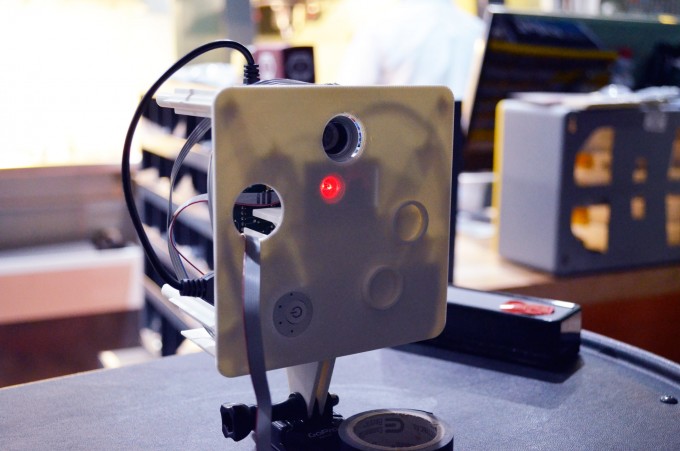
The face of the enclosure is about the surface area of a square box of tissues, but only about a quarter as deep. The back is seemingly missing a rear plate, which gives a clear view of an array of circuit boards and wires. Like Valve’s Lighthouse system, this is a laser-based tracking system. But unlike Lighthouse—which sweeps the room with lasers regardless of what’s in the area—this one actively seeks its intended target.
The MEMS Tracking System (or MTS, which I’m going to call it for ease of use) shoots its laser in a unique way compared to Lighthouse. Lighthouse uses lenses to stretch the laser’s landing area from a point into a line, then it sweeps those lines around a space by mounting the lenses on precisely spinning motors. MTS on the other hand, uses a tiny mirror (which tilts but doesn’t spin) to point the laser in any singular direction.
When initialized, MTS begins scanning a cone area in front of it in a grid-like pattern to search for its target. The target it’s looking for is a point of high reflectivity, measured by the amount of laser light that’s returning to the origin point. Of course, the laser could stop on any slightly reflective surface, so you need to make sure that the target is much more reflective than anything else in the environment, then set a minimum floor for detection, such that the laser continues to scan until a sufficiently bright reflection is found. A retroreflective marker, placed on a headset or motion controllers, serves as that sufficiently bright object, ensuring that much of the laser’s energy is reflected back to the receiver.
McCauley is clear to point out that much of what comprises MTS are off the shelf parts and algorithms pioneered for other purposes.
“Why nobody [applied this tech] for VR/MOCAP, I do not know. Perhaps nobody thought of it recently but it’s 16 years old and very established. They use these mirrors for optical switches in fiber optic bundles,” McCauley told me.
McCauley explained why he thinks this cameraless approach is important. Primarily it’s about range and cost.
Kelly's anticlimactic Skype call, in fact, demonstrates the effectiveness of Sidekick's "Remote Expert Mode," which allows teams on the ground to directly help an astronaut repair the ISS rather than having to rely on mere written or spoken instructions. With the HoloLens and Skype (itself a Microsoft property), the experts in question can circle objects and make annotations within the astronaut's field of view.
Or put it this way: Experts can directly point out what needs to be done rather than wasting time on questions like, "You mean the red button or the green button?"
“Augmented reality really bridges traditional and digital marketing channels and creates, what I’m calling, the next marketing channel,” she says. “It leverages the best of traditional channels, such as direct mail and print, that high touch, very tangible experience and it bridges it to a very digital place. You can now track it, you can measure it, and it can be very successful.”
Part of the measurement piece, Weinberger revealed HP is driving serious results, with a campaign the business ran for a client using direct mail saw conversation rates jump from 3% to 37%, all by adding AR that incorporated a click to purchase button. AR can also be used to add extra content to static images on clothes, launch extra video content over a print add, or even make contact information come alive on a business card.
Cogswell Polytechnical College is pleased to announce the launch of a new VR/AR certificate program, which addresses the development of content for virtual reality (VR) and augmented reality (AR). VR is a new human-user interaction paradigm utilizing computer-generated immersive environments. Users participate in VR using headsets which project images within a closed visual space, special immersive sound technologies, and optionally, articles of clothing that provide tactile sensations that increase the sense of “presence.” AR overlays interaction with the physical world with computer-generated three-dimensional visual and auditory sensory information to provide an enriched experience without excluding the surrounding environment. This program is a 15-credit (CEUs) set of specialzed classes that will be offered weekday evenings and weekends to accommodate the schedules of industry professionals. The purpose of this certificate program is to provide professionals in the computer graphics industry the opportunity to join development teams that create VR or AR content.
VR and AR Courses Include:
VAR400 Perception, Cognition and Presence in VR/AR - starting Summer 2016
This is about how the eyes and ears respond to rich, interactive virtual and augmented stimuli, how they pass that information to the brain, how the brain processes that data and builds representations from those stimuli, and how this is then relayed on to the motor regions of the brain to become action. VR and AR provide very strong stimuli and an understanding of how those stimuli are processed and what responses they evoke, provide useful suggestions for creating powerful and vivid subjective experiences. The experience of virtual and augmented worlds depends upon the mediation of perceptual faculties that can be cognized as 'being in' a virtual or augmented space. This course will first present the perceptual and cognitive fundamentals of sight, sound and touch and then present ways in which these faculties are mediated by technology to create a sense of 'presence,' i.e, of being in that world. The course will include theories of presence as well consider health-related impacts of sensory mediation in VR & AR.
Human Computer Interface design addresses problems of usability in VR and AR systems. This course will begin with fundamental techniques of interaction and address progressively more challenging problems. The course will engage both theory and practice of HCI with hands-on projects. It will include an introduction to spatial audio relevant to VR and AR for non-audio specialists. Essentials of multichannel matrixed audio for designers. HCI design theories focus on techniques and rationales for effective interaction between humans and computing machines. This is a multi-disciplinary subject that includes elements of computer science, behavioral sciences, design and media studies among others. In the end, good HCI design results in flexible and responsive computers interfaces that allow humans the power and freedom for productivity and expression. This particular offering of HCI Design will focus on what VR and AR technologies bring to HCI that increase the immersive impact of a user's experience.
Prerequisite: VAR400 or concurrent enrollment in VAR400
VAR500 VR/AR Design Principles 1
Moving beyond design principles for 2D and 3D art, VR Design Principles 1 addresses semantic vs. responsive gestures, the reactivity of objects in virtual space, interactive element targeting, ergonomics, economy of gestures and other factors specific to VR and AR. This course integrates theory and practice with many hands-on projects.
Principles of motion and design applied to VR/AR environments. The success of VR/AR with the public ultimately might come down to the stories that can be told with these technologies. At the time, these new technologies hold promise of adding something valuable to storytelling. Our program will offer two courses in design principles that will address such issues as addresses semantic vs. responsive gestures, the reactivity of objects in virtual space, interactive element targeting, ergonomics, locomotion, optimization for VR tracking, hand and body design, space and perspective, and progress toward the development and implementation of stories as immersive content.
Prerequisite: VAR400
VAR525 VR/AR Design Principles 2
Following on the foundations established in VR Design Principles 1, VR Design Principles 2 addresses locomotion, optimization for VR tracking, hand and body design, space and perspective. The course will integrate introduce elements of storytelling in an immersive virtual space.
Principles of motion and design applied to VR/AR environments. The success of VR/AR with the public ultimately might come down to the stories that can be told with these technologies. At the time, these new technologies hold promise of adding something valuable to storytelling. Our program will offer two courses in design principles that will address such issues as addresses semantic vs. responsive gestures, the reactivity of objects in virtual space, interactive element targeting, ergonomics, locomotion, optimization for VR tracking, hand and body design, space and perspective, and progress toward the development and implementation of stories as immersive content.
Prerequisite: VAR500
VAR550 VR/AR Studio
The capstone of the VR/AR certificate program is the VR/AR studio project, a multidisciplinary collaborative project that will engage the efforts of engineers, VR/AR content designers and audio specialists. All of the theory and practice of previous courses will come together in the implementation of projects inspired by 'real world' applications and in some cases commissioned by actual clients. Industry professionals will be brought in at intervals to provide expert feedback and to inspire best practices. This feedback will enable students to understand what mixes of elements result in in powerful and informative immersive user experiences. The projects will become a part of students' professional portfolios and will demonstrate their preparation for professional activity within the industry.
Speaking on a panel about how virtual reality can be used to change the way products and services are sold, representatives from Hasbro, The North Face and Lufthansa German Airlines said the mobile era is ripe for virtual reality to go mainstream.
"Once it becomes more accessible, then it doesn't become a fad," said Victor Lee, svp of digital marketing for Hasbro. "And then comes truly the reality of anyone can do this. Then it's a race of who does it best, who's more creative, who tells the best story and who's going crazy with it."
The North Face already has developed two action-packed VR experiences that transported viewers to Yosemite and Mount Everest, both of which have aimed to bring interest to the outdoors. Eric Oliver, director for digital marketing at The North Face, said he's optimistic that the ubiquity of smart phones will be a "gateway" for massive adoption of VR.
Lufthansa is taking more of a grassroots approach to how it introduces both staffers and customers to its VR film, which shows what it's like to fly with the airline. Torsten Wingenter, head of digital innovations for the brand, said even people who were averse to trying on the Google Cardboard to watch the film were hooked after a few minutes. He said airlines are often judged only by price and travel time, but he thinks VR could help marketers like Lufthansa better illustrate its value to those who have never flown with the company.
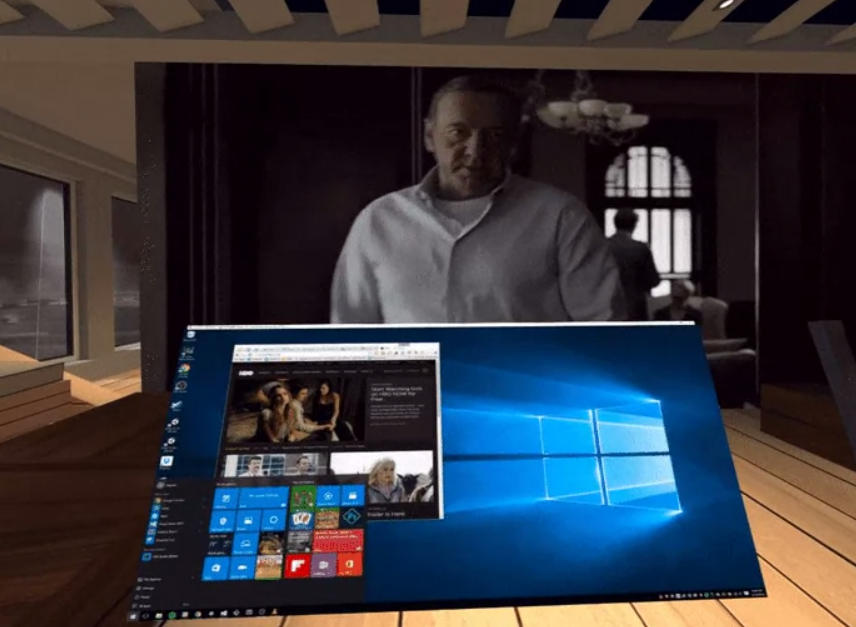
Well, BigScreen apparently allows your friends to share their screen inside the VR environment. Theoretically, this will allow users to view their Windows desktop at one of the parts of the VR environment and watch a movie on the other part (shared by their friends), which is really handy. However, screen sharing on BigScreen will be a lot more useful when it comes to playing online games.
BigScreen will be available for the Oculus Rift and the HTC Vive in April 2016, and the company is planning to release Samsung Gear VR support later this year.
“Virtual reality will be a kinesthetic, immersive experience for students. They’ll learn things in a visceral way,” she said. “I want to know how that boosted engagement will be coupled with good teaching and scaffolded by learning science.”
Much of the press and several of the SXSWedu panels on virtual reality talked excitedly about where the medium and technology will be, rather than where it currently is. A substantial conversation can’t subsist on predictions alone, though. One session focused solely on the “now”: The British Museum offered insights from its pilot virtual reality program, where it created a virtual Bronze Age roundhouse populated with relics from the era. Lizzie Edwards, Education Manager of the Samsung Digital Discovery Center in the British Museum, said that attendance increased fourfold from the normal 300 to 1200 people during the weekend the museum tested its virtual reality offerings. The sizable audience flocking to her 15-minute talk reflected the draw of the program.
Edwards’ team offered virtual reality headsets, in an interactive dome and on tablets. (Students 13 and under were not allowed to use the headsets because of British health and safety codes.) Museum staff facilitated participants’ interactions on a one-to-one basis, which Edwards said kept the flow of visitors moving at a reasonable pace for everyone to see the roundhouse.
Why a Bronze Age roundhouse? Edwards said the project came about because of shifts in the United Kingdom’s national curriculum introduced in 2013. Teachers in the UK must now instruct students on changes in Britain from the Stone Age to the Iron Age, which may include, according to the British Department of Education, “Bronze Age religion, technology and travel.” Edwards said teachers immediately began complaining that few educational materials existed to help students visualize and understand Bronze Age environments.
Augmented reality surgeryhas helped two doctors at NYU’s Langone Medical Center achieve a breakthrough like no one before them. Dr. Pierre Saadeh and Dr. Timothy Rapp used the latest technological advancements to plan as well as an execute a complex surgery for a cancer patient.
The doctors used augmented 3D reality technique to practice the approach of the surgery and plan the entire procedure, as understood from the report on Black Channel. They used a 3D map to understand the depth of the gap created.
This enabled the team to work towards sculpting the bone to the exact size required to fill the gap made by the tumour. While there are many who are calling the move by the two doctors a bold one, it is indeed their decision not to stick to the script that has led to the discovery of a new method to cure.
Read the full story here: http://www.healthaim.com/augmented-reality-surgery-doctors-will-able-operate-better-safer/45092
I don’t think it will, not in the form of feature narrative, per se, but maybe it’ll become more rarified. People still go to the ballet and the opera. I think of both as a collaborative tool. AR is amazing for shot diagrams and shot lists, and working more in physical space with people rather than on flat screens. The potential is to make computing more physical and tactile.
But for AR to become a true art narrative device, I think it’ll happen. If the experience is where people don’t have to be in a headset and just be in space with the people and share with them, if that is AR, it will happen sooner. We’ll lose the craft of directing the camera and the lenses, and that is what makes cinema relevant. It’ll have to be a new form, not a replacement for cinema. And the person who will make this masterpiece is 12 years old right now.