Police are learning when not to shoot using virtual reality
 The Virtra technology originally employed headsets and goggles, much like the Oculus Rift, but found this to be ineffective in real-life scenarios. Today, the technology is projected in 300 degrees of immersive scenario, where the trainer can manipulate any scenario to train and test officers as if they were really in the field.
"... the system I tested out in Morris County, which is now being used at more than 200 training facilities around the world, consists of five large screens that surround a stage and five overhead projectors that cast lifesize videos onto the screens, giving the users the feeling that they’re standing in the center of a scene. The Glock on my hip was a real gun, but rather than being loaded with bullets, it was loaded with carbon dioxide, causing the gun to recoil each time I pulled the trigger. At the end of the gun is a laser, which interacts with the cameras overhead to detect whether or not a shot is accurate. The system also comes with a wearable device that gives officers a small electrical shock to simulate they’ve been shot."
The Virtra system is being used by police departments all over the United States in an effort to curb the violence and tension that's been in the media lately. After the scenarios are run, trainers sit down with officers to identify strengths and weaknesses to make them more capable of protecting the public in every scenario.
See the full story here: http://www.komando.com/happening-now/302319/police-are-learning-when-not-to-shoot-using-virtual-reality/2
Augmented Reality: Teaching Kids About Their World
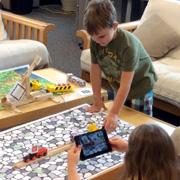 Georgia Tech’s Interactive Media Technology Center (IMTC) is developing and testing a prototype of an augmented reality mobile application. Its purpose: get kids excited about STEM education by using fun, interactive and compelling experiences. IMTC recently tested the prototype with kids ranging from six to 14 years old. They tested four demos – cubes (learning how to calculate volume and density), a train (setting up an experiment and testing hypotheses about forces and mass), a catapult (understanding the paths of projectiles), and lasers (teaching optics via a game controlled by virtual light beams, mirrors, and prisms). The app is designed as a collaborative, social experience, which enhances learning.
See the full story here: http://ipat.gatech.edu/augmented-reality-teaching-kids-about-their-world
Start-up Improbable is Adding Greater Realism to Virtual Worlds
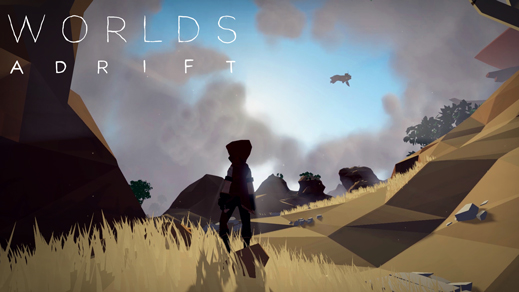 Large-scale online games are usually built using several “shards”—identical instances of the world that no more than about 10,000 people inhabit at any one time before the computational complexity of maintaining the world becomes too great. Once a world is “full up,” new players are sent to a different shard. Improbable’s technology is different, says Narula. Theoretically, an unlimited number of players will be able to occupy the same world and, perhaps most important for the designers hoping to offer those players interesting ways to interact with one another, “everyone will see the same things happening on screen at the same precise moment,” he says.
The technology, which already works with popular game- and virtual world-building tools such as Unity and Unreal, will offer smaller studios and even one-man game makers access to features that typically are only available to vast teams with highly specialized engineers. Improbable plans to sell access to its platform to game developers.
DAQRI acquires Melon – Hardened AR helmet with EEG monitoring!
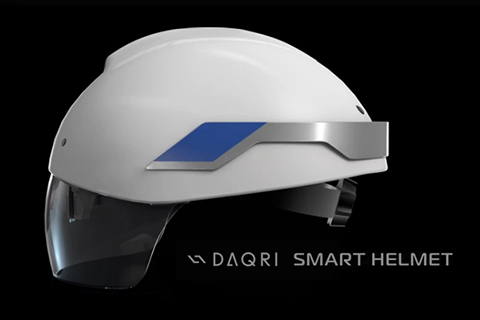 DAQRI created the DAQRI Smart Safety Helmet for blue collar workers. Their site states “every aspect of DAQRI Smart Helmet was designed with the industrial work place in mind, from its advanced sensor package to the intuitive user interface that requires zero calibration, to the battery life that lasts an entire shift”. It’s a wearable augmented reality tool basically.
Mellon is a brainwave monitoring headband or more commonly known as an EEG in the medical and science fields. This device interprets your electrical activity your brain naturally puts out. The device uses Bluetooth to wirelessly transmit data to your phone, thus allowing you to keep track and train your cognitive states. The headband has an adjustability designed in to fit most heads age 10 and up.
...technology will become more advanced and will be able to monitor the stress level, skin temperature, fatigue and heart rate of the users. Companies could in theory now also monitor their employee’s overall wellbeing while on the job, thereby improving work and safety conditions.
Digital Domain Holdings, Immersive Media Form Joint Venture For Virtual Reality Content
Digital Domain Holdings Ltd., the parent company of visual effects studio Digital Domain, has entered into a joint  venture with virtual reality tech provider Immersive Media to create content, including VR content.
The joint venture, to be known as IM360, combines Digital Domain’s expertise in computer generated imagery and motion capture with Immersive Media’s 360-degree video hardware and software platforms.
Immersive Media‘s 360-degree video systems — which can be used for VR or for more limited forms of immersive video — is based on tech developed for military and intelligence applications. Though not a famous name, products using its tech have been quite popular. Its cameras were used for Google Maps’ street view feature. Corporate clients using its tech include Disney ABC, American Express, Converse, Turner Broadcasting and Mountain Dew.
See the full story here: http://variety.com/2015/biz/news/digital-domain-immersive-media-virtual-reality-joint-venture-im360-1201464911/
VIRTUAL NOSE KEEPS GAMERS FROM FEELING SICK
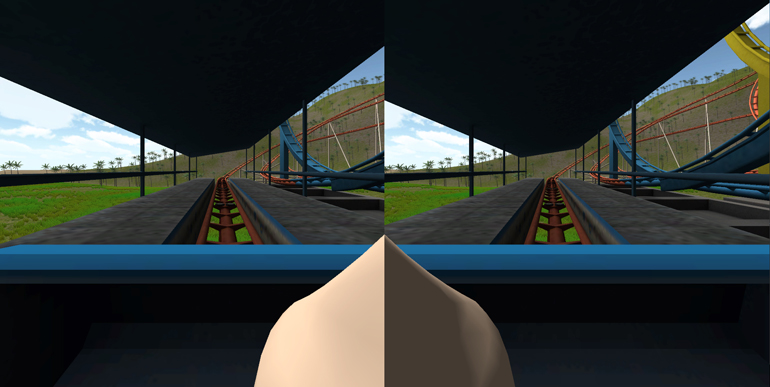
41 test subjects operated two virtual reality applications of varying motion intensity (a slow wander through a Tuscany villa and a white-knuckle roller coaster ride) while wearing a virtual reality headset. They were not told about the nose. Some subjects had the virtual nose, while others played standard versions. “Surprisingly, subjects did not notice the ‘nasum virtualis’ while they were playing the games, and they were incredulous when its presence was revealed to them later in debriefings,” Whittinghill says.
The virtual nose allowed people using the Tuscany villa simulation to play an average of 94.2 seconds longer without feeling sick, while those playing the roller coaster game played an average of 2.2 seconds longer.
The research is ongoing. “Our long-term goal is to create a fully predictive model of simulator sickness that will allow us to predict, given a specific set of perceptual and individual inputs, what level of simulator sickness one can expect,” Whittinghill says.