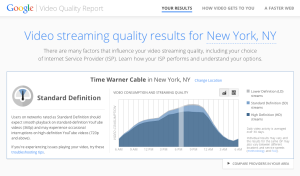
 [Philip Lelyveld comment: Wow! Trying to win hearts and minds in the Net Neutrality debate.]
When videos blur, buffer, or won’t play altogether, YouTube is now pinning the blame on your internet service provider.
“Experiencing interruptions?” reads the message in a blue bar underneath choppy video, as seen in the above screenshot. Clicking “find out why” brings you toGoogle’s new website, where it displays video playback quality for internet service providers (ISPs) in various countries. It’s like a report card for your delinquent ISP.
See the full story here: http://qz.com/230603/youtube-like-netflix-is-now-publicly-shaming-internet-providers-for-slow-video/
 Felix Arvid Ulf Kjellberg's PewDiePie channel is at the top of the charts this week with an incredible nine-figure view count. The 24-year-old Swedish gamer's YouTube channel scored more than 100,424,123 million views during the week, an impressive 22% increase over the week prior. Meanwhile, Shakira is in a far distant second place. The international pop star whose World Cup anthem, "La La La (Brazil 2014) ft. Carlinhos Brown" is still getting a lot of online video play, ended the week with more than 58.7 million views.
In third place is DisneyCollectorBR. The longtime chart topper and online video destination for videos of adults playing with children's toys ended the week with almost 55.9 million views. Up next in the #4 spot is StamyLongHead. The UK-based online video gamer nearly 43.3 million views in the last seven days. And rounding out the Top 5 is Katy Perry. Despite no major music video releases within the last several weeks, the singer was still able to obtain nearly 42.1 million views on the week.
See the full story with links here: http://www.tubefilter.com/2014/07/04/top-50-most-viewed-youtube-channels-worldwide-week-of-070414/
The 11 companies selected to participate in the Disney Accelerator program are:
- Buzzstarter - Buzzstarter is the world's first scalable programmatic content marketing platform.
- ChoreMonster - ChoreMonster is a web and mobile platform that makes chores fun for kids and turns parents into superheroes.
- Codarica - Codarica serves as children’s first interaction into the world of code with help from characters Cody Coder and Holly Hacker.
- Cogo - Cogo provides video monetization solutions for content creators.
- Jogg - Jogg simplifies the act of acquiring video from anyone. Users can gather, edit and share much more than just video from their own device.
- Sphero - Sphero is the connected play company, which fuses digital and physical play by creating robots that you control with a smart device.
- Sidelines - Sidelines fixes the problem of substandard online discussions and comments by sourcing smart, high-quality discussions from its curated team of over 400 experts, and distributing these discussions to publishers based on relevance.
- SnowShoe - SnowShoe makes simple, magical pieces of plastic that interact with touch screens to create the perfect bridge between physical items and digital content.
- Twigtale - Twigtale provides parents with personalized, high-quality, accessible expert advice for every major transition a child undergoes.
- TYFFON - TYFFON is an entertainment app development company and creator of the ZombieBooth series with more than 25 million total downloads.
- Ubooly - Ubooly is a learning toy that talks and listens to kids. Ubooly can be customized to know your child's name, teach lessons, and much more.
See the full story here: http://finance.yahoo.com/news/walt-disney-company-announces-participants-150000249.html
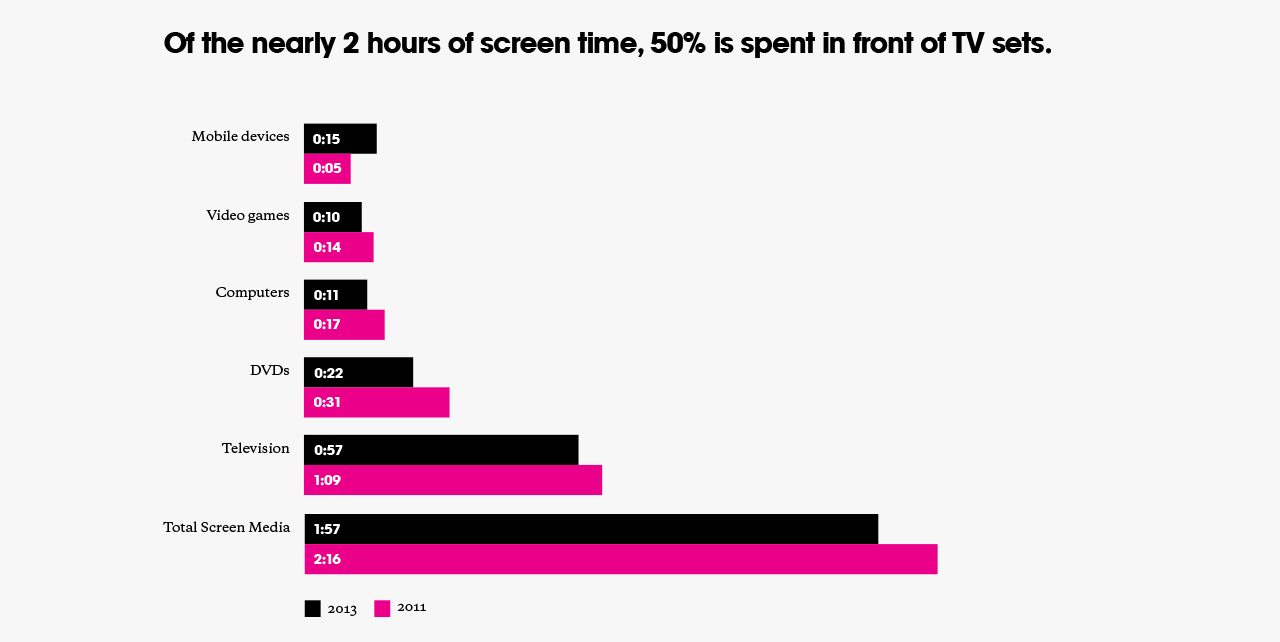
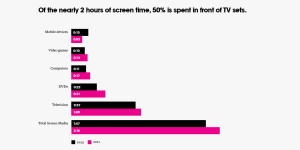 While a great deal of attention has been lavished on the habits and behaviors of Millennials (born in the 1980s and 1990s), another generation of digital natives is coming of age. To better understand the motivations, perceptions and browsing habits of these “digital kids,” Huge conducted multiple focus groups with an ethnically and economically diverse group of ten-year-olds to hear in their own words what excites them and how they discover new content.
As children spend more and more time with mobile screens (both phones and tablets), they are becoming increasingly sophisticated at navigating these interfaces. At the same time, the influence of offline media on their desires and discovery behavior remains pervasive, even if total time spent with these media is declining. Huge also observed childrens’ online behavior. We discovered that this cohort is far savvier online than most marketers give them credit for.
...
Kids are functional and task-oriented browsers. The vast majority of their visual interactive experiences, on sites like Cool Math 4 Kids, would make most designers shudder. Bright colors, cluttered interfaces, and non-intuitive navigation are endemic to these experiences but are not necessarily seen as an impediment to use. Rather than drive kids away, they appear to act as beacons, alerting children that these are experiences meant for them, rather than for adults.
...
While children enjoy engaging in “play” through the use of customization features, as seen in experiences such as Nike iD, the influence of their peers and siblings is pervasive in determining what’s “cool.” Repeatedly, participants noted that something is cool “if a lot of people have it.” This dependence on friends to help delineate what makes something cool seems at odds with the desire to customize items. In fact, children are not that different in that aspiration than teenagers or adults, who want simultaneously to fit in with their friends and co-workers and also to express their individual taste. This tension, born from the countercultural ethos of the 1960s, sought authenticity and rejected conformity while at the same time was co-opted by mainstream popular culture and marketing. It is still relevant today.
...
When we asked participants how they find out about new content or products they want, most cited a TV commercial. Despite the increase in time spent with mobile devices such as phones and tablets (within these focus groups, every child had access to a tablet and preferred to use it to surf online, regardless of family income), the influence of TV is still pervasive. Seeing an ad for something on TV is still a powerful way to fan the flames of desire for children. Additionally, offline channels such as magazines and catalogues (the children have a hard time distinguishing the difference between the two) are also potent motivators for choosing the products they covet.
See the full story here: http://www.hugeinc.com/ideas/report/digital-kids?curator=MediaREDEF
De la Peña has made several immersive virtual-reality documentary films including Project Syria, about refugee children in Syria, which was commissioned by the World Economic Forum, and Hunger in Los Angeles, a film about access to food banks in the U.S. that premiered at the Sundance Film Festival in January 2012.
“I start with eyewitness video, audio, and photographs and then carefully reconstruct an event with high-end animations, environment models, and spatial soundscapes to create a first-person experience of the events,” De la Peña explains.
New modes of storytelling could have broad cultural and social impact.
De la Peña is a former classmate of Oculus Rift’s creator, Palmer Luckey (see “10 Breakthrough Technologies 2014: Oculus Rift”). In 2012, the pair studied under Mark Bolas, a researcher who runs the Mixed Reality Lab at the University of Southern California Institute for Creative Technologies. Hunger in Los Angeleswas, in fact, created with help from Luckey and other USC students.
De la Peña describes her work as “immersive journalism.” While the work is more challenging than traditional reporting—managing teams of animators, character designers, 3-D modelers, and sound designers—she insists that the medium draws upon the same skills and effort necessary for all strong journalism. “Source material captured at real events is necessary to really make these pieces work,” she says, “and that always takes a lot of time and effort whether you are using traditional news platforms or virtual reality.”
See the full story here: http://www.technologyreview.com/news/527931/will-virtual-reality-reshape-documentary-journalism/?utm_campaign=newsletters&utm_source=newsletter-daily-all&utm_medium=email&utm_content=20140704
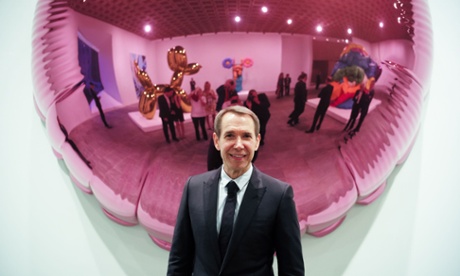
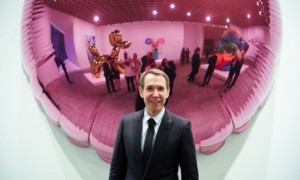 Koons, more than any other artist, has embraced the new possibilities that open up when you can charge seven- or even eight-figure sums for a single piece: his art is like the new luxury apartment buildings going up in Manhattan, which only make financial sense once the residences inside can sell for more than $5,000 per square foot. Koons’s art might be empty; it might be banal. But Koons does something very interesting, which very few other artists do. He turns money into art, rather than just turning art into money.
See the full story here: http://www.theguardian.com/artanddesign/2014/jul/03/jeff-koons-master-innovator-whitney-money-art?curator=MediaREDEF
How about one that makes fake reservations at restaurants and then sells them to the highest bidder?
The assumption in Mayer’s post — and, it seems, the assumption behind similar business models like ParkingMonkey or Sweetch — is that if something can be monetized, then it should be. It’s as though capitalism, or tech-startup life, was a game in which founders try to spot loopholes in the laws or social contracts that govern our behavior, and then figure out ways to get someone to pay to exploit them. This isn’t necessarily a recipe for disaster, but it avoids any question about whether such loopholes *should* be monetized. As Mayer puts it: “If someone does pay for it willingly, is it really unethical?” Well yes, maybe it is.
See the full story here: http://gigaom.com/2014/07/04/its-getting-harder-to-tell-whats-a-real-silicon-valley-startup-and-whats-a-parody/?curator=MediaREDEF
[Philip Lelyveld comment: Actually, Levitagram - software that lets you levitate subjects in pictures - looks far more compelling than the main subject of this story - Pixotale - which lets you create a string of intersperced photos, texts, and videos to create a ‘story.’ I just bought Levitagram - $1.99 in iTunes ]
With Pixotale, the overall goal is to connect people again via these sorts of personal stories – something that’s been a bit lost in the age of social media, Mao believes. After publishing your stories, you’ll be alerted to any likes or comments from fellow app users.
The app is also designed to make creating longer-form content easier on mobile, with a simple interface for adding text, photos, a map and soon video and audio. You can tap to add elements to the story or adjust its layout on the page before publishing. You can also work on stories while offline, and save them to publish later.
The end results are polished, professional creations you can then share to other social networks, like Facebook, Twitter, Whatsapp, and more. The stories are also viewable via the web, which you can seehere, here, here or here, for example.
See the full story here: http://techcrunch.com/2014/07/02/former-microsoft-engineers-launch-pixotale-a-social-networking-app-for-visual-storytelling/
 [Philip Lelyveld note: The teaser looks really interesting. They are 40% to their Kickstarter goal. It will be interesting to see what the interviewees will do when the tech that 'changed their lives' is displaced by the new new thing.]
Those interested in how our culture shapes and is shaped by the software we use every day should check out “App: The Human Story,” a documentary project on Kickstarter that hopes to give an in-depth look at the impact apps have had since their introduction with the original iPhone in 2007.
See the Kickstarter campaign and teaser video here: https://www.kickstarter.com/projects/appdocu/app-the-human-story
People were quick to note two differences. First, children are not in any way similar to rebar steel or disk drives—some of the notable examples Clay had studied. And we shouldn’t treat or imagine them to be so.
But today’s education system all too often does just this. It’s not the fault of anyone in the system today, but patterned after the dominant factory model of the era in which public schooling scaled, our education system functions as though all students learn at the same pace and have the same learning needs, which we know is not true.
Second, others told us that the theories would be useless for education because K–12 education did not operate as a classic market; it was much more of a monopoly.
What I have learned, however, is that schools, as we have created them, do have underlying economic, or business, models. They are not naturally occurring arrangements in the world but rather more recent inventions; the way they operate is not preordained. Disrupting our K–12 schools or our public school districts is impossible today because there is no nonconsumption of education in this country, but helping our schools use disruptive innovation to disrupt the classroom—the way they arrange teaching and learning—is possible.
And what’s exciting is that there are plenty of opportunities to use the first disruptive innovation in education since the printing press—online learning—to transform teaching and learning to better serve each individual student within each school by personalizing and humanizing learning—and undo the factory-model assumptions that dominate our schools and treat uniformly students in the process. Because online learning is inherently modular, it can help the education system customize for each child’s distinct needs and create opportunities for more meaningful collaborative work between children and teachers.
See the full story here: http://www.christenseninstitute.org/disruptive-innovation-and-education/?curator=MediaREDEF
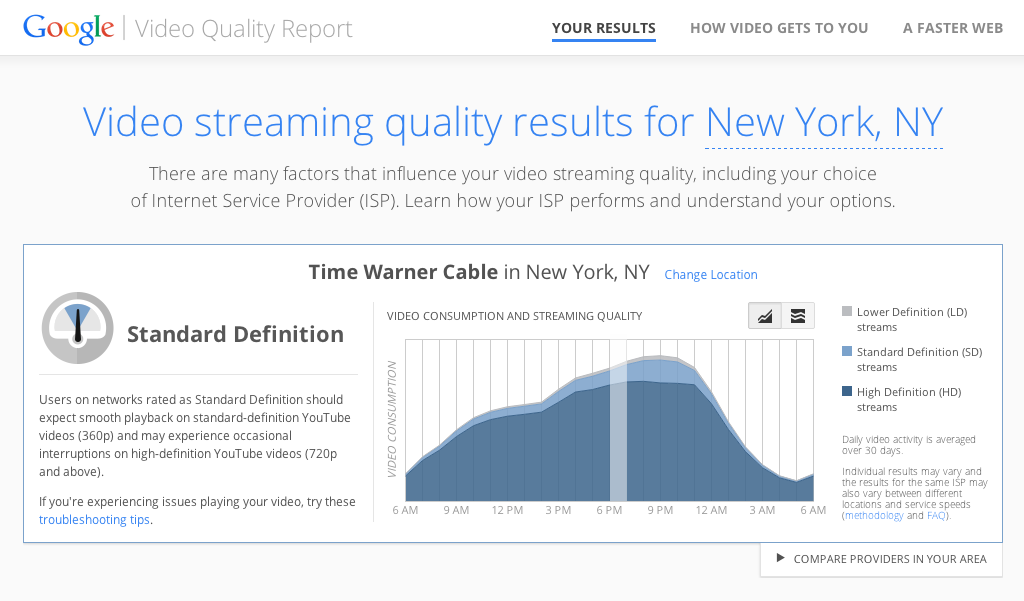 [Philip Lelyveld comment: Wow! Trying to win hearts and minds in the Net Neutrality debate.]
 Felix Arvid Ulf Kjellberg's PewDiePie channel is at the top of the charts this week with an incredible nine-figure view count. The 24-year-old Swedish gamer's YouTube channel scored more than 100,424,123 million views during the week, an impressive 22% increase over the week prior. Meanwhile, Shakira is in a far distant second place. The international pop star whose World Cup anthem, "La La La (Brazil 2014) ft. Carlinhos Brown" is still getting a lot of online video play, ended the week with more than 58.7 million views.
 While a great deal of attention has been lavished on the habits and behaviors of Millennials (born in the 1980s and 1990s), another generation of digital natives is coming of age. To better understand the motivations, perceptions and browsing habits of these “digital kids,” Huge conducted multiple focus groups with an ethnically and economically diverse group of ten-year-olds to hear in their own words what excites them and how they discover new content.
 Koons, more than any other artist, has embraced the new possibilities that open up when you can charge seven- or even eight-figure sums for a single piece: his art is like the new luxury apartment buildings going up in Manhattan, which only make financial sense once the residences inside can sell for more than $5,000 per square foot. Koons’s art might be empty; it might be banal. But Koons does something very interesting, which very few other artists do. He turns money into art, rather than just turning art into money.
 [Philip Lelyveld note: The teaser looks really interesting. They are 40% to their Kickstarter goal. It will be interesting to see what the interviewees will do when the tech that 'changed their lives' is displaced by the new new thing.]