NBA COURTSIDE AT HOME? LIVE ACTION VIRTUAL REALITY IS HERE AND BETTER THAN EXPECTED
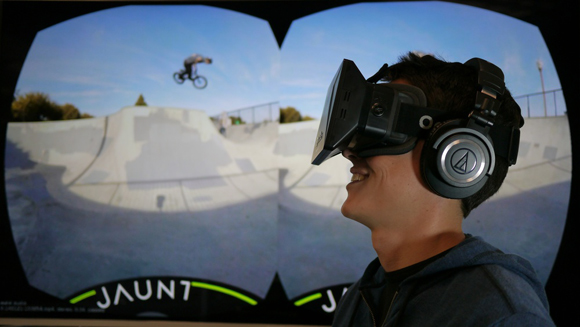 William Gibson famously said, “The future is already here – it’s just not evenly distributed.” I’m guessing Gibson was probably referring to the coming world of live action content for the Oculus Rift, and if that’s true he’s exactly right. The future is stuck in a Palo Alto office loft. JauntVR to be exact.
Forget the simulated world of virtual reality video games. The real VR disruption is coming from live action. Do you want courtside seats for the Lakers? Looking to get inside the White House press room? Have you been on stage with your favorite band lately? It’s not a matter of if, but of “HOLY CRAP it’s already here!!”
To get a sense of what JauntVR has built, their technology is described as “an end-to-end solution for creating cinematic VR experiences.” Their camera films real world footage from everything surrounding it, and their software stitches those clips together to create a seamless experience. The wrap-around film capture means that you’re able to swivel in any direction to maintain that feeling of “actually being there.”
Rarely is the window into the future as stunningly clear as was for me for the next few minutes inside that Oculus Rift.
But as exciting as this sounds, live event ticket sales won’t vanish overnight. Events are a social affair, and live crowds will never and should never be replaced. Even at home, VR will remain (at least for the short term) a companionless substitute for watching with friends.
Businesses in the “experience” industry ought to respect the vaporizing forces of digitization, otherwise risk ending up in the analog graveyard with Blockbuster.
See the full story here: http://singularityhub.com/2014/07/22/nba-courtside-at-home-live-action-virtual-reality-is-already-here-and-its-better-than-expected/
New Breed of Online Stars Rewrite the Rules of Fame
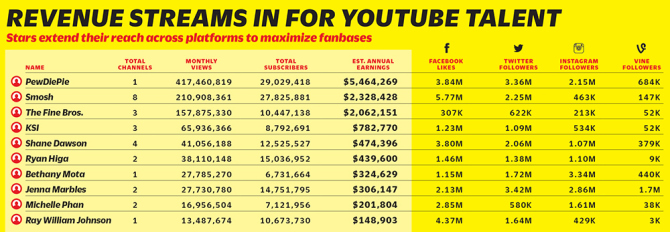 WME digital agent Avi Gandhi said he’s seeing an increasing number of online stars making seven figures a year, with some approaching eight. As the ad business — which has had 70 years of buying on TV — starts figuring out that the Internet is a missed opportunity, even more dollars will pour into the ecosystem. “These digital stars, a lot of them, have online audiences bigger than TV shows,” Gandhi noted.
STAYING NATIVE
Jenna Marbles surely figures into this elite group. With 13.5 million subscribers, she is second only to comedy duo Smosh among U.S.-based YouTubers. Born and raised in Rochester, N.Y., Marbles — whose real name is Jenna Mourey — still has no desire to do anything other than regularly post odd, funny and personal episodes on her channel every Wednesday. The 27-year-old mostly produces the entire show alone from her Los Angeles apartment.
The rise of digital stars — who control their relationship with the audience more closely than any generation of talent that has preceded them — will inevitably change the dynamics of the industry, said Larry Shapiro, senior VP and head of talent at Fullscreen and a former CAA agent. “Hollywood believes in pixie dust. Silicon Valley believes in data,” he said. “Today’s entertainment has to be a combination of both.”
See the full story here: http://variety.com/2014/digital/news/shane-dawson-jenna-marbles-internet-fame-1201271428/
Startup Wants You to Capture the World in 3-D
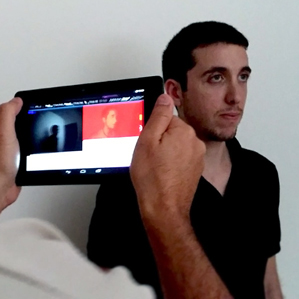 Gur Bittan envisions a future where you’re not just capturing a regular video of a child’s first steps with a smartphone; you’re doing it in 3-D, and sharing it with friends who can manipulate the video to watch it from different perspectives—even the kid’s point of view, providing you’ve scanned the scene from enough angles.
The company’s software and hardware designs are part of Google’s Project Tango tablet, which can map environments and objects. It is also working on apocket-sized 3-D scanner and already offers an enterprise 3-D scanner called the F5.
To capture 3-D information, a projector overlays an infrared light pattern onto whatever it is you’re trying to scan—a teddy bear, for instance. Then a digital camera and a depth sensor, synched to the projector, capture the scene with the light reflected by the bear. The technology works even in complete darkness, since it includes its own illumination; in bright environments the quality of the resulting image depends on the hardware used.
Computer Programming Is a Trade; Let’s Act Like It
 The most intensive schools, like Seattle-based Code Fellows, are so sure they can get students work they will refund a student's tuition—$12,000 for 16 blitzkrieg weeks to get a person from zero to trained—if that person doesn't get a job.
Mr. Carson, co-founder of Treehouse, says his own computer-science degree, which he got in 2000, is useless. Technology now moves so quickly that programmers must constantly retrain in new frameworks. This provides an opening for students willing to learn exactly the skills that are hot right now as long as they're also willing to continue learning for life.
See the full story here: http://online.wsj.com/articles/computer-programming-is-a-trade-lets-act-like-it-1407109947
5 clever apps and games that leverage the 3D screen in Amazon’s Fire Phone Read more: http://www.digitaltrends.com/mobile/apps-games-using-amazons-fire-phone/#ixzz39MKpFlsU Follow us: @digitaltrends on Twitter | digitaltrendsftw on Facebook
 In reviews, one of the biggest knocks against the new Amazon Fire Phone is that it’s full of gimmicks. It has a handful of new features like 3D lockscreens (called “Dynamic Perspective“) and tilt-to-reveal capabilities that look neat, but for the Fire Phone to really ignite ordinary people’s interest, it will need a robust app store and exciting apps that take advantage of its unique features.
“The idea of angry tofu delights me,” he said before demonstrating the game. In it, players maneuver a character through levels while collecting blue orbs and avoiding obstacles along the way, with the goal of saving Fortune Kitty.
Tilting the phone gives players new views and perspectives of the level. Terry Haynes, a producer with HotGen, said working with Amazon Game Studios “graciously guided” them through the “often choppy waters of video game development,” giving them the chance to “shine as a studio.”
See the full story here: http://www.digitaltrends.com/mobile/apps-games-using-amazons-fire-phone/#!buF168
Nvidia Designs New Pixel-Dense LCD Panels for VR Headsets
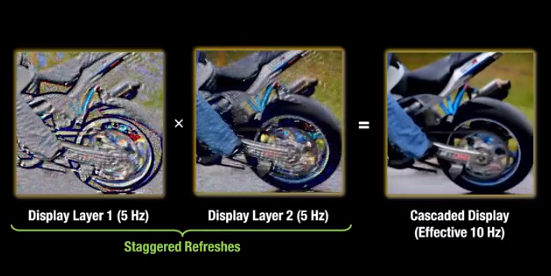 Researchers at Nvidia have found a trick that solves the problem of users being able to see the pixels in their VR headsets. By using a “cascaded display” involving two LCD panels, the researchers found that they could quadruple the pixel density of the headset, making pixels invisible to the eye even at close range. The cascaded displays also have a faster frame rate, making images appear smoother, and a reduced brightness, which is not a concern for the displays in VR headsets.
The cascaded display works by utilizing two LCD panels and the tiny shutters on the panels that control the visibility of each pixel. The shutters from one LCD panel are removed and placed over the shutters of another panel. The extra layer of shutters is installed in an offset position, effectively turning each pixel into four.
See the full post here: http://www.etcentric.org/nvidia-designs-new-pixel-dense-lcd-panels-for-vr-headsets/
and here: http://www.technologyreview.com/news/529201/lcd-hacking-trick-could-make-virtual-reality-more-real/
Now at RadioShack: Connect-Your-Stuff-to-the-Internet Kits
 RadioShack (RSH) said this spring that it would attempt to shore up its crumbling retail empire by providing shelf space to crafty inventors whose gadgets might lure people into the stores. The first items will show up in stores next month, but they aren’t exactly gadgets; rather, they’re kits designed to help people make their ownInternet connected doorbells and toy houses with remote controlled lights.
The idea comes from New York startup LittleBits, which makes a series of brightly colored components that can be snapped together to create Rube Goldberg machines for the digital era. The company has already been selling sets that allow users to connect, say, a small sound detector to a LED light, allowing you to illuminate a small space every time you turn on the radio. Starting Wednesday, LittleBits is selling a kit that connects these things to the Internet. It will be available in a small number of RadioShack stores in August and in 2,000 of them by the fall.
The LittleBits pitch is simplicity. It says its electronics strive to be as easy to play with as Legos. A starter kit costs $99 and is designed to be useful in the hands of complete novices but also offers more advanced tools, such as APIs, for those who want to write code for the gadgets.
See the full story here: http://www.businessweek.com/articles/2014-07-23/diy-home-radio-shacks-connect-your-house-to-the-internet-kits