New Chip to Bring Holograms to Smartphones
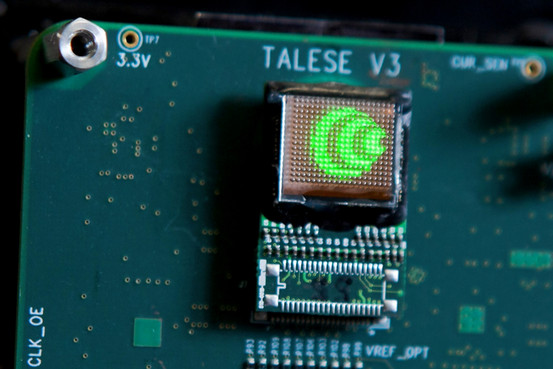 One chipset, small enough to fit into a smartphone, is capable of projecting video on a surface with a 48-inch diagonal. A patchwork of chips, laid together, can form far larger and more complex images. The first iteration of the chip, which is scheduled to begin shipping next year, will only project 2-D videos, but the next version, expected to follow soon after will feature holographic capability, according to Ostendo's chief executive and founder, Hussein S. El-Ghoroury.
During a recent test reviewed by The Wall Street Journal, Ostendo showed a working prototype: a set of six chips laid together that beamed a 3-D image of green dice spinning in the air. The image and motion appeared consistent, irrespective of the position of the viewer.
According to Ramesh Raskar, an associate professor at the Massachusetts Institute of Technology, who is working on 3-D displays for MIT's Media Lab, Ostendo's advantage and the key to its 3-D capability is its resolution. The Retina display on Apple Inc.'siPhone, for example, has about 300 dots per inch, Ostendo's chips are at about 5,000 dots per inch.
Ostendo, which says it has several opportunities with major handset manufacturers, expects the first 2-D projector unit to be in the hands of consumers before the summer of 2015. With a lens attached, it will be less than 0.5 cubic centimeters, roughly the size of the camera in the iPhone. It also expects to begin manufacturing the second version of the chip, with 3-D capability, in the second half of 2015. The cost to the consumer should be about $30 a chip, Ostendo estimates.
See the full story here: http://online.wsj.com/articles/new-chip-to-bring-holograms-to-smartphones-1401752938#printMode
Watch the video of the hologram here: http://stream.wsj.com/story/world-stream/SS-2-44156/SS-2-546759/?mod=wsj_streaming_world-stream
ESPN Opens New Digital Center
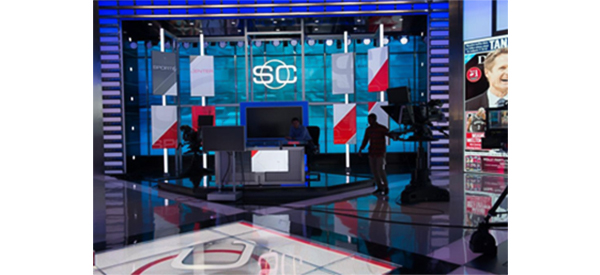 “The group working on DC-2 was given a simple assignment,” said Jodi Markley, senior vice president of operations for ESPN. “Design and build technology that hadn’t been built yet, create studio environments with unlimited capabilities for content creation, make it a very comfortable place for our employees to work, and make it green. This facility far exceeds that original assignment. In fact, DC-2 is the most technically sophisticated media facility in the United States.”
Much of the planning and new technology that went into DC-2 was based on close consultation with the network’s employees and ESPN President John Skipper highlighted the work of Chuck Pagano, the network’s CTO, who played a key role in designing the new facility. Pagano, who started with ESPN before it even began broadcasting in 1979, will be retiring in June.
See the full story here: http://www.c2meworld.com/creation/espn-opens-new-digital-center/
The FCC may consider a stricter definition of broadband in the Netflix age
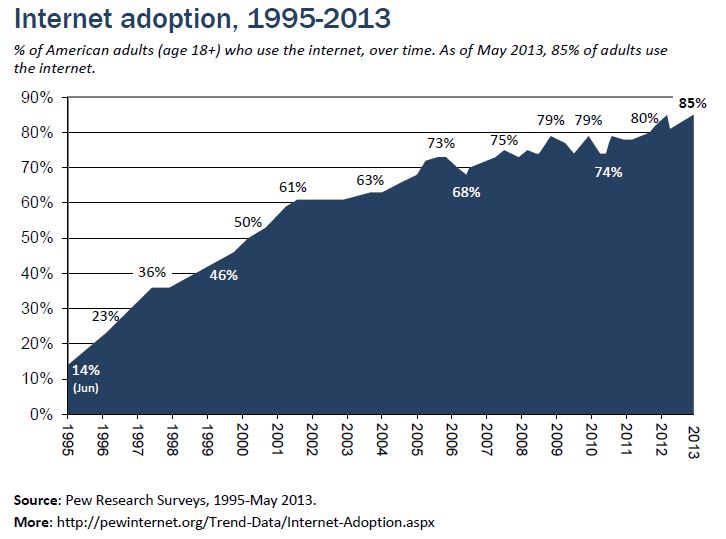 The FCC soon intends to solicit public comments on whether broadband should be redefined as 10 Mbps and up, or even as high as 25 Mbps and up, according to an agency official who asked not to be named because the draft request was not yet public. The new threshold would likely increase the number of people in the United States that statistically lack broadband, which in 2012 amounted to 6 percent of the population.
See the full post here: http://www.washingtonpost.com/blogs/the-switch/wp/2014/05/30/the-fcc-may-consider-a-stricter-definition-of-broadband-in-the-netflix-age/
Samsung is working with Oculus on a media-focused VR headset
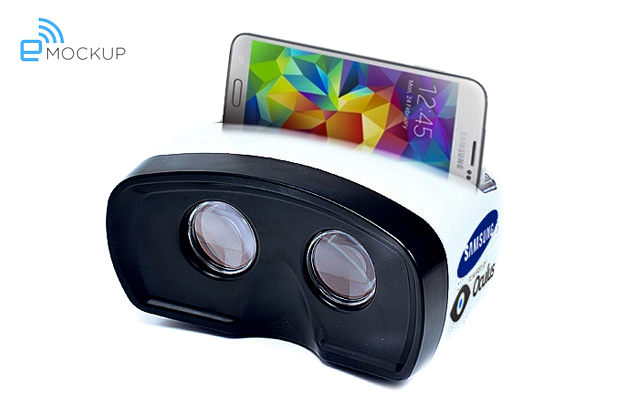 Samsung wants to be first to market with a virtual reality headset, but it doesn't want to invest the time and money that Oculus and Sony are. Oculus VR wants to create a high-quality virtual reality headset specifically for gaming, and it doesn't want to rush one out. And thus, a convenient partnership is born between the two companies: Samsung makes the OLED screens that Oculus needs for its final product; Oculus makes the software that Samsung needs for its upcoming headset.
We're told by sources close to both companies that Samsung's using an early form ofOculus' mobile SDK -- an exclusive use as part of the deal -- developed in part by John Carmack. We were also told that the OLED screens that Oculus is getting as part of the deal are of higher resolution than 1080p, and that the screens will also be used in at least some of Samsung's next flagship phones. And this is where things get weird.
Rather than having its own screen, Samsung's VR headset uses your phone directly. It plugs in using an existing port on your phone (think: micro-USB) and becomes the screen. The headset itself has built-in sensors -- an accelerometer at the very least -- so any motion-tracking functionality is offloaded from your phone's processor.
Wait! Before you write it off forever as "one of those headsets that straps your phone to your face," we're told there are some pretty great benefits to using a mobile device. For one, the rear-facing camera allows for video passthrough. That's to say, "You can see through the phone using the rear camera, which shows a video feed of the outside world to your eyes." Pretty intense sounding, but a smart addition for making long-term use more realistic. While the latency is too great to make augmented reality applications possible, it's a convenient way to pause whatever you're doing and, say, have a sip of a tasty beverage.
Finally, expect Samsung to tout this device as a media player as well.
Oculus VR and Samsung declined to comment for this story.
See the full story here: http://www.engadget.com/2014/05/30/samsung-oculus-partnership/
Virtual Reality Poised for Mass Entertainment, but Can Hollywood Make It Happen?
 Newborns are about unrealized potential; so are new technologies. Franklin understood that aviation would change the world, though it took the arrival of airplanes to realize some of his predictions. Today it seems to be virtual reality’s turn to take flight, perhaps to become as impactful as cinema and television. But the pioneers trying to tell stories in VR are grappling with the same question that confronted Ben Franklin that distant Wednesday in Paris: “What good is it?” Or, more precisely: “How do we use it?”
“I think from a cinematic storytelling perspective, we may be right around — or even before — (the time) metaphorically, when the Lumiere brothers created ‘Train Pulling Into La Ciotat Station’ ” (in 1895), says Eugene Chung, director of film & media for Oculus.
Because VR was nurtured in gaming devices and simulators, videogames have seemed like the most natural fit for the medium. But many developers are already using it for live-action experiences and trying to find the best way to fit it to narrative storytelling. “The original motto of Oculus was, ‘Step Into the Game,’ ” Chung says. “We’ve since modified it to letting people ‘Experience the impossible.’ ”
“Locomotion is a big topic in VR,” [Sony's Rick] Marks says, “How do you move around a 3D world?” “Walking” with a joystick feels fine in a console game; in VR, it can induce simulator sickness. Marks’ team is experimenting with letting players use “teleportation” — which amounts to jumping from point to point.
Another challenge arises from a sense few people are even aware of: “Proprioception,” the body’s positional sense. Going into a VR world and being unable to see your own body and arms can quickly become disorienting.
Many VR pioneers are learning from stage directors, who have always had to guide the audience’s attention using lighting, sound and staging, without being able to control point of view as a film director can.
Some VR creators are also studying theme park design. Hilary Lewis, an architectural historian who has done a deep study of the look and layout of Disneyland, observes: “What (Disney) did at the theme parks was take all the talents they had in developing film and apply that to creating a three-dimensional space you could walk around in. If that’s not the beginning of virtual reality, I don’t know what is.”
VR faces yet another obstacle: Putting on goggles and headphones is isolating. Yet, that’s the point: You shut out the real world for an artificial one. But entertainment is social, too. Today’s VR can quickly become a strangely ghostly, lonely experience, like Scrooge revisiting the shadows of Christmas Past or the dead Emily Webb reliving her birthday in the final act of “Our Town.” Developers are hard at work making the VR experience social, adding avatars for multiple users, and the like. That may turn out to be crucial if VR is ever to rival TV and movies.
Read the full story here: http://variety.com/2014/digital/news/virtual-reality-poised-for-mass-entertainment-but-can-hollywood-make-it-happen-1201193873/?curator=MediaREDEF