Frictionless privacy should come before frictionless sharing
There is a discomforting commonality between some of the largest Internet companies – Google and Facebook, specifically – and the US National Security Agency. While one group takes our information with our tacit consent and the other takes it without our knowledge, both are making assumptions on our behalf about about what is good for us when it comes to online privacy.
See the full story here: http://pandodaily.com/2013/07/04/frictionless-privacy-should-come-before-frictionless-sharing/
Content Protection for 4k Video
[Spencer] Stephens’s wish list included such elements as:
- Title-by-title diversity, so that a technique used to hack one movie title doesn’t necessarily apply to another
- Requiring players to authenticate themselves online before playback, which enables hacked players to be denied but makes it impossible to play 4k content without an Internet connection
- The use of HDCP 2.2 to protect digital outputs, since older versions of HDCP have been hacked
- Session-based watermarking, so that each 4k file is marked with the identity of the device or user that downloaded it (a technique used today with early-window HD content)
- The use of trusted execution environments (TEE) for playback, which combine the security of hardware with the renewability of software
...Stephens’s remarks were a bit of fresh air. They are an invitation to more open dialog among vendors, studios, and service providers about the types of content protection that they may be willing to implement when it comes time to distribute 4k content to consumers.
In the past, such discussions often happened behind closed doors, took the form of unilateral “unfunded mandates,” and/or resulted in implementations that plainly did not work. As technology gets more sophisticated and the world gets more complex, Hollywood is going to have to work more closely with downstream entities in the content distribution chain if it wants its content protected. Spencer Stephens’s presentation was a good start in that direction.
See the full story here: http://copyrightandtechnology.com/2013/07/02/content-protection-for-4k-video/
Don’t Break Your Arm, But If You Break Your Arm Get This Sweet 3D Printed Cast
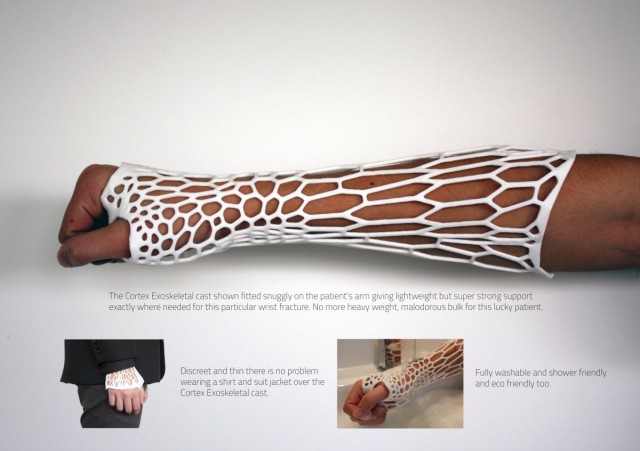 The patient’s broken limb is scanned, and a Cortex model is designed around that scan. The cast is then 3D printed and applied. There’s no real room for your friends and family to sign your Cortex cast, but instead of signatures you can see the look of envy in their faces at your supercool exoskeleton cast.
See the full story here: http://www.geekosystem.com/3d-printed-cast/
Myspace Maintains First-Week Momentum
The newly revamped social service Myspace continues to attract an audience following its debut — with 31 million visitors and 995,000 app downloads reported in its first 14 days. It has also redesigned its mobile app and is launching a major marketing campaign to target millennials, with their music tastes and interests in mind. However, the service may still need to address issues related to offering unlicensed content from independent labels.
See the full story here: http://www.hollywoodreporter.com/news/myspace-maintains-first-week-momentum-576586
Survey: 60 Million Americans Rely on Broadcast TV
 “We’re seeing 19.3 percent of TV homes reporting broadcast-only reception, compared with a level of 17.8 percent in 2012, and as low as 14 percent as recently as 2010,” he wrote. “Projected out, this means that in 2013, roughly around 22 million homes rely only on over-the-air broadcast rather than pay-TV service.” - See more at: http://www.tvtechnology.com/article/survey--million-americans-rely-on-broadcast-tv/220019#sthash.A7hqD1R9.dpuf
See the full story here: http://www.tvtechnology.com/article/survey--million-americans-rely-on-broadcast-tv/220019
Amazon Studios Seeking Concept Videos
[Philip Lelyveld comment: So they are 'democratizing' the old studio model. This could easily echo the plot of Animal Farm.]
The three-year-old studio will begin on Thursday to accept “concept videos” as a way to submit an idea for a commercial theatrical feature film. Videos, which can be two to 15 minutes, can be submitted to the Amazon Studios site.
The process works equivalently to Amazon’s script submission process under which creators can submit publicly or privately with a 45-day option and evaluation period. Creators of projects added to the development slate will receive a $10,000 payment.
Earlier this month, the studio announced the availability of a storyboarding tool — Amazon Storyteller — under which writers can create storyboards by first uploading their script to Amazon Studios. Once a storyboard is published, Amazon Studios takes a 45-day option on the project to decide if it should be added to its development slate.
See the full story here: http://variety.com/2013/film/news/amazon-studios-seeking-concept-videos-1200502379/
MACHINIMA LOOKS TO TURN GAME RE-STREAMS INTO BIG BUSINESS
“Instead of relying on clips contributed by YouTube amateurs and semipros, Machinima wants to spend more money licensing original shows, like the Warner Bros-produced ‘Mortal Kombat’ series it has run, or a forthcoming series from director Ridley Scott,” reports AllThingsD. “Machinima wants to figure out how to create a subscription business, a la Hulu Plus or Netflix, which could run on other platforms, like Microsoft’s Xbox, as well as Machinima’s own, non-YouTube site.”
See the full post here: http://www.etcentric.org/machinima-looks-to-turn-game-re-streams-into-big-business/#more-59874
Intel’s TV ‘Black Box Project’ poised for big changes in debut
Intel plans to launch hardware and software later this year for a subscription broadband service that will provide viewers with access to live television, on-demand programming and additional content in their homes and on their mobile devices.
“Currently, more than 2,000 Intel employees in Northern California, Arizona, and Oregon are testing the product in their homes,” ...
Read the full story here: http://news.cnet.com/8301-1023_3-57590806-93/intels-tv-black-box-project-poised-for-big-changes-in-debut/
How the top 25 YouTube channels earned 144B views, 520M comments, and 1B likes
Surprisingly, viewer engagement does not consistently correlate with overall viewing numbers. VentureBeatlists five common traits among channels that have the most engagement, as identified by the SimulTV study:
1) Post new content at least twice a week.
2) Participate in the discussion; talk to fans and subscribers.
3) Link directly to your Facebook and Twitter accounts, plus consider your Google+ or Tumblr accounts.
4) Use playlists to group videos with similar themes and showcase best-ofs.
5) Design eye-capturing thumbnail images for your videos instead of relying on YouTube’s screen grabs.
See the full story here: http://venturebeat.com/2013/06/25/how-the-top-25-youtube-channels-earned-144b-views-520m-comments-and-1b-likes/
Americans Name Price For Their Personal Data
The research of more than 8,000 individuals in the United States, United Kingdom, Sweden, Russia, Germany, Brazil, China and the Czech Republic also predicted some digital trends:
- Value me — Consumers may eventually utilize data vaults, and possibly even brokers, to negotiate rewards for sharing their personal data.
- Creator culture — The researchers expect consumers to create and build technologies they may need, rather than waiting for others to build those technologies for them.
- My analytics — The rise of wearable technology has created new needs for consumers, especially in being able to analyze data and implement strategies that help them to grow. Continuous data and automated results will drive that adoption.
- The right to anonymity — Researchers expect digital information to be less permanent in the future, allowing consumers and their data to appear, disappear and reappear when they want.
- More-intelligent tech — Researchers also predict that technologies will reduce clutter by changing the always-on nature of technologies. Those technologies will do that by "learning when to be quiet."
- Niche networks — Consumers will eventually shun traditional social networks and sites like Facebook, Amazon and Google, instead opting for specialized networks and services, which will make up online communities in the future.
- Age of serendipity — Technology will eventually help to create experiences to keep people busywhile they are waiting , researchers say.
- Enhancing the real — Researchers expect technology to eventually interact with people's senses. Smell-O-Vision, anyone?
See the full story here: http://news.yahoo.com/americans-name-price-personal-data-093230141.html
Pages
- About Philip Lelyveld
- Mark and Addie Lelyveld Biographies
- Presentations and articles
- Trustworthy AI – A Market-Driven approach
- Tufts Alumni Bio