[Philip Lelyveld comment; new data gathered by the gov't will be open by default.]
Under the terms of the Executive Order and a new Open Data Policy released today by the Office of Science and Technology Policy and the Office of Management and Budget, all newly generated government data will be required to be made available in open, machine-readable formats, greatly enhancing their accessibility and usefulness, while ensuring privacy and security.
“This type of computer is not intended for surfing the internet, but it does solve this narrow but important type of problem really, really fast…If you want it to solve the exact problem it’s built to solve, at the problem sizes I tested, it’s thousands of times faster than anything I’m aware of. If you want it to solve more general problems of that size, I would say it competes – it does as well as some of the best things I’ve looked at.”
In 1995, the European Union introduced privacy legislation that defined “personal data” as any information that could identify a person, directly or indirectly. The legislators were apparently thinking of things like documents with an identification number, and they wanted them protected just as if they carried your name.
Today, that definition encompasses far more information than those European legislators could ever have imagined—easily more than all the bits and bytes in the entire world when they wrote their law 18 years ago.
Much of this data is invisible to people and seems impersonal. But it’s not. What modern data science is finding is that nearly any type of data can be used, much like a fingerprint, to identify the person who created it: your choice of movies on Netflix, the location signals emitted by your cell phone, even your pattern of walking as recorded by a surveillance camera. In effect, the more data there is, the less any of it can be said to be private, since the richness of that data makes pinpointing people “algorithmically possible,” says Princeton University computer scientist Arvind Narayanan.
We’re well down this path already. The types of information we’ve thought of as personal data in the past—our name, address, or credit card records—are already bought and sold by data brokers like Acxiom, a company that holds an average of 1,500 pieces of information on more than 500 million consumers around the world. This was data that people put into the public domain on a survey form or when they signed up for services such as TiVo.
BitTorrent wants more artists to give away stuff to file sharers – which is why they just gave those artists an option to also sell stuff to file sharers.
Our goal is to move the interaction to where it matters; making it a property of the file, versus the distribution framework; giving artists real data about, and real access to, their fans.”
The company went through a bit or a rough patch in the following years, but has since recovered, and put a bigger emphasis on working with independent artists in recent months. Asked whether the company wants to take a cut when people start to sell their music or movies through bundles, a spokesperson told me that there are “no immediate plans for this.”
[Philip Lelyveld comment; as the web continues to evolve, websites are becoming statistically less willing to share data that profits others but not themselves. On top of this there is a nascent movement to give consumers more control over who gets what portions of their personal data, and what they - the consumer - gets in return.]
The amount of data collection on the most popular websites is falling slightly after a period of explosive growth, according to an annual study, suggesting that publishers might be trying to prevent tracking technologies from accessing valuable data on their websites.
The average visit to one of the 50 most popular sites in the U.S. resulted in 42 instances of data collection in March, down from 50 instances about a year earlier, according to a new study by Krux Digital Inc., a company that helps monitor tracking technologies. When Krux conducted its first study in November 2010, data was collected only 10 times on the average page.
The latest reversal could reflect a move by website publishers to take control of data about their own users, rather than allowing many third-party companies to gather information while providing ads on other services.
[Philip Lelyveld comment: Danah Boyd has written a thoughtful and thought provoking commentary on the new nature of work.]
As you think about your own professional practices, how do you define what constitutes work? How do you think labor should be understood in a networked world? And what does fairness in compensation look like when the notion of clocking in and clocking out are passe?
A chain-smoking former statistics professor named Vinny Bruzzese — “the reigning mad scientist of Hollywood,” in the words of one studio customer — has started to aggressively pitch a service he calls script evaluation. For as much as $20,000 per script, Mr. Bruzzese and a team of analysts compare the story structure and genre of a draft script with those of released movies, looking for clues to box-office success. His company, Worldwide Motion Picture Group, also digs into an extensive database of focus group results for similar films and surveys 1,500 potential moviegoers. What do you like? What should be changed?
In a study conducted by NPD Group with over 4,000 participants, only 47 percent of home entertainment devices, such as Blu-ray players, gaming consoles, smart TVs and streaming media devices are connected to the Internet. Results of the study also determined that 40 percent of connected televisions are used to watch Netflix content, with other video sites such as YouTube following at 17 percent, and Hulu at 11 percent.
“Content usage remains dominated by Netflix and YouTube,” notes John Buffone, director, devices, NPD Connected Intelligence. “An opportunity for digital distribution lies in enticing consumers to plug in to the Internet and download the apps available on devices they already own.”
Sure, using Google Glass to record a video is a pretty neat trick, but how about uploading it to YouTube without a computer? Thanks to Fullscreen's BEAM video sharing app for Glass, you can do just that. After setting up an account with the company's website, Glass owners can use their high-tech eyewear to send clips to YouTube along with a tweet linking directly to the video.
I can't explain why I enjoyed reading this book so much, but it was a fascinating page-turner. The book is Plutocrats: The Rise of the New Global Super-Rich and the Fall of Everyone Else. The author describes how we are in the midst of a second gilded age; when emerging markets are catching up with the developed world at a rapid pace driven by two key drivers - technology and globalization. Technology has accelerated the 'industrial revolution' disruption in the emerging world. Globalization makes everyone a customer and every place a market, driving down standards of living in the developed world. More than half of the world's billionaires living today gained their fortunes by directly building businesses from humble beginnings. Many took advantage of 'morally questionable' opportunities, but ultimately society benefited - even as many unfortunate individuals did not. Check it out...
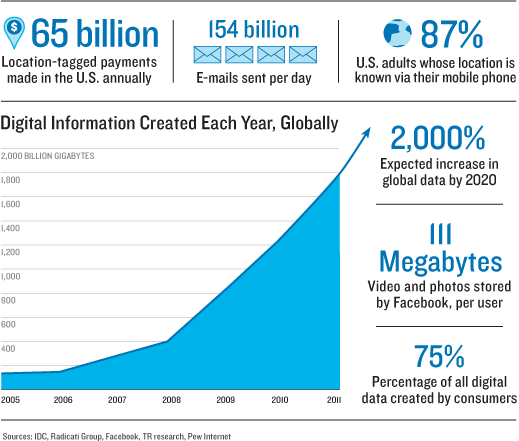 In 1995, the European Union introduced privacy legislation that defined “personal data” as any information that could identify a person, directly or indirectly. The legislators were apparently thinking of things like documents with an identification number, and they wanted them protected just as if they carried your name.
 A chain-smoking former statistics professor named Vinny Bruzzese — “the reigning mad scientist of Hollywood,” in the words of one studio customer — has started to aggressively pitch a service he calls script evaluation. For as much as $20,000 per script, Mr. Bruzzese and a team of analysts compare the story structure and genre of a draft script with those of released movies, looking for clues to box-office success. His company, Worldwide Motion Picture Group, also digs into an extensive database of focus group results for similar films and surveys 1,500 potential moviegoers. What do you like? What should be changed?