Augmented Reality escapes apps for mobile browser
 Augmented reality is set to escape apps and arrive in the browser, according to industry stalwarts, Wikitude, which has a new version of its AR technology that does away with siloed apps. Wikitude AR Window allows webpage developers to access the camera on a smartphone or tablet and display a live view from it, complete with real-time overlays of relevant information, something that would previously have required a separate download.
Although augmented reality apps are beginning to flourish, with a number of different systems from Wikitude, Qualcomm and others competing to power the market, so far each deployment has required its own, individual app. AR window, however, opens up mediation apps in the browser to the device’s camera and sensors, meaning webpages know where the user is, what they’re facing and when, and can insert new information accordingly. ...
Augmented reality has made headlines in recent weeks after Google demonstrated its Project Glass research, a wearable computer that can overlay digital information on top of a real-world view. More on AR in our full round-up.
See the original post here:
What’s the marketing potential from Apple’s recent patent for iPhone 3D camera technology?
...So how would this new 3D camera technology work in the real world? Well according the patent, it would combine radar, laser, light-detection and ranging (LIDAR) and various other sensors to enhance depth and the intensity of color accuracy. The language also indicates that it would enable cameras to detect facial expressions and gestures ranging from a grin to a grimace. It is being speculated that the detection aspect could work by detecting parts of the face such as a person’s eyes, nose, and mouth, and then matching it with a range of expressions and gestures stored in a database.
Marketing potential of 3D camera technology
Should Apple’s 3D camera technology come to life, the marketing potential behind it could be virtually unlimited. We can see it being particularly useful for software and video game developers, companies that provide services to the entertainment industry, and others that exist to create strong visual experiences for end users. Such a concept may sound farfetched, but it isn’t when you consider that the 3D boom has already arrived. In addition to the growing number of 3D-friendly TVs, monitors and mobile devices, the popularity of Hollywood hits like Avatar and Clash of the Titans prove that there is indeed a market for Apple’s concept.
Believe it or not, but a 3D camera-enabled iPhone wouldn’t be the first of its kind in the smartphone space. In fact, that credit actually goes to the HTC Evo 3D, which officially broke the barrier by allowing users to snap pictures, record three dimensional videos, and view the captured content without needing a pair of special glasses. However, what Apple has in store could lend itself to even more exciting possibilities, mainly because of the rich capabilities of its iOS devices. ...
See the full story here: http://www.techi.com/2012/05/whats-the-marketing-potential-from-apples-recent-patent-for-iphone-3d-camera-technology/
Consumers View Video Via More Platforms, But HDTVs Most Popular, CEA Study Finds
... Future television purchases will be based on better picture quality and larger screen sizes as consumers will continue to seek the latest innovations in the market. Almost half (48 percent) of consumers planning to purchase a TV in the next 12 months will be replacing an aging, obsolete or broken set. However, half (51 percent) desire improved picture quality in a new display and half (50 percent) want a larger screen size.One in four (24 percent) consumers with intentions to purchase a TV over the next year expect to purchase a 3DTV; 21 percent plan to purchase an OLED display; and a quarter of consumers (25 percent) plan to purchase an Internet-enabled TV. While stated purchase intentions do not always translate to transactions, the study clearly shows many consumers have their eyes fixed on newer TV technologies.
"Easy access to the Web makes TVs more versatile, allowing us to stay connected, informed and entertained," said DuBravac. "In the future, new technologies, like OLED and 3D, will continue to improve the viewer experience, and Internet-enabled sets will fulfill consumers' desires to be connected."
The Evolving Video Landscape Study (April 2012) was conducted between February 22 and March 2, 2012. It was designed and formulated by CEA Market Research, the most comprehensive source of sales data, forecasts, consumer research and historical trends for the consumer electronics industry. ...
See the original post here
3D Mixing Part 7: Mastering, The Final Chapter (Part 2)
[Philip Lelyveld comment: the links lead to a series of articles on 3D audio mixing.]
- An Introduction To 3D Mixing
- 3D Mixing Part 2: Panorama
- 3D Mixing Part 3: Equalization
- 3D Mixing Part 4: Compression
- 3D Mixing Part 5: Creative Routing
- 3D Mixing Part 6: Depth
- 3D Mixing Part 7: Mastering, The Final Chapter (Part 1)
- 3D Mixing Part 7: Mastering, The Final Chapter (Part 2)
Master EQ
For EQ on the master bus, ‘gentle’ is the word of the day. By the time you are ready to even begin thinking about mastering, your frequency control should be almost, if not completely solid (one of the reasons I went back and did a bit of remixing in the previous chapter). The master bus EQ is meant to be a gentle and wide band EQ which balances overall frequency bands as opposed to individual sounds and instruments. It is a bit of a mental shift from mixing, but a necessary one all the same and a good one to practice. ...
See the full story here:
3D audio enhances military situational awareness
....
Giving sound a tag – for instance a certain distinct noise meaning the movement of an enemy detachment – and giving it context in 3D space enables to a soldier to react immediately without having to read a label, even when the source is behind him. It can also appear to move in accordance with sensors detecting the movement of the tracked item on the battlefield.
During military operation in urban environments, audio is often a more primary sense than vision, providing a soldier with an early warning system. However, sounds like gunshots can bounce off densely-packed buildings, giving an incorrect location, so an artificial 3D cue through headphones could eliminate this.
The research also shows that using audio cues requires little or no training compared with interpreting readouts. By giving a perceived location that matches the actual one, a soldier instinctively knows where to turn and look. ...
See the full storyhere:
Project Glass: Google unveils its geeky augmented reality glasses
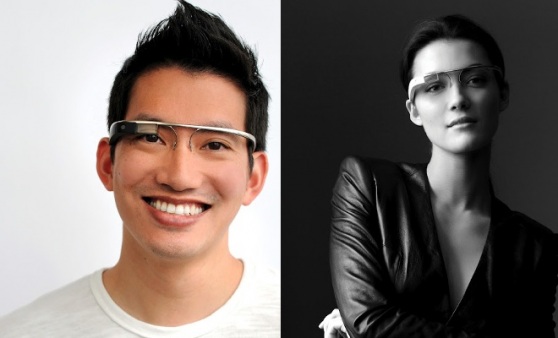 [Philip Lelyveld comment: why do journalists feel compelled to call any piece of tech-related eyewear "geeky"?]
...Dubbed Project Glass, the glasses will allow you to do many of the same things you do with your smartphone without whipping out a separate device. It’s still unclear when the glasses will be for sale, but Google says employees will begin testing them in public.
In a concept video released today, Google showed how the glasses could take pictures, give you directions, check-in to locations, and even perform video chats.
“We’re sharing this information now because we want to start a conversation and learn from your valuable input,” Google’s Babak Parviz, Steve Lee, and Sebastian Thrun wrote on a new Google+ page for the project. “So we took a few design photos to show what this technology could look like and created a video to demonstrate what it might enable you to do.” ...
See the full story here:
Samsung reveals its production-ready 55-inch OLED TV, the ES9500
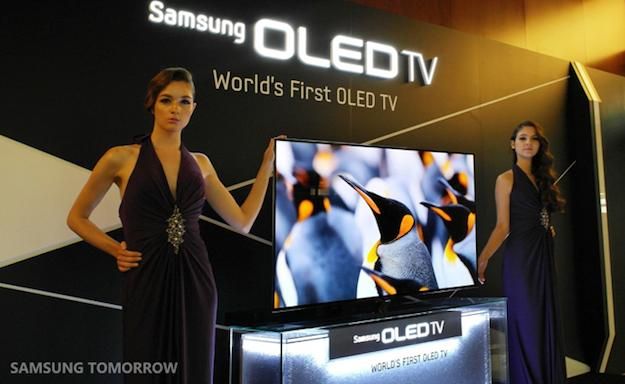
... Now we’ve got Smart DualView, which allows two people to watch two different programs on the same screen at the same time, in full high definition too, by using special 3D glasses with wireless headphones attached.
All this is in addition to the glorious picture offered by an OLED screen, plus the fast response time, and potential lack of motion blur and 3D crosstalk.
The ES9500 is set to go on sale during the second half of the year in Korea, where it will cost the equivalent of more than $9,000. ...
Read the full story here: http://www.digitaltrends.com/home-theater/after-teasing-us-a-ces-samsung-reveals-its-production-ready-55-inch-oled-tv-the-es9500/
At the Summer Box Office, a Battle Between Two Ways of Filming (Digital v Film)

... This intensified, late-stage competition between film and digital is the subject of the extraordinary new documentary Side By Side. Produced and narrated by Keanu Reeves and directed by Chris Kenneally, it recently debuted at New York's Tribeca Film Festival and will be released in select theaters nationwide and on-demand on August 21st. A sophisticated and even-handed take on what remains a controversial subject in movie circles, Side By Side looks at how digital technology has emerged over the past decade to challenge photochemical filmmaking. With almost 70 interviews featuring such directors as Martin Scorsese, George Lucas, and James Cameron—along with an impressive array of leading cinematographers, editors, producers, and technical innovators—it seems destined to be the authoritative documentary on this subject for years to come. And if you're curious, Side by Side was shot digitally. ...
Film's advocates continue to lose vital ground. For example, most of the world's camera companies having already stopped production on celluloid-based motion picture cameras altogether. What's more, Peter Jackson's The Hobbit—set for release this December—is poised to abandon not only film, but the traditional film frame rate of 24 frames-per-second. The Hobbit is currently being shot at 48 frames-per-second (see Jackson's official statement about that here), for Jackson's stated purpose of removing the cinema's traditional stroboscopic "flicker" effect and also to ease eye strain sometimes caused by 3D. Jackson's decision has already provoked much controversy. ...
Read the full, lengthy article, and watch a video, here: http://www.theatlantic.com/entertainment/archive/2012/05/at-the-summer-box-office-a-battle-between-two-ways-of-filming/257057/
Cool Concept: Peelable 3D Lens Stickers for Eyeglasses
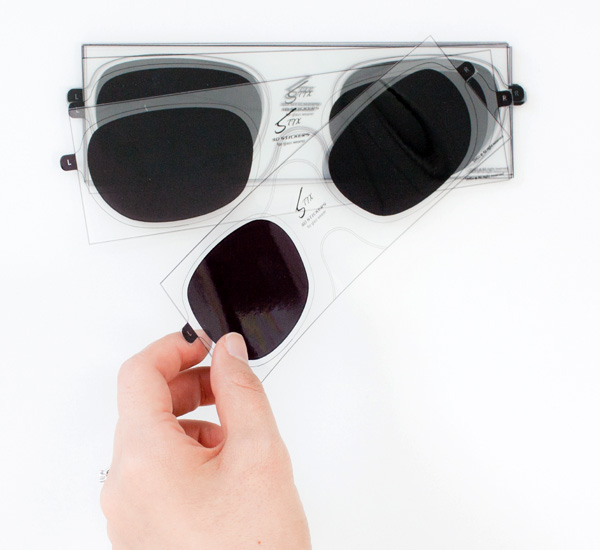
...Just peel off the stickers and apply them to your existing lenses. They spare grease marks from your fingers, as well as space in landfills, since it means less waste from disposable glasses.
Even if your sight is 20/20, geek glasses are super chic these days, and Stix would work just as well on a pair of clear, non-prescription lenses. This way, everyone could have a pair of 3D glasses that they love and that fit well. Plus, there’s no worry about any funk left over from previous wearers. That’s an epic win.
See the full story here:
One-of-a-kind outdoor advertising highlights Utah’s Delicate Arch
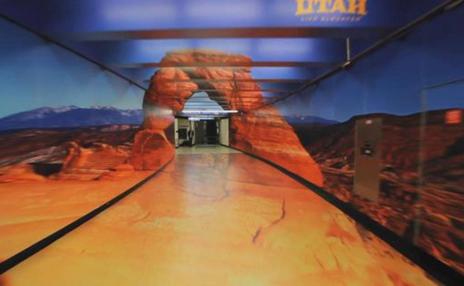
...“We believe our ‘forced perspective’ installation featuring Utah’s Delicate Arch is the first of its kind in the environmental advertising category,” said Struck executive creative director Steve Driggs. “The creation of the tunnel wrap required us to collaborate with a 3D illustrator who scanned the entire length of the tunnel in all its dimensions. We then needed to plot the scans based on GPS coordinates in a 3D architectural rendering program. In the end, we’ve delivered a unique advertising experience in San Francisco that literally transports viewers to Utah.” The "wow" factor seems to be working.
"And then as you walk underneath the beams you're looking up and you feel like you're walking through the arch, it's pretty clever," Williams said. "People were saying, ‘Wow the floor, I almost have to be careful walking along, it looks so real.'"
Inside the tunnel, there are images of Utah's other parks, and QR codes that people can click with their cellphone to get more information.
See the full story and watch the brief video here;