4K Brings Even Higher Resolution To TV
 [Philip Lelyveld comment: this lengthy article is an overview update on 4K and beyond in both theatrical and home theaters situations.]
... Nonetheless, 4K technology is entering the TV market in a variety of ways.
"4K may be the greatest thing that happens to HD," says Mark Schubin, an Emmy-winning TV engineer, who focuses on the evolution of production tactics. "At the tail end of the standard-definition era, producers were shooting with HD cameras and over-sampling. 4K cameras inherently over-sample, which makes it so much better looking even if you watch the show on a traditional HD set."
Schubin, a long-time technical consultant to Lincoln Center's Metropolitan Opera and an organizer of major Hollywood production technology programs, cites other 4K routes to market. Studios have been working on 4K for at least 10 years, he notes, with the expectation that it will emerge in digital cinema theaters.
"Now we're in a new era where people have large screens and home theaters," Schubin says. "4K is a differentiator." ...
Read the full story here:
Bigger and louder: New cinemas strive for an enhanced movie experience

[Philip Lelyveld comment: this story is an overview of theatrical technology implementations worldwide.]
The Giant Screen at Millennium Point reopened on Oct. 24 in Birmingham, United Kingdom, after a major refurbishment that included Barco’s Enhanced 4K-32B DLP Cinema large-format twin-projector system with Dolby digital-cinema servers. ...
With Dolby 3D on its 72 x 51 foot (22 x 15.5 m) Perlux high-gain screen installed by Franklin Designs, Millennium Point now has “the U.K.’s largest independent giant-screen digital 3D cinema.” (For more tech details, check out The Giant Screen’s blog.) ...
Shortly thereafter, Cineplex Entertainment exercised its option to equip an additional ten locations with 250 D-BOX MFX seats, bringing the total install base at the circuit to 21 theatres and over 520 motion-controlled seats.
D-BOX system deployment has seen similar growth worldwide since launching in April 2009 at UltraStar Surprise Pointe (Arizona) and Chinese 6 in Hollywood (Calif.). According to Guy Marcoux, VP of marketing, the breakdown of locations at the end of February is 77 sites in the U.S., 17 in Canada and an additional 11 D-Box theatres operating in seven countries. “Outside of North America, the leading markets for D-BOX have been Europe and Asia so far,” he details. “This widespread success clearly demonstrates the attractiveness of our business model as well as the acceptance of our motion experience as a fast-growing trend in movie viewing.” ...
See the full story here:
LG launches new Xnote A540 3D and IPS notebooks
 LG has announced two new additions to its Xnote A540 notebook lineup with the A540-T/D that features a 3D-capable screen and the A540-P that packs an AH-IPS display. These two follow the A540-H model introduced back at CES that offers a glasses-free 3D display that uses eye-tracking technology to properly display 3D videos and images. The A540-T/D, however, requires passive 3D glasses. ...
See the full story here:
FIRST LOOK at SeaWorld’s TurtleTrek entrance
 ...In another Central Florida On Demand exclusive, we were the only ones allowed through the doors to see the 3D 360 degree theater with house lights on, and this far along.
"No one's ever done a 3D dome before. It is hyper-real 3D all around the guests, including overhead. It's jaw-dropping."
One-hundred-ninety people at a time can stand in the theater to watch a sea turtle's incredible journey. We're told the first minute-and-a-half is pretty intense as 34 projectors and 22 audio channels expose a sea turtle's hardships. You're taken on their epic journey to see the extraordinary challenges they face to survive and even how -- somewhat miraculously -- they make it back to where they hatched. ...
See the full story here:
Steve Boland, Director of Market Development at Presteigne Charter talks about their new 3D nightvision camera and his ideas about the future of 3D sport
 [Philip Lelyveld comment: this is a lengthy interview covering the technical and business side of 3D.]
Steve Boland currently heads Presteigne Charter’s market development. The company boasts an extensive 3DTV project portfolio including a 3D multi-camera fly pack for MTV’s World Stage in Malaysia, Sony’s ‘Lens to living room’ live 3D production at IFA Berlin and single-camera 3D documentaries for Electric Sky.
In 2010, Steven Boland received a BAFTA nomination in the ‘New Media’ category along with the Sky Arts team and Antony Gormley for ‘One and Other’, a 24/7, 100-day live project in Trafalgar Square, London.
In this exclusive MIPTV interview, we start by asking Steve Boland what message he has for MIPTV delegates about Presteigne Charter’s strategy and ambitions.
Steve Boland: MIPTV is a very important event for 3DTV and it is encouraging to see the 3D conference 3D grow from last year. From a technology and support perspective, I think the industry has moved to an advanced stage in a very short period. There are now more intuitive tools than ever to create 3D and the cost of production is being reduced thanks to faster set up times and experienced crew. The challenge is to continue developing the creative language and engage viewers in new ways. Presteigne Charter remains committed to a long term view of 3D development and continues to invest in education, people and technology to support the format.
3D Focus: I understand you have been working on a night-vision 3D camera – can you elaborate?
Steve Boland: Presteigne Charter commissioned the build of a portable single-bodied 3D camera around 2.5 years ago. Called the RT-1000, the camera has been used extensively on 3D sports events since. We were approached by wildlife producers to look at ideas of translating 2D programmes to 3D. An area of interest was night filming. With software and control interface adjustments we were able to switch the camera remotely from colour day-mode to a monochrome night-mode. With minimal infrared lighting the camera can offer a surprising amount of detail in monochrome 3D. As the camera also operates wirelessly we are hoping the night vision feature may stimulate some creative ideas for factual or reality-style programming.
3D Focus: Is there an argument that 3D television could outshine 3D cinema as home screens get bigger and there is no ‘per viewer’ glasses premium anymore with passive sets?
Steve Boland: I think this will be driven largely by appropriate content for the viewing environment. Premium live events could benefit from larger screens at home and cheaper passive glasses. Getting people in front of TV screens at certain times is an on-going challenge, particularly against other media outlet options in the home. A shared experience that offers a closer viewer proximity to a live event is clearly attractive to both cinemas and television.
3D Focus: Live sport can include frequent edge violations, sun flare issues and sports men and women suddenly appearing very close to the camera creating extreme uncomfortable negative parallax. In a live scenario, when there are no post fixes available, will these problems always exist? Should live 3D streams be slightly delayed?
....
See the full story here:
3D TV Sales Slow Down After 5 Consecutive Growth Years
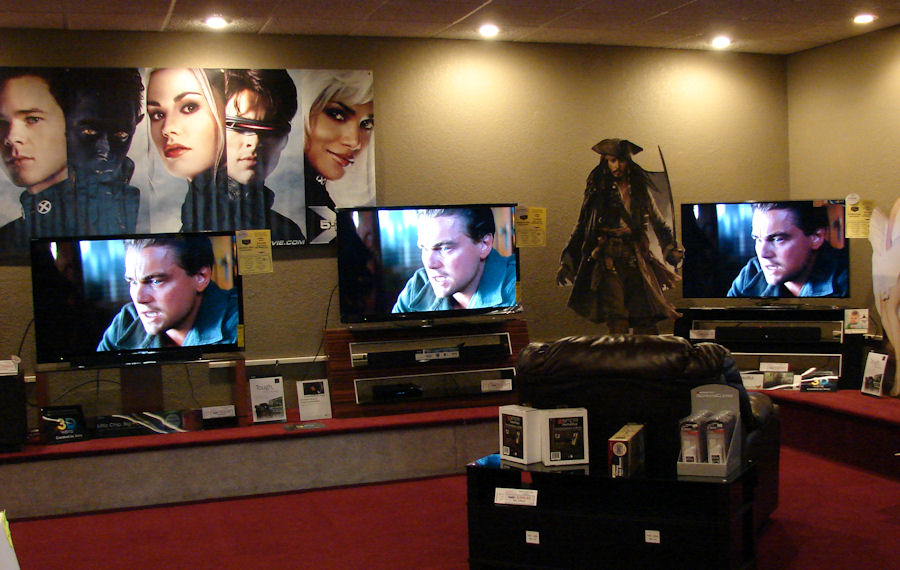 The latest home entertainment fad has been the TV in 3D format. Sales of this new technology took the world at large with rising sales which lasted for five years. However, it is this year — the sixth that the sales have taken a downward curve.
LCD TV sales have however shown an upward swing by the percentage increasing by seven percent. In 2011 the total units of LCD TV sold has been 205 million. Overall sales of TV sets, 3D and 2D included have therefore remained a bit stable in the overall sense.
Survey conducted indicates a very strange spread or acceptance of the 3D TV as an entertainment item in the homes. Europe and China comes out to be the country where 3D TV finds great demand with 21 percent of population there favoring 3D sets and 23 percent in China. The survey also found that in the US the number of house where 3D TV was installed was just nine percent.
The decline in demand has been more in Japan and Western Europe. China is one single market where TV has been seen to increase in sales recording 90 percent of TV sales in 2011. ...
See the full story here:
Birds Eye Fish Fingers 3D cinema campaign
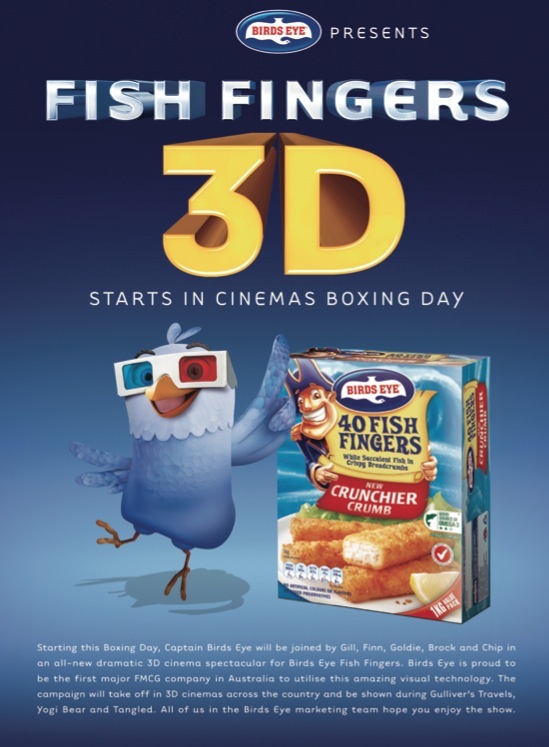 [Philip Lelyveld comment: useful 3D cinema marketing case study]
The cultural insight
What was engaging the hearts and minds of today’s young families? A chance cinema visit to see Avatar by a Belgiovane Williams Mackay strategy planner and his young family ignited a the idea: retelling old stories with new 3D wizardry.
The channel insight
What could be more perfect? An ageing product in need of a refreshed image, a new and relevant story to tell, and an ageing animated character that could benefit from a bit of 3D technology.
Even braver was our suggestion that we were going to launch using only one traditional media channel – cinema – and a small budget (under $500,000) for media and 3D production!
The big idea… If you thought Birds Eye Fish Fingers were old school, think again.
...
Results
Objective 1
We achieved a 26% volume increase (versus our goal of 5%) without any price promotion. NB: this is based on actual Scan Data; i.e. sales to consumers, not weighted retailer stock. This equated to 211,750 units in the launch month versus the monthly average previously of 167,407 units, a 26.5% increase – the biggest increase in years. The increased dollar value of these sales represented a 76% return on every dollar invested in advertising.
Objective 2
And sales are also up 16% YOY, initiated through the cinema launch period – importantly, an increase in unit sales greater in size and sustained effect than those previously achieved through heavy discounting.
Objective 3
There was also a significant jump in share growth (and decrease in growth for our main competitor) during the initial cinema launch period, climbing from 59.15% to 64.45% market share (well above our target of 60% market share) during the four-week launch period and, importantly, this effect was sustained after the cinema campaign.
Objective 4
We also achieved a great result in increasing the key measure for the new and improved Fish Finger product… that ‘Birds Eye Fish Fingers are made from real fish’. Total impressions after the initial launch campaign in January were 58%, a massive improvement on our last measure of 23%. It proved that we could change perceptions around the product and differentiate our quality over competitors.
We also won a Silver Effie in the Best Small Budget under $500,000 category, as well as being a national finalist in the brand revitalisation category of the 2011 AMI Awards.
See the full story here:
Microsoft Invents Projector Eyewear for Xbox & Beyond
 [Philip Lelyveld comment: this is an in-depth commentary on the Microsoft patent filing.]
...
Microsoft's Virtual Image Displays for Glasses
In Microsoft's patent FIG. 1 shown below we see an example head-mounted display device (10) which is an example of video-display eyewear. Although the eyewear may closely resemble an ordinary pair of eyeglasses or sunglasses, the fact is that the device includes a pair of projectors (12A and 12B) which project virtual display images for view by a wearer. More particularly, the virtual display images are projected directly in front of the wearer's eyes. To this end, the device includes a wearable mount configured to position the projectors a short distance in front of the wearer's eyes.
In the illustrated embodiment, the wearable mount takes the form of conventional eyeglass frames (14). In one embodiment, each projector may project a 16:9 aspect ratio image that will appear to the wearer as if it were 21 inches in diagonal and viewed at arm's length. The device also includes controller 16, which controls the internal componentry of the projectors in order to form the virtual display images.
...
See the full story here:
Microsoft planning 3D virtual reality helmet?
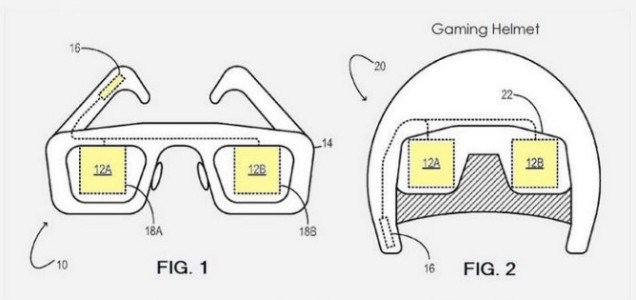
The new patent shows two different kinds of headset, with the first being a simple pair of 3D glasses that are apparently intended for smartphone (Windows Phone 7, natch) and mobile devices.
The wackier looking helmet is apparently for the Xbox, although it's not clear whether it'd be the current Xbox 360 or Microsoft's next generation machine.
The patents were uncovered by website Patent Bolt and contain enough technobabble that they don't just seem to have been an idle thought or patent block to stop rivals. The patents were filled in the autumn of 2010, but so far Microsoft has never mentioned them, or even hinted at them, in public.
According to the patents the headsets would seem to be 21 inch displays from the wearer's perspective, working in full widescreen 3D and seeming to be about an arm's length away.
Apart from 3D there's also talk of transparent displays to allow for AR (augmented reality) projections onto real-world objects. What exactly all this would be used for isn't really mentioned, but the applications for gaming are obvious.
Of course 3D goggles and virtual reality helmets aren't a new idea, in fact they seems almost endearingly old fashioned in their view of the future. ...
See the full story here: http://www.metro.co.uk/tech/games/893663-microsoft-planning-3d-virtual-reality-helmet
Sony simplifies TV lineup, focuses on image quality
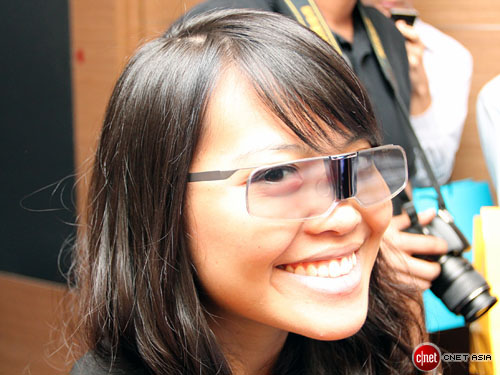 Sony has just announced a leaner TV lineup with a renewed emphasis on picture quality for the Asia Pacific market. The Japanese electronics giant said this simplifies the buying decision for consumers, thanks to a clearer distinction between key features offered by these new entries. Leading the pack are the flagship HX-series Bravia TVs, followed by their high-end NX-series and midrange EX-series counterparts. ...
Other notable new capabilities available for the 2012 HX-, NX- and EX-series are as follows:
3D Experience: A collection of sample 3D videos such as popular PlayStation game demo clips, as well as movie trailers to test drive your Sony 3D TV.
Premium 3D glasses (TDG-BR750): These active shutter 3D glasses weigh 34g and come with a lightweight titanium frame, USB recharging and adjustable nose pads.
See the full story here: