Scripps Alumnus Wins International Science & Engineering Visualization Challenge
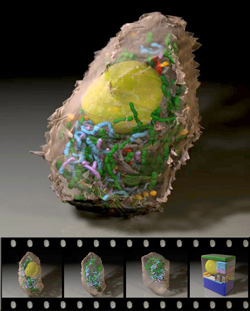 Their winning video, “Rapid Visual Inventory & Comparison of Complex 3D Structures,” illustrates the tool that enables scientists to compare and contrast multiple parameters of complicated structures, like those found in whole-cell tomograms, at a glance. The video shows how the tool can morph beta cells into simplified geometric versions to enable the visual comparison of the organelle volumes of a single cell and how it can compare relationships between four beta cells collected by Noske, Marsh, and colleagues under different physiological conditions.
Read the full story here:
3D advertising boosts Red Bull sales by 8.5%
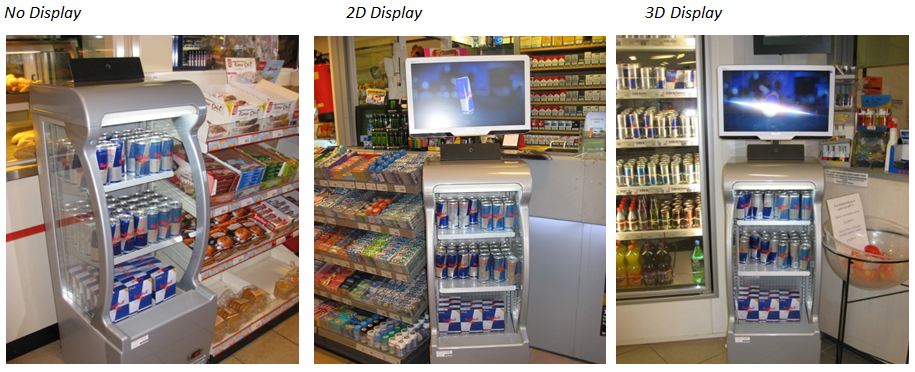
“We collected more than 15.000 eye-trackings and we interviewed more than 180 customers for this study".
According to the data on average, a customer looked at the 3D screen 3 seconds longer than the 2D screen (10.92 seconds) which translates to a 45% increase of attention and a 75% increase compared to no display at all.
...there was no doubting the attention grabbing properties of the 28 view screens during ISE as people stared at the screens in bewilderment.
Earphones that know when they’re in the wrong ear
 Place the earphone on the right and the sensor points to the back of your head, detecting the ear behind it, while swapping to the left ear means the sensor points in front of you into the open air. A small embedded audio circuit swaps channels when the sensor detects a mismatch.
These new earphones also solve another common listening problem - sharing your 'phones with a friend, which - as anyone who has listened to just one half of a Beatles song (or any other track with hard audio panning) knows - isn't the most satisfying musical experience.
When worn by a single user the Universal Earphones run a weak electrical current from one side to the other, but this connection is broken if the earphones are shared between two users, causing each speaker to play both left and right channels through at once.
The researchers will present their work at Intelligent User Interface conference in Lisbon, Portugal later this month, but they also have further plans for improving ordinary earphones, including skin conductance sensors that detect whether the earphones are actually in your ear, which would let them automatically pause or resume your music on removal or insertion.
Read the full story here:
Sony’s Highly Personal, Surprisingly Decent 3D Viewer
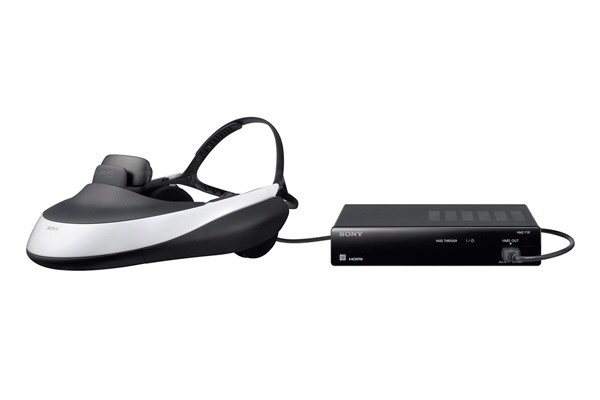 ..then there’s Sony’s Personal 3D Viewer HMZ-T1. The $799.99 gadget is, essentially, a high-definition video View-Master based on 21st-century technology. Instead of looking at the View-Maser’s two tiny frames of film, you look at twin OLED screens which deliver 720P video from an external source. Built-in headphones pump stereo sound into your ears.
The HMZ-T1 is unique, but it’s also a fresh take on an idea Sony first unveiled in 1997. That original version was called the Glasstron; it used LCD screens and didn’t do 3D or HD. The technology has come a long way in the past 15 years.
...
The HMZ-T1′s dual OLEDs added up to a beautifully colorful, detailed image, and the 3D effect was–this is the first time I’ve used this word in conjunction with 3D–excellent. Instead of wincing and feeling queasy, I marveled at how sharp and subtle it was. Toy Story 3 looked better than it did when I saw it in a theater in 2010. 2D Blu-rays were pleasing, too.
The viewer’s OLEDs may be dinky, but they’re so close to your eyes that they blend into a picture that looks far larger than it is. (Sony says it’s the equivalent of a 750″ screen.) The headphones block out ambient noise, making the whole effect even more enveloping.
Gaming in 3D was also a blast: As I ran around whomping bad guys in Green Lantern: Rise of the Manhunters, the extra dimensionality made it seem a little less like a video game and a little more like virtual reality, (Many current games are 3D-friendly; they’re identified as such on their cases.)
...
... the quality of the picture makes this a notable product. It provides the rest of the industry a standard to shoot for–and gives skeptics like me definitive proof that 3D video isn’t inherently unpleasant.
Read the full story here:
MakerBot provides shells for hermit crabs using 3D printing
 Called Project Shellter, MakerBot joined forces with TeamTeamUSA to create environmentally-friendly 3D shells realistic enough for the hermit crabs to adopt as their homes. There is actually a shortage of natural shells in the wild, causing a housing shortage for the marine animals and leading to large amounts of them dying off.
Read the full story here.
How Martin Scorsese Pulls Off Hugo’s Nostalgia
 The trouble I have with most of the retro-tech material in the contemporary art galleries is that it ends up feeling desiccated, with inventions that were never really meant to be contemplated as freestanding works of art now isolated from the history that gave them their meaning. What might originally have been a technological marvel—a figure that moves, a machine that speaks—becomes at best a historical specimen, now experienced only as a Dadaist object, a variation on one of Duchamp’s Readymades. The secret of Scorsese’s success in Hugo has everything to do with the inherently impure and unstable nature of the movies, where art can be precipitated by—can maybe even be a by-product of—technological innovation. Say what you will, that’s not possible in an art gallery, where purity and stability are the standard and traditions have to be transformed gradually, from within.
Working in a medium that is nothing if not forward looking, Scorsese can afford to indulge in a nostalgia that from the very different perspective of the art gallery amounts to little more than tradition reduced to kitsch. With Hugo, Scorsese has reintegrated the technological exhilaration of times past into a work of cinematic art we accept as absolutely alive in the present. We see everything—the automaton’s clockwork body, Méliès elaborately hand-colored movies, the spectacle of 1930s Paris—through Asa Butterfield’s young, avid eyes.
Read the full essay here
Top 10 Technologies That Revolutionized The Way We Watch Movies
 The Hand-Held Camera – And we’re off! In the 1890s, Auguste and Louis Lumière developed the Cinematograph, which could be mounted on a tripod or carried by a cameraman. Shaky-cam, here we come!
Rotoscoping -
The Optical Printer –
Sync Sound –
Color –
The Steadicam –
Video –
Digital Video –
3D – 3D films first arrived in the 1950s, but were largely regarded as a niche in the movie industry for decades before experiencing a full-blown cultural breakthrough in the 2000s, culminating in the unforeseen success of James Cameron’s Avatar. Nowadays, nearly every blockbuster is released in 3D or IMAX. Sometimes both!
Computers –
Read the full story here:
3D Chocolate Printer Promises Sweetest Custom Gifts Ever
 Research into 3D printing with chocolate has been ongoing at the Engineering and Physical Sciences Research Council. The team found chocolate to be an ideal material to work with since it melts easily, is inexpensive and can be re-melted so there is little to no waste. Melting and tempering the chocolate at the right temperatures is a challenge, but one that can be overcome.
The goal of the research is to revolutionize the online chocolate-shopping business. Rather than choosing from a selection of ready-made confections, users can design their own treats and upload them so that a 3D printer can bring those ideas to sweet, delicious life. Even shapes as complex as a human face can be printed in detail (although watching Mom eat her own face on Christmas morning might be a little weird). As more industries get on board with 3D printing technology, we may eventually see bespoke designs overtaking mass-produced products, creating an entirely new retail environment.
See the full story here:
American Gamers Declare 3D Gaming Dead
... The independent survey by leading coupon website http://www.CouponCodes4U.com polled 2,291 gamers and was conducted following Nintendo's recently announced financial losses, to delve into whether or not consumers were against 3D gaming. ...
Gamers taking part in the study were asked; 'Are you in favour of future next generation consoles having 3D technology?' to which the majority, 71%, of respondents answered 'no'.
Of those who stated that they were not in favour of next generation 3D console technology in future devices, the majority, 84%, claimed that they simply thought 3D gaming was 'a fad'. More than a third, 36%, claimed to have played on the Nintendo 3DS and were 'unimpressed'.
18% of those who said they'd played the 3DS claimed that playing the 3DS made them feel dizzy, while 46% said they just didn't feel it improved their gaming experience.
The survey also took the opportunity to ask questions about other 3D technology. 42% of respondents said they thought 3D movies were 'unnecessary', with 61% admitting they thought it was overly expensive. Just 3% of survey participants said they owned a 3D TV, with more than two thirds, 69%, saying they didn't think it would add to the overall viewing experience. ...
Read the full story here:
3D Printer Takes Paper-Based Approach
 [Philip Lelyveld comment: Mcor claims that the cost of maintenance and materials for 3D printers can dwarf the purchase price, which is why they have a service-only pricing model and focused on paper as the printing medium.]
The Matrix 300 looks much like one of those big office copiers. A paper stack on the side feeds individual sheets into the printer, where a blade cuts a 2D profile, and each subsequent sheet is attached with a water-based adhesive.
In addition to its unique paper-based approach, Mcor is flexing its muscle with a novel pricing model. Instead of charging a set fee for the printer, the company is giving the printer away for free and generating revenue by charging for a print service plan that can be purchased for one, two, or three years. The one-year plan starts at $18,500 and includes all maintenance fees and unlimited printing. Mcor is offering the Matrix 300 and the service plans in Europe, and it will introduce the model to the US market this year, MacCormack said.
Read the full story here: