This is what native 4K home cinema looks like on Sony’s VPL-VW1000ES projector
 Why are folks so keyed up about 4K? At first glance, that's the type of question that answers itself: by definition, a 4096-pixel wide image delivers around four times the resolution of 1920 x 1080, and that's a healthy multiple. It's actually of a broadly similar magnitude to the difference between 1080p and old-fashioned analog NTSC video, and nobody these days questions the value of that upgrade. On the other hand, there must come a point where pixels cease to be visible in a home theater environment, such that buying more of them at inflated prices stops being worth it. Sure, 4K can be a big help with 3D footage, because it boosts the resolution to each eye -- something we experienced with the REDray projector. But what about regular 2D material, which is still very much the default viewing option? That question's been nagging at us, so when Sony invited us back for a second look at its 4K projector, the VPL-VW1000ES, this time with full-throttle native 4K source material rather than just upscaled 1080p, we turned up with a tape measure. Read on for what came next. ...
Nevertheless, we have the beginnings of an answer to our original question: if your screen is around three or four meters wide, and if you sit less than six meters away from it, you'll notice a clear benefit in switching from 1080p to 4K for 2D material. Interestingly, you'll also see a significant impact from upscaling your footage through the Sony projector's processing engine -- which makes 'Reality Creation' one of the stars of this show, not least because 4K content is so hard to find. ...
See the full story here:
War of the Worlds Tour [“Hologram”]
 Jeff Wayne’s War of the Worlds musical has announced another UK stadium tour, which will kick off in December 2012 featuring Liam Neeson in the role of George Herbert, The Journalist.
Wayne described the use of 3D holography to present Neeson’s character as a “technological leap forward”, and confirmed that, ahead of the tour, a new double album will be released in the summer. ...
Neeson, who declared himself a fan of the original album, will appear in three ways during the show: as an 11-foot high hologram; within CGI sequences on a 100-foot ‘animation wall’; and as a ‘full body interacting holographically with the show’s live performers’. He won't be singing though - "I only do that in the bath", he said. ...
See the full storyhere:
Cannes 2012: 3D Comes Into Sharper Focus
 ...Despite the format’s troubles, 2011 marked another record year for 3D, with total box office revenue from 3D movies hitting $6.9 billion, an 18 percent jump, according to provisional figures from Screen Digest.
But in North America, still the largest 3D market, revenue actually was down, to $1.9 billionfrom $2.1 billion in 2010. While part of that drop was Avatar-related — no 3D release has come close to the take of Cameron’s record-breaking blockbuster — there are also clear signs of 3D fatigue.
“While 3D definitely isn’t going away, the audience is becoming a lot more selective,” says Screen Digest senior analyst Charlotte Jones, who points out that in North America, the 3D/2D split — the percentage of box office a 3D title generates from 3D screens — was down to 56 percent last year, after garnering 66 percent in 2010 and a whopping 70 percent back in 2008. ...
There are still plenty of 3D titles cramming the halls of Cannes’ Marche du Film. ...
“Actually, I spent a lot of my time in the past few years discouraging filmmakers from making their movies in 3D,” says Caroline Stern, director of international sales and acquisitions at Kaleidoscope. “3D is costly and it doesn’t necessarily have a value. There has to be a reason to shoot in 3D.” ...
Wildlife documentaries seem to be one genre that is benefiting from 3D, particularly as 3D cameras and rigs get smaller and lighter, allowing documentary filmmakers to get places they could never have gone before. ...
“If you look at the success of films like Wim Wenders’ Pina, it totally proves there is a market for indie product in 3D,” Horley says, “But you have to create an event that audiences are willing to pay a premium for.” ...
Read the full story here:
AlloSphere Leads The Way In Integrated Multimedia Systems Research (May 29 open house!)

[Philip Lelyveld comment: the Allosphere is a walk-in 3D video, 3D audio fully immersive interactive environment at UC Santa Barbara]
“This is kind of like where video gaming meets high-performance computing,” said Dr. JoAnn Kuchera-Morin as she led awestruck onlookers through the AlloSphere, a virtual environment housed in University of California Santa Barbara’s Elings Hall.
The AlloSphere, which is a product of 26 years of Kuchera-Morin’s research and labor, is a spherical, three-story anechoic chamber that uses multiple projectors, speakers and a super computer to visually and sonically represent data. The multi-sensory display that characterizes the AlloSphere is derived from complex mathematical algorithms mapped by Kuchera-Morin and teams of researchers, and has been. ...
The AlloSphere is not merely a demonstration; it offers an immersion of a highly complex mathematical visualization and anatomical data that would be frustrating for scientists to explore otherwise. ...
The AlloSphere will be featured in the annual Media Art Technology End of Year Show “Bits and Pieces” onTuesday, May 29 from 6 to 9 p.m. Those in attendance will have the opportunity to tour the instrument, which is rarely exhibited because it costs about $3,000 an hour to run.
“We’ll have all of our labs open and all of the Ph.D.’s will be exhibiting their work. We’ll show the AlloSphere as well. We’re anticipating hundreds of people,” Kuchera-Morin said about the annual display.
See the full story here:
Flexible Displays Landing in 2012, But Not in Apple Gear
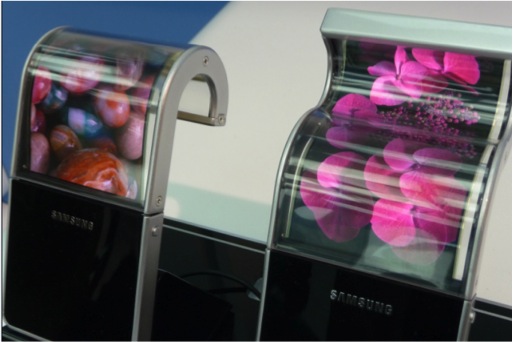 ...In early March, Samsung announced it would be mass-producing its flexible OLED displays, like the one seen above, by the end of this year. Now flash-forward to this Monday: According to a report from the Korea Times, Samsung is seeing “huge” orders for this display, and Apple is “likely” to be one of the major players.
Such a display could be useful in a number of applications, such as in a device with a gently curved screen. Ultimately, the display could even be deployed in a flexible, bendable phone or tablet. But that’s probably not on the horizon — especially Apple’s horizon — anytime soon. ...
Samsung’s flexible OLED display certainly has some advantages over current display tech. For one, it’s basically unbreakable because it doesn’t use glass, but rather a type of plastic called polyamide. ...
Colegrove said there are two reasons why Samsung’s flexible OLED is attractive to device manufacturers. First, the display is thin, lightweight and difficult to break — this offers immediate design benefits. Second, any type of new, novel technology offers marketing benefits. You can hear the commercial spiel now: “We have the first flexible AMOLED display devices in human history!” ...
And if you’re looking to find a flexible display in an iDevice, you’ll probably have to wait until the 2013-2014 time frame, says Colgrove — with truly bendy iDevices appearing in 2015 at the earliest.
See the full story here:
Red Bull Developing 3D Parkour Version of “Oliver Twist”
 Red Bull Media House has signed on toproduce"Twist," a 3D re-telling of Charles Dickens' "Oliver Twist" that's set in thepresentday. Theplanis to go into pre-production this January.
Story will center around the novel's Fagin Gang, which will use parkour to carry out a series of art thefts in the film. The original idea comes from brothers Lynch and Simon Thomas.
Austria-based energy giant Red Bull launched its media and content business in 2007.Companyowns television channel ServusTV channeland last year released "The Art ofFlight
Read the original story here:
Augmented Reality escapes apps for mobile browser
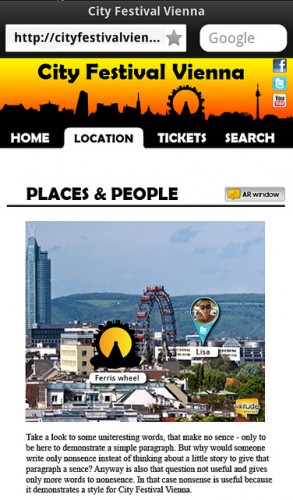 Augmented reality is set to escape apps and arrive in the browser, according to industry stalwarts, Wikitude, which has a new version of its AR technology that does away with siloed apps. Wikitude AR Window allows webpage developers to access the camera on a smartphone or tablet and display a live view from it, complete with real-time overlays of relevant information, something that would previously have required a separate download.
Although augmented reality apps are beginning to flourish, with a number of different systems from Wikitude, Qualcomm and others competing to power the market, so far each deployment has required its own, individual app. AR window, however, opens up mediation apps in the browser to the device’s camera and sensors, meaning webpages know where the user is, what they’re facing and when, and can insert new information accordingly. ...
Augmented reality has made headlines in recent weeks after Google demonstrated its Project Glass research, a wearable computer that can overlay digital information on top of a real-world view. More on AR in our full round-up.
See the original post here:
What’s the marketing potential from Apple’s recent patent for iPhone 3D camera technology?
...So how would this new 3D camera technology work in the real world? Well according the patent, it would combine radar, laser, light-detection and ranging (LIDAR) and various other sensors to enhance depth and the intensity of color accuracy. The language also indicates that it would enable cameras to detect facial expressions and gestures ranging from a grin to a grimace. It is being speculated that the detection aspect could work by detecting parts of the face such as a person’s eyes, nose, and mouth, and then matching it with a range of expressions and gestures stored in a database.
Marketing potential of 3D camera technology
Should Apple’s 3D camera technology come to life, the marketing potential behind it could be virtually unlimited. We can see it being particularly useful for software and video game developers, companies that provide services to the entertainment industry, and others that exist to create strong visual experiences for end users. Such a concept may sound farfetched, but it isn’t when you consider that the 3D boom has already arrived. In addition to the growing number of 3D-friendly TVs, monitors and mobile devices, the popularity of Hollywood hits like Avatar and Clash of the Titans prove that there is indeed a market for Apple’s concept.
Believe it or not, but a 3D camera-enabled iPhone wouldn’t be the first of its kind in the smartphone space. In fact, that credit actually goes to the HTC Evo 3D, which officially broke the barrier by allowing users to snap pictures, record three dimensional videos, and view the captured content without needing a pair of special glasses. However, what Apple has in store could lend itself to even more exciting possibilities, mainly because of the rich capabilities of its iOS devices. ...
See the full story here: http://www.techi.com/2012/05/whats-the-marketing-potential-from-apples-recent-patent-for-iphone-3d-camera-technology/
Consumers View Video Via More Platforms, But HDTVs Most Popular, CEA Study Finds
... Future television purchases will be based on better picture quality and larger screen sizes as consumers will continue to seek the latest innovations in the market. Almost half (48 percent) of consumers planning to purchase a TV in the next 12 months will be replacing an aging, obsolete or broken set. However, half (51 percent) desire improved picture quality in a new display and half (50 percent) want a larger screen size.One in four (24 percent) consumers with intentions to purchase a TV over the next year expect to purchase a 3DTV; 21 percent plan to purchase an OLED display; and a quarter of consumers (25 percent) plan to purchase an Internet-enabled TV. While stated purchase intentions do not always translate to transactions, the study clearly shows many consumers have their eyes fixed on newer TV technologies.
"Easy access to the Web makes TVs more versatile, allowing us to stay connected, informed and entertained," said DuBravac. "In the future, new technologies, like OLED and 3D, will continue to improve the viewer experience, and Internet-enabled sets will fulfill consumers' desires to be connected."
The Evolving Video Landscape Study (April 2012) was conducted between February 22 and March 2, 2012. It was designed and formulated by CEA Market Research, the most comprehensive source of sales data, forecasts, consumer research and historical trends for the consumer electronics industry. ...
See the original post here
Perfume-puffing robot sniffs out social media mentions
 The old saying that your ears go red when people are talking about you is getting a 21st Century update.
Now your nose can tell you when you are being talked about on social networks thanks to a net-connected robot.
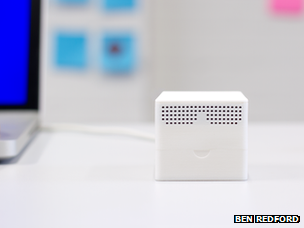
Called Olly, the robot watches the millions of messages passing through social networks and spots when its owner is mentioned. ...
Olly (short for olfactory) has gone through several versions since its initial design. The latest plans are for a gadget much smaller than the original. ...
Once finished, Olly can keep an eye on Twitter, Facebook or almost any other online account. The software that controls Olly can be tuned to emit a puff of perfume for a few different types of online interaction such as a retweet, posting a comment, a mention by name or a specific text search. ...
See the full story here: http://www.bbc.co.uk/news/technology-18059740