Feel the real world and the virtual world at the same time
... Researchers from the University of Chicago have figured out a clever way around this problem. In a paper that will be presented at the 2023 Conference on Human Factors in Computing Systems, or CHI 2023, (where it will also be honored with a best paper award), they demonstrate a wearable system that can generate tactile sensations across the bottom of your fingers and palm without any hardware getting in the way, by hacking into the nerves on the back of your hand instead.
This method depends on what’s called “referred sensation,” where stimulation of your body in one place gets felt in another place—it’s like when you accidentally bash your elbow against something but can feel tingling up through your fingers, because the signal has traveled along your nerves up through your hand. In some places, including in the fingers, referred sensation can be targeted with a reasonable amount of precision. With a signal electrode on the top of a finger and a ground electrode closer to the wrist, it’s possible to stimulate individual parts of each finger, creating 11 separately controllable tactile zones across five fingers and the palm. ...
... "AI is alarming and amazing all at once," said TED's head and curator Chris Anderson during the five-day conference's opening on Monday at the Vancouver Convention Centre.
Of the nearly 80 people who delivered talks at the conference, at least a fifth directly addressed developments in AI and its potential to uplift life on the planet with medical, environmental or communications breakthroughs — and also disrupt through misinformation, or worse. ...
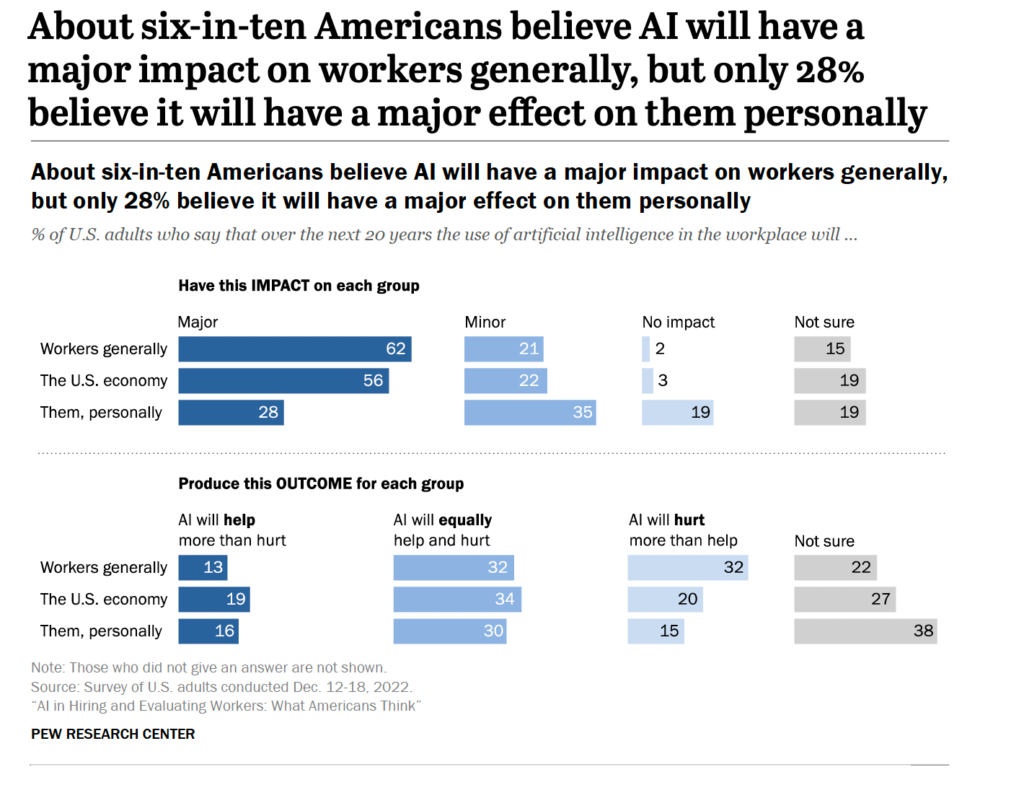
... While there’s no shortage of reports about people’s attitudes toward AI, Pew’s data is sizable and relatively fresh, drawing from 11,004 US adults who were consulted between December 12 and 18 of last year—just as ChatGPT mania was taking hold after its release at the end of November.
The report suggests that most workers expect AI to transform hiring, firing, and evaluations. Many people report feeling uncertain about what those changes might look like, and concerned about AI’s potential impacts. ...
National Association of Broadcasters president and CEO Curtis LeGeyt spoke out on the potential dangers of Artificial Intelligenceon Monday at the NAB Show in Las Vegas. “This is an area where NAB will absolutely be active,” he asserted of AI, which is one of the buzziest topics this week at the annual convention. “It is just amazing how quickly the relevance of AI to our entire economy — but specifically, since we’re in this room, the broadcast industry — has gone from amorphous concept to real.”
...We need to ensure that our stations, our content creators are going to be fairly compensated.”
He added that he worries for journalists. “We’re already under attack for any slip-up we might have with regard to misreporting on a story. Well, you’re gonna have to do a heck of a lot more diligence to ensure that whatever you are reporting on is real, fact-based information and not just some AI bot that happens to look like Joe Biden.” Finally, he warned of images and likenesses being misappropriated where AI is involved. ...
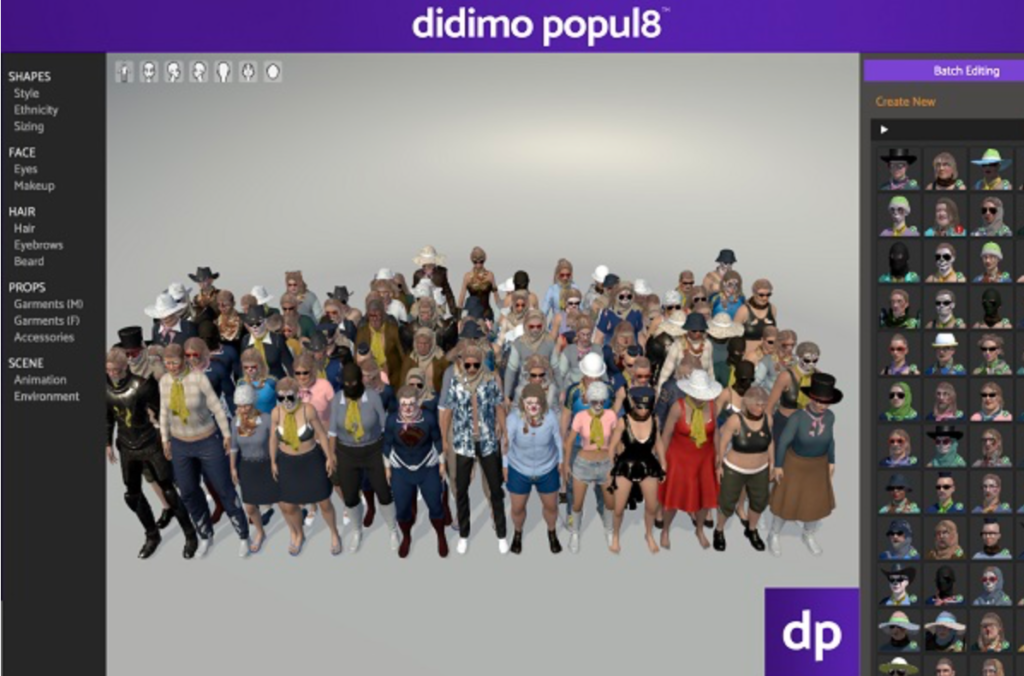
Synthetic media is drawing a lot of attention from the video game industry. Startups like Scenario use generative AI for video game art, while game developer Latitude created AI Dungeon to use advanced language models to produce the game’s text and interact with players through its characters. The game currently uses the Jurassic-1 model created by AI21 Labs. Meanwhile, Google has experimented with using its Imagen text-to-image AI tool to augment classic 1970s text adventure Zork with graphics. Roblox is also experimenting with generative AI tools for game creation, writing the code for objects and their behavior in a virtual environment.
On April 1, after students presented their ideas for AI-Assisted Experiences during ETC’s latest student challenge, a group of leading tech executive judges engaged the students in a spirited discussion of possibilities, opportunities and ethics related to artificial intelligence. Interactive Media and Game Design senior Toby Zhao and Universal Pictures’ Sherry Wong discussed the uses and limitations of AI in today’s creative process. Psychology graduate Erik Rollins asked whether the industry is thinking about how AI will influence society. Epic Games CTO Kim Libreri responded that society needs standards that will let us know when something is real versus synthetic or altered. It is already too easy to distribute manipulated or false information and rile people up, he said.
In response to a student asking whether AI will drive a decline in our ability to reason our way through problems, Sony Pictures Entertainment CTO Bill Baggelaar countered that, for some people, the calculator made math and science more accessible.
Paramount Pictures futurist Ted Schilowitz noted that “the way humanity today searches for information versus researches information has fundamentally changed the human condition.” He recommends that students should think about the ethical concerns of AI all the time.
ETC’s George Gerba noted that we are accustomed to things happening at the speed of Moore’s Law, but AI is evolving much faster than that and society is struggling to cope.
These discussions and other topics are covered in the 9-minute highlight reel.
The aesthetic dentist skipped the usual goopy impressions and instead captured details of the director’s bite with a 3D scanner in less than a minute. The digital file was immediately input into a 3D printer, which created a replica of the broken tooth. Using a Computer Aided Design (CAD) and Computer Aided Manufacturing (CAM) dental milling machine, a new porcelain crown was quickly fabricated, verified on the printed model, and within hours bonded onto the patient’s damaged tooth. ...
“I had a previous version of the scanner and it was the biggest waste of money because the resolution was terrible, slow and not accurate, like a dial-up modem — but this one, called the Treos, is super kick-ass and like high-speed internet,” Marashi adds. “It takes 45 seconds to get the image of an entire mouth.” ...
...AutoGPT. They are software that allow you to create autonomous agents based on AI, able, given a wide-ranging objective, to arrive at a solution through a series of steps, which can also include actions such as web search or code execution.
“Today ChatGPT allows you to perform one task at a time, always starting from a stimulus from a human being (the so-called prompt, ed) – he explained to us Pietro Schirano, head of artificial intelligence at the US fintech Brex – Systems such as AutoGPT are instead capable of reaching the desired result for intermediate steps, autonomously, among other things by exceeding the token limits of GPT-4 (about 24 thousand words in the developer version, ed). If we ask him to write a book, he’ll proceed to character creation first, then a plot outline, and only it will eventually come down to the writing job real. There are many possible uses: someone used it to do market research, others to have an assistant in scientific research”. ...
From a technical point of view, AutoGPT is actually software based on GPT versions 4 and 3.5, which is used to interpret user goals, establish a course of action, and create intermediate instructions. It has a medium-long term memory, which allows it to remember the passages of reasoning, and can access the Web, as well as files and everything the user makes available. A bit like with the ChatGPT pluginswith the substantial difference that in this case it is the artificial intelligence itself that autonomously decides which systems to interrogate. ...
“It is a resource still in its infancy – is Schirano’s conclusion – Sometimes it gets stuck, doesn’t finish the task it has been assigned or gets lost in too complex passages. That said, it’s improving at impressive speed.” ...
... The researchers developed a computer program called Psyrreal that uses virtual reality to give people an experience similar to taking psychedelic drugs. They used a software called Unreal Engine to create different virtual environments that are surreal and meant to convey certain feelings and ideas associated with psychedelic experiences, like feeling connected to everything or losing your sense of self.
During the Psyrreal experience, participants start in a normal virtual world and then progress through 19 different psychedelic environments that use abstract shapes and patterns. The levels last between 30 seconds to 2 minutes. ...
On the first day, the participants completed a 15-minute VR demonstration, which included guided VR meditation, to familiarize themselves with the technology. On the second day, the participants completed the Psyrreal experience. During the study, a psychologist was nearby in case there was a mental health emergency, and a technician monitored the VR system. After the participants completed the VR experience, they were allowed to rest and then had a meeting with the psychologist to discuss their experience and answer some questionnaires.
Three validated questionnaires were used to assess different subjective aspects of the VR experience: the Psychological Insight Questionnaire, the Ego-Dissolution Inventory, and the Revised Mystical Experience Questionnaire. These three measures are commonly used in psychedelic research. The Emotional State Questionnaire was used to evaluate differences in depression symptoms before the experiment and at the two-week follow-up. ...
During the VR experiences, participants reported feeling positive emotions such as calmness, joy, pleasure, and fun. Some also reported having personal thoughts, changes in perspective, and alterations in their sense of self. Some also experienced somatic effects during the experience. ...