Verizon Media Immersive Launches To Foster Next-Gen 5G, AR And VR Advertising Ecosystem
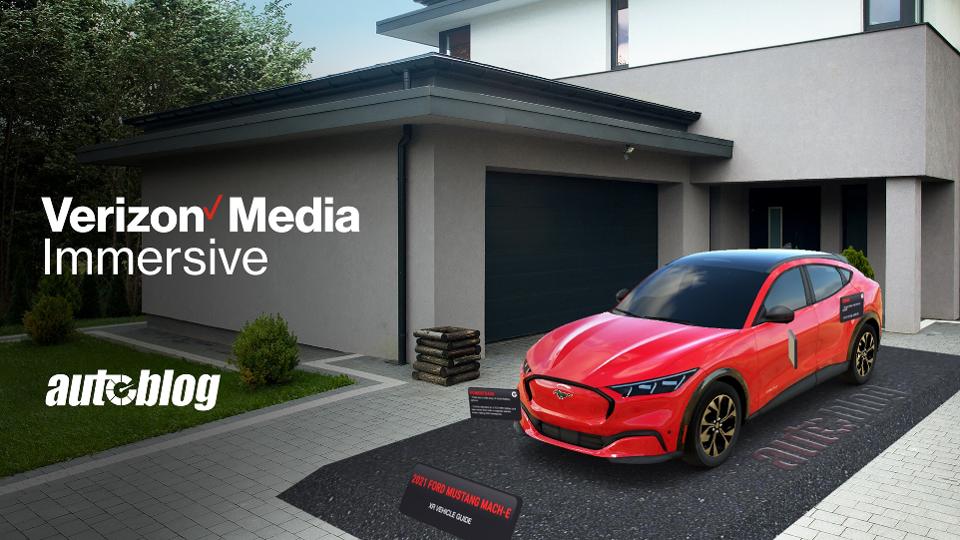 Today, Verizon Media announced the launch of a new extended reality (XR) toolset called Verizon Media Immersive, the largest XR platform for creating augmented, mixed, and virtual reality advertising and branded content with an emphasis on next-generation 5G experiences.
Verizon Media is a suite of brands that includes Yahoo, HuffPost, and TechCrunch, reaching nearly 900M unique monthly visitors worldwide. As a toolset, Verizon Media Immersive enables partners to create, distribute, and monetize XR content with authoring tools; a content library and search; and the ability to track performance through analytics. Through direct integration with Verizon Media Ad Platform, this branded content can then be deployed across different articles, search, and affiliate links in Verizon Media properties.
Because the platform incorporates WebAR (sometimes referred to more broadly as “WebXR”) toolset, experiences created with VMI can be delivered directly from the browser, as opposed to needing to work exclusively from an app. Brands can integrate immersive experiences across the web, whether on desktop and mobile, opening new pathways for connecting with audiences.
RYOT, which Verizon acquired in 2014—and has become the first and only 5G production studio in the U.S.—was a driving force behind the development of Verizon Media Immersive. Through the studio’s creative expertise across film/TV, VFX, and XR, Verizon Media intends its immersive platform as one that allows partners to streamline content across delivery formats.
Of course, 5G plays a large role in Verizon Media Immersive’s functionality. Formats like volumetric capture and motion capture have traditionally been difficult to deliver across 4G LTE, but the advent of 5G will dramatically reduce the barrier to these mediums...
For more information, visit the official Verizon Media website.
Measuring Augmented Reality Experiences
 Dwell Time: “How long were you there?”

Engagement: “What did you do”?
Recall: “What did you see”?
Sentiment: “Did you have fun?”
To help you get started with measuring your experiences, we have recently updated our documentation with a new section on “Advanced Analytics,”beginning with outlining how to integrate Google Analytics and Google Tag Manager in your WebAR projects.
See the full story here: https://medium.com/8th-wall/measuring-augmented-reality-experiences-6d9e58cf6451
The startup taking on Apple and Snapchat in a mini-app war
Here's Dmitry Shapiro's big idea: apps that go inside your apps. Want to play a game inside a Reddit post, make a GIF without leaving the iMessage window, or pick theater seats with your friends? That's what Shapiro, his co-founder Sean Thielen, and their new company Koji, want to do.
See the full story here: https://www.protocol.com/koji?fbclid=IwAR3BFKGOx51HQQsAZFU_Y1AlpjUUXEpp5oTKjEPb33Bjw1dJ93xpCmiDAx4
This German town replicated itself in VR to keep its tourism alive
 Tourists may soon be able to explore the picturesque cross-timbered houses and historic churches of Herrenberg via virtual reality (VR), thanks to a digital twin developed with the High-Performance Computing Center Stuttgart (HLRS).
Building a digital twin
HLRS developed Herrenberg’s digital twin together with the Fraunhofer Institute, the University of Stuttgart, and Kommunikationsbüro Ulmer, starting with a concept called ‘space syntax’.
Dr. Fabian Dembski of HLRS said: “Just as the human skeleton provides a scaffolding for all of the other systems and functions of the human body, space syntax produces a 2D outline of physical grids in a city, offering a framework for performing spatial analysis, such as predicting the likely paths that car or pedestrian traffic might take to move from one point to another.”
We shouldn’t overestimate the technology, though, he noted. “Cities are not machines,” he commented. “A digital twin can be a great help in reducing complexity for cities, assessing measures at an early stage, and explaining interrelationships. But there are many aspects that are deeply human and cannot be reproduced in digital copies, such as culture, interpersonal relationships, joy, and happiness. A digital twin is a tool, not a solution.”
He added: “I also think it is important for cities to retain control over data and models,” urging co-operation between science, city administrations, businesses, and citizens.
See the full story here: https://thenextweb.com/syndication/2020/05/31/this-german-town-replicated-itself-in-vr-to-keep-its-tourism-alive/
Tom Hall interview — Why Doom co-creator is making virtual reality games
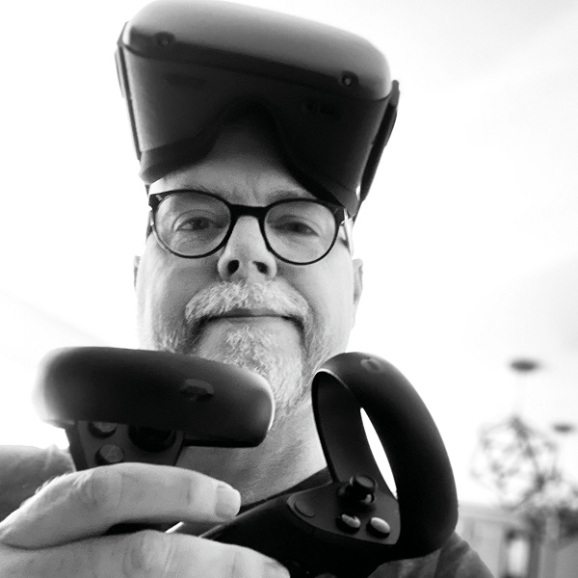 Tom Hall is a versatile game designer with over three decades of experience. He has worked on note games such as Doom, Duke Nukem, Rise of the Triad, Wolfenstein 3-D, and Anachronox (all traditional games). But he has also shown interest in the broader craft of making games for other platforms, working on the Diner Dash mobile games at PlayFirst and later at Glu Mobile.
Now he’s shifting his focus to virtual reality games. This week he announced he’s joining Resolution Games, the Stockholm, Sweden-based company that Candy Crush Saga co-creator Tommy Palm runs. Hall has joined as a senior creative director and said he’s happy to work on “de-stressors,” or games that reduce daily stress.
Hall’s endorsement comes at an interesting time for VR, which has struggled to find its footing. Initial sales are far below what advocates hoped for around 2014, but passion for VR abides, and headsets such as the Oculus Quest have been selling out during the pandemic.
See the full story here: https://venturebeat.com/2020/06/27/tom-hall-interview-why-doom-co-creator-is-making-virtual-reality-games/
Stuart Russell on AI Governance – AI Futures Podcast (S1E1)
 In this episode, Stuart explores some of the correlates between AI governance and the governance and control of other technologies – including electricity and nuclear materials. He also explores some of his thoughts about international AI transparency and governance.
Interview Questions
(3:15) You believe that at some point we’ll need global governance of AI – can you summarize your position on this topic?
(8:15) Are there existing standards, procedures, or laws for other technologies that might apply well to AI as well?
(13:00) Do you think that early AI governance progress will begin with individual, discrete governance instances (say, around using AI to market to children)?
(19:10) Do you think that AI principles can be the right starting point for drilling down to more concrete governance?
(22:10) How can we develop an international AI values consensus with nations that don’t share values such as individualism, privacy, freedom of speech, etc?
(27:00) What does near-term international AI convening look like? How could nations begin to come together?
(33:30) Do you believe that the shared prosperity from beneficial strong AI would relieve the tensions towards violent international competition?
(38:00) What is the role for the private sector in helping to bring us closer to a better AI future?
(41:15) Do you believe that the “new normal” for AI governance and ethics in industries (like insurance or banking) can set a precedent for the bigger picture of AI ethics and governance?
Every Saturday from June 27th to September 12th, we’ll be covering a new AI Futures episode about AI governance.
The podcast can be found here: https://emerj.com/ai-podcast-interviews/stuart-russell-ai-governance/
A reflection on artificial intelligence singularity
 Should you feel bad about pulling the plug on a robot or switch off an artificial intelligence algorithm? Not for the moment. But how about when our computers become as smart—or smarter—than us?
Jalsenjak takes us through the philosophical anthropological view of life and how it applies to AI systems that can evolve through their own manipulations. He argues that “thinking machines” will emerge when AI develops its own version of “life,” and leaves us with some food for thought about the more obscure and vague aspects of the future of artificial intelligence.
This is not a discussion about how and when we’ll reach AGI. ... Jalsenjack rather speculates of how the identity of AI (and humans) will be defined when we actually get there, whether it be tomorrow or in a century.
According to philosophical anthropology, the first signs of life take shape when organisms develop toward a purpose, which is present in today’s goal-oriented AI. The fact that the AI is not “aware” of its goal and mindlessly crunches numbers toward reaching it seems to be irrelevant, Jalsenjak says, because we consider plants and trees as being alive even though they too do not have that sense of awareness.
Another key factor for being considered alive is a being’s ability to repair and improve itself, to the degree that its organism allows.
An ideal self-improving AI, however, would be one that could create totally new algorithms that would bring fundamental improvements. This is called “recursive self-improvement” and would lead to an endless and accelerating cycle of ever-smarter AI.
Recursive self-improvement, however, will give AI the “possibility to replace the algorithm that is being used altogether,” Jalsenjak notes. “This last point is what is needed for the singularity to occur.”
See the full story here: https://bdtechtalks.com/2020/06/29/artificial-intelligence-singularity/