‘You Can Slow Down Time in Virtual Reality’: Why This Artist Is Using VR to Recreate Lost Ecosystems in the Era of Climate Change
 The last Kaua’i ‘ō’ō bird died in 1987. After the species went extinct, a user uploaded a recording of the Hawaiian bird’s unique mating call to YouTube in 2009 and it has since been played by humans more than a half-million times since.
One of them was the Danish-born, New York-based artist Jakob Kudsk Steensen, who uses Virtual Reality as a tool to remix and create a new kind of landscape that is not bound to time or space, and that recalls the irretrievable, lost nature of history.
For his recent installation RE-ANIMATED (2018-19), which was on view in the Future Generation Art Prize’s exhibition in Venice during last year’s biennale, Steensen brings the Kaua’i ‘ō’ō bird back to life via an imagined virtual-reality world.
There’s another layer of this story, which is personal, and I don’t want to go into details, but it’s about family and losses. Even though I grew up in a digital time and am used to archiving things with social-media pictures and everything, people still die and vanish and can never come back.
What about the limits of VR as a medium?
The limits of VR as medium would be the size of the audience. I have eight headsets now, and after each exhibition they just broke down because the technology is so new. All these complications can play in when dealing with a big audience.
See the full story here: https://news.artnet.com/art-world/jakob-kudsk-steensen-vr-1748265
R2-D2 finally joins cast of Star Wars characters roaming around Disneyland’s Galaxy’s Edge
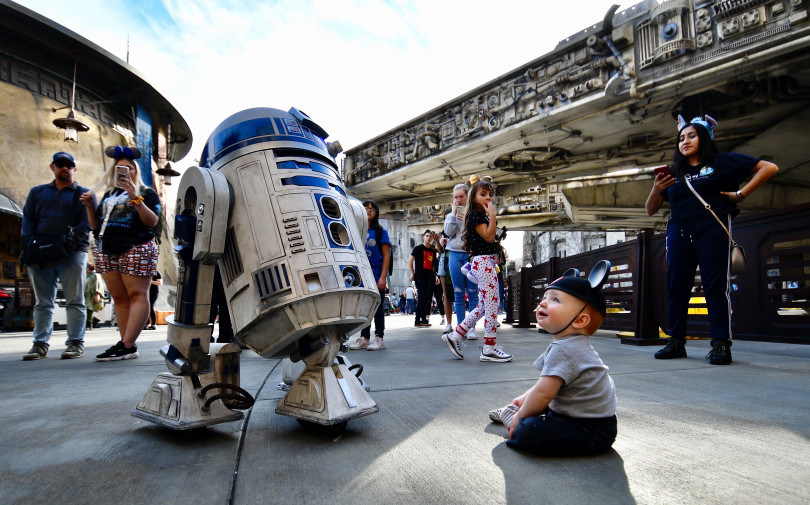
Ronan Chavez, 1, from Arizona, stares at R2D2 as the droid roams around Star Wars Galaxy’s Edge at Disneyland in Anaheim, CA, on Tuesday, Jan. 7, 2020.
(Photo by Jeff Gritchen, Orange County Register/SCNG)
It’s taken seven months for Artoo to begin making the rounds through Black Spire Outpost on the Star Wars planet of Batuu, the setting for the new Galaxy’s Edgethemed land that debuted in May at Disneyland.
Previously, R2-D2 had been confined to the droid-building workshop where well-heeled visitors could purchase the remote-controlled astromech unit for a whopping $25,000.
Artoo doesn’t have a set appearance schedule or an official meet-and-greet location in Galaxy’s Edge. You’ll have to just stumble upon the R2-unit much like the seemingly serendipitous encounters with Kylo Ren, Rey, Chewbacca, Vi Moradi and the stormtroopers that populate the land. Disneyland cast members walk alongside Artoo as the droid makes his way around Galaxy’s Edge.
R2-D2 isn’t the first droid to roll around the Anaheim theme park. An orange and white maintenance droid named Jake wowed Disneyland visitors in 2017 as he roamed freely around Tomorrowland posing for photos with curious onlookers and pausing for hugs from adoring kids.
The J4-K3 Tomorrowland play test at Disneyland was independent of any work being done on Galaxy’s Edge, according to Walt Disney Imagineering officials. Imagineering has no current plans to use the J4-K3 autonomous character technology in Star Wars: Galaxy’s Edge or with any particular character or type of character.
See the full story here: https://www.ocregister.com/2020/01/08/r2-d2-finally-joins-cast-of-star-wars-characters-roaming-around-disneylands-galaxys-edge/
BMW Augmented Reality Windshield Concept Adds Gaze Detection for Natural Interaction
 During the climax of its presentation at this week's CES 2020 in Las Vegas, the automaker unveiled its BMW i Interaction Ease, a concept cabin for autonomous vehicles that combines an AR windshield, a contextual user interface, intelligent lighting, and a luxurious, adaptable interior that looks more like a hotel suite than a passenger vehicle.
The BMW Natural Interaction system uses not only voice and gesture control, but also gaze detection to interact with navigation and infotainment features on the Panorama Head-Up Display, which adds a digital layer to the entire expanse of the real-world view. Meanwhile, intelligent materials turn dashboards and seats into interactive surfaces for additional interaction.
According to Fröhlich, the first BMW Natural Interaction features will arrive in the BMW iNext in 2021.
materials turn seats into interactive surfaces, so, with a touch, seats recline into a position that emulates the feeling of weightlessness. The display and lighting also adjust, while soothing sounds from Academy Award-winning composer Hans Zimmer and BMW sound designer Renzo Vitale fill the cabin.
See the full story here: https://next.reality.news/news/bmw-augmented-reality-windshield-concept-adds-gaze-detection-for-natural-interaction-0228950/
AI can now read emotions—but should it?
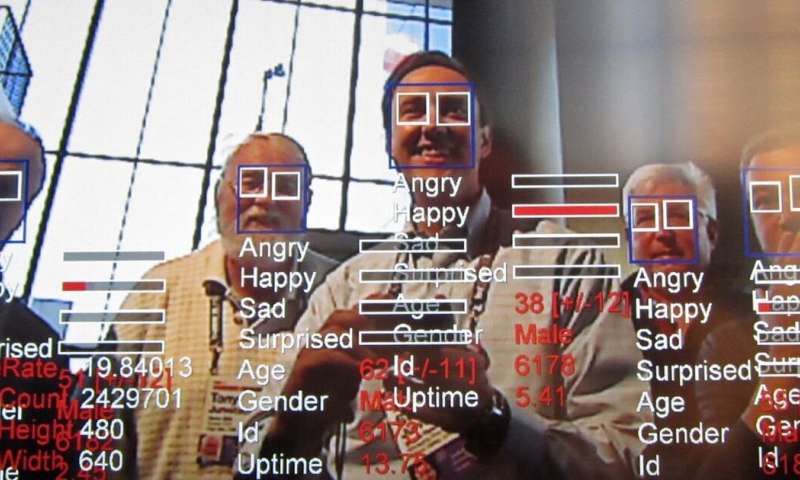 The report released by AI Now sheds light on some ways in which AI is being applied to the workforce in order to evaluate worker productivity and even as early as at the interview stage. Analyzing footage from interviews, especially for remote job-seekers, is already underway. If managers can get a sense of their subordinates' emotions from interview to evaluation, decision-making regarding other employment matters such as raises, promotions or assignments might end up being influenced by that information. But there are many other ways that this technology could be used.
Why the worry
These types of systems almost always have fairness, accountability, transparency and ethical ("FATE") flaws baked into their pattern-matching. For example, one study found that facial recognition algorithms rated faces of black people as angrier than white faces, even when they were smiling.
As the AI Now report highlights: "Despite the increase in AI ethics content … ethical principles and statements rarely focus on how AI ethics can be implemented and whether they're effective." It notes that such AI ethics statements largely ignore questions of how, where, and who will put such guidelines into operation.
There are useful applications however, for instance in helping spot warning signs to prevent youth suicide and detecting drunk drivers. That's one reason why even concerned researchers, regulators and citizens have generally stopped short of calling for blanket bans on AI-related technologies.
It's also well-known that humans tend to trust these systems more than other authority figures.
See the full story here: https://techxplore.com/news/2020-01-ai-emotionsbut.html?fbclid=IwAR3_G9XcmtctRqcGVunM46jHjPaw_ZRbGx-tfFUhGYgCqN8yZghrn-EGDEg
The photo is of Steve Jurvetson and his dad. He posted this on Facebook;
It reminds me of Yuval Noah Harari’s warning in 21 Lessons for the 21st Century: “AI is now beginning to outperform humans in the understanding of human emotions. In particular, AI can be better at jobs that demand intuitions about other people.
Feelings guide not just voters but their leaders as well. This reliance on the heart might prove to be the Achilles’ heel of liberal democracy. For once somebody (whether in Beijing or San Francisco) gains the technological ability to hack and manipulate the human heart, democratic politics will mutate into an emotional puppet show.”
Snapchat quietly acquired AI Factory, the company behind its new Cameos feature, for $166M
 After acquiring Ukraine startup Looksery in 2015 to supercharge animated selfie lenses in Snapchat — arguably changing the filters game for all social video and photo apps — Snap has made another acquisition with roots in the country, co-founded by one of Looksery’s founders, to give a big boost to its video capabilities.
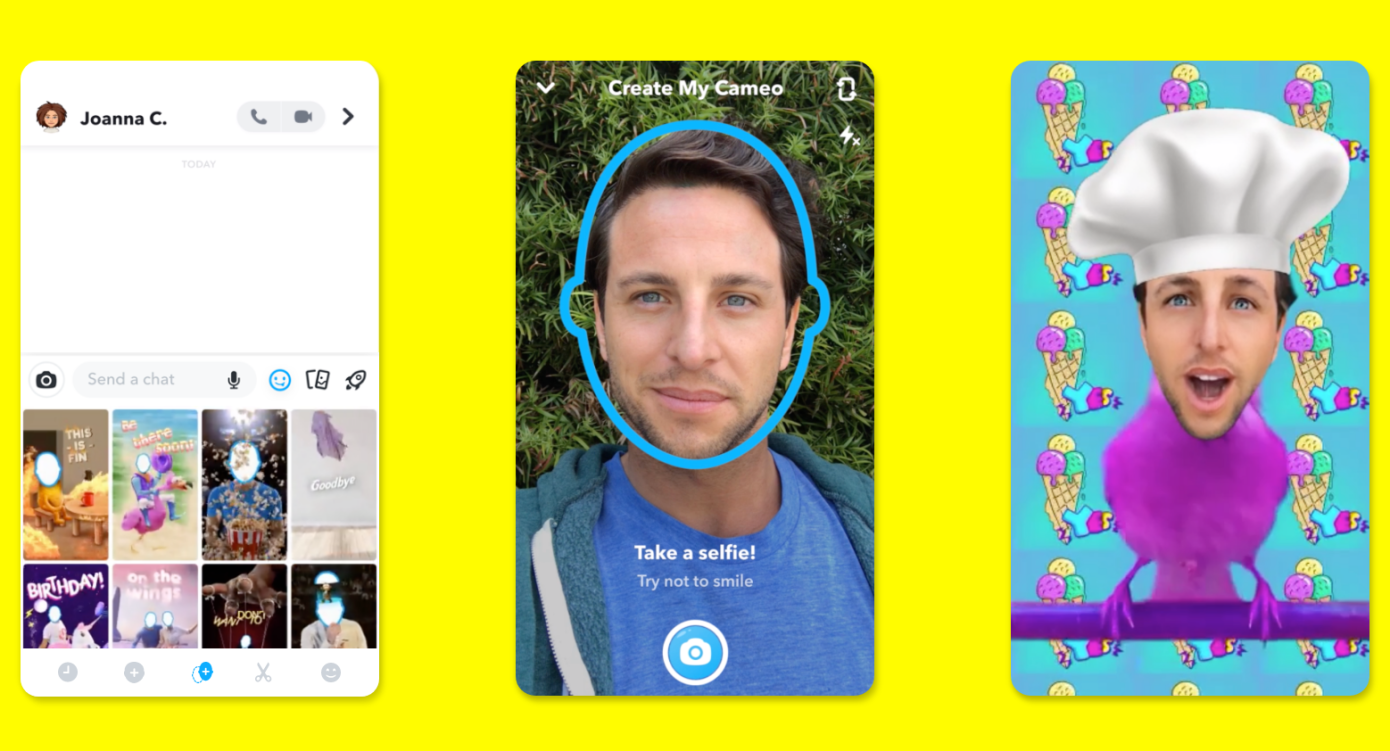
The company has acquired AI Factory, a computer vision startup that Snap had worked with to create Snapchat’s new Cameos animated selfie-based video feature, for a price believed to be in the region of $166 million.
Cameos, launched last month, lets you take a selfie, which is then automatically “animated” and inserted into a short video. The selection of videos, currently around 150, is created by Snap, with the whole concept not unlike the one underpinning “deepfakes” — AI-based videos that look “real” but are actually things that never really happened.
See the full story here: https://techcrunch.com/2020/01/03/snapchat-quietly-acquired-ai-factory-the-company-behind-its-new-cameos-feature-for-166m/