MIT researchers design a tiny computer chip for drones as small as a fingernail
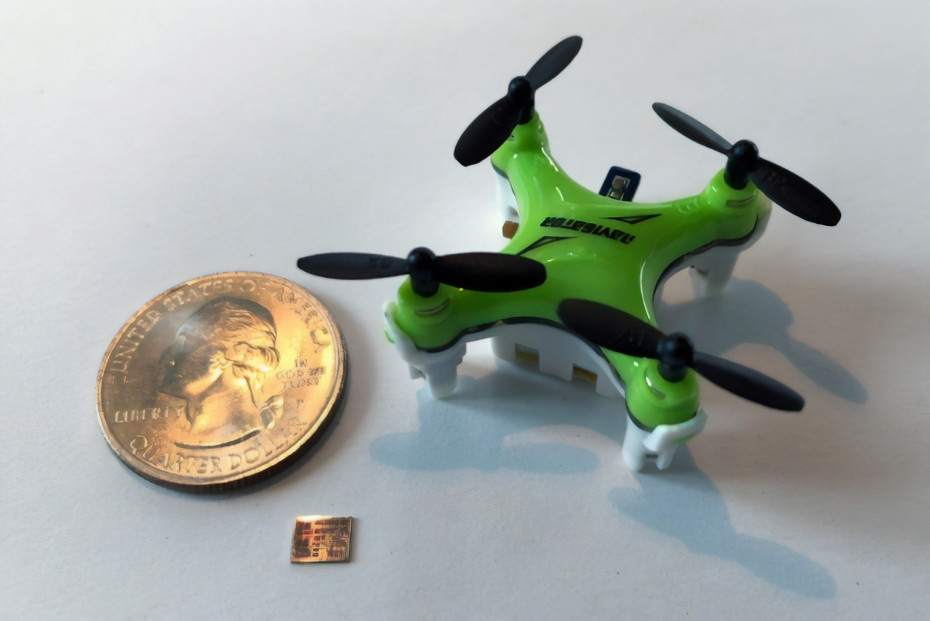 Drones as small as a fingernail may one day buzz overhead, thanks to research out of the Massachusetts Institue of Technology (MIT). A team in the Department of Electrical Engineering and Computer Science (EECS) designed a 20 square millimeter computer chip that can process inertial and camera images — two critical components of drone flight — in real time.
It isn’t the team’s first microchip rodeo. Last year, it used a field-programmable gate array (FPGA), a type of highly configurable integrated circuit, to develop a drone control chip that required just 2 watts of power and 2GB of memory. But shrinking the design wasn’t easy.
In the end, the researchers decided to build the new chip from the ground up. They found a way to minimize the amount of data that’s stored on its memory at any given time, reducing the chip’s power consumption to 24 milliwatts — 1 one-thousandth of the energy required to power a lightbulb — and the size of its memory to 0.8MB.
They also optimized the design for image processing. The new chip can handle up to 171 frames per second, a rate even faster than what the team projected.
The chip isn’t bound for mini-drones just yet. The team’s proof-of-concept will be a miniature race car with an onboard camera that’ll stream live video. Next, it’s planning to build it into an actual drone.
See the full story here: https://venturebeat.com/2018/06/20/mit-researchers-design-a-tiny-computer-chip-for-drones-as-small-as-a-fingernail/
Stanford researchers harnessed AI to generate memes
 In a white paper titled “Dank Learning” (yes, really), Abel L. Peirson and E. Meltem Tolunay, the two lead scientists on the project, describe a neural network that ingests, gains an understanding of, and spits out internet in-jokes. The AI consists of a convolutional neural network (CNN) that takes images as inputs and translates them into mathematical representations called vector embeddings (an encoder), and a long short-term memory (LSTM) recurrent neural network (RNN) that creates captions (a decoder).
The verdict: Humans were able to pick out the algorithmically created memes about 70 percent of the time, but graded them fairly evenly on wittiness.
See the full story here: https://venturebeat.com/2018/06/15/stanford-researchers-harnessed-ai-to-generate-memes/
HOW MAPS BECAME THE NEW SEARCH BOX
 These small tweaks are part of Uber’s plan to transform from a ride-sharing service into a global logistics platform. If this strategy works, one day you’ll open to the Uber app’s city grid every time you want to figure out how to get yourself—or anything else—from one point to another. In other words, you’ll use Uber like you use Google Maps’ app: to find out what’s around you and how to reach it.
Search has always been partially about location: if Google knows you are in Indiana, you’ll get more meaningful results when you type “today’s weather” into your laptop. Traditionally, though, the physical and digital worlds have been divided. You use search when you need information, and a map when you need to get someplace.
But now, a number of companies are producing maps that decode the three-dimensional world. Have a toothache? Plug “dentist” into Google Maps.
But for Uber to become the de facto transportation and logistics app, it must be the most accurate: An error as minor as locating a passenger on the wrong side of a street might break a sale by adding extra wait time. These challenges will only grow.
See the full story here: https://www.wired.com/story/how-maps-became-the-new-search-box/
Cannes Lions Witnesses World’s First Augmented Reality Video Ad Format in Action
 This is just the latest innovation from Teads – in the last week the company announced a revolutionary new AI-enabled performance offering, Teads True Visits, and in 2017, the company was the first in the world to integrate chatbots into video ads.
The integration of AR is possible thanks to a partnership with DeepAR, a team of engineers and researchers from MIT and 3D designers previously involved with Candy Crush and Dreamworks. Through the partnership, Teads’ internal creative strategists and designers will use DeepAR’s AR and face-tracking SDK to enable the experience.
See the full story here: https://martechseries.com/sales-marketing/programmatic-buying/cannes-lions-witnesses-the-launch-of-worlds-first-augmented-reality-video-ads/
Globo Enhances 2018 Russia World Cup Coverage with Avid’s Augmented Reality Solutions
 Through a suite of augmented reality tools, Avid’s Maestro | AR provides the ability to create captivating 3D virtual objects that look like part of the actual environment. The solution allows the insertion and control of 3D virtual objects and graphics, as well as sophisticated real time multiple image manipulation. Avid’s Maestro | Designer is a powerful design tool used by graphics artists and designers to create the compelling graphics seen in the broadcast. Maestro l Designer can import stills, video, and graphics from other third-party programs while giving artists the flexibility to create and design compelling 2D and 3D content. Avid Professional Services provided valuable training and support for the project.
“Globo needed a powerful augmented reality solution to bring to life the world’s most prestigious football tournament for the millions of passionate fans in Brazil—the most successful country in the tournament’s history,” said Tom Cordiner, Senior Vice President, Global Sales at Avid. “We worked closely with Gearhouse to deliver an Avid Maestro solution that enables Globo to keep up with the fast-paced action on the pitch and create eye-catching graphics that boost ratings and engage viewers in exciting new ways.”
See the full story here: https://globenewswire.com/news-release/2018/06/20/1527276/0/en/Globo-Enhances-2018-Russia-World-Cup-Coverage-with-Avid-s-Augmented-Reality-Solutions.html
Future of art galleries includes virtual reality
 The future of art galleries is here.
Te Papa's Toi Art Gallery has a host of artworks to explore, including a virtual reality aspect which its creator hoped would become more common in New Zealand galleries.
Jeweller Lisa Walker's exhibition, I want to go to my room but I can't be bothered includes a virtual reality tour of the Wellington artist's studio.
VR is being explored as a way to open up art to anyone coming through the gallery, allowing them to step into an artist's studio and see the creative process.
The VR experience contained about 35 minutes of content, he said. Within it, people could look around and focus on certain items or area. A small video clip would start playing, with Walker explaining a little bit about what the person was seeing.
As she talked, people could look around her studio and get a feel for what her creative space was like.
See the full story here: https://www.stuff.co.nz/dominion-post/capital-life/capital-day/104795550/future-of-art-galleries-includes-virtual-reality
5 developments shaping the future of augmented reality
 One of the major themes of this year’s show was the “AR Cloud,” a term coined by AWE cofounder Ori Inbar.
Aside from being a catchy sounding mashup of two technical terms, the AR Cloud represents the idea that augmented reality is evolving from a single-user experience into a shared digital layer on top of the physical world.
See the full story here: https://technical.ly/baltimore/2018/06/19/5-developments-shaping-the-future-of-augmented-reality/
Creating Virtual Virtual Reality
Launched initially on Daydream in early 2017, and now available on Gear VR, Oculus Go, and Oculus Rift, Virtual Virtual Reality’s smart interaction design gives players freedom and control which—combined with a narrative tying it all together—makes Virtual Virtual Reality one of the most immersive mobile VR games to date. This guest article by Mitch Mastroni, Interaction Designer at Tender Claws, the studio behind the game, explores how the game achieved significant immersion even on more restrictive mobile VR headsets.
Our game Virtual Virtual Reality is a comedic adventure that is both love letter to VR and playful commentary on the tech industry. Players are welcomed by their manager Chaz to Activitude, a virtual service where humans are tasked with assisting AI clients. These AI, which appear in various forms ranging from a tempermental artichoke to a demanding stick of butter, have increasingly bizarre requests for the player to perform. The story unfolds as the player travels between virtual realities, diving deeper and deeper into the machinations of Activitude.
When players pick up objects in Virtual Virtual Reality, they see a curved line connecting their VR controller to the object in question. This ‘leash’ is the only tool that players have at their disposal for the full duration of the game. All other object interactions in the game (plugging a plug into a socket, watering flowers with a watering can, etc.) are performed with the leash. Even simple interactions—like tossing a ball in the air or dragging your manager by his robotic legs—are very satisfying to perform with the leash.
The leash helps the player understand the relationship between the controller’s movement and the object’s movement. It also enhances game feel by giving virtual objects weight.

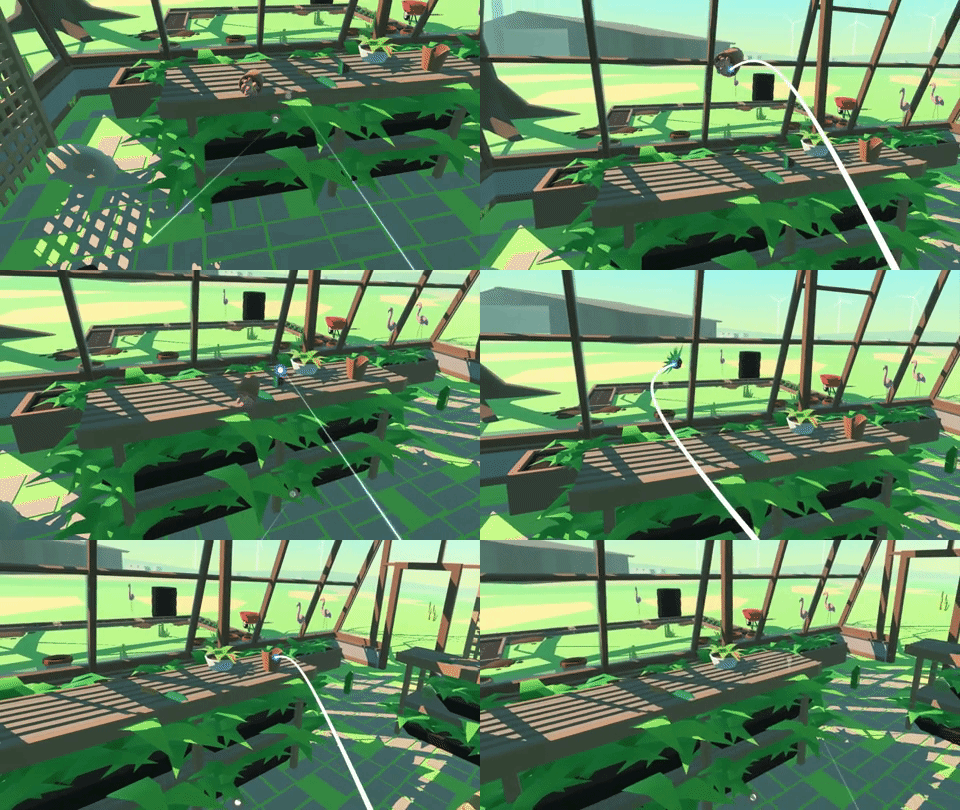 The choice of the leash was also informed by the distance between players and the objects that they interact with. Early VR experiments at Tender Claws resulted in us constraining object interactions to the “mid-range.”
We began the process of localizing Virtual Virtual Reality into eight languages after the game launched on Daydream.
The decision to use subtitles instead of recording dialogue in new languages was a matter of resources and quality control.
Early into our development of the headset transition mechanic at a 2015 hackathon, we realized that the experience of taking off and putting on headsets had potential beyond a narrative framing device. We wanted players to interact with headsets as often as possible.
See the full story here: https://www.roadtovr.com/designing-virtual-virtual-reality-mitch-mastroni-tender-claws/
What it’s like to watch an IBM AI successfully debate humans
 Project Debater will argue with you and make jokes
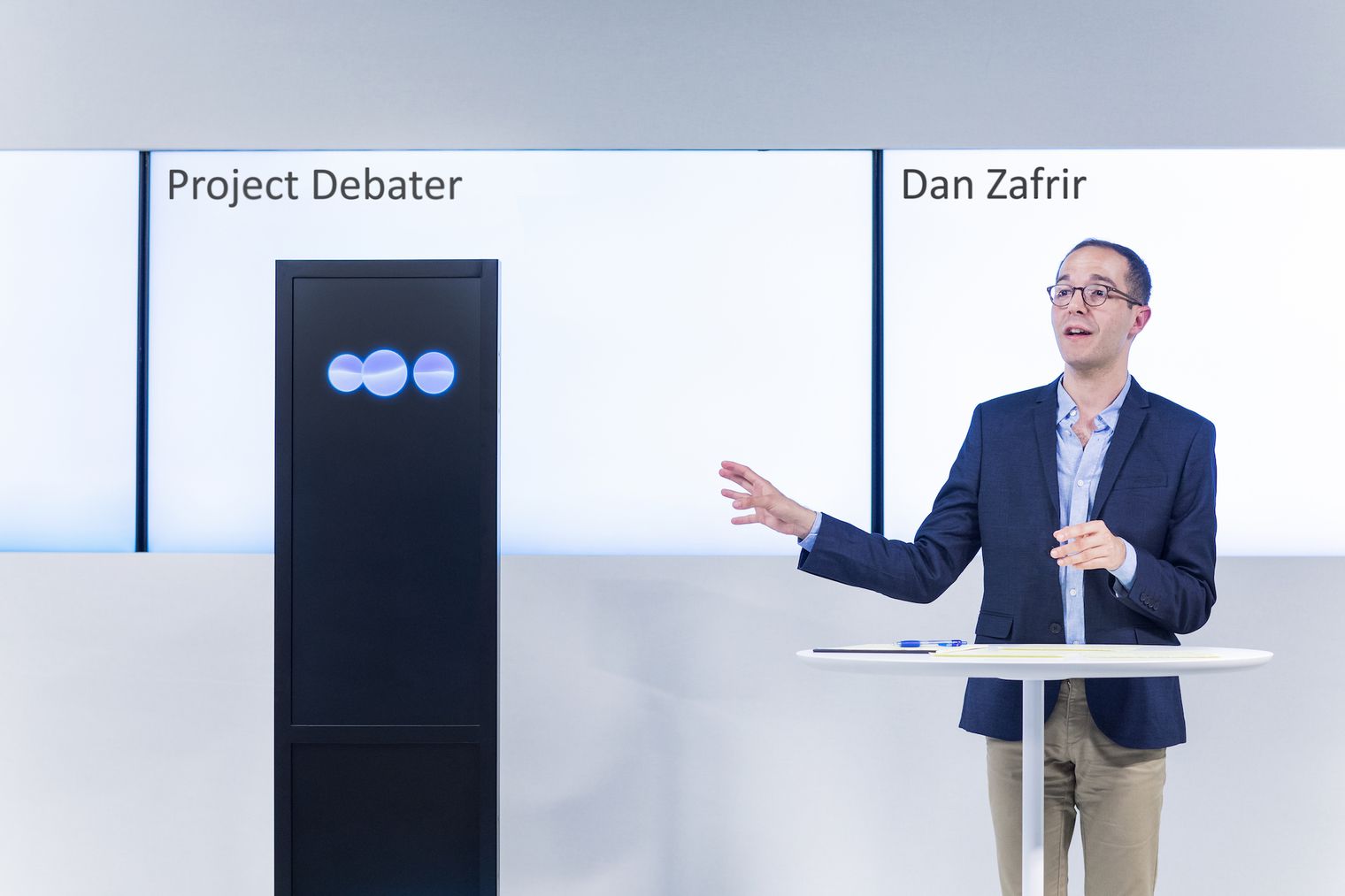
At a small event in San Francisco last night, IBM hosted two debate club-style discussions between two humans and an AI called “Project Debater.” The goal was for the AI to engage in a series of reasoned arguments according to some pretty standard rules of debate: no awareness of the debate topic ahead of time, no pre-canned responses. Each side gave a four-minute introductory speech, a four-minute rebuttal to the other’s arguments, and a two-minute closing statement.
Project Debater held its own.
It looks like a huge leap beyond that other splashy demonstration we all remember from IBM when Watson mopped the floor with its competition at Jeopardy. IBM’s AI demonstration today was built on that foundation. It had many corpora of data it could draw from, just like Watson did back in the day. And like Watson, it was able to analyze the contents of all that data to come up with the relevant answer. But this time, the “answer” was cogent points related to subsidizing space and telemedicine laid out in a four-minute speech defending each.
Project Debater cited sources, pandered to the audience’s affinity for children and veterans, and did a passable job of cracking a relevant joke or two in the process.
That’s pretty impressive. It essentially created a freshman-level term paper kind of argument in just a couple of minutes when presented with a debating topic it had no specific preparation for.
...it was able to move from the “present information” mode we usually think of when we hear AI to a “make an argument” mode. But what impressed me more was that it attempted to directly argue with points that its human opponents made, in nearly real time. (The system needed a couple minutes to analyze the human’s four-minute speech before it could respond.)
It frankly made me feel a little unsettled, but not because of the usual worries like “robots are going to become self-aware and take over” or “AI is coming for our jobs.” It was something subtler and harder to put my finger on. For maybe the first time, I felt like an AI was trying to dissemble. I didn’t see it lie, nor do I think it tried to trick us, but it did engage in a debating tactic that, if you saw a human try it, would make you trust that human a little bit less.
What Project Debater didn’t do was directly engage the criteria set forth by its human opponent. And here’s the thing: if I were in that debate, I wouldn’t have done so either. It’s a strong debating tactic to set the framework of debate, and accepting that framework is often a recipe for losing.
Another IBM researcher suggested that this technology could help judge fake news.
How close is this to being something IBM turns into a product? “This is still a research-level project,” Welser says, though “the technologies underneath it right now” are already beginning to be used in IBM projects.
See the full story here: https://www.theverge.com/2018/6/18/17477686/ibm-project-debater-ai