Baobab’s ‘Jack’ Merges Theater And Virtual Reality With Empathy
 I was ushered into the room without any means of interacting with a digital space. At first, I did my best to take in my cartoonish surroundings, not paying much attention to where I was walking. I hit my head on a light-bulb hanging on a string, which may as well have been akin to a figurative light-bulb switching on inside of my cranium.
“Oh, this is all real,” I murmured to no one at all.
And it was. Well, about as real as mixed reality gets, anyway.
I walked over to the far end of the room where a hot plate burner was running and a kettle was sitting idle. I picked it up and placed it on the burner, where there was quite clearly some kind of heat source concentrated in that area. I walked back across the room, bumped my head on the same damn light-bulb (because it still hadn’t sunk in that my virtual world and the real world existed in the same capacities), only to be startled by a voice and a physical presence in the room with me. I suppressed a yelp.
Chelebourg acknowledged that it was a difficult task, bringing theater and virtual reality together.
Lee pointed out that it was difficult to live up to the Baobab ethos of bringing the best virtual reality experiences to everyone in the world when the installation could only accommodate one person at a time.
Jack is a fully immersive experience, straddling the virtual and physical worlds in a way that I’ve never seen before. Chelebourg’s gift for visual storytelling and emergent narrative is stunning. Baobab’s eye for talent is equally astounding and the indie studio may very well see another Emmy under its belt by this time next year. More than anything, I’m truly excited to see what Part Two of Jack will look like.
See the full story here: http://www.shacknews.com/article/104726/baobabs-jack-merges-theater-and-virtual-reality-with-empathy
VR Needs More Social
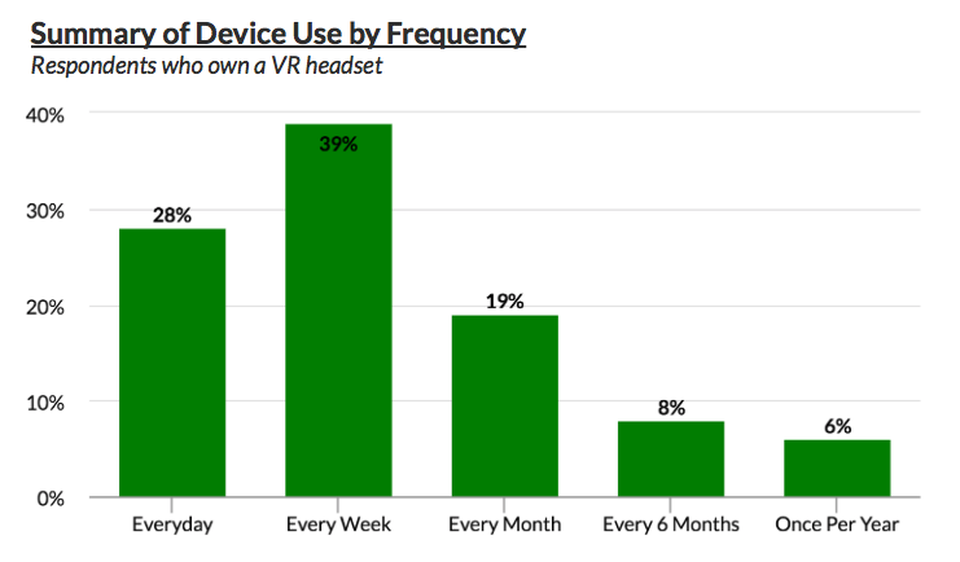 77% of people who use virtual reality want more social engagement in VR, according to a new survey of 4,217 consumers. And while many of their headsets don't get regular use, most intend to use their VR headsets more in the future.
"Led by Generation Z and Millennials, 77% of respondents who own a VR headset say they are interested in interacting socially with other people in VR," says Greenlight Insights, which ran the survey. "Playing games, watching videos and video communications ranked highest as social VR activities of interest."
See the full story here: https://www.forbes.com/sites/johnkoetsier/2018/04/30/virtual-reality-77-of-vr-users-want-more-social-engagement-67-use-weekly-28-use-daily/#6eb0cd1518fc
Israeli Startup Uses Augmented Reality to Battle Hiring Biases
 Actiview’s system can help companies become more diversified by eliminating any prejudice from the process, according to Mr. Libi. “Intellectually, we all want to create a diversified company, but the human brain is limited in its ability to ignore traits that are irrelevant for the position such as ethnicity, gender or sexual orientation,” he explained. Actiview’s system can simply ignore these traits, only taking into account a person’s performance, qualifications, and personal traits, he added.
In order to asses the most significant traits for candidates, Actiview’s system first tests the company’s current employees to get a better idea of what it takes to succeed in the specific environment of that company, Mr. Libi said.
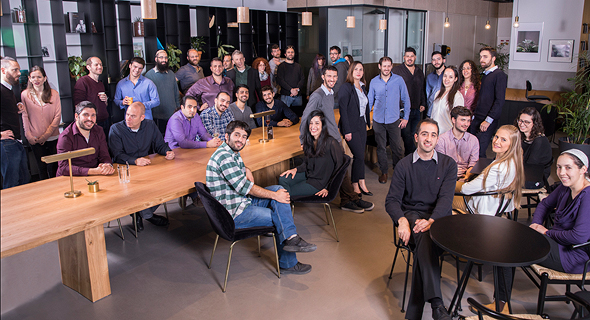
Actiview has almost 50 employees working out of its headquarters in Lod, a town in central Israel, and additional offices in Tel Aviv and London. The team includes neuroscientists, data scientists, engineers, psychologists, and designers. Actiview has 10 current clients and collaborations with academic research centers such as Tel Aviv University’s neuroscience research lab.
See the full story here: https://www.calcalistech.com/ctech/articles/0,7340,L-3737181,00.html
Virtual Reality Asserts Itself as an Art Form in Its Own Right

 The Berlin-based artist Olafur Eliasson said that we were only in “the Stone Age” or prehistoric period for the medium.
“There is a new space out there where a lot more people will have access to artistic experience,” he said last week in a panel discussion here at the Art Leaders Network hosted by The New York Times. He added that “the quality of the glasses is getting so much intensely better” over the three years he has been experimenting with virtual reality.
Mr. Eliasson envisions a future in which people access art “on a platform like Netflix” once the necessary equipment is more widespread and the business model more developed. “Rainbow” was presented in March at the contemporary exhibition space Kunsthal Charlottenborg during the Copenhagen International Documentary Film Festival.
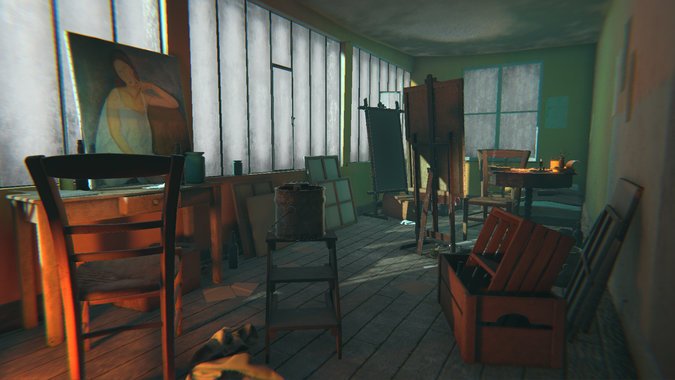
If virtual reality has proved useful as an educational tool through recent initiatives such as a re-creation of Modigliani’s last Parisian studio at the Tate Modern in London, it is still asserting itself as an artistic form in its own right. A panel discussion with Sandra Nedvetskaia, partner of the virtual-reality production company Khora Contemporary, and Edward Klaris, an adviser and lawyer specializing in intellectual property, addressed some of the issues at stake.
While a painting is acquired through a single sale payment, Mr. Klaris said, virtual-reality works may demand a monetization plan more along the lines of the film industry. An artist who creates such a work “might be paid every time it is sold or distributed,” he said.
Ms. Nedvetskaia cited a “triangular” business model involving the artist, production company and gallery. The structure varies on a “case-by-case basis.”
But the collector base is just developing. “It is too early to talk about at this point,” she said of “a very nascent market” while mentioning sales in Asia and the interest of private museums and collections.
“When art doesn’t move people emotionally, it has no purpose,” she said. “The next generation only grows up with screens. They have a totally different point of access.”
“There use to be these categories,” he said. “High art, fashion, commerce, you name it. Artists have demolished that.”
See the full story here: https://www.nytimes.com/2018/05/01/arts/art-leaders-network-berlin-vr-virtual-reality.html
All We Want to Do Is Watch Each Other Play Video Games
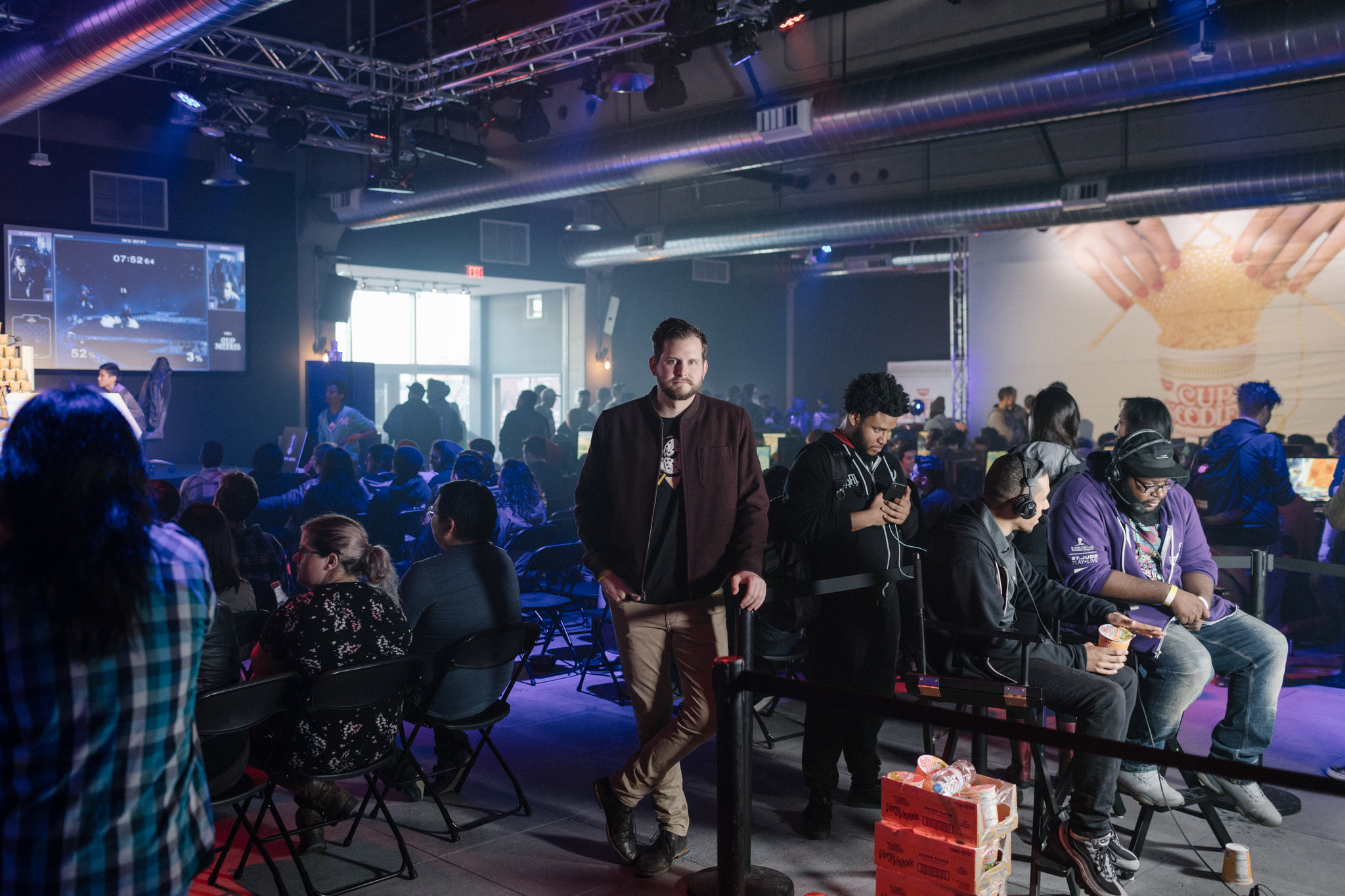
Across North America this year, companies are turning malls, movie theaters, storefronts and parking garages into neighborhood esports arenas.
At the same time, content farms are spinning up in Los Angeles, where managers now see gamers as some peculiar new form of famous person to cultivate — half athlete, half influencer.
And much of it is powered by the obsession with one game: Fortnite. Over the last month, people have spent more than 128 million hours on Twitch just watching other people play Fortnite, the game that took all the best elements of building, shooting and survival games and merged them into one.
How obsessed are people? After each of their wins this season, the Houston Astros — among many other sports teams — are doing a very specific dance, their arms in the air, fingers spread, their legs bent, toes tapping rapidly. It’s a Fortnite dance.
Gamers are coming together for practical reasons as well as social ones. Games are so sophisticated that they can overload home connections. And cryptocurrency miners have driven the price of crucial gear — like the graphics card gamers use to amp up their computers’ processing speeds.
“We’re seeing the rebirth of social gaming,” Luigino Gigante, 27, who opened a gaming center called Waypoint Cafe on the Lower East Side of New York late last year. “It’s bringing back the community aspect of gaming again. It’s like, ‘O.K., we’re still playing separately, but we’re together.’”
And there’s an underused asset already at hand.
“The movie theater!” said Ann Hand, the C.E.O. of Super League Gaming, which converts movie theaters into esports arenas, and has raised $32 million from investors. “It has that thunderous sound, and it’s empty a lot of the time.”
Two days a week, Ms. Hand and her crews convert about 50 movie auditoriums into esports arenas, where kids, mostly younger, compete and watch the game projected onto the big screen.
For the Super League Gamers, the events can accompany or replace traditional sports. It’s a new Little League and Minor League for today’s athletes. Each city plays together as a branded team — there’s the Chicago Force, the New York Fury, the San Francisco Ionics. So far, there are 50,000 players.
Parents accompany younger players, and the real-life experience opens their eyes. “The most common piece of feedback was that they knew their son or daughter loved this game, but they had no way to understand the game or know if they were any good at it,” Ms. Hand said. “Like, ‘I didn’t know my son or daughter was that competitive.’”
By 2019, she expects to be in 500 venues.
See the full story here: https://www.nytimes.com/2018/05/02/style/fortnite.html
Facebook Announces AR Support For Messenger & Instagram, Updates To AR Studio
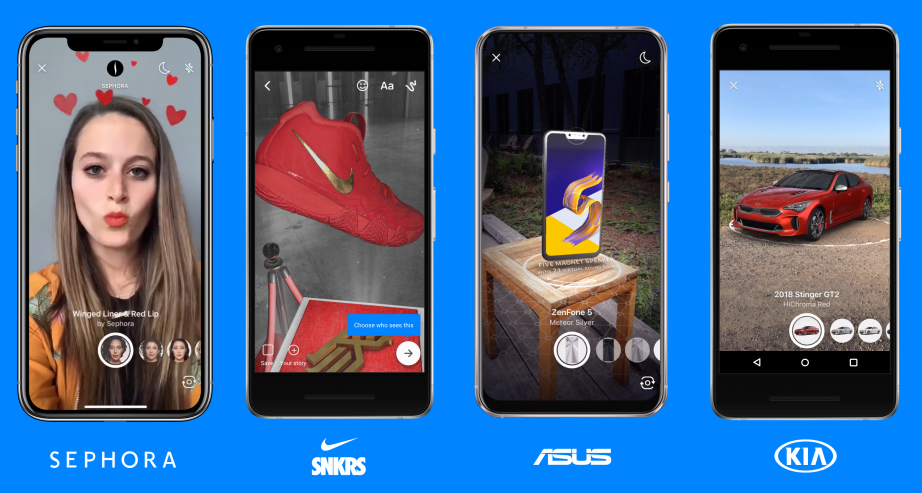 As part of an ongoing closed beta, Facebook has begun allowing select brands to begin implementing AR filters to the official Messenger smartphone app. By tapping on a specialized AR button located on the app, you open access to a variety of augmented filters from companies such as Nike, KIA, Sephora, and ASUS. Sephora’s filter for example lets you try on different styles of make-up and then upload photos or videos to friends and family.
Oculus Go Is the $200 Headset That Could Make You Try VR
In the middle, a new kind of headset is finally appearing. Devices like the Oculus Go and Mirage Solo don’t need a PC and don’t steal your phone. They have no cables. They can’t play intense games, but they’re great for casual use. And with web browsers and video players, they satisfy needs that border on the practical.
The Go reminds me of my first Amazon Echo. I owned better speakers, but I gravitated to the Echo because asking Alexa to play a song was so easy. Similarly, the Go is so simple I found myself using it most—more than the Vive Pro and Sony Corp.’s PlayStation VR, even though both have more impressive tech and better games. The Go makes VR feel less like an event you have to schedule and more like just picking up your phone.
The tech makes it possible to “hang out” in a more intimate and real-feeling way than a phone call or video chat. I like the premise, and was impressed by a demo of Oculus Rooms, where you join up with your friends to play games or watch videos. My room got a bit lonely, though. None of my friends was ever online.
Yes, the Go lacks crucial features. It doesn’t have controllers that track and mimic your hand motion like the Vive Pro or the Go’s expensive, PC-dependent sibling, the Oculus Rift. Instead, the Go uses a simple remote, similar to what you get with Nintendo Co.’s Wii consoles.
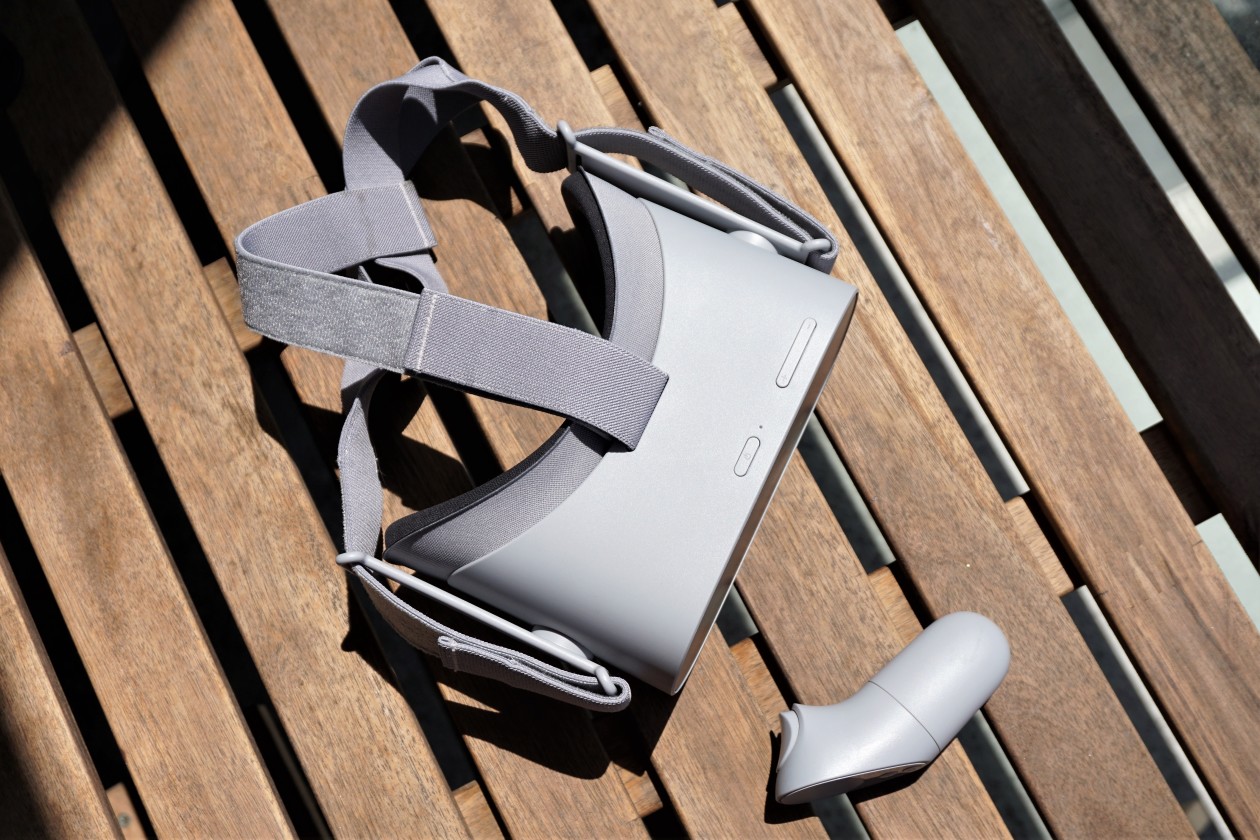 At $200, the Oculus Go finds a balance between features and price—it’s one of the easiest and most useful headsets available. PHOTO: DAVID PIERCE/THE WALL STREET JOURNAL
See the full story here: https://www.wsj.com/articles/oculus-go-is-the-200-headset-that-could-make-you-try-vr-1525195800