CEA agrees on Ultra HD label for next-gen TVs
Consumers will soon encounter a higher-definition technology option for their TV set, one that the Consumer Electronics Association today announced will be called “Ultra High-Definition” or “Ultra HD.”
Getting the entire industry to agree on the name is intended to avoid confusion and to emphasize that these televisions are an improvement over the already commonplace HDTV televisions. Other considered names included “4K TV,” “UDTV,” “Super Hi-Vision” and “UHDTV.”
The labeling decision was timely, since these sets will be prominently featured at International CES 2013 in January and several networks used the Olympics as an opportunity to make programming at that resolution. LG already began U.S. sales of a $20,000 84-inch Ultra HD TV (pictured) in September, and Sony soon after released its competing 84-inch Ultra HD TV for about $5,000 more.
Here’s the geeky stuff. Before a television, monitor or projector can label itself Ultra HD, it must meet the following criteria:
- Display resolution of at least eight million active pixels, with at least 3,840 horizontally and at least 2,160 vertically
- Display aspect ratio with width to height of at least 16 X 9.
- At least one digital input capable of carrying and presenting native 4K format video from this input at full 3,840 X 2,160 resolution without relying solely on up-converting.
The Ultra HD name was endorsed unanimously by CEA’s Board of Industry Leaders in their Thursday meeting, at which the organization also codified the attributes a television must have before it can be called Ultra HD. These measures were recommended by the 4K Working Group – which has now changed its name to the CEA Ultra HD Working Group – and incorporates research from both technological and marketing studies.
See the original post here: http://www.dmwmedia.com/news/2012/10/19/cea-agrees-on-ultra-hd-label-for-next-gen-tvs
Will high frame rate video finally kill off interlace?
However the next clip was 60fps, and stereo. This was like a veil being lifted. It was close to looking at the real thing—if you ignored some of the cue conflicts of depth perception inherent in stereo 3D.
The high frame rate does lift the viewer out of the marginal success of motion portrayal exhibited by legacy film and 25/30-frame television. ...
Read the full story here: http://broadcastengineering.com/blog/will-high-frame-rate-video-finally-kill-interlace
Nielsen: HD Sets in Over Three Quarters of U.S. Homes, Yet 71% of primetime broadcast viewing still done in standard definition
Despite 61 percent of primetime viewing experienced on an HD set in May, only 25 percent of cable primetime and 29 percent of English-language broadcast primetime occurred in "true HD" -- when an HD set is connected to an HD signal and HD channels are being viewed.
Read the full story here: http://www.broadcastingcable.com/article/489938-Nielsen_HD_Sets_in_Over_Three_Quarters_of_U_S_Homes.php
Big Data To Drive $232 Billion In IT Spending Through 2016
Big data is not a distinct market. More so, data is everywhere, impacting business in any imaginable way. Its influx will force a change in products, practices and solutions. The change is so rapid that companies may have to retire early existing solutions that are not up to par.
See the full story here: http://techcrunch.com/2012/10/17/big-data-to-drive-232-billion-in-it-spending-through-2016/
How HP Could Reinvent 3D Printing…and Itself
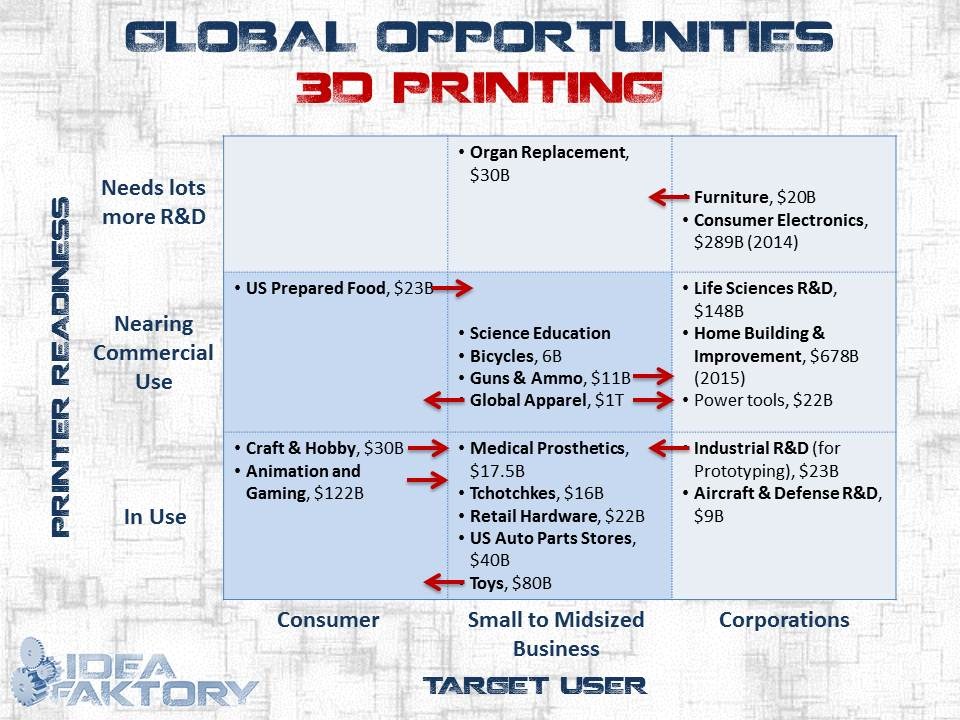
[Philip Lelyveld comment: This article contains a useful graphic of the markets and market sizes for 3D printers.]
 Read the article here: http://www.forbes.com/sites/stevefaktor/2012/10/15/how-hp-could-reinvent-3d-printing-and-itself/
COCA-COLA EQUIPS VENDING MACHINES WITH KINECTS, LETS YOU DANCE FOR FREE COKES
Vending machines may not seem like a place for cutting edge technology, but that is changing and quickly. Last year, Pepsi created a Social Vending machine that allowed you to gift a soda to a friend and the machine would text them with a code to receive it. At the University of Texas, a robotic barista from Briggo was installed that serves up coffee drinks ordered on site or via smartphone. And it’s not just drinks — an Italian company has also created a vending machine that makes and bakes fresh pizza.
Considering the relatively low cost of a Kinect compared to a vending machine, it makes sense that a company would try to use the tech for its advantage. ...
Comment Voting: Ars Technica’s new solution to shills and kooks
What Ars offers instead is a simple score that lets people quickly identify wheat and chaff as they scroll through the comments. So far, the system has helped to flag astro-turfers (ie disguised PR people who write things like “I just love the new Kindle XYZ”) through negative scores.
More intriguing is what happens next. As Fisher explains, low scores will cause a comment to fade to grey and, if the score is really low, it will disappear altogether. The idea is that trolls and pitchmen will quickly get discouraged and migrate to other sites. Meanwhile, Ars is also introducing a star system that will let readers quickly scroll to the good stuff.
So what to make of all this? My initial impression is that Ars has hit on a effective way to crowd source comment quality. The only question is whether there is a risk of fostering the hive mentality and group think that can infect even the smartest sites. For instance, would an intelligent pro-SOPA, copyright advocate simply be voted out of existence?
According to Fisher, ”it’s not what people say, it’s how they say it that earns the votes,” meaning unpopular opinions will have a fighting chance.
‘NewsHour’ Launches Do-It-Yourself Political Ads
Online tools give users chance to use Facebook info to assemble mock ad attacking themselves
With campaigns and outside groups spending hundreds of millions to make and place political spots,PBS NewsHour is giving Jane and John Q. Public the chance to create their own political ad, including their own negative ad attacking themselves, all for free and at the click, actually several clicks, of a mouse.
The NewsHour has teamed with Mozilla and Ocupop on AdLibs, an online tool that allows Facebook users to integrate some of that content into a slick campaign ad for or against themselves.
The idea, says NewsHour Political Editor Christina Bellantoni in announcing the app, is to show that there is a science to campaign spots.
To give it a try, go here.
See the original post here: http://www.broadcastingcable.com/article/489843-_NewsHour_Launches_Do_It_Yourself_Political_Ads.php
Abu Dhabi Media Summit: Warner Bros., Weather Channel Executives See Continued Mobile Growth
In a session entitled "Tablets Rising: Mobile Doubles Down" at the Abu Dhabi Media Summit, Jim Wuthrich, president, Warner Bros. international home video and digital distribution, said that mobile is "an important part of our [digital] business, but it's still a small part" at maybe around 30 percent, although there are no hard figures. "Most people are still accessing their content through PCs," but "tablets are becoming a more important way."
Especially in the case of long-form content, "consumers will gravitate to the best screen they have available at the time," the Warner executive suggested. And that means the continued importance of big-screen TVs in homes.
But he also acknowledged that his two sons use other screens that have become their substitution for the TV. As such, they use laptops or tablets in the home, and mobiles primarily when outside the home.
See the full story here: http://www.hollywoodreporter.com/news/bill-gates-abu-dhabi-media-summit-400192
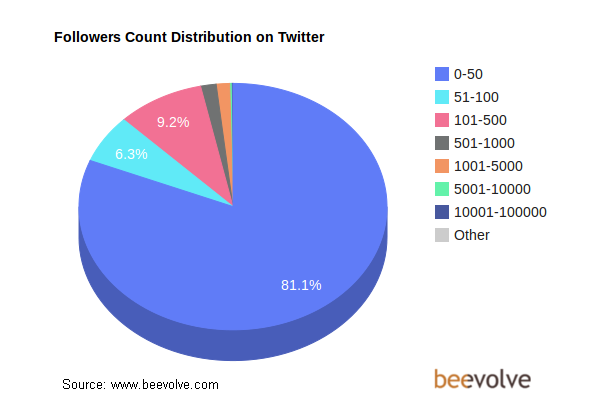
An Exhaustive Study of Twitter Users Across the World
[Philip Lelyveld comment: the full report is an easy quick read with interesting stats.]
See the source report here: http://www.beevolve.com/twitter-statistics/
Pages
- About Philip Lelyveld
- Mark and Addie Lelyveld Biographies
- Presentations and articles
- Trustworthy AI – A Market-Driven approach
- Tufts Alumni Bio