Bose AR shows off augmented reality audio games
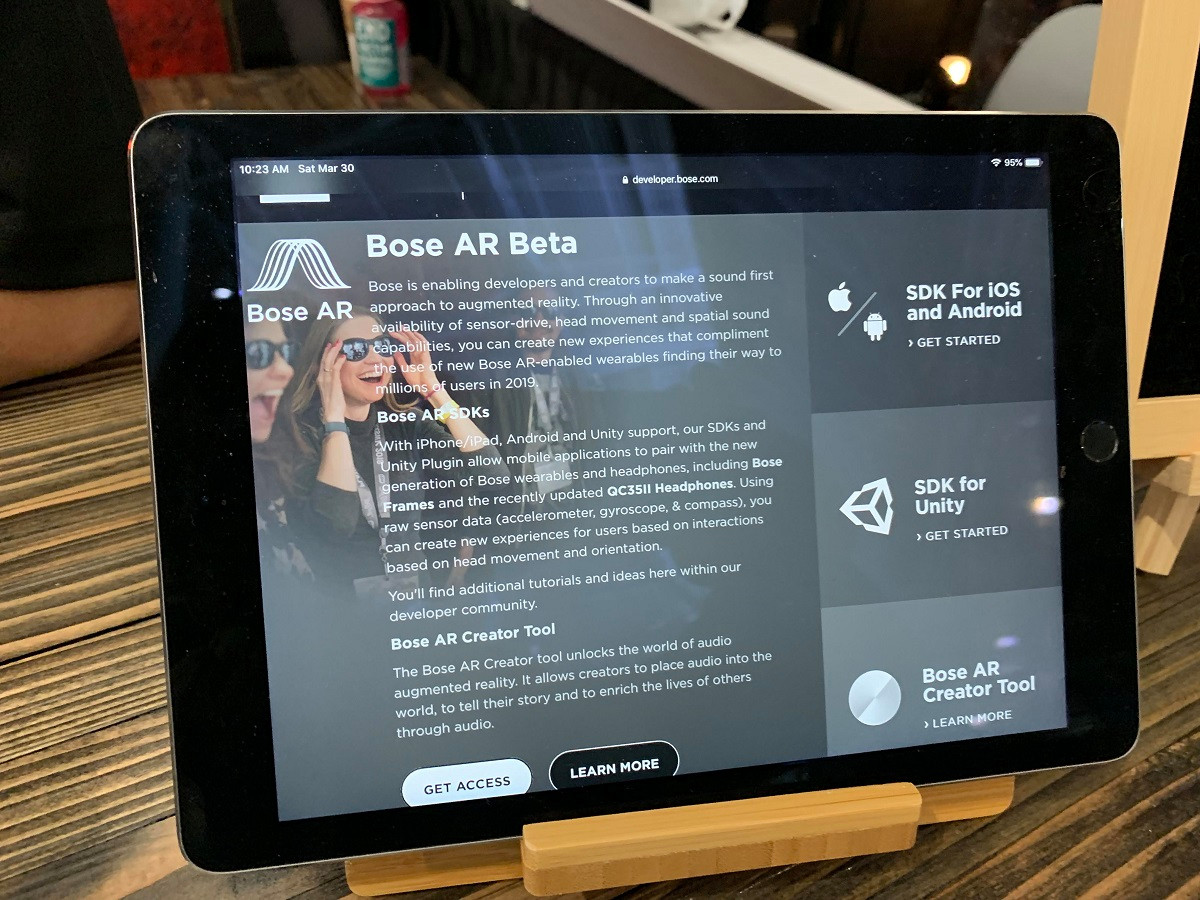 An indie game studio in Boston, Worthing & Moncrief, made a game called Overherd to work with the glasses. Eric Hamel, one of the developers, told me how it worked. The game was a comic take on the opening scene of Monty Python & the Holy Grail, where a French knight in a castle taunts King Arthur.
Your job is to listen to the French knight’s voice and figure out where he is in a circle around you. You turn to face him, double tap your glasses, and let loose a catapult throw a cow at his castle. If you hear a crash, you’ve hit his castle with the flying cow. If I moved my chin up or down, I could change the elevation of the targeting.
I had to listen closely, but Hamel put some noise-canceling headphones on my ears to block out the convention noise. My hearing isn’t the best. But I was able to send the cows crashing into the castles, eliminating the French guy as he taunted me.
See the full story here: https://venturebeat.com/2019/04/06/bose-ar-shows-off-augmented-reality-audio-games/
 The Royal Academy of Arts has unveiled a series of installations that show how virtualand augmented reality technologies can change the experience of buildings and spaces.
The four installations were created by architect Gilles Retsin, 3D-scanning studio ScanLAB, designer Keiichi Matsuda and design studio Soft Bodies.
Together they form the third and final instalment of Invisible Landscapes, a project by RA curator Gonzalo Herrero Delicado exploring how digital technologies are changing the world.
See the full story here; https://www.dezeen.com/2019/04/04/virtual-reality-installations-invisible-landscapes-royal-academy/
Believing virtual reality is a promising tool for learning languages, companies, colleges invest
 After two years of lessons and little progress, he enrolled in an Arabic-immersion program in Jordan where he hung out with a Bedouin woman six hours a day. And then he moved into a house in a Syrian refugee camp in Beirut, Lebanon with six men who didn’t speak English.
“And guess what happened? I learned Arabic,” he says. “Because I’d go to a hookah bar and practice. I’d go play soccer and practice.”
Mark Warschauer, the director of UC Irvine's Digital Learning Lab who founded the journal Language Learning and Technology in 1997, says studies show that effective language learning involves a combination of structured instruction and immersive practice.
As an academic, Warschauer once advised a study looking at how users could improve their Spanish playing Spanish-language versions “World of Warcraft.” There has also been research on language-learning in 3D virtual worlds like “Second Life.”
“Virtual reality is the only type of technology that truly allows immersion,” says Dylan Walch, Immerse’s VR engineer. “In VR, if we put you in a conference room and ask you to give a presentation onstage, it simulates the emotions and anxiety you feel for public speaking. And because we can simulate that in a safe environment with a tutor that’s patient, that’s such a powerful thing.”
Because Mandarin-language speakers who want to learn English form the biggest language market by far, Immerse launched in Taiwan, targeting international companies that want their employees to be able to do business in English. Current clients include a management consulting firm, a semiconductor production company, and an accounting firm.
Users are sent VR headsets. Each English teacher, who can be based anywhere in the world, can instruct up to five students at a time, and once they (and their avatars) enter virtual reality for their lesson, the teacher takes them on an adventure.
“If you’re going on a business trip, I can take you to the airport and we can practice ordering a ticket, checking out the flight time,” says Walch. “And if you say something incorrectly, I can type in front of you and show you in real time.”
The reality is that virtual reality is not quite mainstream yet.
Most people who own their own VR headsets are still gamers, says Taber, and none of his clients had used the technology before.
See the full story here: https://www.latimes.com/socal/daily-pilot/entertainment/tn-wknd-et-virtual-reality-language-20190404-story.html
One in Five Consumers Uses Voice to Interact With Their TVs
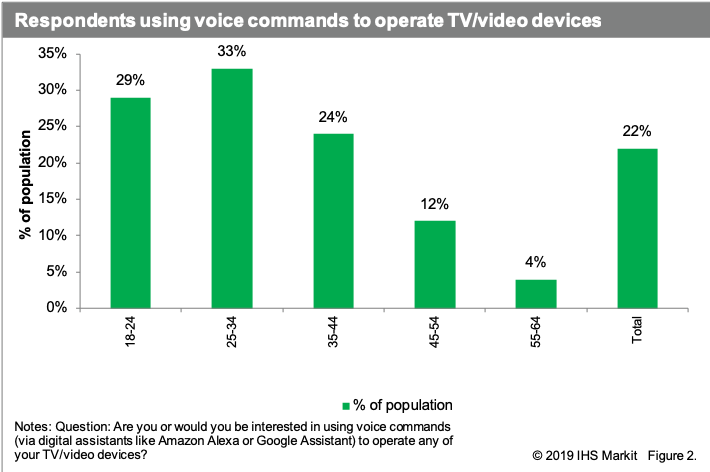 More than 20% of all consumers interact with their TVs or streaming devices via voice commands, according to a new survey from IHS Markit. An additional 30% aren’t currently using voice for TV viewing, but are interested in the technology.
TV manufacturers and pay TV service operator alike have increasingly been embracing voice control, adding not only voice remotes but also support for third-party speakers to their devices. More recently, consumer electronics manufacturers have begun to add far-field microphones directly to their TV sets, effectively turning them into smart speakers with giant displays.
IHS Markit’s voice data comes from a new report titled “Voice Commands on Devices: Content Discovery and Navigation” that is based on a recent survey of 9,636 internet users in the U.S., the U.K., Australia and India.
See the full story here: https://variety.com/2019/digital/news/tv-voice-control-usage-1203178496/
What are the challenges of designing virtual reality experiences?
 There are technical, physical and experiential challenges to designing virtual reality, augmented reality or mixed reality experiences.
The technical challenges are easier in that we know what a right answer looks like. The devices need to be smaller, lighter, wireless and higher resolution, as well as have a wider field of view, improved tracking, lower latency and so forth. That's all engineering. And, while it isn't easy, at least we know what the targets are.
Physical challengescenter around two main areas: exterior and interior comfort. Exterior comfort plays on some of the technical challenges: The gear needs to be lighter, not have wires and be comfortable enough for long-term use -- i.e., hours. At some point in the future, people will likely work in some form of augmented reality (AR) or virtual reality (VR), so eight-hours-a-day use needs to be viable.
Interior comfort refers to issues around motion sickness, cognitive and emotional overload, and possible long-term side effects. There is a rough estimate that about 10% of the population is highly susceptible to motion sickness -- I'm one of them. There are technical parameters that can ameliorate some of the effects: Tracking needs to be fast and accurate; frame rates need to be high -- no or low latency; and the experience needs to be designed in such a way that it avoids certain interactions that can exacerbate motion sickness.
This leads to the longest tent pole in the room: experiential challenges of designing virtual reality, augmented reality and mixed reality (MR) experiences.
We are exceptionally good at telling stories on screens, as we're building on centuries of experience, dating back to the Greeks first creating the proscenium arch, which effectively put content within a boundary. Paintings, movies, television -- all are forms of narrative bounded by a screen border. VR, AR and MR remove those boundaries, and with it, a lot of our narrative forms lose efficacy. ...
See the full story here: https://internetofthingsagenda.techtarget.com/answer/What-are-the-challenges-of-designing-virtual-reality-experiences
56% Have Heard Of Virtual Reality, Only 23% Can Explain It
 [PhilNote: I asked the story's author Chuck@MediaPost.com if there is a link to the source study for this data.]
While most (56%) people have heard about virtual reality, they’re not able to explain it. More significantly, fewer than a quarter (23%) of people are familiar with it and could explain it to someone else. That’s down 13% from 2017, when more than a third (36%) of people were very familiar with it and could even explain it to a friend.
Brands take a hit here as well. Just over a quarter (28%) of people can name a VR industry leader, which is 17% fewer than in 2017.
The good news is that the majority (62%) of consumers have a positive attitude about virtual reality.
See the full story here: https://www.mediapost.com/publications/article/334007/56-have-heard-of-virtual-reality-only-23-can-ex.html