security robot, Nimbo, whose Segway-based design includes a unique "Ride-On Mode" that lets a passenger hop on and travel at up to 11MPH. The bot is designed to autonomously patrol areas and deliver audiovisual warnings if it catches a trespasser with its computer vision (based on tech like Intel RealSense), but this helps its organic counterparts respond to alerts or supplement the machine's own coverage.
10Jan/18Off
Artificial Intelligence Startup Oben Raises $10 Million
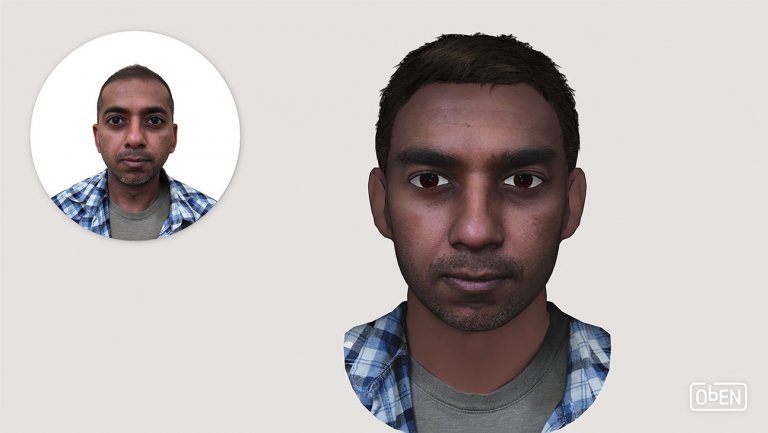 Pasadena-based artificial intelligence startup Oben has raised $10 million, bringing its total funding to roughly $23.7 million.
Its new investor is entrepreneur Adrian Cheng’s K11, the company behind a museum-retail concept, the “art mall,” that already has sites in Hong Kong and Shanghai.
Oben intends to use the funding to further develop its platform for creating AI-driven avatars. Part of the plan is to incorporate custom avatars at K11 locations as guides.
As previously reported, Oben also has been reaching out to Hollywood talent agencies with an eye toward creating digital "copies" of actors and celebrities for a variety of uses. For instance, Siri’s voice could be replaced by that of a famous actor or actress.
See the full story here: https://www.hollywoodreporter.com/behind-screen/artificial-intelligence-startup-oben-raises-10-million-1073508
9Jan/18Off
Lytro is Positioning Its Light Field Tech as VR’s Master Capture Format
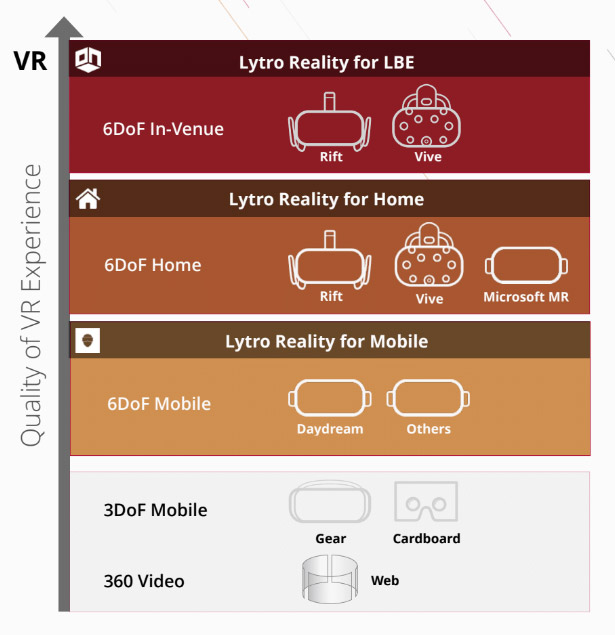 There’s three main pieces of Lytro’s toolset that makes it all possible. First is the company’s light-field camera, Immerge, which enables high-quality live-action light-field capture; we recently detailed its latest advancements here. Then there’s the company’s Volume Tracer software which renders synthetic light-fields from CG content. And finally there’s the company’s playback software which aims to enable the highest-fidelity playback on each device.
For example, a creator could create a high-fidelity CGI scene like One Morning—a Lytro Reality Experience which the company recently revealed—with their favorite industry-standard rendering and animation tools, and then output that experience as a Lytro Reality Experience which can be deployed across high-end, low-end, and even 360 video without needing to modify the source content for the specific capabilities of each device, and without giving up the graphical quality of raytraced, pre-rendered content.
Lytro is keeping its tools close to the chest for now; the company is working one on one with select customers to release more Lytro Reality Experiences, and encourages anyone interested to get in touch.
While Rosenthal says the company is still working on reining in light-field file sizes, the company provided Road to VR with a fresh look at the their current data envelopes for each consumption end-point:
- 0.5TB/minute for 6DoF in-venue
- 2.7GB/minute for in-home desktop
- 2.5GB/minute for tablet/mobile devices
- 9.8MB/minute for 360 omnistereo
See the full story here: http://www.virtualrealitypulse.com/edition/monthly-apple-htc-2017-12?open-article-id=7659216&article-title=lytro-is-positioning-its-light-field-tech-as-vr-s-master-capture-format&blog-domain=roadtovr.com&blog-title=road-to-vr
9Jan/18Off
Why Print Legacies Like Time Are Betting Big on Augmented Reality
 Last week’s issue of Time magazine is the first edited by a guest editor in its 94 years of existence. It’s also the first issue to feature augmented reality activations—four of them, all on the issue’s theme of optimism.
According to Mia Tramz, managing editor of Life VR, and Claire Howorth, assistant managing editor of Time, the original impetus to include AR in this issue came from Bono, who wanted his contribution to have an AR or VR component. But the team, which includes the third-party Ryot Labs, had already been brainstorming ideas for over a year, since they had produced a “Capturing Everest” feature for Sports Illustrated. A single AR activation quickly became four.
“We’ve published about 23 or 24 VR projects since we launched Life VR last year,” Tramz said. “In the way that VR was nascent [for media companies] a few years ago, I think AR is right now.” The plan is to continue to develop AR activations across Time, Inc’s line of titles, as well as standalone AR and VR experiences.
“Since you’re using your phone for the activation, it’s almost like having Bono and Bill Gates in your hand,” Tramz said.
“A lot of the response we’ve gotten is, ‘What can we be first at with you? What can we really make an impact with?’
See the full story here: http://www.adweek.com/digital/why-print-legacies-like-time-are-betting-big-on-augmented-reality/
9Jan/18Off
Everipedia – Wikipedia with Blockchain security and editor buy-in
 Everipedia already uses a points system where creating articles and approved edits amasses “IQ.” In January, when the site moves over to a blockchain, Everipedia will convert IQ scores to a token-based currency, giving all existing editors an allotment proportionate to their IQ—and giving them a real, financial stake in Everipedia. From then on, creating and curating articles will allow users to earn tokens, which act as virtual shares of the platform. To prevent bad actors from trying to cash in with ill-founded or deliberately false articles and edits, Everipedia will force users to put up a token of their own in order to submit. If their work is accepted, they get their token back, plus a little bit for their contribution; if not, they lose their token. The assumption is that other users, motivated by the desire to maintain the site’s value, will actively seek to prevent such efforts.
Everipedia wants to create an entirely new class of of truth-seekers. “Wikipedia is largely older white men,” Forselius says. “We’ve tried to focus on getting a lot of female edits, younger editors, and diverse background and ethnicities.” (A 2011 survey found that 90% of “Wikipedians” are indeed male, and 28% are over 40.)
See the full story here: https://www.wired.com/story/everipedia-blockchain/
9Jan/18Off
HTC’s Vive Pro gets sharp enough to read text, goes wireless

 The new headset is backwards compatible with the original base stations, and features a 10m x 10m tracking space.
The new Vive Pro headset will not supplant the original Vive headset, but they’ll be sold as contrasting options — like the iPhone 8 and iPhone X, the basic model and the premium model. What that means is the Vive Pro will likely be very expensive, and the original HTC Vive might see a price cut similar to what we saw out of the Oculus Rift earlier in 2017.
On top of that, Vive Pro will support a new “Vive wireless adapter” that will finally let you experience VR without being tethered to a computer. The wireless adapter mounts to the top of the headset, like a set of high-tech antlers, and it will use Intel’s WiGig to minimize interference from other wireless devices and deliver a seamless experience. A battery pack is included, too.
See the full story here: https://www.digitaltrends.com/computing/htc-vive-pro-announcement/
9Jan/18Off
Content Creators Discuss What Is Driving Augmented Reality
 As to AR’s biggest challenges, Leventhal identified hardware as “one of the primary things holding us up.” “We don’t have a lot of units out there,” he said. “That keeps people from developing content for them, and that creates a cycle.”
Cornish said that developing the cinematic language of storytelling and having a great user experience in AR are the biggest obstacles. “We have to figure out the experiences that are addictive,” he said. For Hildebrandt, working in the enterprise sector also has a main challenge. “To be a successful platform in enterprise, you have to embrace the workflows that they will continue to use,” he said. “You have to have the patience and energy to work with those big companies.”
See the full story here: http://www.etcentric.org/content-creators-discuss-what-is-driving-augmented-reality/
8Jan/18Off
Inmates Use VR To Prepare For Life On The Outside

 Moeller has designed an eclectic catalogue of instructional VR applications that educate users in everything from bagging groceries and using a debit card, to doing laundry and de escalating potentially violent confrontations. The idea is to prepare these soon-to-be released prisoners with the necessary life skills they missed while incarcerated as teenagers.
Statistics have shown that specialized outreach programs have done wonders in the re education and rehabilitation of prisoners.
See the full story here: https://vrscout.com/news/inmates-vr-prepare-life-on-outside/