 What he could only do in the physical world before, either projecting on buildings or on installations he created out of 3-D materials, he’s now increasingly able to do with virtual reality (VR), an emerging territory in art. And while Trich has been experimenting with it in his studio, he’s finally unveiling his first VR demo at Techweek during the first week of November.
“In the future once Apple and Android come out with headsets that look like a regular pair of glasses, then everybody will be wearing them,” says Trich. “I’ll be able to put things in 3-D space wherever I want them, and anybody wearing that headset will be able to walk in and download my app and they'll see everything I designed in that space.”
Trich is most concerned with the interactive and immersive possibilities of VR – principles he’s already been manipulating in the physical world.
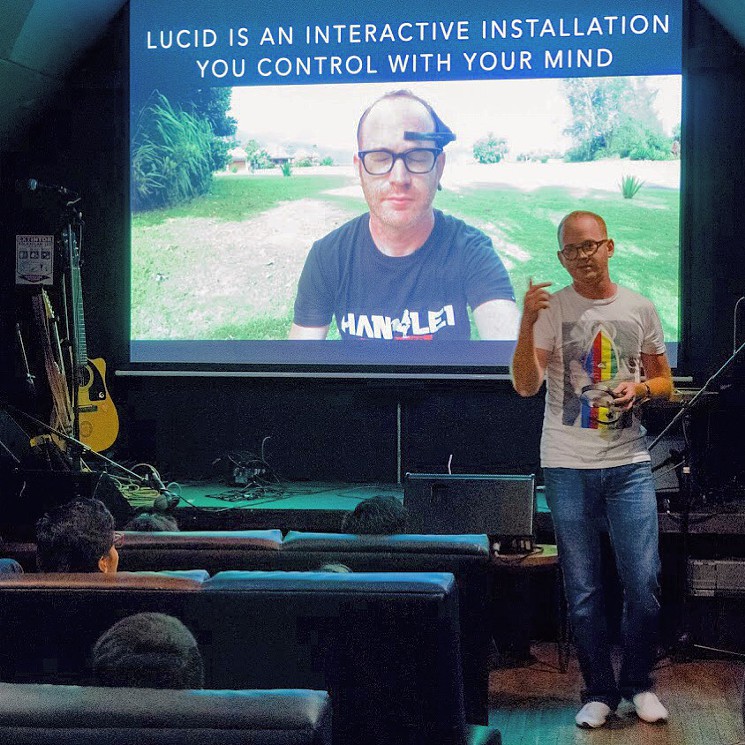
McKane is known for his LUCiD project, an installation that literally feeds off the brainwaves of participants. A user wearing a neurofeedback headset manipulates the images in the installation in real time. Scenes of floating ocean detritus turn into beautiful images of whales and dolphins when the user enters a meditative state.
See the full story here: http://www.dallasobserver.com/arts/local-artists-are-turning-to-virtual-reality-technology-to-take-their-work-to-the-next-level-8650804
Instead of adapting a traditional ballet, the piece actually is said to have been originally developed for the sake of showcasing virtual reality technology. According to a press release, the dancers do not limit themselves to one space but dance around the room and around the camera to help simulate the appearance of dimensions.
Reportedly, the piece is aimed towards audiences that would not normally attend a live stage production of a ballet.
According to the company’s website, there are three ways to watch a VR program. - Samsung Gear VR, - a smartphone through a cardboard lens - attend a VR cinema.
See the full story with video here: http://us.blastingnews.com/showbiz-tv/2016/09/dutch-company-releases-world-s-first-virtual-reality-ballet-001103393.html
"We're giving these teachers a true day-one experience in a virtual world," said Asst. Professor Dr. Jason Beach, who helped develop the technology with the use of Oculus Rift.
For one teacher, the virtual world setting was the first day of kindergarten. The scene was reading time.
"You're gonna be asked to read the book while the students are listening," Beach told a student.
The virtual kids are controlled by other teaching students, and they have all sorts of distractions up their sleeves for the teacher, who today is grad student Sarah Moran.
The kids may lay down, talk, touch a classmate or just generally fidget. Someone may come to the door unexpectedly - all distractions that happen every day in a real classroom.
The teachers-in-training have to react to the little issues before they turn into big problems.
See the full story here: http://www.newschannel5.com/news/teaching-students-use-virtual-reality-to-learn-how-to-manage-class
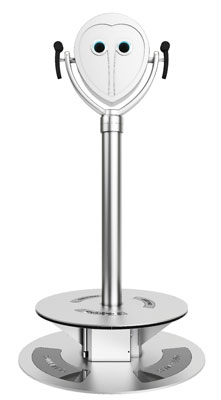
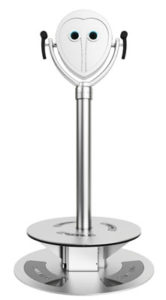 Unlike the standard tower magnification viewers, made famous by Tower Optical Co. of Norwalk, CT, Owlized's concept provides a view of a future landscape by incorporating augmented reality. The Owls load immersive 3D technology in a familiar outdoor, weatherproof package. They also run virtual reality programing, and offer adjustable head rotation (180°, 270° and 350°), 10,000 x 5,000 spherical resolution, support for 360° video and audio. The viewer's stand can bolt into concrete. However, it is not offered with a coin mechanism or any other payment system.
See the full story here: http://www.vendingtimes.com/ME2/dirmod.asp?sid=EB79A487112B48A296B38C81345C8C7F&nm=Vending+Features&type=Publishing&mod=Publications%3A%3AArticle&mid=8F3A7027421841978F18BE895F87F791&tier=4&id=F0A5AB911F214B84AEA42A608FF1BCEB
 If travelers happen to visit Departure Hall 3 of Amsterdam’s Schiphol Airport, they may notice an immersive installation of clouds. Titled Beyond, Dutch artist Daan Roosegaard’s latest work is a “cloud wall” that creates the impression of a 3D cloud-laden sky vanishing into a great aerial distance. A beautiful feat of optical illusion, it is 100 meters long and 10 centimeters thick, and comprised of 160 billion pixels.
So think of Beyond as a massive lenticular print designed to give and up close and personal immersive 3D experience.
“Its 3D effect is enhanced by yellowish-white LED lamps embedded in the wall, creating a space that is both physical and poetical,” Roosegaarde says.
See the full story here: http://thecreatorsproject.vice.com/blog/beyond-cloud-exhibit-daan-roosegaarde
AR and VR are rapidly evolving technologies but they still need to fit within established legal frameworks.
The main legal requirements
In the UK, the Data Protection Act 1998 (DPA) governs the processing (which includes obtaining, organising, using and destroying) of personal data. Personal data means data which can (alone or in combination with other information held or likely to be held by a data controller) identify a living individual. In the language of the DPA, the “data controller” is the person or business which determines how and why the personal data are processed. Sometimes there may be more than one organisation acting jointly with another; it can also be challenging to work out in the complex online ecosystems which party is a “data controller” and for which use of data; for example, the user could be a data controller, so could the app owner, the social media website or the advertising network.
Businesses must comply with the DPA’s eight principles of data processing, the first of which requires the processing of personal data to be fair and lawful. To be lawful, the processing must meet one of the prescribed conditions for processing. In the context of AR or VR systems, the most relevant condition is the consent of the individual whose data are being collected. Consent needs to be a freely given, specific and informed indication of the individual’s wishes; this means that it is not a valid consent if someone has simply failed to object. In the UK, online consent may take the form of a data protection notice (with full information explaining the types of processing proposed) accompanied by a clear and positive consent statement.
In essence, the VR or AR user must be given every opportunity to appreciate what they are consenting to. If the users could be children, then a method for obtaining parental consent needs to be built in. The DPA includes rules about using personal data to carry out marketing, keeping personal data secure and preventing its loss or misuse; it also includes restrictions over retaining personal data indefinitely and sending it outside of the EEA without proper safeguards.
What are the consequences of mishandling data?
Where a data controller fails to comply with the provisions of the DPA, the Information Commissioner’s Office (ICO), which enforces compliance with the DPA, can take action. The ICO has the power to issue enforcement notices requiring data processing to cease or the deletion of data, issue monetary penalty notices up to £500,000, and even prosecute non-compliant data controllers. Where individuals’ rights have been infringed, individuals may bring compensation claims in the courts.
What rights do individuals have?
Individuals are legally entitled to make a Subject Access Request (SAR) to any data controller organisation that is processing their personal data. Organisations may charge a maximum of £10 for responding to such requests, and must produce a copy of the personal data held by the organisation, unless an exemption applies.
A SAR must be completed within 40 days, and a significant level of time and resources must be expended to comply (SARs are one of the main reasons for complaints received by the ICO). Preparation and efficient processes are therefore key. Individuals are also entitled to object to their data being used for direct marketing purposes and can force an organisation to delete their personal data in certain circumstances.
What if processing takes place outside the UK?
The DPA only applies to data controllers established in the UK or who use equipment to process personal data in the UK. Where an organisation processes personal data in the context of an establishment (a registered company, office, branch, or regular practice) in another country, then the data protection laws of that country may apply to the processing instead of the DPA. If the organisation also has a UK establishment, it would – though - be prudent to comply with UK law as well.
New data protection laws ahead
The EU General Data Protection Regulation (GDPR) comes into force on 25 May 2018 and will replace the domestic data protection laws of every EU member state.
In the likely event that the UK’s Brexit negotiations have not concluded by that time, the GDPR will also come into force in the UK (at least for a brief period). It brings in more onerous consent and transparency requirements, introduces liability for data processors (those who simply process data upon the instruction of the data controller) and strengthens the protections for and rights of individuals.
Further, the GDPR introduces significantly tougher sanctions for non-compliance. Organisations may be fined up to €20 million or 4 per cent of annual global turnover if they fail to comply. The GDPR also brings in “privacy by design” and “privacy by default” approaches to encourage privacy to be a cornerstone of new product and services development.
Organisations operating in the VR and AR industry should consider their obligations under UK and EU data protection law, both present and future. The processing of facial images, location and real-time data should be compliant prior to such activities taking place. This is just as relevant for start ups as longer established businesses. It is not unknown for innovation to fail at the first funding hurdle if the business model or system design have failed to respect privacy principles.
Kate Brimsted, Partner, Reed Smith
When Pokémon Go launched in July, the game quickly swept up gamers in a craze across the world, capturing more than 20 million active users in less than two weeks.
But just as the popularity rose quickly, so did its decline. The BBC reported that some 10 million players have given it up since mid-July. The decline occurred when Pokémon Go was rolling out across dozens of countries in Asia and Latin America, including Hong Kong, Taiwan, and Japan. Which only means the fall in popularity in the United States and Europe must have been steeper still.
Even so, the rise of Pokémon Go, however short-lived it might be, has forever changed the development of augmented reality (AR).
Pokémon Go broke the deadlock. Yes, Pokémon may be only a game for teens and millennials, but it has irrevocably changed societal expectations of what information is presented and how it is accessed. Very soon, visitors at major museums will demand to know everything about the exhibit’s installations far beyond what is posted on the walls. At boutique galleries in Central, discerning shoppers will expect to hold up their phones to obtain more details about how the latest ceramic vase is handcrafted.
See the full story: http://www.scmp.com/business/companies/article/2012409/pokemon-go-passes-peak-augmented-reality-live
MIT graduate students Dennis Lally and Reed Hayes are pioneering the use of this technology with seniors, reports CBS News correspondent Michelle Miller.
“I feel for the people living inside these communities, that they don’t have enough stimulation,” Hayes said. “They need to have a sense of wonder about the world again, they need to be curious, they need to be exploring. And when you’re physically not able to do that by yourself, then virtual reality is a wonderful aid to provide that.”
“You touched off her emotions. She felt something,” Miller said.
“Absolutely. Other people in the room felt it,” Hayes said. “And those were extremely powerful moments that 2D picture won’t provide. It requires virtual reality, the immersive nature of it, to generate those emotions.”
Abdus Shakur, a chef, said he’s still got many traveling days ahead of him. But he was overjoyed to virtually visit a restaurant he opened in Berlin nearly two decades ago.
“That’s seriously addictive, come on!” Shakur said about the virtual reality experience. “I could stay there just, you know, go wherever I want, without going anywhere.”
Lally and Hayes plan to start offering their service to senior communities for an upfront fee plus a monthly subscription.
See the full story here: http://www.cbsnews.com/news/virtual-reality-rendever-mit-company-helps-seniors-physical-limitations-travel-world/
 Part of the challenge of “Jungle Book” was to make the technology disappear. With this new technology, it’s very attractive to look at all of the bells and whistles, but the idea of creating something that feels organic is the challenge I find the most interesting. I want to find the humanity in the technology.
See the full story here: http://www.nytimes.com/2016/08/31/movies/jon-favreau-on-gnomes-goblins-and-virtual-reality.html?_r=0

 Long before Oculus Rift and HTC Vive, the paper peep show—a small, layered diorama that expands like an accordion to create the illusion of depth—was a way for audiences in the 19th century to peer into times and places beyond their own experience.
"They look quite unassuming when they’re collapsed. You don’t realize the depth that they have, and you don’t quite know what to expect initially," she said. "They have a title, but it’s only when you peep into the hole that the landscape unfolds."
Paper peep shows were invented in the early 19th century in Germany and Austria, and they run the gamut in size and style. Some are as small as a matchbox while others stretch to two meters long; some are handmade and others were mass-produced and then hand-painted. Peep shows typically depict historical events, contemporary entertainment, and engineering feats, as well as foreign or imaginary locales.
Peep shows, also known as tunnel books, are widely considered to be the ancestors of animation and film.
See the full story here: https://www.fastcodesign.com/3062465/paper-peepshows-were-the-virtual-reality-of-the-19th-century

 Part of the challenge of “Jungle Book” was to make the technology disappear. With this new technology, it’s very attractive to look at all of the bells and whistles, but the idea of creating something that feels organic is the challenge I find the most interesting. I want to find the humanity in the technology.